


Digital transformation is shaking up the advertising world faster than ever, and in 2026, consumer expectations are evolving daily. The pressure is on for every advertising agency site to perform, not just as a digital brochure, but as a true engine for leads and growth.
If you want to win clients and stand out in a crowded market, your website must deliver instant value, seamless experiences, and measurable results. Mastering the strategies behind a high-performing site means more leads, higher conversion rates, and lasting growth.
This expert guide gives you a step-by-step roadmap, proven tactics, and the latest trends to future-proof your agency website for success in 2026. We’ll cover strategy, UX, AI, SEO, content, analytics, and what’s next.
Defining Success for Advertising Agency Sites in 2026
To stand out in 2026, an advertising agency site must do more than just look the part. It needs to deliver value instantly, engage visitors, and convert them into loyal clients. Let’s break down what success looks like for agency websites in the new digital landscape.
The Evolving Role of Agency Websites
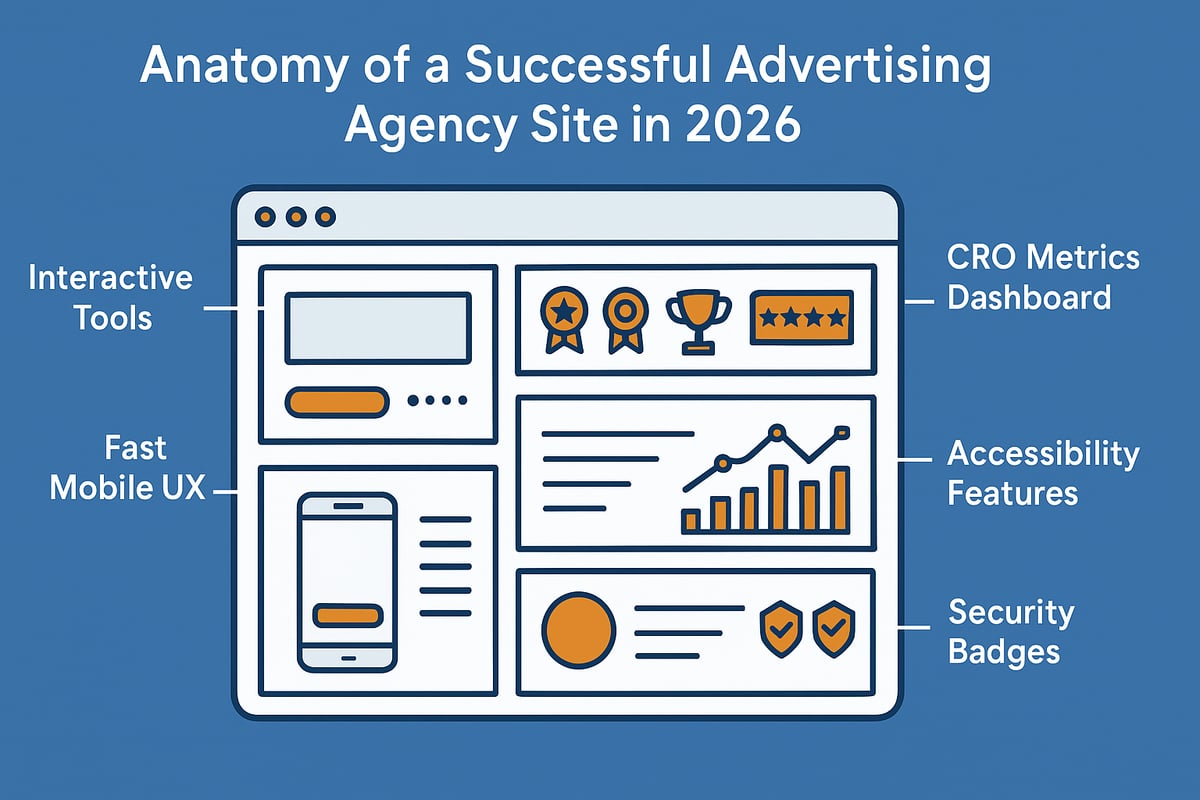
The role of an advertising agency site has evolved from a simple digital portfolio to a dynamic lead generation engine. In 2026, clients expect interactive tools, real-time personalisation, and immediate value from the moment they land on your homepage.
Agencies embracing features like live calculators or interactive demos are seeing engagement rates spike by up to 35%. This shift means your website is now your top salesperson, working round the clock to qualify leads and showcase your unique strengths.
Key Performance Metrics
Success is now measured by more than just traffic. Conversion rate optimisation benchmarks are critical for any advertising agency site. Top performers track not only leads but also demo bookings and content downloads.
According to industry reports, the best agency sites hit conversion rates of 4% to 7%. For practical ways to boost these numbers, dive into Conversion rate optimisation insights to sharpen your CRO strategy.
| Metric | Top Performer Benchmark |
|---|---|
| Conversion Rate | 4–7% |
| Engagement (Tools) | +35% |
| Lead Form Completion | +22% |
Trust, Credibility, and Social Proof
Building trust is non-negotiable for any advertising agency site. Display awards, client testimonials, and in-depth case studies where visitors can see them. Real-time reviews and third-party validation add another layer of credibility.
Agencies using video testimonials report 30% higher trust signals. This social proof can be the difference between a curious visitor and a new client.
Seamless User Experience (UX)
A seamless user experience is essential. Your advertising agency site must load quickly, look sharp on mobile, and offer intuitive navigation. Anything less, and you risk losing business.
A Forrester study found that 70% of B2B buyers abandon sites that are slow or confusing. Think of your site as a well-lit, welcoming shopfront—if it’s hard to enter, people walk away.
Accessibility and Inclusivity
Accessible design isn’t just a legal checkbox—it’s an ethical must. Every advertising agency site should follow WCAG 2.2 standards, use ARIA labels, and ensure sufficient colour contrast.
This opens your agency to everyone, regardless of ability, and demonstrates a commitment to inclusivity that clients notice.
Security and Compliance
Trust is built on security. By 2026, every advertising agency site must comply with GDPR, CCPA, and any new privacy regulations. Use SSL certificates, clear privacy policies, and visible trust badges to reassure visitors their data is safe.
Regular audits and transparent practices aren’t just best practice—they’re expected by your clients.
Building a High-Converting Agency Website: Step-by-Step
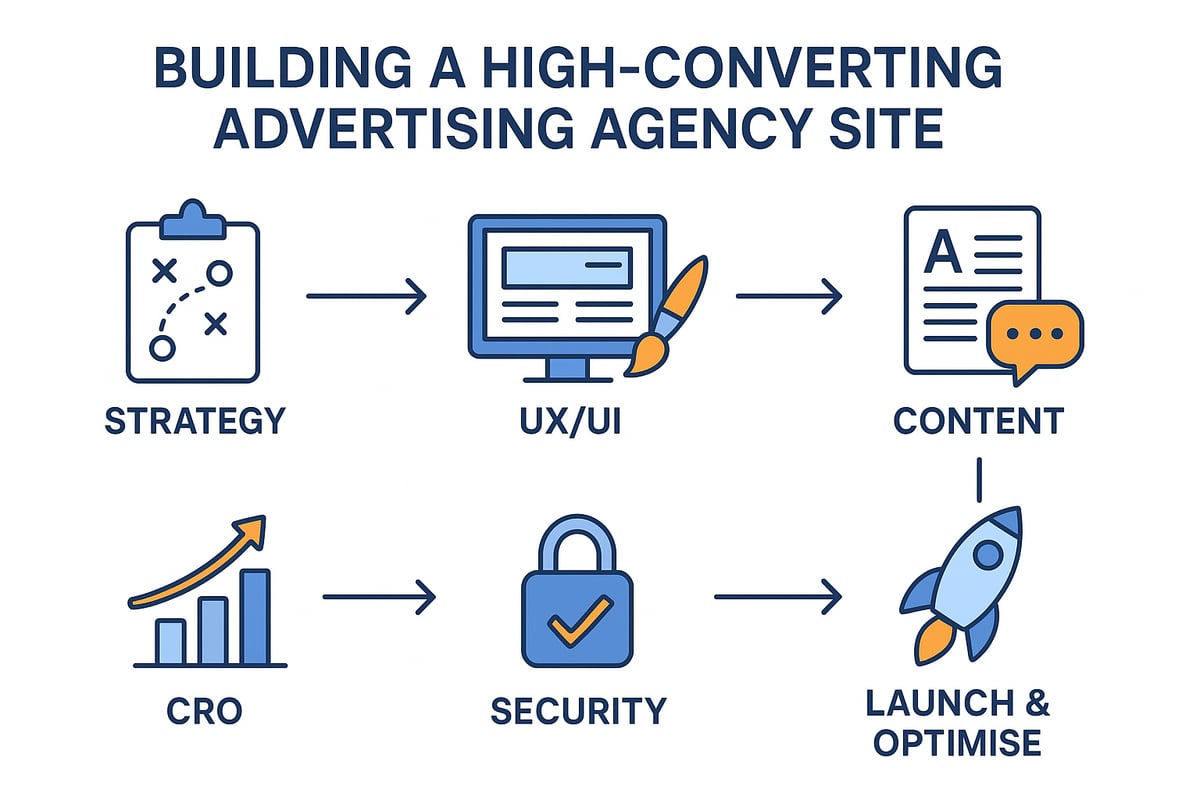
Ready to transform your advertising agency site into a conversion powerhouse? Let’s break down the exact steps successful agencies are taking in 2026 to stand out, win clients, and deliver results. Follow this roadmap to build a site that not only looks impressive but drives real business growth.
Step 1: Strategic Planning and Positioning
Kick off your advertising agency site project by nailing down your unique value proposition. Who is your ideal client? What can you offer that your competitors can’t? Get specific, because a generic pitch simply won’t cut it in 2026.
Study other agencies in your niche. What do they do well? Where do they fall short? Use this insight to sharpen your own positioning. For example, agencies that specialise in a specific sector often see a 22% boost in conversions.
Create detailed personas for your target audience. Map out their pain points, buying triggers, and decision criteria. This groundwork ensures your advertising agency site speaks directly to the clients you want most.
Step 2: UX/UI Design for Engagement
Now, bring your strategy to life with user-focused design. Start with wireframes and prototypes to visualise the site’s flow. Test these with real users to catch issues early. Mobile-first design is non-negotiable, as over half your traffic will come from phones.
Add interactive elements like calculators, quizzes, or pricing tools. These keep visitors engaged, increasing average session duration by up to 40%. Navigation must be intuitive, with clear pathways to core services and contact points.
For a deeper dive on creating engaging layouts and practical design strategies, check out these website design strategy tips. A strong design foundation sets your advertising agency site apart from the competition.
Step 3: Content Architecture and Messaging
Compelling content is the engine of any high-converting advertising agency site. Start with punchy headlines that speak directly to your audience’s needs. Use crisp service descriptions and persuasive calls to action to guide visitors toward conversion.
Don’t overlook visual storytelling. Incorporate explainer videos and subtle animations to make complex services easy to grasp. Agencies that use video content see 20% higher lead capture rates.
Microcopy—those small bits of text on buttons and forms—can make a big difference. It reassures users and reduces friction, helping your advertising agency site convert more prospects into leads.
Step 4: Conversion Rate Optimisation (CRO) Techniques
Once your site’s live, it’s all about continual improvement. Run A/B tests on your landing pages and calls to action to find what truly resonates. Use heatmaps and scroll tracking to see where visitors engage most—and where they drop off.
Gather feedback through quick surveys or chat widgets. Personalise the experience by showing different content to different visitor segments. Dynamic content can turn a generic advertising agency site into one that feels tailor-made for each user.
Track the results of every tweak. Over time, these small adjustments stack up, pushing your conversion rates ever higher.
Step 5: Speed, Security, and Accessibility
A high-performing advertising agency site must load in seconds, not minutes. Optimise images, streamline your code, and choose a reliable hosting provider. Fast sites keep visitors engaged and signal trust to search engines.
Security is critical. Implement SSL certificates, firewalls, and DDoS protection. Make privacy policies transparent and easy to find. Accessibility isn’t just a legal box to tick—use WCAG 2.2 guidelines, ARIA labels, and strong colour contrast to make your site inclusive for all.
These technical foundations are invisible to users, but they’re essential for a trustworthy, future-proof advertising agency site.
Step 6: Launch, QA, and Continuous Improvement
Before going live, run through a robust pre-launch checklist. Test every link, form, and interactive feature. Set up Google Analytics, heatmaps, and automated reporting to monitor performance from day one.
Don’t treat launch as the finish line. Adopt an agile, iterative approach. Review analytics and user feedback monthly, then refine your advertising agency site accordingly. The agencies that win in 2026 are those that never stop optimising.
Continuous improvement ensures your advertising agency site not only meets current standards but adapts to changing client expectations and technology advancements.
Leveraging AI and Automation for Agency Site Performance
The AI revolution has fundamentally shifted what an advertising agency site can achieve. No longer just digital brochures, today’s agency sites must work smarter, not harder. AI and automation now drive personalisation, lead generation, content, and insights, making agency websites true growth engines.
AI-Driven Personalisation
Personalisation is no longer optional for an advertising agency site. AI enables real-time tailoring of messaging, offers, and imagery based on each visitor’s profile and behaviour. Imagine a site that instantly recognises if a user is a potential client or a returning customer, then adapts its content accordingly.
Agencies leveraging AI-driven personalisation see a 19% lift in conversion rates, according to Adobe. Dynamic landing pages, smart recommendations, and contextual CTAs help agencies stand out and deliver instant value. This level of sophistication is what clients expect in 2026.
Chatbots and Conversational Interfaces
Chatbots have become a non-negotiable feature for any high-performing advertising agency site. AI-powered chat captures leads, qualifies them, and answers queries around the clock, even while your team sleeps.
Integrating chatbots with CRM and marketing automation tools ensures every conversation is tracked and actionable. Agencies using chatbots report a 50% increase in qualified leads, making this technology a must-have for those seeking to maximise site performance and client acquisition.
Content Generation and Optimisation
Speed and quality of content are critical for the modern advertising agency site. AI tools like ChatGPT streamline the creation of blogs, case studies, and landing pages. Automated A/B testing allows for rapid experimentation, ensuring only the best-performing content stays live.
Content optimisation powered by AI means agencies can quickly update messaging, adjust headlines, and refine calls to action based on real user data. This keeps your site fresh, relevant, and always aligned with your audience’s interests.
Predictive Analytics and Lead Scoring
Predictive analytics empowers an advertising agency site to identify high-value leads and prioritise follow-up. AI analyses visitor behaviour, engagement patterns, and demographic data to forecast which prospects are most likely to convert.
By implementing AI-powered lead scoring, agencies can reduce sales cycles by up to 15%, according to Gartner. This means your team spends time on the hottest opportunities, improving efficiency and boosting revenue.
Automation of Routine Tasks
Routine admin no longer needs to bog down your team. Automation can handle scheduling, follow-up emails, proposal generation, and reporting—freeing up valuable time for creative and strategic work.
Integrating these automations with your advertising agency site ensures nothing falls through the cracks. Project management tools, email platforms, and CRM systems all benefit from seamless AI-driven workflows, keeping your operations lean and responsive.
How Marketing XP Empowers Agencies with AI
Marketing XP leads the charge in helping agencies harness AI for their advertising agency site. Their AI-driven solutions have improved conversion rates and cut manual workload for countless SME agencies.
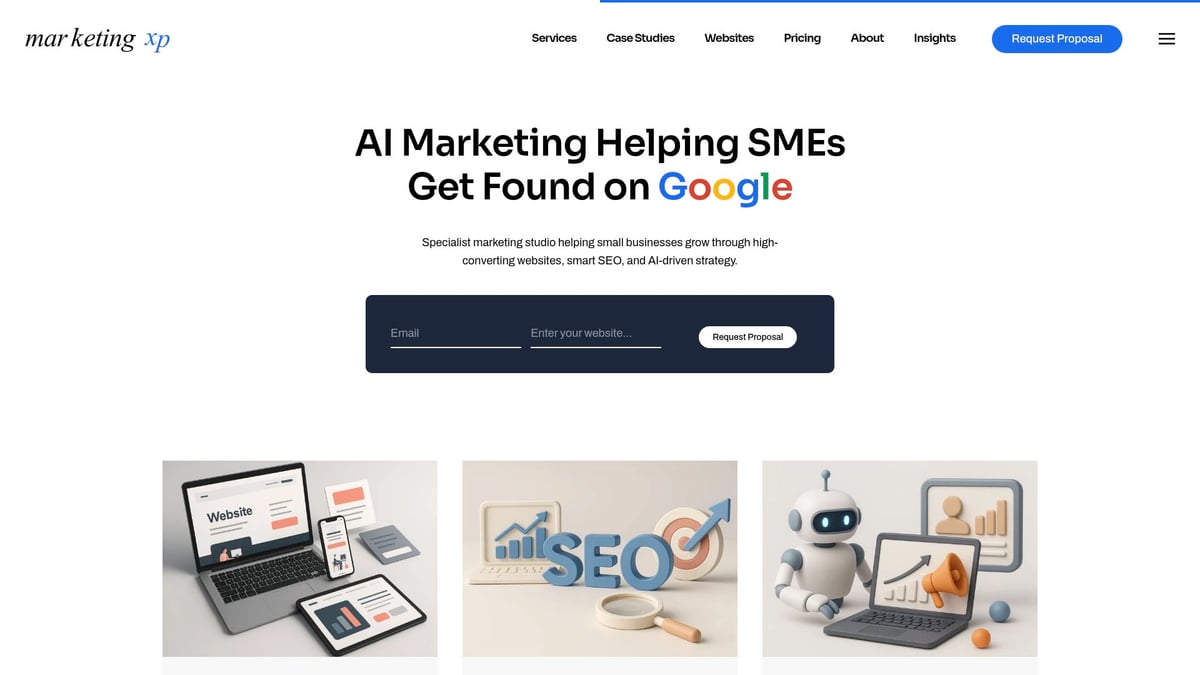
Through tailored training and coaching, Marketing XP ensures your team adopts the right AI tools with confidence. Their approach accelerates growth, future-proofs your site, and keeps you ahead of the competition.
SEO and Content Strategies for Maximum Visibility
Staying visible in 2026 is a moving target. Your advertising agency site must keep pace with ever-evolving search algorithms and new content consumption habits. Let’s break down the strategies that will get you seen, clicked, and chosen over the competition.
Advanced SEO for 2026
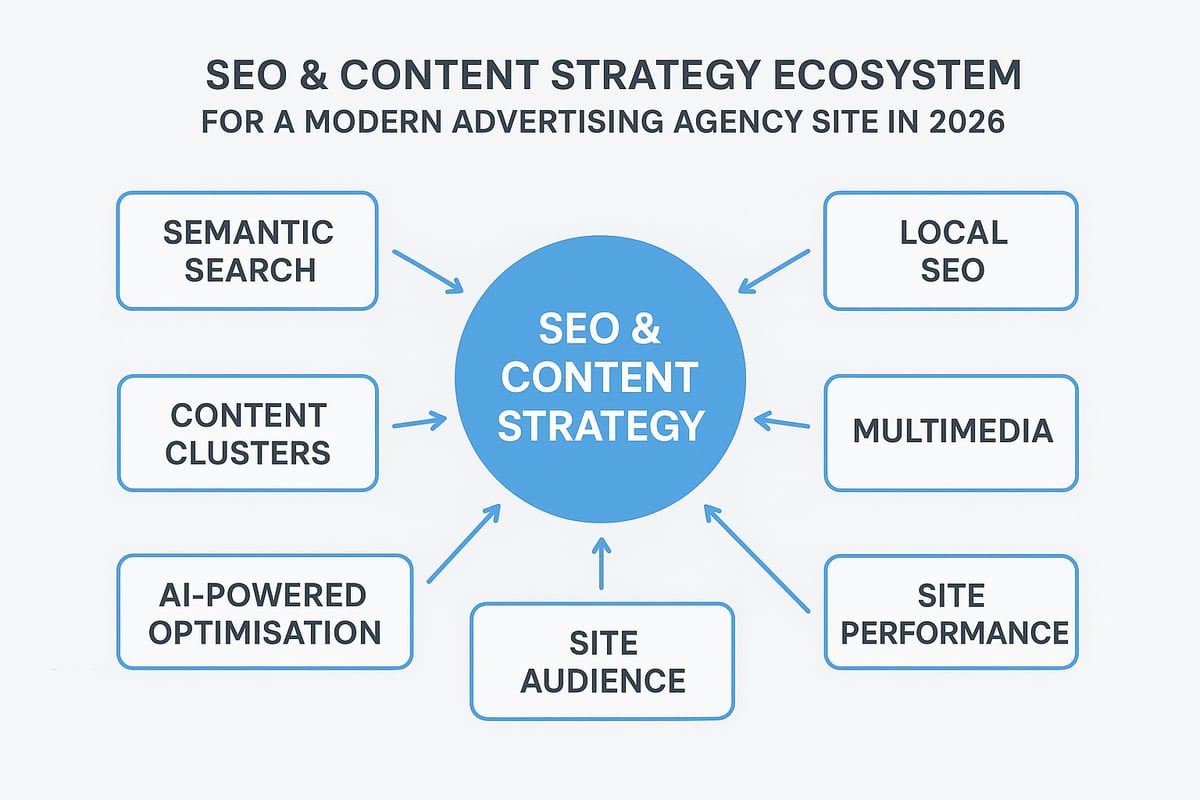
SEO is no longer just about keywords. In 2026, semantic search and user intent rule the rankings. Your advertising agency site needs to answer real questions, provide context, and use structured data to help search engines understand what you offer.
Optimising for Google’s Search Generative Experience (SGE) means your content must be conversational and comprehensive. Make sure every service page and blog speaks directly to the needs your audience is searching for.
Do not overlook technical SEO. Fast load times, mobile-first layouts, and clean site architecture are now mandatory. For expert tips, explore Web design for agencies, where SEO and design best practices intersect.
Local and Niche SEO Tactics
Local visibility is a game changer for agencies. Claim and optimise your Google Business Profile, keep your NAP details consistent, and secure local citations. This makes your advertising agency site the obvious choice for clients searching nearby.
Niche SEO is just as important. Develop hyperlocal content that speaks to specific audiences or industries. Agencies with strong local and niche SEO see three times more local enquiries than those that ignore these tactics.
List your core services, awards, and testimonials on every local landing page. This builds trust and increases conversion rates for your advertising agency site.
Content Marketing That Converts
Content is still king, but 2026 demands a smarter approach. Use data to guide your topic selection and build content clusters that answer related questions. Long-form guides and thought leadership pieces show authority, while case studies prove results.
Weekly blog publishing is proven to generate 67 percent more leads for your advertising agency site. Mix in practical resources, FAQs, and downloadable assets to keep visitors engaged.
Always pair strong calls to action with every piece of content. Use microcopy and smart CTAs to guide visitors towards booking a demo or downloading a resource.
Video, Podcasts, and Multimedia Content
Multimedia is no longer optional. Video case studies, webinars, and podcasts massively increase engagement and time on site. Agencies using video see visitors stay 2.6 times longer on their advertising agency site.
Mix formats to appeal to different learning styles. Host live Q&A sessions, share behind-the-scenes clips, or launch a podcast series about industry trends.
Optimise every video with transcripts, captions, and schema markup. This ensures your multimedia assets boost SEO and make your advertising agency site accessible.
Generative Engine Optimisation (GEO)
AI-powered search assistants and voice search are reshaping how users discover agencies. To future-proof your advertising agency site, create content that’s ready for these platforms.
Use structured data, clear FAQs, and conversational copy. Prepare answers for common voice queries and integrate them into your main pages. GEO is about being found by both humans and AI.
Review and update content regularly. As algorithms evolve, so must your advertising agency site, keeping it visible and relevant in every search channel.
Analytics, Reporting, and Continuous Optimisation
Staying ahead in the digital landscape means tracking every move your users make on your advertising agency site. You cannot improve what you do not measure, so expert analytics and ongoing optimisation are the backbone of consistent performance and growth.
Setting Up Effective Analytics
To future-proof your advertising agency site, start with robust analytics. Google Analytics 4 (GA4) is essential, letting you track user journeys and key events. Heatmaps and session recordings reveal what grabs attention and what gets ignored.
Set up custom dashboards for real-time stats. This way, you see which pages convert and where users drop off. Use event tracking to monitor clicks, form submissions, and downloads. Here is an example of a simple GA4 event:
gtag('event', 'contact_form_submit', {
  'event_category': 'Engagement',
  'event_label': 'Lead Form'
});
The right analytics foundation is what sets high-performing sites apart.
Attribution and ROI Measurement
Attribution is about knowing exactly where your leads come from and what drives results on your advertising agency site. Multi-touch attribution models show the journey across channels, revealing which campaigns deliver real ROI.
A table like this can help summarise attribution approaches:
| Model | Strength | Best Use Case |
|---|---|---|
| First Touch | Simple, fast | Awareness campaigns |
| Last Touch | Conversion-focused | Direct-response campaigns |
| Multi-Touch | Full journey insight | Complex, multi-channel sales |
Top agencies using advanced attribution see a 15% ROI boost. Track every lead source and closed deal to know what to double down on.
Conversion Funnel Analysis
Funnel analysis is the secret weapon for unlocking conversions on your advertising agency site. Identify where users abandon forms or leave at pricing.
Use tools to visualise stages: awareness, consideration, conversion. For example, if 60% of leads drop off at the pricing page, you know exactly where to optimise. Remove friction, clarify value, and test different layouts.
Regular funnel reviews mean you are never blind to opportunity leaks. Small tweaks here can lead to big gains in leads and revenue.
Reporting for Clients and Stakeholders
Clients want proof that your advertising agency site delivers. Build visual, actionable reports that highlight wins and reveal areas to improve. Automated monthly reporting with alert systems means no surprises and total transparency.
Use custom dashboards to share performance in real time. Show off growth in leads, conversion rates, and pipeline value. When clients see the numbers, your credibility soars.
Keep reports simple, visual, and focused on business impact. This keeps stakeholders engaged and eager for next steps.
Iterative Optimisation Processes
Continuous improvement is not just a buzzword, it is how you keep your advertising agency site ahead of the curve. Adopt agile sprints for regular site updates and campaign adjustments.
Gather user feedback, run A/B tests, and roll out new features monthly. Using AI for marketing agencies can automate reporting, uncover hidden trends, and free up your team for strategy.
Iterate, measure, and improve. This relentless approach ensures your site never goes stale and always delivers results.
Future Trends and Innovations for Agency Websites
Staying ahead in the advertising agency site world means embracing innovation. The next few years will see radical shifts, with technology and user expectations setting the pace. Let’s explore what will truly matter for agency websites in 2026.
Immersive Experiences: AR, VR, and Interactive Demos
Immersive technology is changing the advertising agency site landscape. Agencies are moving beyond static pages, using AR and VR for interactive showrooms and service demos. This approach lets clients visualise campaigns or creative outputs in real time, boosting engagement.
- Agencies with AR demos report up to 45% more engagement.
- Interactive 3D visuals set brands apart from the competition.
- Clients linger longer, exploring services in a hands-on way.
If you want to see how 3D and interactivity are shaping digital experiences, check out Immersive 3D Visuals in Web Design. Adopting these features on your advertising agency site can be the difference between a memorable pitch and a forgettable one.
Hyper-Personalisation and Predictive UX
Personalisation is no longer a nice-to-have; it’s expected. AI-powered tools enable advertising agency site experiences to adapt in real time based on user behaviour, preferences, and past interactions. Predictive UX goes further, anticipating needs before users even express them.
- Dynamic content recommendations drive conversions.
- AI chatbots offer tailored support and suggestions.
- Real-time personalisation increases user satisfaction.
To dive deeper into how AI is driving these changes, see AI-Driven Personalisation in Advertising. When you personalise your advertising agency site, you’re not just meeting expectations, you’re setting new standards.
Sustainability and Ethical Design
Sustainability is now a deciding factor for many clients searching for the right advertising agency site. Agencies are choosing eco-friendly hosting, reducing energy use, and highlighting green credentials on their sites.
- 38% of buyers prefer agencies with visible sustainability efforts.
- Ethical design means privacy-first, transparent data practices.
- Clear sustainability messaging builds trust and credibility.
Greener choices are no longer optional. Making your advertising agency site sustainable is a smart business move and a powerful USP.
Integration with Emerging Platforms
The digital ecosystem never stands still. The most future-ready advertising agency site will be the one prepared for new platforms: Web3, blockchain credentials, and decentralised identity. These technologies unlock new ways to verify authenticity and engage audiences.
- Blockchain can secure credentials and case studies.
- Decentralised identity helps clients control their data.
- Web3 integration opens doors to new ad channels.
Future-proofing means your advertising agency site is ready to pivot as these platforms gain traction.
Preparing for Regulatory Changes
Regulations are tightening, and compliance is a must for any advertising agency site. Privacy laws like GDPR and emerging standards will shape how agencies collect, use, and store data.
- Transparent privacy policies are essential.
- Accessibility and inclusivity standards are evolving.
- Proactive compliance avoids costly penalties.
Review your advertising agency site regularly to ensure you’re not just compliant, but ahead of the curve.
If you’ve read this far, you know just how much goes into building a high converting agency site that actually wins clients in 2026. From nailing your positioning and user experience, to leveraging AI and driving real leads, it’s a lot to get right—but you don’t have to do it alone. If you’re serious about making your site work harder for you and want some honest, expert advice on what’ll really move the needle, let’s talk. Book your Get free 45 min consultation and I’ll help you spot what’s holding you back—and how you can finally turn clicks into customers.
Digital transformation is shaking up the advertising world faster than ever, and in 2026, consumer expectations are evolving daily. The pressure is on for every advertising agency site to perform, not just as a digital brochure, but as a true engine for leads and growth.
If you want to win clients and stand out in a crowded market, your website must deliver instant value, seamless experiences, and measurable results. Mastering the strategies behind a high-performing site means more leads, higher conversion rates, and lasting growth.
This expert guide gives you a step-by-step roadmap, proven tactics, and the latest trends to future-proof your agency website for success in 2026. We’ll cover strategy, UX, AI, SEO, content, analytics, and what’s next.
Defining Success for Advertising Agency Sites in 2026
To stand out in 2026, an advertising agency site must do more than just look the part. It needs to deliver value instantly, engage visitors, and convert them into loyal clients. Let’s break down what success looks like for agency websites in the new digital landscape.
The Evolving Role of Agency Websites
The role of an advertising agency site has evolved from a simple digital portfolio to a dynamic lead generation engine. In 2026, clients expect interactive tools, real-time personalisation, and immediate value from the moment they land on your homepage.
Agencies embracing features like live calculators or interactive demos are seeing engagement rates spike by up to 35%. This shift means your website is now your top salesperson, working round the clock to qualify leads and showcase your unique strengths.
Key Performance Metrics
Success is now measured by more than just traffic. Conversion rate optimisation benchmarks are critical for any advertising agency site. Top performers track not only leads but also demo bookings and content downloads.
According to industry reports, the best agency sites hit conversion rates of 4% to 7%. For practical ways to boost these numbers, dive into Conversion rate optimisation insights to sharpen your CRO strategy.
| Metric | Top Performer Benchmark |
|---|---|
| Conversion Rate | 4–7% |
| Engagement (Tools) | +35% |
| Lead Form Completion | +22% |
Trust, Credibility, and Social Proof
Building trust is non-negotiable for any advertising agency site. Display awards, client testimonials, and in-depth case studies where visitors can see them. Real-time reviews and third-party validation add another layer of credibility.
Agencies using video testimonials report 30% higher trust signals. This social proof can be the difference between a curious visitor and a new client.
Seamless User Experience (UX)
A seamless user experience is essential. Your advertising agency site must load quickly, look sharp on mobile, and offer intuitive navigation. Anything less, and you risk losing business.
A Forrester study found that 70% of B2B buyers abandon sites that are slow or confusing. Think of your site as a well-lit, welcoming shopfront—if it’s hard to enter, people walk away.
Accessibility and Inclusivity
Accessible design isn’t just a legal checkbox—it’s an ethical must. Every advertising agency site should follow WCAG 2.2 standards, use ARIA labels, and ensure sufficient colour contrast.
This opens your agency to everyone, regardless of ability, and demonstrates a commitment to inclusivity that clients notice.
Security and Compliance
Trust is built on security. By 2026, every advertising agency site must comply with GDPR, CCPA, and any new privacy regulations. Use SSL certificates, clear privacy policies, and visible trust badges to reassure visitors their data is safe.
Regular audits and transparent practices aren’t just best practice—they’re expected by your clients.
Building a High-Converting Agency Website: Step-by-Step
Ready to transform your advertising agency site into a conversion powerhouse? Let’s break down the exact steps successful agencies are taking in 2026 to stand out, win clients, and deliver results. Follow this roadmap to build a site that not only looks impressive but drives real business growth.
Step 1: Strategic Planning and Positioning
Kick off your advertising agency site project by nailing down your unique value proposition. Who is your ideal client? What can you offer that your competitors can’t? Get specific, because a generic pitch simply won’t cut it in 2026.
Study other agencies in your niche. What do they do well? Where do they fall short? Use this insight to sharpen your own positioning. For example, agencies that specialise in a specific sector often see a 22% boost in conversions.
Create detailed personas for your target audience. Map out their pain points, buying triggers, and decision criteria. This groundwork ensures your advertising agency site speaks directly to the clients you want most.
Step 2: UX/UI Design for Engagement
Now, bring your strategy to life with user-focused design. Start with wireframes and prototypes to visualise the site’s flow. Test these with real users to catch issues early. Mobile-first design is non-negotiable, as over half your traffic will come from phones.
Add interactive elements like calculators, quizzes, or pricing tools. These keep visitors engaged, increasing average session duration by up to 40%. Navigation must be intuitive, with clear pathways to core services and contact points.
For a deeper dive on creating engaging layouts and practical design strategies, check out these website design strategy tips. A strong design foundation sets your advertising agency site apart from the competition.
Step 3: Content Architecture and Messaging
Compelling content is the engine of any high-converting advertising agency site. Start with punchy headlines that speak directly to your audience’s needs. Use crisp service descriptions and persuasive calls to action to guide visitors toward conversion.
Don’t overlook visual storytelling. Incorporate explainer videos and subtle animations to make complex services easy to grasp. Agencies that use video content see 20% higher lead capture rates.
Microcopy—those small bits of text on buttons and forms—can make a big difference. It reassures users and reduces friction, helping your advertising agency site convert more prospects into leads.
Step 4: Conversion Rate Optimisation (CRO) Techniques
Once your site’s live, it’s all about continual improvement. Run A/B tests on your landing pages and calls to action to find what truly resonates. Use heatmaps and scroll tracking to see where visitors engage most—and where they drop off.
Gather feedback through quick surveys or chat widgets. Personalise the experience by showing different content to different visitor segments. Dynamic content can turn a generic advertising agency site into one that feels tailor-made for each user.
Track the results of every tweak. Over time, these small adjustments stack up, pushing your conversion rates ever higher.
Step 5: Speed, Security, and Accessibility
A high-performing advertising agency site must load in seconds, not minutes. Optimise images, streamline your code, and choose a reliable hosting provider. Fast sites keep visitors engaged and signal trust to search engines.
Security is critical. Implement SSL certificates, firewalls, and DDoS protection. Make privacy policies transparent and easy to find. Accessibility isn’t just a legal box to tick—use WCAG 2.2 guidelines, ARIA labels, and strong colour contrast to make your site inclusive for all.
These technical foundations are invisible to users, but they’re essential for a trustworthy, future-proof advertising agency site.
Step 6: Launch, QA, and Continuous Improvement
Before going live, run through a robust pre-launch checklist. Test every link, form, and interactive feature. Set up Google Analytics, heatmaps, and automated reporting to monitor performance from day one.
Don’t treat launch as the finish line. Adopt an agile, iterative approach. Review analytics and user feedback monthly, then refine your advertising agency site accordingly. The agencies that win in 2026 are those that never stop optimising.
Continuous improvement ensures your advertising agency site not only meets current standards but adapts to changing client expectations and technology advancements.
Leveraging AI and Automation for Agency Site Performance
The AI revolution has fundamentally shifted what an advertising agency site can achieve. No longer just digital brochures, today’s agency sites must work smarter, not harder. AI and automation now drive personalisation, lead generation, content, and insights, making agency websites true growth engines.
AI-Driven Personalisation
Personalisation is no longer optional for an advertising agency site. AI enables real-time tailoring of messaging, offers, and imagery based on each visitor’s profile and behaviour. Imagine a site that instantly recognises if a user is a potential client or a returning customer, then adapts its content accordingly.
Agencies leveraging AI-driven personalisation see a 19% lift in conversion rates, according to Adobe. Dynamic landing pages, smart recommendations, and contextual CTAs help agencies stand out and deliver instant value. This level of sophistication is what clients expect in 2026.
Chatbots and Conversational Interfaces
Chatbots have become a non-negotiable feature for any high-performing advertising agency site. AI-powered chat captures leads, qualifies them, and answers queries around the clock, even while your team sleeps.
Integrating chatbots with CRM and marketing automation tools ensures every conversation is tracked and actionable. Agencies using chatbots report a 50% increase in qualified leads, making this technology a must-have for those seeking to maximise site performance and client acquisition.
Content Generation and Optimisation
Speed and quality of content are critical for the modern advertising agency site. AI tools like ChatGPT streamline the creation of blogs, case studies, and landing pages. Automated A/B testing allows for rapid experimentation, ensuring only the best-performing content stays live.
Content optimisation powered by AI means agencies can quickly update messaging, adjust headlines, and refine calls to action based on real user data. This keeps your site fresh, relevant, and always aligned with your audience’s interests.
Predictive Analytics and Lead Scoring
Predictive analytics empowers an advertising agency site to identify high-value leads and prioritise follow-up. AI analyses visitor behaviour, engagement patterns, and demographic data to forecast which prospects are most likely to convert.
By implementing AI-powered lead scoring, agencies can reduce sales cycles by up to 15%, according to Gartner. This means your team spends time on the hottest opportunities, improving efficiency and boosting revenue.
Automation of Routine Tasks
Routine admin no longer needs to bog down your team. Automation can handle scheduling, follow-up emails, proposal generation, and reporting—freeing up valuable time for creative and strategic work.
Integrating these automations with your advertising agency site ensures nothing falls through the cracks. Project management tools, email platforms, and CRM systems all benefit from seamless AI-driven workflows, keeping your operations lean and responsive.
How Marketing XP Empowers Agencies with AI
Marketing XP leads the charge in helping agencies harness AI for their advertising agency site. Their AI-driven solutions have improved conversion rates and cut manual workload for countless SME agencies.
Through tailored training and coaching, Marketing XP ensures your team adopts the right AI tools with confidence. Their approach accelerates growth, future-proofs your site, and keeps you ahead of the competition.
SEO and Content Strategies for Maximum Visibility
Staying visible in 2026 is a moving target. Your advertising agency site must keep pace with ever-evolving search algorithms and new content consumption habits. Let’s break down the strategies that will get you seen, clicked, and chosen over the competition.
Advanced SEO for 2026
SEO is no longer just about keywords. In 2026, semantic search and user intent rule the rankings. Your advertising agency site needs to answer real questions, provide context, and use structured data to help search engines understand what you offer.
Optimising for Google’s Search Generative Experience (SGE) means your content must be conversational and comprehensive. Make sure every service page and blog speaks directly to the needs your audience is searching for.
Do not overlook technical SEO. Fast load times, mobile-first layouts, and clean site architecture are now mandatory. For expert tips, explore Web design for agencies, where SEO and design best practices intersect.
Local and Niche SEO Tactics
Local visibility is a game changer for agencies. Claim and optimise your Google Business Profile, keep your NAP details consistent, and secure local citations. This makes your advertising agency site the obvious choice for clients searching nearby.
Niche SEO is just as important. Develop hyperlocal content that speaks to specific audiences or industries. Agencies with strong local and niche SEO see three times more local enquiries than those that ignore these tactics.
List your core services, awards, and testimonials on every local landing page. This builds trust and increases conversion rates for your advertising agency site.
Content Marketing That Converts
Content is still king, but 2026 demands a smarter approach. Use data to guide your topic selection and build content clusters that answer related questions. Long-form guides and thought leadership pieces show authority, while case studies prove results.
Weekly blog publishing is proven to generate 67 percent more leads for your advertising agency site. Mix in practical resources, FAQs, and downloadable assets to keep visitors engaged.
Always pair strong calls to action with every piece of content. Use microcopy and smart CTAs to guide visitors towards booking a demo or downloading a resource.
Video, Podcasts, and Multimedia Content
Multimedia is no longer optional. Video case studies, webinars, and podcasts massively increase engagement and time on site. Agencies using video see visitors stay 2.6 times longer on their advertising agency site.
Mix formats to appeal to different learning styles. Host live Q&A sessions, share behind-the-scenes clips, or launch a podcast series about industry trends.
Optimise every video with transcripts, captions, and schema markup. This ensures your multimedia assets boost SEO and make your advertising agency site accessible.
Generative Engine Optimisation (GEO)
AI-powered search assistants and voice search are reshaping how users discover agencies. To future-proof your advertising agency site, create content that’s ready for these platforms.
Use structured data, clear FAQs, and conversational copy. Prepare answers for common voice queries and integrate them into your main pages. GEO is about being found by both humans and AI.
Review and update content regularly. As algorithms evolve, so must your advertising agency site, keeping it visible and relevant in every search channel.
Analytics, Reporting, and Continuous Optimisation
Staying ahead in the digital landscape means tracking every move your users make on your advertising agency site. You cannot improve what you do not measure, so expert analytics and ongoing optimisation are the backbone of consistent performance and growth.
Setting Up Effective Analytics
To future-proof your advertising agency site, start with robust analytics. Google Analytics 4 (GA4) is essential, letting you track user journeys and key events. Heatmaps and session recordings reveal what grabs attention and what gets ignored.
Set up custom dashboards for real-time stats. This way, you see which pages convert and where users drop off. Use event tracking to monitor clicks, form submissions, and downloads. Here is an example of a simple GA4 event:
gtag('event', 'contact_form_submit', {
  'event_category': 'Engagement',
  'event_label': 'Lead Form'
});
The right analytics foundation is what sets high-performing sites apart.
Attribution and ROI Measurement
Attribution is about knowing exactly where your leads come from and what drives results on your advertising agency site. Multi-touch attribution models show the journey across channels, revealing which campaigns deliver real ROI.
A table like this can help summarise attribution approaches:
| Model | Strength | Best Use Case |
|---|---|---|
| First Touch | Simple, fast | Awareness campaigns |
| Last Touch | Conversion-focused | Direct-response campaigns |
| Multi-Touch | Full journey insight | Complex, multi-channel sales |
Top agencies using advanced attribution see a 15% ROI boost. Track every lead source and closed deal to know what to double down on.
Conversion Funnel Analysis
Funnel analysis is the secret weapon for unlocking conversions on your advertising agency site. Identify where users abandon forms or leave at pricing.
Use tools to visualise stages: awareness, consideration, conversion. For example, if 60% of leads drop off at the pricing page, you know exactly where to optimise. Remove friction, clarify value, and test different layouts.
Regular funnel reviews mean you are never blind to opportunity leaks. Small tweaks here can lead to big gains in leads and revenue.
Reporting for Clients and Stakeholders
Clients want proof that your advertising agency site delivers. Build visual, actionable reports that highlight wins and reveal areas to improve. Automated monthly reporting with alert systems means no surprises and total transparency.
Use custom dashboards to share performance in real time. Show off growth in leads, conversion rates, and pipeline value. When clients see the numbers, your credibility soars.
Keep reports simple, visual, and focused on business impact. This keeps stakeholders engaged and eager for next steps.
Iterative Optimisation Processes
Continuous improvement is not just a buzzword, it is how you keep your advertising agency site ahead of the curve. Adopt agile sprints for regular site updates and campaign adjustments.
Gather user feedback, run A/B tests, and roll out new features monthly. Using AI for marketing agencies can automate reporting, uncover hidden trends, and free up your team for strategy.
Iterate, measure, and improve. This relentless approach ensures your site never goes stale and always delivers results.
Future Trends and Innovations for Agency Websites
Staying ahead in the advertising agency site world means embracing innovation. The next few years will see radical shifts, with technology and user expectations setting the pace. Let’s explore what will truly matter for agency websites in 2026.
Immersive Experiences: AR, VR, and Interactive Demos
Immersive technology is changing the advertising agency site landscape. Agencies are moving beyond static pages, using AR and VR for interactive showrooms and service demos. This approach lets clients visualise campaigns or creative outputs in real time, boosting engagement.
- Agencies with AR demos report up to 45% more engagement.
- Interactive 3D visuals set brands apart from the competition.
- Clients linger longer, exploring services in a hands-on way.
If you want to see how 3D and interactivity are shaping digital experiences, check out Immersive 3D Visuals in Web Design. Adopting these features on your advertising agency site can be the difference between a memorable pitch and a forgettable one.
Hyper-Personalisation and Predictive UX
Personalisation is no longer a nice-to-have; it’s expected. AI-powered tools enable advertising agency site experiences to adapt in real time based on user behaviour, preferences, and past interactions. Predictive UX goes further, anticipating needs before users even express them.
- Dynamic content recommendations drive conversions.
- AI chatbots offer tailored support and suggestions.
- Real-time personalisation increases user satisfaction.
To dive deeper into how AI is driving these changes, see AI-Driven Personalisation in Advertising. When you personalise your advertising agency site, you’re not just meeting expectations, you’re setting new standards.
Sustainability and Ethical Design
Sustainability is now a deciding factor for many clients searching for the right advertising agency site. Agencies are choosing eco-friendly hosting, reducing energy use, and highlighting green credentials on their sites.
- 38% of buyers prefer agencies with visible sustainability efforts.
- Ethical design means privacy-first, transparent data practices.
- Clear sustainability messaging builds trust and credibility.
Greener choices are no longer optional. Making your advertising agency site sustainable is a smart business move and a powerful USP.
Integration with Emerging Platforms
The digital ecosystem never stands still. The most future-ready advertising agency site will be the one prepared for new platforms: Web3, blockchain credentials, and decentralised identity. These technologies unlock new ways to verify authenticity and engage audiences.
- Blockchain can secure credentials and case studies.
- Decentralised identity helps clients control their data.
- Web3 integration opens doors to new ad channels.
Future-proofing means your advertising agency site is ready to pivot as these platforms gain traction.
Preparing for Regulatory Changes
Regulations are tightening, and compliance is a must for any advertising agency site. Privacy laws like GDPR and emerging standards will shape how agencies collect, use, and store data.
- Transparent privacy policies are essential.
- Accessibility and inclusivity standards are evolving.
- Proactive compliance avoids costly penalties.
Review your advertising agency site regularly to ensure you’re not just compliant, but ahead of the curve.
If you’ve read this far, you know just how much goes into building a high converting agency site that actually wins clients in 2026. From nailing your positioning and user experience, to leveraging AI and driving real leads, it’s a lot to get right—but you don’t have to do it alone. If you’re serious about making your site work harder for you and want some honest, expert advice on what’ll really move the needle, let’s talk. Book your Get free 45 min consultation and I’ll help you spot what’s holding you back—and how you can finally turn clicks into customers.


