


In 2026, the digital world moves at lightning speed, and advertising web strategies must keep up if you want to stay ahead. Are you ready to lead the pack, not just follow?
This guide is your go-to resource for expert insights, practical tactics, and the latest trends. We want to help business owners, marketers, and web professionals get real results from their advertising web campaigns.
You’ll discover the current landscape, how to plan strategically, pick the right platforms, craft standout creative, measure success, and future-proof your campaigns. Let’s unlock your potential for digital advertising web success together.
The 2026 Digital Advertising Landscape
The advertising web is transforming at lightning speed in 2026. Brands are seeing new ways to connect, target, and convert audiences. If you want to stay ahead, you need to understand the landscape and how to use its changes to your advantage.
Key Trends Shaping Web Advertising
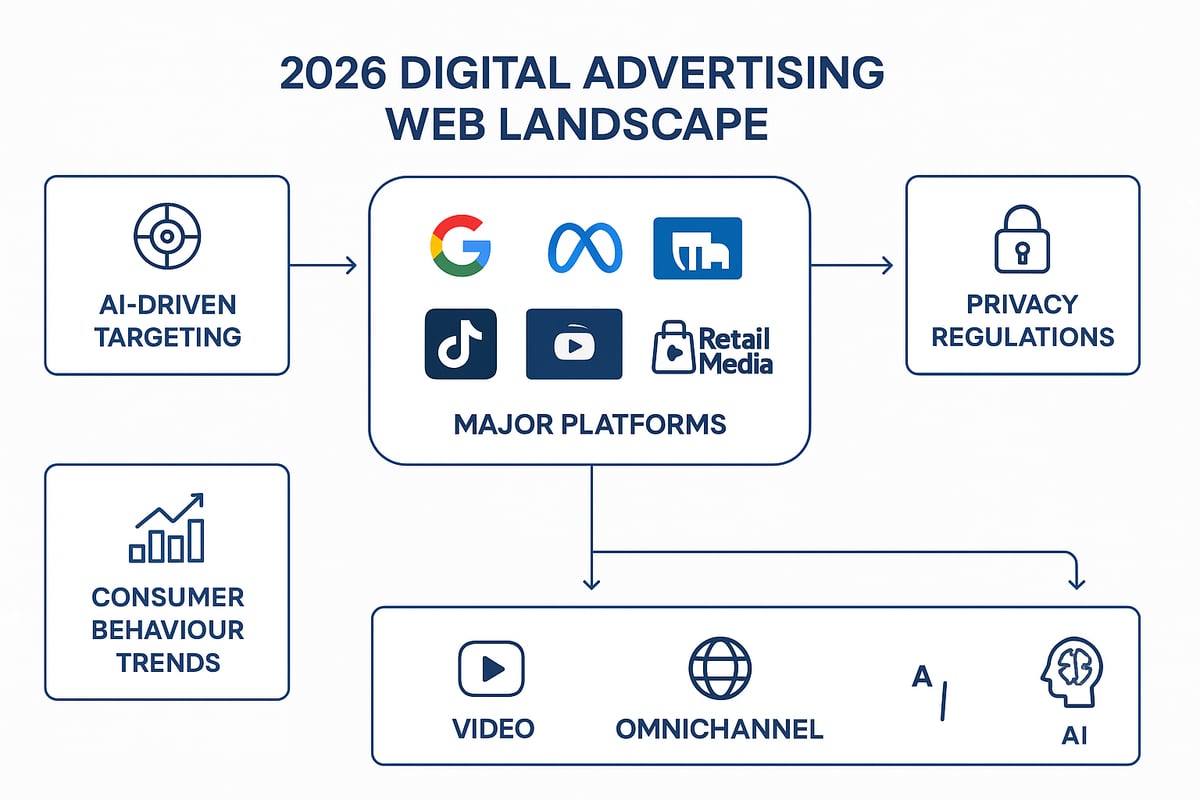
The advertising web in 2026 is defined by rapid innovation and shifting user expectations. AI-driven targeting and automation are now mainstream, making campaigns smarter and more efficient. Video content, especially short-form and interactive formats, dominates engagement metrics. Privacy regulations continue to tighten, with GDPR updates and cookie-less tracking pushing brands to rethink how they gather and use data.
Voice and visual search are no longer fringe—they're a vital part of many strategies. Omnichannel integration means ads reach users across devices and contexts, not just on desktops. According to recent UK digital ad spend forecasts, 60% of UK businesses have increased their digital channel spend. Static banners are being replaced by dynamic, personalised ads that adjust in real time based on user behaviour. If your advertising web approach ignores these trends, you risk falling behind.
Major Platforms & Their Evolution
The major players in the advertising web have evolved quickly to keep pace with new demands. Google Ads leads with enhanced automation and Performance Max campaigns, letting marketers reach users at every touchpoint. Meta (Facebook and Instagram) focuses on Reels, Stories, and AI-powered targeting, making it easier to engage younger audiences.
LinkedIn has become the go-to for B2B lead generation, thanks to improved audience segmentation tools. TikTok and YouTube are the kings of short-form, shoppable video ads, which drive both brand awareness and direct sales. Emerging platforms like retail media networks and connected TV are gaining traction, giving brands new ways to appear where their customers are. A recent industry report found that 70% of SMEs now use at least three digital ad platforms as part of their advertising web strategy. The options are growing, and so is the complexity.
| Platform | 2026 Focus | Key Benefit |
|---|---|---|
| Google Ads | Automation, Performance Max | Omnichannel reach |
| Meta | Reels, Stories, AI targeting | Youth engagement |
| B2B segmentation | Lead quality | |
| TikTok/YouTube | Shoppable video, short-form content | High engagement |
| Retail Media | Contextual ads | Point-of-sale impact |
Regulatory & Consumer Behaviour Shifts
The regulatory landscape for the advertising web is stricter than ever. GDPR updates and new ePrivacy rules mean brands must be transparent and seek clear consent for data use. Consumers are more aware of how their data is handled, demanding both control and honesty from advertisers.
Ad fatigue is a real problem, with more users installing ad blockers—35% of UK users in 2025, to be exact. Brands are responding by focusing on first-party data and building trust through value-driven content. If you want your advertising web efforts to succeed, you need to balance compliance, transparency, and creativity. Those who adapt will keep their audiences engaged, while others risk being ignored.
The Role of AI and Automation in 2026
AI has transformed the advertising web, making it possible to segment audiences, test creative, and optimise bids with minimal manual effort. Predictive analytics now power campaign planning, letting marketers forecast results and adjust in real time. Chatbots and conversational ads engage users instantly, improving conversion rates.
For example, AI-driven campaign management has cut manual workload by 40% for many agencies. Automation is freeing up time for creative thinking, but human oversight is still crucial. You need to strike the right balance between machine-driven efficiency and original, human-led ideas. The advertising web is smarter than ever, but it still rewards those who innovate and adapt quickly.
Building a Winning Web Advertising Strategy
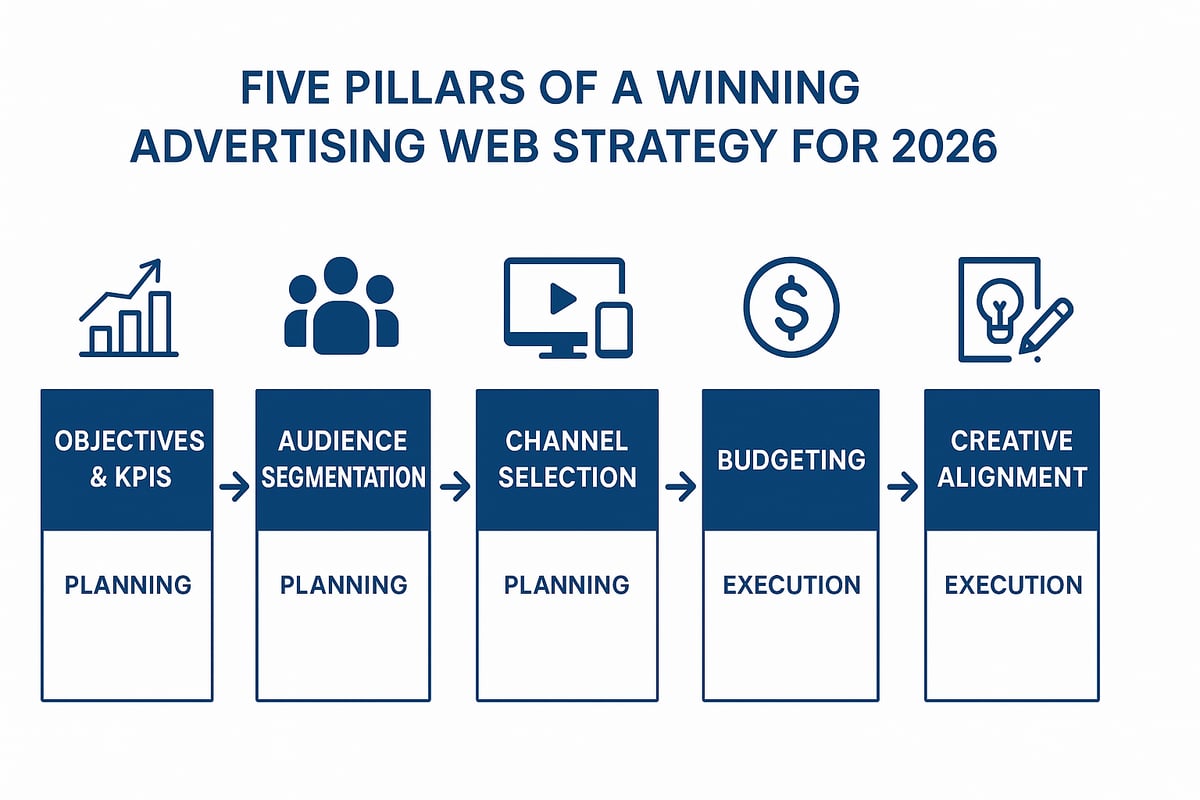
Crafting an effective advertising web strategy in 2026 means more than just choosing platforms and setting a budget. It’s about aligning every part of your campaign with business goals, audience insights, and creative excellence. Let’s break down each step so you can build a web advertising machine that doesn’t just tick boxes, but delivers results.
Setting Clear Objectives & KPIs
Start your advertising web journey by defining what success looks like. Are you after brand awareness, qualified leads, sales, or customer retention? Pinpointing clear objectives keeps your campaigns focused and measurable.
Choose KPIs that truly matter for each goal. For example, if you want more leads, don’t just track volume—track lead quality and conversion rates. Align objectives and KPIs with your wider business growth targets, so every pound spent moves the needle.
Here’s a quick comparison table:
| Objective | Suggested KPI |
|---|---|
| Awareness | Impressions, CTR |
| Lead Generation | CPA, Lead Quality |
| Sales | ROAS, Conversion |
| Retention | Lifetime Value |
Remember, 80% of top-performing advertising web campaigns start with crystal-clear KPIs.
Audience Research & Segmentation
Knowing your audience is the cornerstone of successful advertising web campaigns. Go beyond basic demographics—build detailed buyer personas based on interests, behaviour, and purchase history.
Leverage both first-party and third-party data to spot patterns and preferences. AI-powered tools can help you micro-segment, so you reach the right people at the right time with the right message.
For example, an eCommerce brand using advertising web channels might serve personalised ads based on each customer’s shopping history. Personalisation is not just a buzzword, it’s your competitive edge.
Channel & Platform Selection
Not every channel will suit your brand or audience. Evaluate advertising web platforms—Google Ads, Meta, LinkedIn, TikTok, and more—based on where your target customers spend their time and what your objectives demand.
Decide whether a multi-channel or single-channel approach fits best. Allocate your budget to the platforms that deliver, and don’t be afraid to test emerging spaces like retail media or connected TV.
For more strategic tips and expert perspectives on choosing the right channels, see these Web ad agency insights. Remember, omnichannel advertising web campaigns typically see a 30% higher ROI.
Budgeting & Resource Planning
Smart budgeting is key to advertising web success. Set your spend based on industry benchmarks and your business’s growth stage. Don’t just pour money into ads—allocate funds for creative production, campaign management, and ongoing testing.
Keep some budget flexible for rapid iteration. For instance, a start-up may dedicate 20% of their spend to experimentation, learning what works before scaling up. Prioritise continuous optimisation in your advertising web strategy to stay ahead of the curve.
Creative & Messaging Alignment
Your creative is what stops the scroll and drives action. Make sure every advertising web asset—copy, visuals, video—reflects your brand and speaks directly to your audience.
Keep messaging consistent across all touchpoints, from web to social to email. Test different value propositions and calls-to-action to discover what resonates. For example, a law firm could highlight trust signals in their ads, boosting credibility.
Creative quality is a game-changer, directly influencing 50% of advertising web campaign success. Never settle for average—test, refine, and align every message for maximum impact.
Creative Excellence: Designing Ads That Convert
Standing out in the advertising web space in 2026 is all about creative excellence. Your ads need to stop the scroll, spark emotion, and drive results. Let’s break down the proven tactics and fresh ideas that will turn browsers into buyers.
Best Practices for Ad Design in 2026
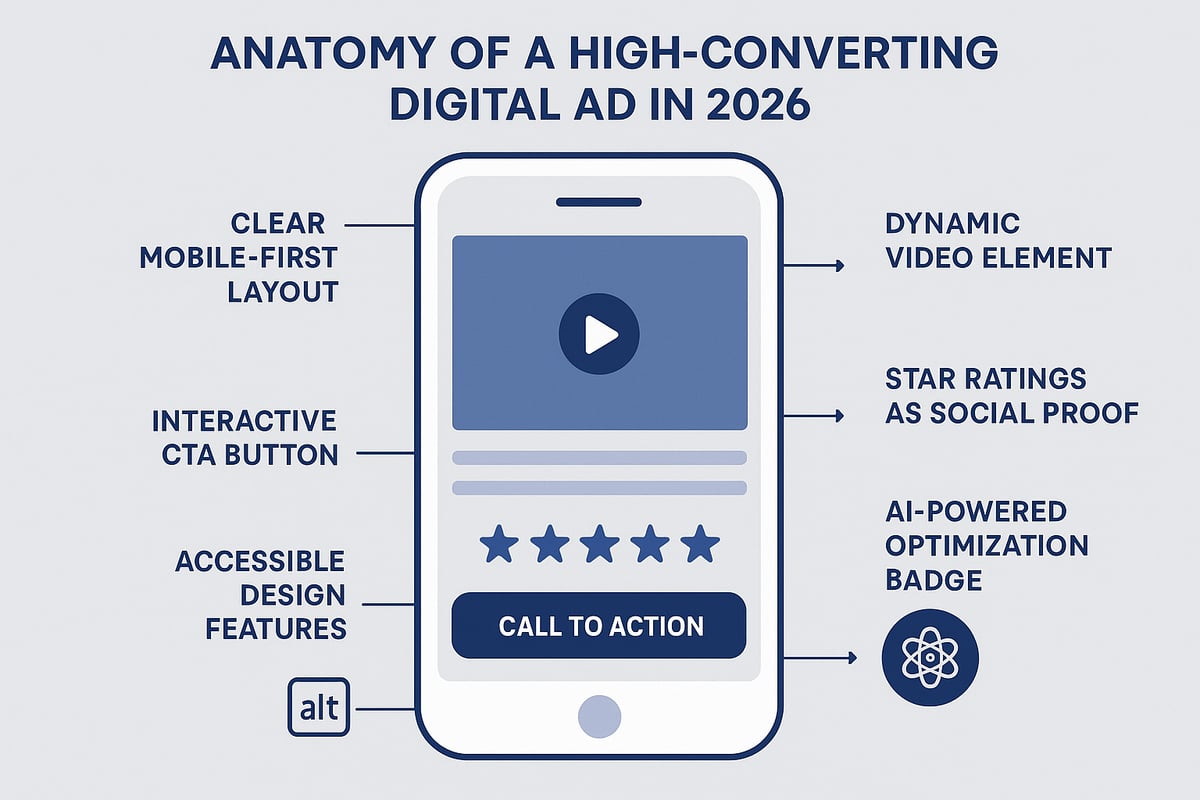
The advertising web demands mobile-first, responsive creative. Prioritise formats that look stunning on any device. Video, animation, and interactive elements are now essential, not optional. Make your ads accessible, with clear fonts, alt text, and high contrast.
Experiment with augmented reality previews, letting customers “try before they buy.” But don’t let innovation overshadow clarity. Your message must be obvious at a glance.
Design checklist:
- Responsive layouts for all screens
- Short, punchy video or animated visuals
- Accessible colours and text
- AR or interactive features for engagement
A retailer using AR previews saw dwell time double, proving that creative innovation is a winning strategy in the advertising web.
Messaging That Resonates
Personalisation sits at the core of effective advertising web messaging in 2026. Use dynamic content to tailor offers for each user. Tell stories that tap into your audience’s emotions and needs.
Match your message to the funnel stage. Top-funnel? Focus on curiosity and problem-solving. Bottom-funnel? Use trust signals and clear calls to action. Tradespeople, for example, find before-and-after stories build instant credibility.
Key tactics:
- Dynamic product recommendations
- Emotional hooks in headlines
- Funnel-aligned messaging
Personalised ads now deliver three times higher engagement, making relevance non-negotiable in the advertising web.
Leveraging User-Generated Content & Social Proof
Trust is currency on the advertising web. Incorporate user-generated content like reviews, testimonials, and real customer photos into your ad creative. Social proof, such as star ratings and case studies, reassures buyers and lifts conversion rates.
A beauty brand featuring customer video reviews in their ads saw credibility soar. Remember, 70 percent of consumers trust peer reviews more than brand claims.
Types of social proof to use:
- Star ratings and badges
- Customer photos or videos
- Authentic testimonials
Bringing the voice of the customer into your advertising web creative is one of the easiest ways to make your brand instantly relatable.
Video & Interactive Content Strategies
Video rules the advertising web in 2026, accounting for 80 percent of all digital ad impressions. Use short-form video to grab quick attention, and long-form for deeper storytelling.
Shoppable video and live commerce are must-haves for eCommerce growth. Add interactive elements like quizzes, polls, or gamified CTAs to boost engagement. A fitness coach running live Q&A ads saw real-time interaction skyrocket.
When to use which format:
| Format | Best For | Example Use |
|---|---|---|
| Short-form video | Awareness | Product teasers |
| Long-form video | Education | How-to demos |
| Interactive quiz | Engagement | Product finders |
| Live commerce | Conversion | Flash sales |
The advertising web is now a playground for immersive experiences.
Creative Testing & Iteration
Relentless testing is the secret sauce for advertising web success. Run A/B and multivariate tests on headlines, visuals, and CTAs. Harness AI to predict which creative combinations will win.
Rapid iteration cycles mean you can spot what works and scale it fast. For example, a professional services firm boosted conversions by 25 percent just by testing new headlines.
Tap into AI-powered marketing strategies to supercharge your creative optimisation. Test early, test often, and let data drive your next move.
A disciplined approach to creative testing will keep your advertising web campaigns converting, no matter how fast the market shifts.
Measurement, Analytics & Optimisation
Staying ahead in advertising web measurement is no longer just about tracking clicks. With the privacy landscape shifting and new tech emerging, knowing what to measure and how to optimise is what separates high performers from the rest. Let’s break down how to measure what matters and keep your campaigns future-ready.
Tracking & Attribution in a Privacy-First World
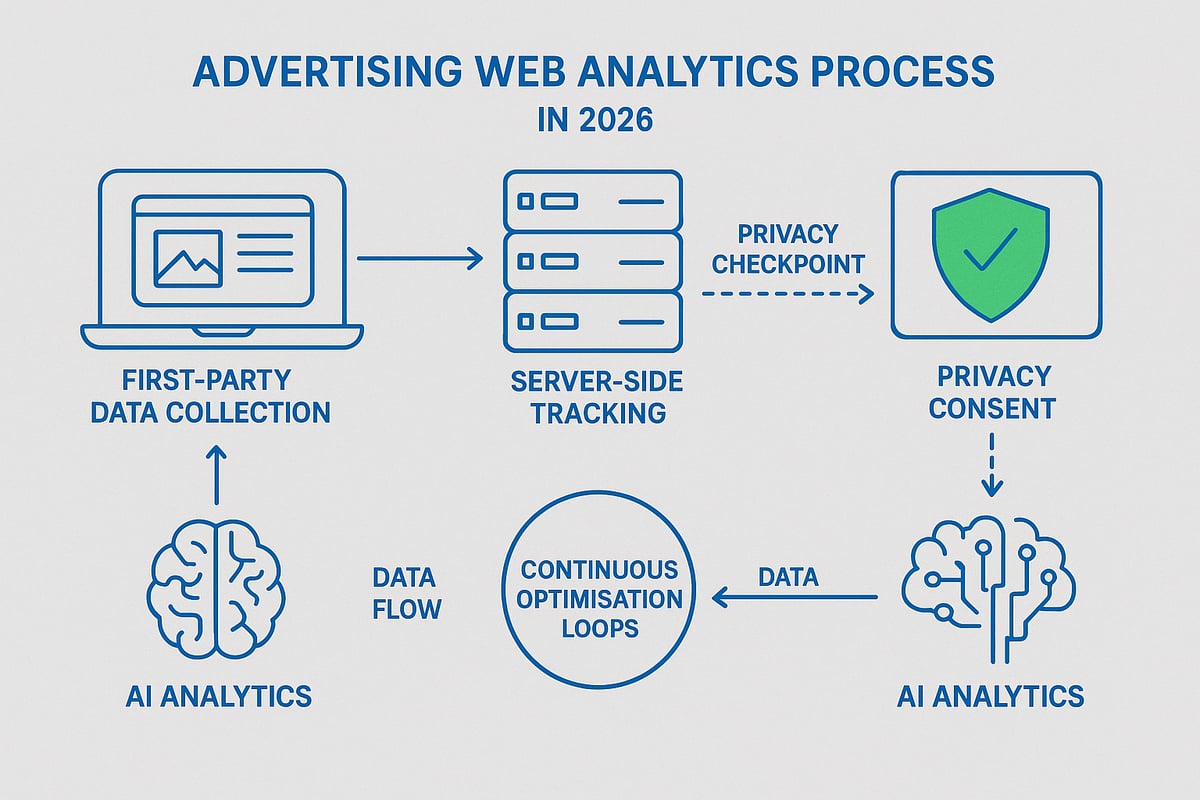
The advertising web is evolving as privacy regulations tighten and third-party cookies fade away. Brands now rely on first-party data, collecting insights directly from their own platforms. Server-side tracking preserves data accuracy while respecting user consent, making it a must-have in 2026.
Attribution is trickier, but not impossible. Multi-touch attribution models reveal how different touchpoints contribute to conversions. For example, eCommerce brands use UTM tags and CRM integration to follow the customer journey, even as attribution accuracy drops by 25 percent without third-party cookies.
The key? Focus on consented, high-quality data and robust tracking methods to keep your advertising web performance on track.
Key Metrics for Success
Effective advertising web campaigns depend on tracking the right numbers. Core metrics like impressions, clicks, conversions, and ROAS are your foundation. But the real magic happens when you add advanced metrics: lifetime value, churn rate, and assisted conversions.
Custom dashboards bring all this data together, making it easier to spot trends and act fast. Top advertisers often use automated reporting to stay agile. For B2B, tracking pipeline value gives a clearer picture of ROI.
Want to dig deeper? Check out this guide on measuring digital marketing ROI for practical advice on attribution and analytics. The right metrics mean every advertising web pound works harder.
Continuous Optimisation Processes
Optimising your advertising web campaigns is not a one-off job. The smartest teams review performance weekly or monthly, always looking for underperforming segments. If something’s lagging, budgets are quickly reallocated.
Here’s a quick optimisation checklist:
- Review campaign data regularly.
- Test new creative and landing pages.
- Reallocate spend to top-performing channels.
- Optimise checkout or lead flows.
Small, frequent tweaks deliver better results than waiting for a major overhaul. For example, a retail brand might increase conversions just by simplifying its checkout page. Regular, data-driven changes keep your advertising web campaigns ahead of the curve.
Leveraging AI & Automation for Analytics
AI is transforming advertising web analytics. AI-powered tools spot anomalies, predict trends, and automate repetitive tasks like bid adjustments or budget shifts. This means less manual work and faster reaction times.
Predictive modelling is a game changer, helping you forecast seasonal spikes or spot declining segments early. For instance, SMEs now use AI to anticipate demand surges and adjust spend accordingly.
Still, human oversight remains essential. AI provides the insights, but it’s your expertise that turns data into action. The best advertising web results come from a smart blend of automation and human judgement.
Building a Culture of Experimentation
The most successful advertising web teams foster a test-and-learn mindset. Experimentation happens at every stage, from ad copy to landing pages. Monthly “test and learn” sprints encourage innovation and knowledge sharing across teams.
Rewarding data-driven risks pays off. Studies show companies with an experimentation culture grow twice as fast. Sharing results and learnings helps everyone improve, not just individual campaigns.
In 2026, continuous testing is your secret weapon. Embrace experimentation and watch your advertising web performance soar.
Expert Insights & Future-Proofing Your Advertising
Digital advertising web strategies are evolving rapidly, and staying ahead means thinking beyond the basics. To future-proof your campaigns, you need to understand not just what works now, but what is coming next. Let us dive into the expert insights that will keep your advertising web approach resilient and ready for 2026.
Adapting to Emerging Technologies
The pace of change in advertising web technology is staggering. Generative AI is now streamlining ad creation and targeting, enabling brands to launch bespoke campaigns in minutes. AR and VR are no longer futuristic; they are part of the mainstream, with retailers and service providers offering immersive ad experiences you can try before you buy.
Voice search and conversational commerce are also reshaping how consumers interact with ads. Imagine a hospitality brand using AI chatbots for instant bookings, or a retailer letting you shop via voice. Being an early adopter is a real differentiator. For more on these trends, see Five trends reshaping how brands buy advertising in 2026 and beyond.
The bottom line? The brands embracing these shifts in their advertising web strategies are winning attention and loyalty.
Navigating Regulation & Ethical Advertising
Regulation is not just a box to tick; it is central to building trust in your advertising web campaigns. Staying compliant with GDPR, ePrivacy, and ASA guidelines is non-negotiable. But ethical advertising goes further, focusing on transparency, inclusivity, and even sustainability.
Consumers now expect to know how their data is used. They want to see brands reflect their values. For example, a professional services firm with clear ad disclosures and accessible messaging can turn legal compliance into a trust signal.
Did you know 65% of consumers are more likely to buy from ethical brands? Prioritising ethics in your advertising web approach creates loyalty and stands out in a crowded market.
Building High-Performance Teams & Partnerships
Your advertising web success depends on your people. Should you go in-house, agency, or hybrid? There is no one-size-fits-all answer. High-performing teams blend creative, data, tech, and compliance skills. Cross-functional collaboration is key.
Consider this mix for your team:
- Data analysts to interpret campaign results
- Creative pros for visuals and copy
- Tech specialists for automation
- Compliance experts to keep you legal
Many SMEs are partnering with specialist studios for conversion rate optimisation and AI. This flexible model supercharges advertising web campaigns and keeps you adaptable.
Case Studies: UK Businesses Succeeding in 2026
Let us see how leading UK businesses are nailing their advertising web strategies:
| Business Type | Key Tactic | Result |
|---|---|---|
| Service business | Local SEO & Google Ads | Tripled qualified leads |
| eCommerce retailer | Shoppable video | Doubled online sales |
| Tradesman | Social proof & reviews in ads | Boosted trust, more bookings |
| Professional services | LinkedIn for B2B | Accelerated pipeline growth |
UK SMEs are reporting an average 40% uplift in digital ad ROI. It shows that the right advertising web approach pays off, no matter your sector.
Action Plan: Steps for 2026 Advertising Success
Ready to future-proof your advertising web efforts? Here is a step-by-step plan:
- Audit your current advertising web performance and creative assets.
- Define clear goals, audiences, and platforms.
- Invest in high-quality creative, robust measurement, and smart automation tools.
- Build agile processes for testing, learning, and rapid optimisation.
- Stay informed on technology, trends, and compliance to keep your campaigns ahead.
Advertising web success in 2026 is not about luck. It is about making smart, informed moves, and never standing still.
Ready to put these 2026 advertising strategies into action for your business? If you want honest, practical advice on boosting your website leads or making your ad spend work harder, let’s have a proper chat. I’ll look at your current set up, give you tailored tips, and point out where you’re missing out on easy wins—no big agency waffle, just a straight talking session focused on getting you more results. Grab your spot now for a Get free 45 min consultation and let’s start making your web advertising really deliver.
In 2026, the digital world moves at lightning speed, and advertising web strategies must keep up if you want to stay ahead. Are you ready to lead the pack, not just follow?
This guide is your go-to resource for expert insights, practical tactics, and the latest trends. We want to help business owners, marketers, and web professionals get real results from their advertising web campaigns.
You’ll discover the current landscape, how to plan strategically, pick the right platforms, craft standout creative, measure success, and future-proof your campaigns. Let’s unlock your potential for digital advertising web success together.
The 2026 Digital Advertising Landscape
The advertising web is transforming at lightning speed in 2026. Brands are seeing new ways to connect, target, and convert audiences. If you want to stay ahead, you need to understand the landscape and how to use its changes to your advantage.
Key Trends Shaping Web Advertising
The advertising web in 2026 is defined by rapid innovation and shifting user expectations. AI-driven targeting and automation are now mainstream, making campaigns smarter and more efficient. Video content, especially short-form and interactive formats, dominates engagement metrics. Privacy regulations continue to tighten, with GDPR updates and cookie-less tracking pushing brands to rethink how they gather and use data.
Voice and visual search are no longer fringe—they're a vital part of many strategies. Omnichannel integration means ads reach users across devices and contexts, not just on desktops. According to recent UK digital ad spend forecasts, 60% of UK businesses have increased their digital channel spend. Static banners are being replaced by dynamic, personalised ads that adjust in real time based on user behaviour. If your advertising web approach ignores these trends, you risk falling behind.
Major Platforms & Their Evolution
The major players in the advertising web have evolved quickly to keep pace with new demands. Google Ads leads with enhanced automation and Performance Max campaigns, letting marketers reach users at every touchpoint. Meta (Facebook and Instagram) focuses on Reels, Stories, and AI-powered targeting, making it easier to engage younger audiences.
LinkedIn has become the go-to for B2B lead generation, thanks to improved audience segmentation tools. TikTok and YouTube are the kings of short-form, shoppable video ads, which drive both brand awareness and direct sales. Emerging platforms like retail media networks and connected TV are gaining traction, giving brands new ways to appear where their customers are. A recent industry report found that 70% of SMEs now use at least three digital ad platforms as part of their advertising web strategy. The options are growing, and so is the complexity.
| Platform | 2026 Focus | Key Benefit |
|---|---|---|
| Google Ads | Automation, Performance Max | Omnichannel reach |
| Meta | Reels, Stories, AI targeting | Youth engagement |
| B2B segmentation | Lead quality | |
| TikTok/YouTube | Shoppable video, short-form content | High engagement |
| Retail Media | Contextual ads | Point-of-sale impact |
Regulatory & Consumer Behaviour Shifts
The regulatory landscape for the advertising web is stricter than ever. GDPR updates and new ePrivacy rules mean brands must be transparent and seek clear consent for data use. Consumers are more aware of how their data is handled, demanding both control and honesty from advertisers.
Ad fatigue is a real problem, with more users installing ad blockers—35% of UK users in 2025, to be exact. Brands are responding by focusing on first-party data and building trust through value-driven content. If you want your advertising web efforts to succeed, you need to balance compliance, transparency, and creativity. Those who adapt will keep their audiences engaged, while others risk being ignored.
The Role of AI and Automation in 2026
AI has transformed the advertising web, making it possible to segment audiences, test creative, and optimise bids with minimal manual effort. Predictive analytics now power campaign planning, letting marketers forecast results and adjust in real time. Chatbots and conversational ads engage users instantly, improving conversion rates.
For example, AI-driven campaign management has cut manual workload by 40% for many agencies. Automation is freeing up time for creative thinking, but human oversight is still crucial. You need to strike the right balance between machine-driven efficiency and original, human-led ideas. The advertising web is smarter than ever, but it still rewards those who innovate and adapt quickly.
Building a Winning Web Advertising Strategy
Crafting an effective advertising web strategy in 2026 means more than just choosing platforms and setting a budget. It’s about aligning every part of your campaign with business goals, audience insights, and creative excellence. Let’s break down each step so you can build a web advertising machine that doesn’t just tick boxes, but delivers results.
Setting Clear Objectives & KPIs
Start your advertising web journey by defining what success looks like. Are you after brand awareness, qualified leads, sales, or customer retention? Pinpointing clear objectives keeps your campaigns focused and measurable.
Choose KPIs that truly matter for each goal. For example, if you want more leads, don’t just track volume—track lead quality and conversion rates. Align objectives and KPIs with your wider business growth targets, so every pound spent moves the needle.
Here’s a quick comparison table:
| Objective | Suggested KPI |
|---|---|
| Awareness | Impressions, CTR |
| Lead Generation | CPA, Lead Quality |
| Sales | ROAS, Conversion |
| Retention | Lifetime Value |
Remember, 80% of top-performing advertising web campaigns start with crystal-clear KPIs.
Audience Research & Segmentation
Knowing your audience is the cornerstone of successful advertising web campaigns. Go beyond basic demographics—build detailed buyer personas based on interests, behaviour, and purchase history.
Leverage both first-party and third-party data to spot patterns and preferences. AI-powered tools can help you micro-segment, so you reach the right people at the right time with the right message.
For example, an eCommerce brand using advertising web channels might serve personalised ads based on each customer’s shopping history. Personalisation is not just a buzzword, it’s your competitive edge.
Channel & Platform Selection
Not every channel will suit your brand or audience. Evaluate advertising web platforms—Google Ads, Meta, LinkedIn, TikTok, and more—based on where your target customers spend their time and what your objectives demand.
Decide whether a multi-channel or single-channel approach fits best. Allocate your budget to the platforms that deliver, and don’t be afraid to test emerging spaces like retail media or connected TV.
For more strategic tips and expert perspectives on choosing the right channels, see these Web ad agency insights. Remember, omnichannel advertising web campaigns typically see a 30% higher ROI.
Budgeting & Resource Planning
Smart budgeting is key to advertising web success. Set your spend based on industry benchmarks and your business’s growth stage. Don’t just pour money into ads—allocate funds for creative production, campaign management, and ongoing testing.
Keep some budget flexible for rapid iteration. For instance, a start-up may dedicate 20% of their spend to experimentation, learning what works before scaling up. Prioritise continuous optimisation in your advertising web strategy to stay ahead of the curve.
Creative & Messaging Alignment
Your creative is what stops the scroll and drives action. Make sure every advertising web asset—copy, visuals, video—reflects your brand and speaks directly to your audience.
Keep messaging consistent across all touchpoints, from web to social to email. Test different value propositions and calls-to-action to discover what resonates. For example, a law firm could highlight trust signals in their ads, boosting credibility.
Creative quality is a game-changer, directly influencing 50% of advertising web campaign success. Never settle for average—test, refine, and align every message for maximum impact.
Creative Excellence: Designing Ads That Convert
Standing out in the advertising web space in 2026 is all about creative excellence. Your ads need to stop the scroll, spark emotion, and drive results. Let’s break down the proven tactics and fresh ideas that will turn browsers into buyers.
Best Practices for Ad Design in 2026
The advertising web demands mobile-first, responsive creative. Prioritise formats that look stunning on any device. Video, animation, and interactive elements are now essential, not optional. Make your ads accessible, with clear fonts, alt text, and high contrast.
Experiment with augmented reality previews, letting customers “try before they buy.” But don’t let innovation overshadow clarity. Your message must be obvious at a glance.
Design checklist:
- Responsive layouts for all screens
- Short, punchy video or animated visuals
- Accessible colours and text
- AR or interactive features for engagement
A retailer using AR previews saw dwell time double, proving that creative innovation is a winning strategy in the advertising web.
Messaging That Resonates
Personalisation sits at the core of effective advertising web messaging in 2026. Use dynamic content to tailor offers for each user. Tell stories that tap into your audience’s emotions and needs.
Match your message to the funnel stage. Top-funnel? Focus on curiosity and problem-solving. Bottom-funnel? Use trust signals and clear calls to action. Tradespeople, for example, find before-and-after stories build instant credibility.
Key tactics:
- Dynamic product recommendations
- Emotional hooks in headlines
- Funnel-aligned messaging
Personalised ads now deliver three times higher engagement, making relevance non-negotiable in the advertising web.
Leveraging User-Generated Content & Social Proof
Trust is currency on the advertising web. Incorporate user-generated content like reviews, testimonials, and real customer photos into your ad creative. Social proof, such as star ratings and case studies, reassures buyers and lifts conversion rates.
A beauty brand featuring customer video reviews in their ads saw credibility soar. Remember, 70 percent of consumers trust peer reviews more than brand claims.
Types of social proof to use:
- Star ratings and badges
- Customer photos or videos
- Authentic testimonials
Bringing the voice of the customer into your advertising web creative is one of the easiest ways to make your brand instantly relatable.
Video & Interactive Content Strategies
Video rules the advertising web in 2026, accounting for 80 percent of all digital ad impressions. Use short-form video to grab quick attention, and long-form for deeper storytelling.
Shoppable video and live commerce are must-haves for eCommerce growth. Add interactive elements like quizzes, polls, or gamified CTAs to boost engagement. A fitness coach running live Q&A ads saw real-time interaction skyrocket.
When to use which format:
| Format | Best For | Example Use |
|---|---|---|
| Short-form video | Awareness | Product teasers |
| Long-form video | Education | How-to demos |
| Interactive quiz | Engagement | Product finders |
| Live commerce | Conversion | Flash sales |
The advertising web is now a playground for immersive experiences.
Creative Testing & Iteration
Relentless testing is the secret sauce for advertising web success. Run A/B and multivariate tests on headlines, visuals, and CTAs. Harness AI to predict which creative combinations will win.
Rapid iteration cycles mean you can spot what works and scale it fast. For example, a professional services firm boosted conversions by 25 percent just by testing new headlines.
Tap into AI-powered marketing strategies to supercharge your creative optimisation. Test early, test often, and let data drive your next move.
A disciplined approach to creative testing will keep your advertising web campaigns converting, no matter how fast the market shifts.
Measurement, Analytics & Optimisation
Staying ahead in advertising web measurement is no longer just about tracking clicks. With the privacy landscape shifting and new tech emerging, knowing what to measure and how to optimise is what separates high performers from the rest. Let’s break down how to measure what matters and keep your campaigns future-ready.
Tracking & Attribution in a Privacy-First World
The advertising web is evolving as privacy regulations tighten and third-party cookies fade away. Brands now rely on first-party data, collecting insights directly from their own platforms. Server-side tracking preserves data accuracy while respecting user consent, making it a must-have in 2026.
Attribution is trickier, but not impossible. Multi-touch attribution models reveal how different touchpoints contribute to conversions. For example, eCommerce brands use UTM tags and CRM integration to follow the customer journey, even as attribution accuracy drops by 25 percent without third-party cookies.
The key? Focus on consented, high-quality data and robust tracking methods to keep your advertising web performance on track.
Key Metrics for Success
Effective advertising web campaigns depend on tracking the right numbers. Core metrics like impressions, clicks, conversions, and ROAS are your foundation. But the real magic happens when you add advanced metrics: lifetime value, churn rate, and assisted conversions.
Custom dashboards bring all this data together, making it easier to spot trends and act fast. Top advertisers often use automated reporting to stay agile. For B2B, tracking pipeline value gives a clearer picture of ROI.
Want to dig deeper? Check out this guide on measuring digital marketing ROI for practical advice on attribution and analytics. The right metrics mean every advertising web pound works harder.
Continuous Optimisation Processes
Optimising your advertising web campaigns is not a one-off job. The smartest teams review performance weekly or monthly, always looking for underperforming segments. If something’s lagging, budgets are quickly reallocated.
Here’s a quick optimisation checklist:
- Review campaign data regularly.
- Test new creative and landing pages.
- Reallocate spend to top-performing channels.
- Optimise checkout or lead flows.
Small, frequent tweaks deliver better results than waiting for a major overhaul. For example, a retail brand might increase conversions just by simplifying its checkout page. Regular, data-driven changes keep your advertising web campaigns ahead of the curve.
Leveraging AI & Automation for Analytics
AI is transforming advertising web analytics. AI-powered tools spot anomalies, predict trends, and automate repetitive tasks like bid adjustments or budget shifts. This means less manual work and faster reaction times.
Predictive modelling is a game changer, helping you forecast seasonal spikes or spot declining segments early. For instance, SMEs now use AI to anticipate demand surges and adjust spend accordingly.
Still, human oversight remains essential. AI provides the insights, but it’s your expertise that turns data into action. The best advertising web results come from a smart blend of automation and human judgement.
Building a Culture of Experimentation
The most successful advertising web teams foster a test-and-learn mindset. Experimentation happens at every stage, from ad copy to landing pages. Monthly “test and learn” sprints encourage innovation and knowledge sharing across teams.
Rewarding data-driven risks pays off. Studies show companies with an experimentation culture grow twice as fast. Sharing results and learnings helps everyone improve, not just individual campaigns.
In 2026, continuous testing is your secret weapon. Embrace experimentation and watch your advertising web performance soar.
Expert Insights & Future-Proofing Your Advertising
Digital advertising web strategies are evolving rapidly, and staying ahead means thinking beyond the basics. To future-proof your campaigns, you need to understand not just what works now, but what is coming next. Let us dive into the expert insights that will keep your advertising web approach resilient and ready for 2026.
Adapting to Emerging Technologies
The pace of change in advertising web technology is staggering. Generative AI is now streamlining ad creation and targeting, enabling brands to launch bespoke campaigns in minutes. AR and VR are no longer futuristic; they are part of the mainstream, with retailers and service providers offering immersive ad experiences you can try before you buy.
Voice search and conversational commerce are also reshaping how consumers interact with ads. Imagine a hospitality brand using AI chatbots for instant bookings, or a retailer letting you shop via voice. Being an early adopter is a real differentiator. For more on these trends, see Five trends reshaping how brands buy advertising in 2026 and beyond.
The bottom line? The brands embracing these shifts in their advertising web strategies are winning attention and loyalty.
Navigating Regulation & Ethical Advertising
Regulation is not just a box to tick; it is central to building trust in your advertising web campaigns. Staying compliant with GDPR, ePrivacy, and ASA guidelines is non-negotiable. But ethical advertising goes further, focusing on transparency, inclusivity, and even sustainability.
Consumers now expect to know how their data is used. They want to see brands reflect their values. For example, a professional services firm with clear ad disclosures and accessible messaging can turn legal compliance into a trust signal.
Did you know 65% of consumers are more likely to buy from ethical brands? Prioritising ethics in your advertising web approach creates loyalty and stands out in a crowded market.
Building High-Performance Teams & Partnerships
Your advertising web success depends on your people. Should you go in-house, agency, or hybrid? There is no one-size-fits-all answer. High-performing teams blend creative, data, tech, and compliance skills. Cross-functional collaboration is key.
Consider this mix for your team:
- Data analysts to interpret campaign results
- Creative pros for visuals and copy
- Tech specialists for automation
- Compliance experts to keep you legal
Many SMEs are partnering with specialist studios for conversion rate optimisation and AI. This flexible model supercharges advertising web campaigns and keeps you adaptable.
Case Studies: UK Businesses Succeeding in 2026
Let us see how leading UK businesses are nailing their advertising web strategies:
| Business Type | Key Tactic | Result |
|---|---|---|
| Service business | Local SEO & Google Ads | Tripled qualified leads |
| eCommerce retailer | Shoppable video | Doubled online sales |
| Tradesman | Social proof & reviews in ads | Boosted trust, more bookings |
| Professional services | LinkedIn for B2B | Accelerated pipeline growth |
UK SMEs are reporting an average 40% uplift in digital ad ROI. It shows that the right advertising web approach pays off, no matter your sector.
Action Plan: Steps for 2026 Advertising Success
Ready to future-proof your advertising web efforts? Here is a step-by-step plan:
- Audit your current advertising web performance and creative assets.
- Define clear goals, audiences, and platforms.
- Invest in high-quality creative, robust measurement, and smart automation tools.
- Build agile processes for testing, learning, and rapid optimisation.
- Stay informed on technology, trends, and compliance to keep your campaigns ahead.
Advertising web success in 2026 is not about luck. It is about making smart, informed moves, and never standing still.
Ready to put these 2026 advertising strategies into action for your business? If you want honest, practical advice on boosting your website leads or making your ad spend work harder, let’s have a proper chat. I’ll look at your current set up, give you tailored tips, and point out where you’re missing out on easy wins—no big agency waffle, just a straight talking session focused on getting you more results. Grab your spot now for a Get free 45 min consultation and let’s start making your web advertising really deliver.


