


Digital product marketing isn't the same as selling physical goods. You can't hold an ebook, inspect a course module in-store, or test-drive software before purchase. That fundamentally changes how you position, promote and sell. The best digital product marketing strategies work because they build trust fast, demonstrate value clearly, and remove every possible barrier between discovery and purchase. This guide shows you what actually works in 2026, with real tactics you can implement this week.
Why Digital Product Marketing Demands a Different Approach
Physical products have tangible qualities. Customers can touch them, see them on shelves, read packaging. Digital products exist only as promises until after purchase. That shifts your entire marketing challenge.
Your job is to make the intangible feel real. You need proof before purchase, not after. This means your product pages must do more heavy lifting than any physical retail display ever could.
The Trust Gap Problem
New customers face a genuine risk buying digital products. They're handing over money for something they can't examine. Poor digital product marketing ignores this. Effective campaigns address it head-on.
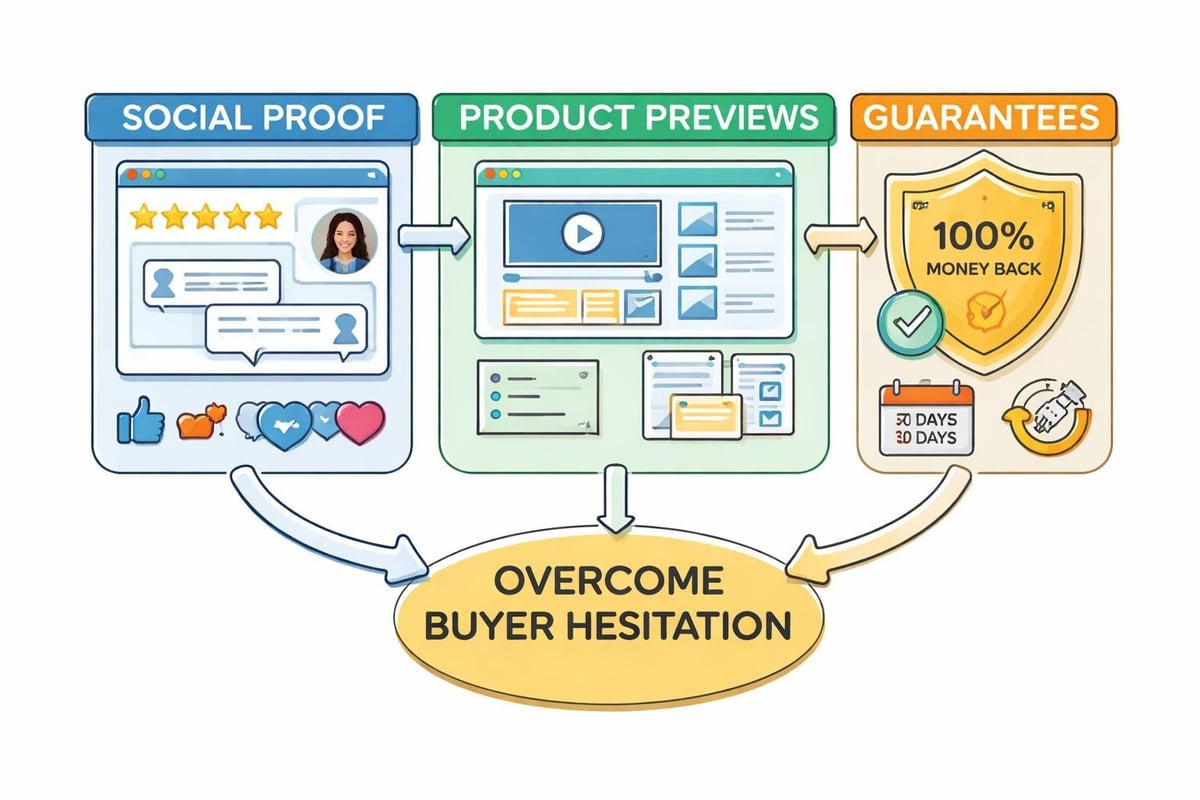
Three ways to close the trust gap:
- Social proof that's specific: Not just "5 stars" but "this template saved me 12 hours on my first project"
- Preview content generously: Show actual pages from your ebook, real module screenshots, genuine feature demos
- Money-back guarantees that mean it: Make refunds simple, not a customer service battle
A well-structured product page with these elements can double conversion rates. I've seen Shopify stores go from 1.2% to 2.8% conversion just by adding video previews and detailed testimonials.
SEO for Digital Products: Getting Found First
Search traffic converts brilliantly for digital products because people are actively looking for solutions. Someone searching "project management template for consultants" has clear intent and an open wallet.
The challenge is that digital product keywords often sit in competitive niches. You're fighting established marketplaces, big SaaS companies and affiliate content farms.
Keyword Strategy That Actually Ranks
Forget chasing "online courses" or "ebooks". Those are vanity searches that won't pay your bills. Instead, implementing proper SEO practices means targeting specific problem-solving queries.
| Keyword Type | Example | Search Volume | Conversion Potential |
|---|---|---|---|
| Generic | "online course" | High | Very Low |
| Category | "marketing course" | Medium | Low |
| Solution-specific | "email sequence templates for coaches" | Low-Medium | Very High |
| Comparison | "Notion vs Asana for freelancers" | Low | High |
Those solution-specific and comparison keywords are your goldmine. Lower competition, higher intent, better conversion rates.
Practical SEO tactics for digital products:
- Create comparison content: "X vs Y" articles rank well and capture high-intent traffic
- Build tool pages: Free calculators, templates or assessments that naturally link to your paid products
- Target "how to" queries: Then position your product as the faster solution
- Optimise for featured snippets: Answer questions directly in the first 50 words
- Internal linking structure: Connect blog content to product pages with relevant anchor text
Your product pages themselves need optimisation too. Title tags should include the problem solved, not just product names. "Instagram Content Calendar Template for 2026" beats "Social Media Template Pack".
Paid Advertising: When and How to Invest
Organic traffic takes time. Paid ads can work immediately, but only if you understand digital product economics. Your customer lifetime value and conversion rate determine whether ads are profitable or just expensive noise.
Let's say you sell a £97 course. Your landing page converts at 2%. That means you need 50 visitors to make one sale. If your ads cost £1.50 per click, you're spending £75 to make £97. Profit margin: £22, assuming no refunds.
That's tight. Too tight for most businesses to scale comfortably.
Making Paid Traffic Profitable
The answer isn't just "get cheaper clicks". It's improving the entire funnel so the maths works in your favour.
Three levers you can actually control:
- Landing page conversion rate: Get this from 2% to 4% and you've doubled profit per visitor
- Average order value: Offer bundle deals, payment plans with slight premiums, or upsells at checkout
- Customer lifetime value: One-off buyers are hard to profit from, but customers who buy three products are gold
Google Ads works well for solution-specific searches. Someone typing "grant writing template charity sector" is ready to buy. Facebook and Instagram ads need a different approach because people aren't actively searching, they're scrolling.
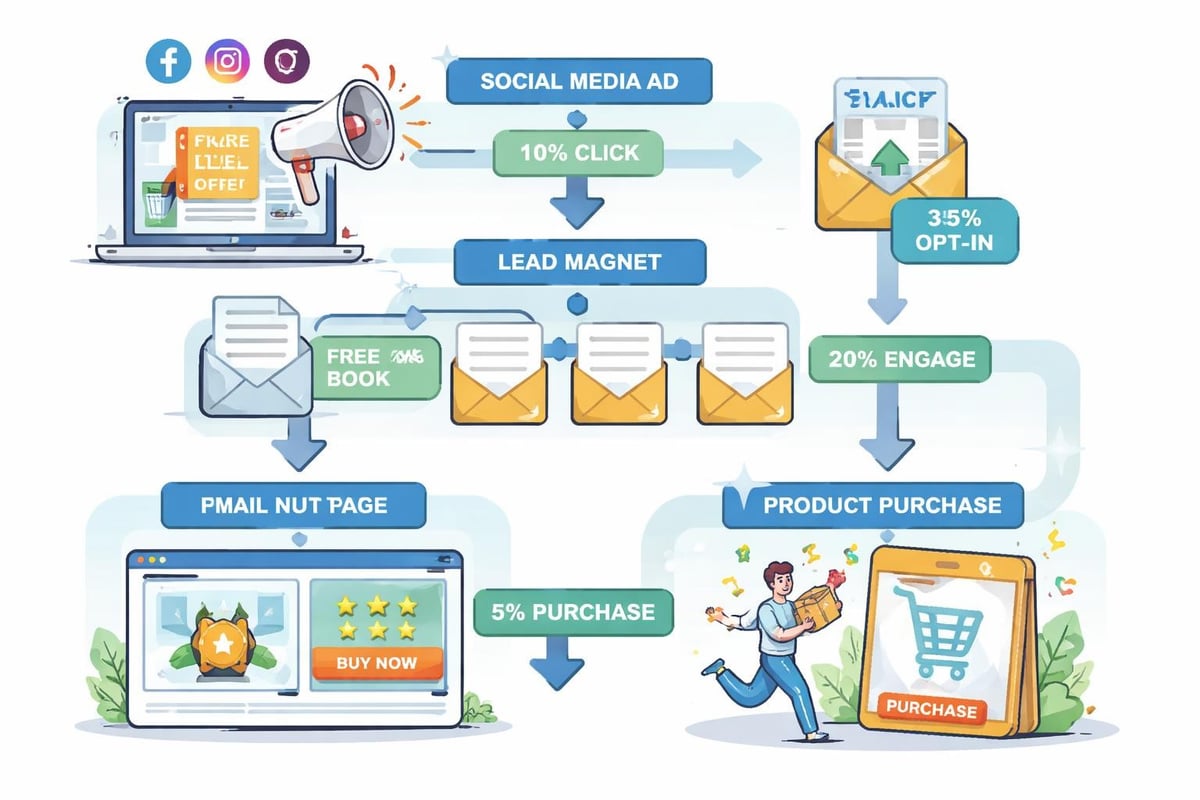
For social ads, lead magnets outperform direct product promotion. Offer a free checklist or mini-course, build an email list, then sell through sequences. The cost per lead might be £3-8, but your email conversion rate should sit around 8-15% over 30 days.
Email Marketing: Your Most Valuable Channel
Email converts better than any other channel for digital product marketing. Not because people love emails (they don't), but because you control the timing and message.
A visitor who lands on your product page once and leaves has a 2-3% chance of buying. A subscriber who receives six valuable emails over two weeks has a 12-18% chance. The difference is proof and relationship-building.
Email Sequences That Sell
Your welcome sequence matters most. This is when attention is highest and trust is forming. Waste it with generic "thanks for subscribing" nonsense and you've blown your best opportunity.
Effective welcome sequence structure:
- Email 1 (immediate): Deliver the promised lead magnet, set expectations, show personality
- Email 2 (day 2): Share a quick win or valuable tip related to your paid product
- Email 3 (day 4): Tell your story or share a case study
- Email 4 (day 6): Introduce your paid product as the natural next step
- Email 5 (day 8): Handle objections and share testimonials
- Email 6 (day 10): Create urgency with a time-limited discount or bonus
This isn't manipulation, it's education. You're showing value before asking for money. The product pitch in email 4 should feel inevitable, not jarring.
Regular broadcast emails keep you visible. Weekly is ideal for most digital products. Less frequent and people forget you. More frequent and they tune out unless your content is exceptional.
Content Marketing That Converts Browsers to Buyers
Blog posts, YouTube videos, podcasts. Everyone says "create content", but most content marketing fails because it's disconnected from revenue.
Effective content for digital product marketing does three jobs: attracts the right traffic, demonstrates your expertise, and creates desire for your paid solution.
Let's look at proven digital marketing strategies that actually drive sales. The key is creating content that solves 80% of a problem, then positioning your product as the efficient solution to the remaining 20%.
The Content-to-Product Bridge
Say you sell social media templates. A blog post titled "How to Create Instagram Content in 30 Minutes" should walk through the process, genuinely help readers, and naturally mention that your template pack does this automatically.
You're not hiding the solution. You're showing the manual path and offering the shortcut.
Content formats that work brilliantly for digital products:
- Process breakdowns: Step-by-step guides that showcase how complex the manual approach is
- Tool comparisons: Reviews that include your product as one option (be honest about limitations)
- Case studies: Real examples of your product in action with specific results
- Template teardowns: Analysing good examples in your niche, subtly showing what your templates include
- "How I" stories: Personal experiences that naturally feature your product as part of your workflow
Publishing frequency matters less than consistency and quality. One exceptional piece monthly beats four rushed articles. Learning from successful case studies shows that depth and usefulness drive more conversions than volume.
Social Media Strategy for Digital Products
Social platforms want you to stay on their site. That makes direct selling difficult. Your Instagram post can't include clickable links. Your TikTok video competes with infinite scroll.
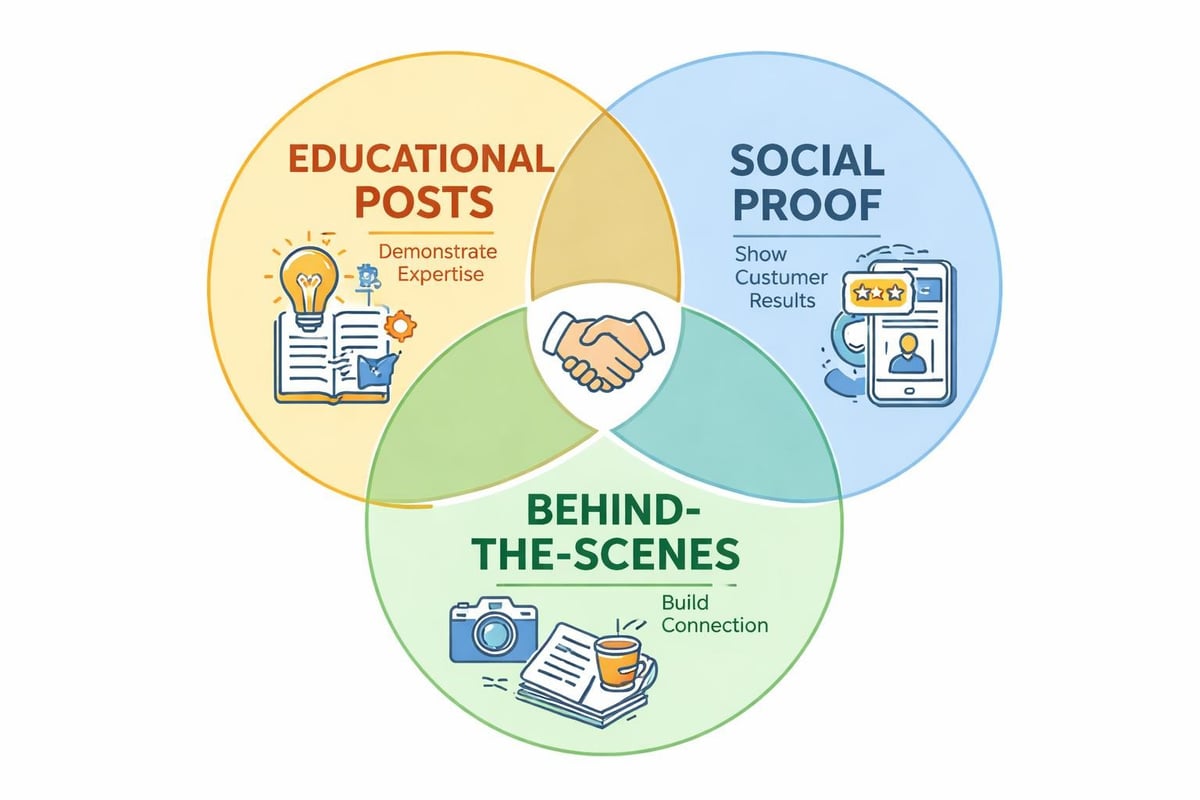
Smart digital product marketing on social media focuses on building awareness and credibility, not immediate sales. You're creating recognition so when people do see your product elsewhere, they already trust you.
Platform-Specific Approaches
Different platforms serve different roles in your digital product marketing strategy.
| Platform | Primary Goal | Content Type | Link Strategy |
|---|---|---|---|
| Build authority | Carousel education posts, Reels | Link in bio, Stories | |
| TikTok | Reach new audiences | Quick tips, before/after | Profile link only |
| B2B credibility | Long-form posts, articles | Direct linking allowed | |
| Twitter/X | Real-time engagement | Quick insights, threads | Tweets with links |
| YouTube | Deep education | Tutorials, walkthroughs | Description and cards |
YouTube deserves special attention for digital product marketing. Video tutorials that solve real problems build enormous trust. A 15-minute walkthrough of your process (even if it promotes your paid product) generates more sales than a dozen promotional posts.
The key is ratio. For every promotional post, share ten pieces of genuine value. Effective social media marketing means your audience actively wants your content, not just tolerates it.
Conversion Rate Optimisation for Product Pages
Your traffic sources don't matter if your product page can't convert. Most digital product pages fail because they're either too salesy or not persuasive enough. The sweet spot is informative confidence.
Good product pages follow a proven structure. You're taking visitors on a journey from problem recognition through solution understanding to purchase confidence.
Essential Elements of High-Converting Product Pages
Above the fold:
- Clear headline stating the transformation or outcome
- Subheading addressing the target customer
- Primary call-to-action button
- Trust indicator (reviews, customer count, security badge)
Middle section:
- What's included (be specific, not vague)
- Who it's for (and who it's not for, this builds trust)
- How it works (process or curriculum overview)
- Social proof (testimonials with photos and specifics)
Lower section:
- FAQ addressing common objections
- Guarantee or refund policy
- Final call-to-action
- Creator bio (establishes authority)
Pricing psychology matters. Single products at £47, £97 or £197 convert well. Odd numbers like £47 test marginally better than round numbers, but clarity beats tricks. If you offer payment plans, show the monthly amount prominently but include total price too.
Partnerships and Affiliate Marketing
You don't need to do all the marketing yourself. Strategic partnerships multiply your reach without multiplying your workload.
Affiliate marketing works beautifully for digital products because margins allow generous commissions. Offering 30-50% commission attracts quality affiliates who actually promote your product.
The mistake most creators make is treating affiliates like free advertising. The best affiliate relationships are genuine partnerships where both parties win.
Building a profitable affiliate programme:
- Recruit strategically: Find partners whose audiences overlap with your ideal customer
- Provide resources: Email templates, social posts, banner ads, unique selling points
- Pay promptly: Use automated systems, not manual tracking
- Communicate regularly: Monthly newsletters with conversion tips and new promotional angles
- Reward top performers: Increased commissions, exclusive bonuses, co-created content
Influencer partnerships work differently. Rather than ongoing commissions, you're often paying flat fees or offering high-value products in exchange for promotion. Be selective. A smaller, engaged audience beats massive reach with no relevance.
Analytics and Improvement: What to Actually Track
Data without decisions is just noise. Track metrics that inform action, ignore vanity numbers that feel good but don't drive revenue.
For digital product marketing, your dashboard should show:
Acquisition metrics:
- Traffic sources and their cost per visitor
- Email list growth rate and source quality
- Social media follower growth (only if tracking conversion rate too)
Engagement metrics:
- Email open rates and click-through rates per campaign
- Time on product pages and scroll depth
- Video completion rates for tutorials
Conversion metrics:
- Product page conversion rate by traffic source
- Email sequence conversion rate
- Average order value and cart abandonment rate
- Refund rate (high refunds signal positioning problems)
Set up weekly reviews. Monthly is too slow, daily is overwhelming. Every Friday, check your core numbers. Are product page conversions up or down? Which traffic source converted best this week? What email got the highest click rate?
Automation and AI for Scaling Digital Product Marketing
Manual marketing doesn't scale. Smart automation does your repetitive work whilst you focus on strategy and creation.
Email automation is obvious (welcome sequences, cart abandonment, re-engagement campaigns). But automation goes deeper than emails.
Automation opportunities in 2026:
- Social media scheduling: Create a month of content in one session, schedule it, done
- Lead magnet delivery: Automatic PDF delivery, course access, template downloads
- Customer onboarding: Drip content that helps customers get value from your product
- Upsell sequences: Triggered emails based on purchase history and behaviour
- Feedback collection: Automated surveys sent X days after purchase
AI tools now handle content creation, but quality control still requires human judgement. Use AI to draft email sequences or social posts, then edit for voice and accuracy. Use it to generate product description variations for testing, analyse customer feedback themes, or create personalised email content at scale.
The goal isn't replacing yourself. It's removing bottlenecks so you can focus on high-value activities like product development, strategic partnerships and conversion optimisation.
Platform Selection and Marketplace Strategy
Should you sell on your own site, a marketplace like Gumroad or Etsy, or both? Each option has different implications for your digital product marketing approach.
Own website advantages:
- You control the customer experience completely
- You own the customer data and email list
- Higher profit margins (no marketplace fees)
- Better for brand building
Own website disadvantages:
- You handle all traffic generation yourself
- Payment processing and technical setup required
- No built-in marketplace traffic
Marketplace advantages:
- Existing traffic and discovery features
- Simple setup and payment handling
- Social proof from platform reviews
- Lower barrier to first sale
Marketplace disadvantages:
- Platform takes 10-30% commission
- Limited customer data access
- Competing directly with similar products
- Less control over positioning and pricing
Most successful digital product creators use both. Launch on marketplaces to validate demand and generate initial reviews, then build your own site for better margins and customer relationships. Joining online marketplaces strategically can accelerate early growth whilst you build owned channels.
Your Shopify store gives you complete control. You can optimise checkout flows, test pricing strategies, bundle products dynamically and build sophisticated email automation. Marketplaces are faster to start but harder to scale profitably.
Retention Marketing: Turning Buyers Into Repeat Customers
Acquiring a new customer costs five times more than selling to an existing one. Yet most digital product marketing focuses entirely on acquisition.
Smart retention marketing turns one-time buyers into loyal customers who purchase multiple products and recommend you to others.
Post-purchase sequence essentials:
- Immediate delivery and welcome (within minutes of purchase)
- Quick-start guide (help them get value fast)
- Check-in email (ask how they're progressing, offer help)
- Value-add content (bonus tips, advanced strategies)
- Review request (once they've had time to use the product)
- Relevant product recommendation (natural upsell based on what they bought)
The timing matters. Don't ask for a review the day after purchase. Wait until they've had time to implement and see results. Two weeks for templates and simple products, 30-45 days for courses and complex systems.
Build a product ecosystem where each item naturally leads to the next. If someone buys your email template pack, they might need your copywriting guide next. If they buy your beginner course, an advanced programme is the logical progression.
Create a customer community if your products support it. A private Facebook group, Discord server or members-only forum adds value beyond the product itself and increases perceived value of future purchases.
Digital product marketing succeeds when you address the unique challenges of selling intangible goods: building trust before purchase, demonstrating clear value, and removing every friction point between discovery and sale. Focus on conversion optimisation, strategic automation, and genuine relationship-building rather than chasing the latest platform or tactic. If you're looking for hands-on support with high-converting product pages, SEO that actually drives revenue, or marketing automation that saves time whilst increasing sales, Marketing XP combines web development expertise with practical marketing strategy to deliver measurable results for growing businesses.
Digital product marketing isn't the same as selling physical goods. You can't hold an ebook, inspect a course module in-store, or test-drive software before purchase. That fundamentally changes how you position, promote and sell. The best digital product marketing strategies work because they build trust fast, demonstrate value clearly, and remove every possible barrier between discovery and purchase. This guide shows you what actually works in 2026, with real tactics you can implement this week.
Why Digital Product Marketing Demands a Different Approach
Physical products have tangible qualities. Customers can touch them, see them on shelves, read packaging. Digital products exist only as promises until after purchase. That shifts your entire marketing challenge.
Your job is to make the intangible feel real. You need proof before purchase, not after. This means your product pages must do more heavy lifting than any physical retail display ever could.
The Trust Gap Problem
New customers face a genuine risk buying digital products. They're handing over money for something they can't examine. Poor digital product marketing ignores this. Effective campaigns address it head-on.
Three ways to close the trust gap:
- Social proof that's specific: Not just "5 stars" but "this template saved me 12 hours on my first project"
- Preview content generously: Show actual pages from your ebook, real module screenshots, genuine feature demos
- Money-back guarantees that mean it: Make refunds simple, not a customer service battle
A well-structured product page with these elements can double conversion rates. I've seen Shopify stores go from 1.2% to 2.8% conversion just by adding video previews and detailed testimonials.
SEO for Digital Products: Getting Found First
Search traffic converts brilliantly for digital products because people are actively looking for solutions. Someone searching "project management template for consultants" has clear intent and an open wallet.
The challenge is that digital product keywords often sit in competitive niches. You're fighting established marketplaces, big SaaS companies and affiliate content farms.
Keyword Strategy That Actually Ranks
Forget chasing "online courses" or "ebooks". Those are vanity searches that won't pay your bills. Instead, implementing proper SEO practices means targeting specific problem-solving queries.
| Keyword Type | Example | Search Volume | Conversion Potential |
|---|---|---|---|
| Generic | "online course" | High | Very Low |
| Category | "marketing course" | Medium | Low |
| Solution-specific | "email sequence templates for coaches" | Low-Medium | Very High |
| Comparison | "Notion vs Asana for freelancers" | Low | High |
Those solution-specific and comparison keywords are your goldmine. Lower competition, higher intent, better conversion rates.
Practical SEO tactics for digital products:
- Create comparison content: "X vs Y" articles rank well and capture high-intent traffic
- Build tool pages: Free calculators, templates or assessments that naturally link to your paid products
- Target "how to" queries: Then position your product as the faster solution
- Optimise for featured snippets: Answer questions directly in the first 50 words
- Internal linking structure: Connect blog content to product pages with relevant anchor text
Your product pages themselves need optimisation too. Title tags should include the problem solved, not just product names. "Instagram Content Calendar Template for 2026" beats "Social Media Template Pack".
Paid Advertising: When and How to Invest
Organic traffic takes time. Paid ads can work immediately, but only if you understand digital product economics. Your customer lifetime value and conversion rate determine whether ads are profitable or just expensive noise.
Let's say you sell a £97 course. Your landing page converts at 2%. That means you need 50 visitors to make one sale. If your ads cost £1.50 per click, you're spending £75 to make £97. Profit margin: £22, assuming no refunds.
That's tight. Too tight for most businesses to scale comfortably.
Making Paid Traffic Profitable
The answer isn't just "get cheaper clicks". It's improving the entire funnel so the maths works in your favour.
Three levers you can actually control:
- Landing page conversion rate: Get this from 2% to 4% and you've doubled profit per visitor
- Average order value: Offer bundle deals, payment plans with slight premiums, or upsells at checkout
- Customer lifetime value: One-off buyers are hard to profit from, but customers who buy three products are gold
Google Ads works well for solution-specific searches. Someone typing "grant writing template charity sector" is ready to buy. Facebook and Instagram ads need a different approach because people aren't actively searching, they're scrolling.
For social ads, lead magnets outperform direct product promotion. Offer a free checklist or mini-course, build an email list, then sell through sequences. The cost per lead might be £3-8, but your email conversion rate should sit around 8-15% over 30 days.
Email Marketing: Your Most Valuable Channel
Email converts better than any other channel for digital product marketing. Not because people love emails (they don't), but because you control the timing and message.
A visitor who lands on your product page once and leaves has a 2-3% chance of buying. A subscriber who receives six valuable emails over two weeks has a 12-18% chance. The difference is proof and relationship-building.
Email Sequences That Sell
Your welcome sequence matters most. This is when attention is highest and trust is forming. Waste it with generic "thanks for subscribing" nonsense and you've blown your best opportunity.
Effective welcome sequence structure:
- Email 1 (immediate): Deliver the promised lead magnet, set expectations, show personality
- Email 2 (day 2): Share a quick win or valuable tip related to your paid product
- Email 3 (day 4): Tell your story or share a case study
- Email 4 (day 6): Introduce your paid product as the natural next step
- Email 5 (day 8): Handle objections and share testimonials
- Email 6 (day 10): Create urgency with a time-limited discount or bonus
This isn't manipulation, it's education. You're showing value before asking for money. The product pitch in email 4 should feel inevitable, not jarring.
Regular broadcast emails keep you visible. Weekly is ideal for most digital products. Less frequent and people forget you. More frequent and they tune out unless your content is exceptional.
Content Marketing That Converts Browsers to Buyers
Blog posts, YouTube videos, podcasts. Everyone says "create content", but most content marketing fails because it's disconnected from revenue.
Effective content for digital product marketing does three jobs: attracts the right traffic, demonstrates your expertise, and creates desire for your paid solution.
Let's look at proven digital marketing strategies that actually drive sales. The key is creating content that solves 80% of a problem, then positioning your product as the efficient solution to the remaining 20%.
The Content-to-Product Bridge
Say you sell social media templates. A blog post titled "How to Create Instagram Content in 30 Minutes" should walk through the process, genuinely help readers, and naturally mention that your template pack does this automatically.
You're not hiding the solution. You're showing the manual path and offering the shortcut.
Content formats that work brilliantly for digital products:
- Process breakdowns: Step-by-step guides that showcase how complex the manual approach is
- Tool comparisons: Reviews that include your product as one option (be honest about limitations)
- Case studies: Real examples of your product in action with specific results
- Template teardowns: Analysing good examples in your niche, subtly showing what your templates include
- "How I" stories: Personal experiences that naturally feature your product as part of your workflow
Publishing frequency matters less than consistency and quality. One exceptional piece monthly beats four rushed articles. Learning from successful case studies shows that depth and usefulness drive more conversions than volume.
Social Media Strategy for Digital Products
Social platforms want you to stay on their site. That makes direct selling difficult. Your Instagram post can't include clickable links. Your TikTok video competes with infinite scroll.
Smart digital product marketing on social media focuses on building awareness and credibility, not immediate sales. You're creating recognition so when people do see your product elsewhere, they already trust you.
Platform-Specific Approaches
Different platforms serve different roles in your digital product marketing strategy.
| Platform | Primary Goal | Content Type | Link Strategy |
|---|---|---|---|
| Build authority | Carousel education posts, Reels | Link in bio, Stories | |
| TikTok | Reach new audiences | Quick tips, before/after | Profile link only |
| B2B credibility | Long-form posts, articles | Direct linking allowed | |
| Twitter/X | Real-time engagement | Quick insights, threads | Tweets with links |
| YouTube | Deep education | Tutorials, walkthroughs | Description and cards |
YouTube deserves special attention for digital product marketing. Video tutorials that solve real problems build enormous trust. A 15-minute walkthrough of your process (even if it promotes your paid product) generates more sales than a dozen promotional posts.
The key is ratio. For every promotional post, share ten pieces of genuine value. Effective social media marketing means your audience actively wants your content, not just tolerates it.
Conversion Rate Optimisation for Product Pages
Your traffic sources don't matter if your product page can't convert. Most digital product pages fail because they're either too salesy or not persuasive enough. The sweet spot is informative confidence.
Good product pages follow a proven structure. You're taking visitors on a journey from problem recognition through solution understanding to purchase confidence.
Essential Elements of High-Converting Product Pages
Above the fold:
- Clear headline stating the transformation or outcome
- Subheading addressing the target customer
- Primary call-to-action button
- Trust indicator (reviews, customer count, security badge)
Middle section:
- What's included (be specific, not vague)
- Who it's for (and who it's not for, this builds trust)
- How it works (process or curriculum overview)
- Social proof (testimonials with photos and specifics)
Lower section:
- FAQ addressing common objections
- Guarantee or refund policy
- Final call-to-action
- Creator bio (establishes authority)
Pricing psychology matters. Single products at £47, £97 or £197 convert well. Odd numbers like £47 test marginally better than round numbers, but clarity beats tricks. If you offer payment plans, show the monthly amount prominently but include total price too.
Partnerships and Affiliate Marketing
You don't need to do all the marketing yourself. Strategic partnerships multiply your reach without multiplying your workload.
Affiliate marketing works beautifully for digital products because margins allow generous commissions. Offering 30-50% commission attracts quality affiliates who actually promote your product.
The mistake most creators make is treating affiliates like free advertising. The best affiliate relationships are genuine partnerships where both parties win.
Building a profitable affiliate programme:
- Recruit strategically: Find partners whose audiences overlap with your ideal customer
- Provide resources: Email templates, social posts, banner ads, unique selling points
- Pay promptly: Use automated systems, not manual tracking
- Communicate regularly: Monthly newsletters with conversion tips and new promotional angles
- Reward top performers: Increased commissions, exclusive bonuses, co-created content
Influencer partnerships work differently. Rather than ongoing commissions, you're often paying flat fees or offering high-value products in exchange for promotion. Be selective. A smaller, engaged audience beats massive reach with no relevance.
Analytics and Improvement: What to Actually Track
Data without decisions is just noise. Track metrics that inform action, ignore vanity numbers that feel good but don't drive revenue.
For digital product marketing, your dashboard should show:
Acquisition metrics:
- Traffic sources and their cost per visitor
- Email list growth rate and source quality
- Social media follower growth (only if tracking conversion rate too)
Engagement metrics:
- Email open rates and click-through rates per campaign
- Time on product pages and scroll depth
- Video completion rates for tutorials
Conversion metrics:
- Product page conversion rate by traffic source
- Email sequence conversion rate
- Average order value and cart abandonment rate
- Refund rate (high refunds signal positioning problems)
Set up weekly reviews. Monthly is too slow, daily is overwhelming. Every Friday, check your core numbers. Are product page conversions up or down? Which traffic source converted best this week? What email got the highest click rate?
Automation and AI for Scaling Digital Product Marketing
Manual marketing doesn't scale. Smart automation does your repetitive work whilst you focus on strategy and creation.
Email automation is obvious (welcome sequences, cart abandonment, re-engagement campaigns). But automation goes deeper than emails.
Automation opportunities in 2026:
- Social media scheduling: Create a month of content in one session, schedule it, done
- Lead magnet delivery: Automatic PDF delivery, course access, template downloads
- Customer onboarding: Drip content that helps customers get value from your product
- Upsell sequences: Triggered emails based on purchase history and behaviour
- Feedback collection: Automated surveys sent X days after purchase
AI tools now handle content creation, but quality control still requires human judgement. Use AI to draft email sequences or social posts, then edit for voice and accuracy. Use it to generate product description variations for testing, analyse customer feedback themes, or create personalised email content at scale.
The goal isn't replacing yourself. It's removing bottlenecks so you can focus on high-value activities like product development, strategic partnerships and conversion optimisation.
Platform Selection and Marketplace Strategy
Should you sell on your own site, a marketplace like Gumroad or Etsy, or both? Each option has different implications for your digital product marketing approach.
Own website advantages:
- You control the customer experience completely
- You own the customer data and email list
- Higher profit margins (no marketplace fees)
- Better for brand building
Own website disadvantages:
- You handle all traffic generation yourself
- Payment processing and technical setup required
- No built-in marketplace traffic
Marketplace advantages:
- Existing traffic and discovery features
- Simple setup and payment handling
- Social proof from platform reviews
- Lower barrier to first sale
Marketplace disadvantages:
- Platform takes 10-30% commission
- Limited customer data access
- Competing directly with similar products
- Less control over positioning and pricing
Most successful digital product creators use both. Launch on marketplaces to validate demand and generate initial reviews, then build your own site for better margins and customer relationships. Joining online marketplaces strategically can accelerate early growth whilst you build owned channels.
Your Shopify store gives you complete control. You can optimise checkout flows, test pricing strategies, bundle products dynamically and build sophisticated email automation. Marketplaces are faster to start but harder to scale profitably.
Retention Marketing: Turning Buyers Into Repeat Customers
Acquiring a new customer costs five times more than selling to an existing one. Yet most digital product marketing focuses entirely on acquisition.
Smart retention marketing turns one-time buyers into loyal customers who purchase multiple products and recommend you to others.
Post-purchase sequence essentials:
- Immediate delivery and welcome (within minutes of purchase)
- Quick-start guide (help them get value fast)
- Check-in email (ask how they're progressing, offer help)
- Value-add content (bonus tips, advanced strategies)
- Review request (once they've had time to use the product)
- Relevant product recommendation (natural upsell based on what they bought)
The timing matters. Don't ask for a review the day after purchase. Wait until they've had time to implement and see results. Two weeks for templates and simple products, 30-45 days for courses and complex systems.
Build a product ecosystem where each item naturally leads to the next. If someone buys your email template pack, they might need your copywriting guide next. If they buy your beginner course, an advanced programme is the logical progression.
Create a customer community if your products support it. A private Facebook group, Discord server or members-only forum adds value beyond the product itself and increases perceived value of future purchases.
Digital product marketing succeeds when you address the unique challenges of selling intangible goods: building trust before purchase, demonstrating clear value, and removing every friction point between discovery and sale. Focus on conversion optimisation, strategic automation, and genuine relationship-building rather than chasing the latest platform or tactic. If you're looking for hands-on support with high-converting product pages, SEO that actually drives revenue, or marketing automation that saves time whilst increasing sales, Marketing XP combines web development expertise with practical marketing strategy to deliver measurable results for growing businesses.


