You've spent time and money getting someone to buy from you. They've signed up, handed over their card details, and you've celebrated another conversion. Then they ghost you. No second purchase, no engagement, nothing. This is where most businesses lose customers, and it's entirely preventable. Customer onboarding is the bridge between acquisition and retention, and if you're not doing it properly, you're haemorrhaging revenue.
Why Customer Onboarding Actually Matters
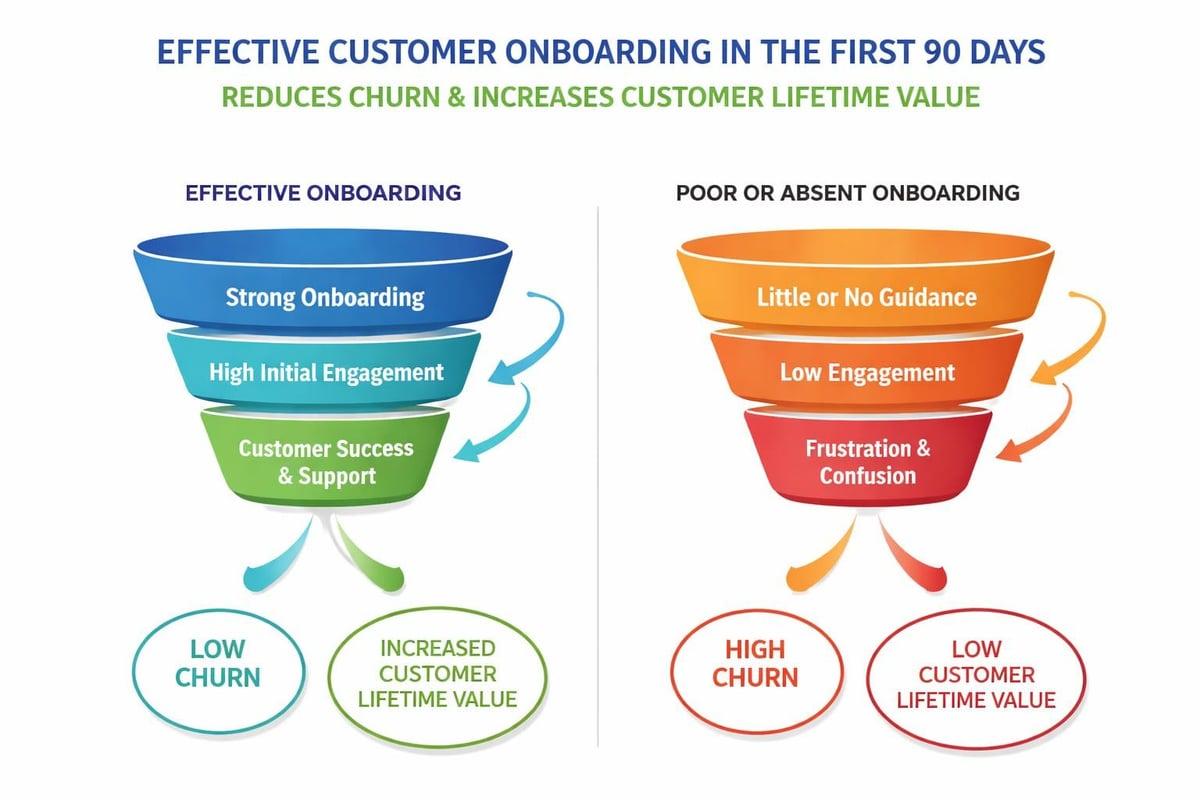
Most small businesses treat onboarding as a nice-to-have. Send a welcome email, maybe a discount code, job done. Wrong. Research from OnRamp reveals that delays and confusion in the first 90 days directly increase churn and damage revenue. Your new customer is most vulnerable right after purchase. They're wondering if they made the right choice, whether your product will actually solve their problem, and if they'll get value for money.
The onboarding period is when you prove you're worth keeping. Do it well, and you'll build loyalty, increase lifetime value, and generate referrals. Mess it up, and you'll watch them drift to a competitor who makes their life easier.

Here's what proper customer onboarding achieves:
- Reduces time-to-value so customers see results faster
- Decreases support tickets because you've pre-empted confusion
- Increases product adoption across features and services
- Builds confidence in their purchase decision
- Creates advocates who refer others
Think about your own Shopify store or service business. When someone buys from you, what happens next? If the answer is "they get an order confirmation and that's it," you're leaving money on the table.
Map the Customer Journey Before You Build Anything
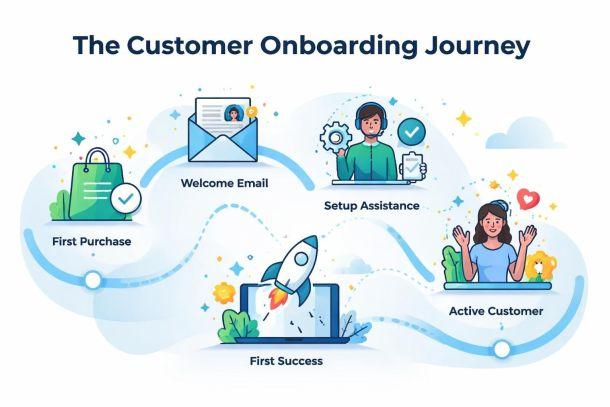
You can't onboard effectively if you don't know where customers get stuck. Start by mapping every touchpoint from purchase to their first successful outcome. This isn't theory, it's practical. Sit down with a spreadsheet or piece of paper and list every interaction.
For an ecommerce business, this might look like:
- Order confirmation email
- Shipping notification
- Delivery
- First use of the product
- Follow-up to check satisfaction
- Encouragement to leave a review or make a second purchase
For a service or subscription business:
- Welcome email with login details
- Account setup guidance
- Initial consultation or tutorial
- First task or project completion
- Check-in at 7, 30, and 90 days
- Upsell to premium features
The Guidde best practices guide for 2026 emphasizes mapping this journey as a foundational step. You need to know where friction exists. Is it during account setup? Do people abandon at a particular feature? Are they confused about what to do first?
Identify Drop-Off Points and Fix Them
Once you've mapped the journey, look at your data. Where do people stop engaging? If you're running Google Analytics on your website or Shopify store, track behaviour after purchase. If you're using email marketing, check open rates and click rates at each stage.
Common drop-off points include:
- Complex setup processes with too many steps
- Lack of clarity about what to do next
- Overwhelming feature lists with no guidance
- Slow response times to questions
- No clear path to the first win
Fix these systematically. Simplify signup forms. Add progress indicators. Send targeted emails that guide the next action. Make it impossible to get lost.
Personalise the Experience Based on Customer Type
Not all customers are the same, and treating them identically is a mistake. A first-time buyer needs different onboarding than a returning customer. Someone purchasing a complex service needs more hand-holding than someone buying a simple product.
Forrester’s foundations of customer onboarding report stresses the need to adapt onboarding to various customer roles. This applies just as much to small businesses as it does to enterprises.
Segment Your Customers and Tailor Communication
Create segments based on:
- Purchase type: Product A needs setup instructions, Product B needs usage tips
- Customer experience level: Beginners need more guidance, experienced users want to skip ahead
- Purchase value: High-ticket customers deserve more personal attention
- Channel source: Google Ads customers might need different messaging than email subscribers
| Customer Segment | Onboarding Focus | Communication Style |
|---|---|---|
| First-time buyer | Product education, how-to guides | Friendly, detailed |
| Returning customer | New features, upsells | Brief, value-focused |
| High-value client | Personal support, consultations | Direct, premium |
| Free trial user | Quick wins, conversion to paid | Motivational, clear ROI |
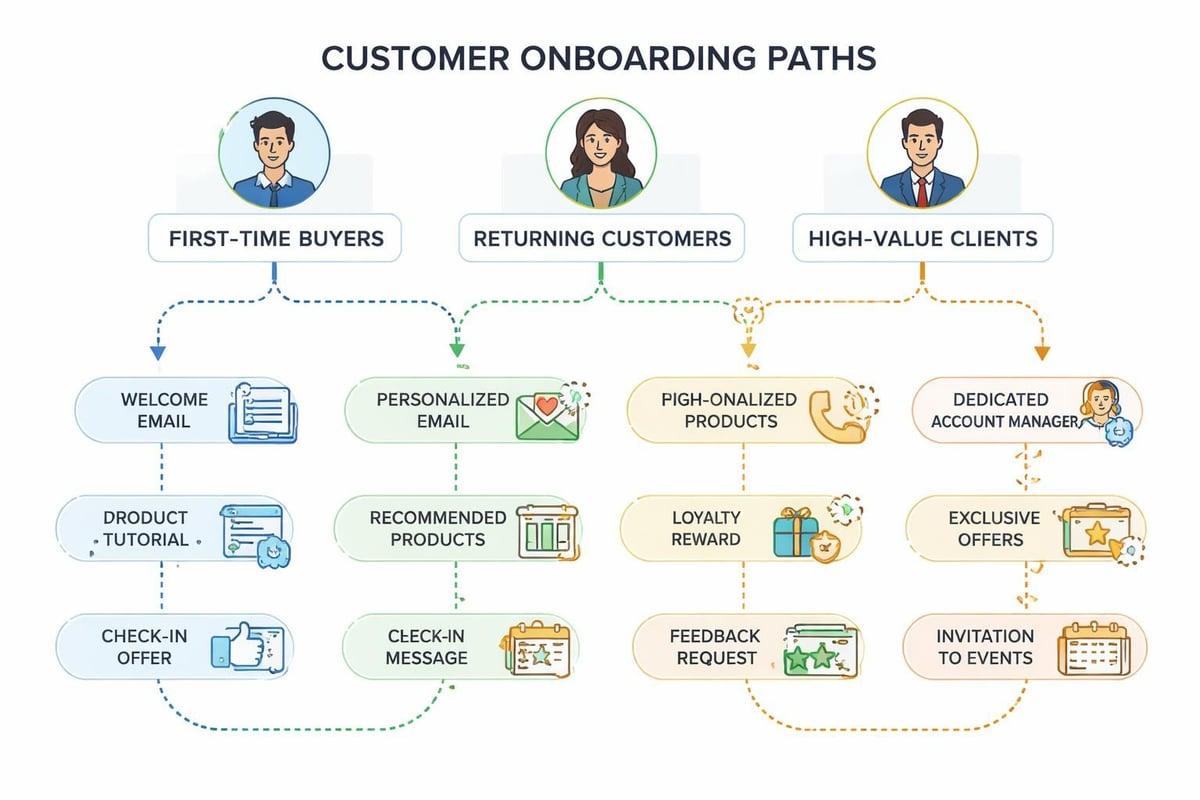
Use your email marketing platform or CRM to automate these segments. If someone buys a specific product, trigger a tailored email sequence. If they're a high-value client, flag them for a personal call.

Build a Structured Onboarding Sequence That Drives Action
Random emails won't cut it. You need a deliberate sequence that moves customers from "I've just bought this" to "I'm getting value from this." Each touchpoint should have a clear purpose and drive a specific action.
Day 0: Welcome and Immediate Next Steps
The moment someone purchases, send an email that confirms the order and tells them exactly what to do next. If it's a physical product, tell them when it ships and how to prepare. If it's a service or digital product, give them login details and a single action to take.
Example: "Your order is confirmed. You'll receive shipping details tomorrow. While you wait, here's how to get the most from [product] when it arrives."
Day 1-3: Quick Win
Guide them to their first success. This could be setting up their account, using a key feature, or getting a result. The quicker they see value, the less likely they'll churn.
Example: "Set up your first campaign in 5 minutes" or "Here's how to use [feature] to save 2 hours a week."
Day 7: Check-In and Support
Ask how it's going. Make it easy to get help if they're stuck. This is where you catch people before they disengage.
Example: "How are you finding [product]? Hit reply if you have questions, or book a free setup call here."
Day 14-30: Education and Expansion
Introduce additional features or products that complement what they've already bought. Don't hard-sell. Frame it as making their experience better.
Example: "You're using [feature A]. Customers who also use [feature B] report 40% better results."
Day 60-90: Retention and Advocacy
By now, they should be active users. Focus on retention (preventing churn) and advocacy (getting referrals or reviews).
Example: "You've been with us for 60 days. If you're happy with the results, we'd love a review."
The ZapScale blog on customer onboarding highlights reducing churn and accelerating time-to-value, both of which hinge on this structured approach.
Use Automation to Scale Without Losing the Personal Touch
You can't manually onboard every customer if you want to grow. Automation handles the repetitive tasks whilst you focus on high-touch interactions for valuable clients.
Set Up Email Sequences in Your CRM
If you're using email marketing tools like Mailchimp, Klaviyo, or ActiveCampaign, create automated workflows triggered by purchase events. These should include:
- Welcome email (immediate)
- Setup guide (Day 1)
- Tips and tricks (Day 3, 7, 14)
- Check-in (Day 7, 30)
- Upsell or cross-sell (Day 21, 60)
Make sure each email has one clear call to action. Don't overwhelm with multiple asks.
Add In-App or On-Site Guidance for Digital Products
If you're selling software, subscriptions, or services that require login, use tooltips, walkthroughs, or progress bars. Show customers what to do next without making them hunt for it.
For Shopify stores, this might mean post-purchase pages that guide customers on product care, usage, or complementary items. For service businesses, it could be a client portal with clear next steps and milestone tracking.
Combine Automation with Manual Touchpoints
Automation shouldn't replace human contact for important customers. High-value clients, complex onboarding scenarios, or customers showing signs of struggle need personal attention.
Flag these customers in your CRM and reach out directly. A five-minute call or personal email can prevent churn and build loyalty that automation alone can't match.
Measure What Matters and Iterate
You won't get customer onboarding perfect on the first try. Track the right metrics, spot what's not working, and improve continuously.
Key metrics to monitor:
- Time-to-first-value: How long until a customer gets their first result or successful outcome?
- Onboarding completion rate: What percentage finish the onboarding sequence?
- Engagement rate: Are customers opening emails, logging in, using features?
- Support ticket volume: Are you reducing confusion and questions?
- Churn rate in first 90 days: How many customers leave before becoming established?
- Customer satisfaction scores: Use NPS or CSAT surveys to gauge experience
Hiver’s guide to customer onboarding covers engagement and completion rates as critical indicators of success.
| Metric | What It Tells You | How to Improve It |
|---|---|---|
| Time-to-first-value | How quickly customers see results | Simplify first steps, guide immediately |
| Completion rate | How many finish onboarding | Remove friction, shorten sequences |
| Engagement | Are customers active? | Send timely, relevant content |
| Churn (0-90 days) | Are you losing new customers? | Improve support, personalise experience |
Set up a simple dashboard (Google Sheets works fine) and review these monthly. Look for patterns. If completion drops at a certain email, rewrite it. If engagement spikes after a specific touchpoint, do more of that.
Avoid Common Onboarding Mistakes
Even well-intentioned customer onboarding can fail if you make these errors:
Overloading Customers with Information
Trying to teach everything at once overwhelms people. Focus on one action per touchpoint. They can learn advanced features later.
Ignoring Customer Feedback
If multiple customers ask the same question, your onboarding isn't clear enough. Listen to support tickets and adjust your process.
Making It About You, Not Them
Your onboarding emails shouldn't celebrate how great your product is. They should focus on what the customer will achieve. Shift from "Our platform has 50 features" to "You'll save 3 hours a week using these tools."
Stopping Too Early
Onboarding isn't just the first week. The first 90 days are critical. Stay engaged, keep providing value, and don't assume they're sorted after one email.
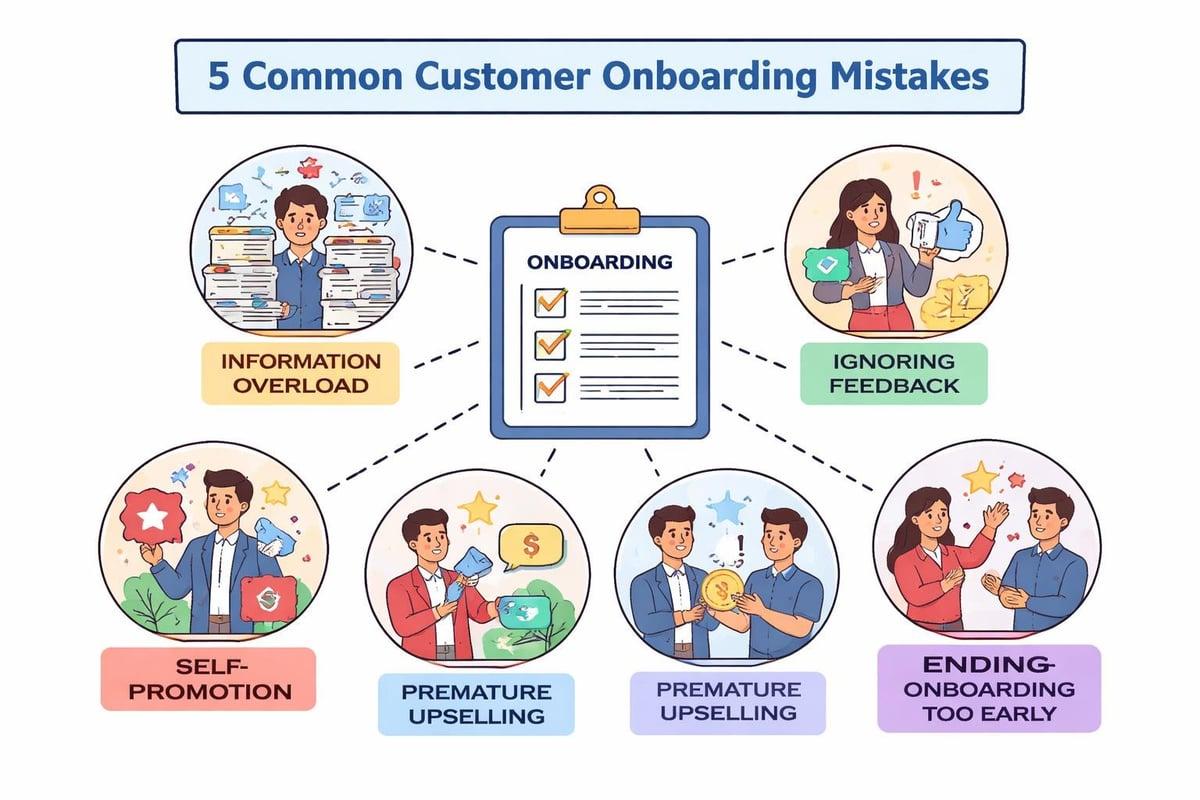
Academic research on B2B digital subscription add-ons shows that poorly-timed upsells during onboarding can backfire. Don't push sales before customers see value.

Make Customer Onboarding a Revenue Driver
Done properly, customer onboarding doesn't just reduce churn. It increases lifetime value, shortens sales cycles for upsells, and generates referrals. Treat it as a revenue strategy, not a cost centre.
When customers feel supported and see results quickly, they buy more. They stick around longer. They tell others. That's how you build a sustainable, profitable business without constantly chasing new leads.
Start small. Pick one customer segment or product. Map their journey. Build a simple email sequence. Track what happens. Refine. Then scale.
The businesses winning in 2026 aren't the ones with the flashiest products. They're the ones that make customers successful from day one.
Customer onboarding separates businesses that grow from those that stagnate. Get people to value faster, and they'll stay longer and spend more. If you need help building onboarding sequences, optimising your Shopify checkout experience, or setting up automated email workflows that actually convert, Marketing XP combines strategy and hands-on execution to drive measurable results for small businesses. Let's turn your new customers into long-term revenue.
You've spent time and money getting someone to buy from you. They've signed up, handed over their card details, and you've celebrated another conversion. Then they ghost you. No second purchase, no engagement, nothing. This is where most businesses lose customers, and it's entirely preventable. Customer onboarding is the bridge between acquisition and retention, and if you're not doing it properly, you're haemorrhaging revenue.
Why Customer Onboarding Actually Matters
Most small businesses treat onboarding as a nice-to-have. Send a welcome email, maybe a discount code, job done. Wrong. Research from OnRamp reveals that delays and confusion in the first 90 days directly increase churn and damage revenue. Your new customer is most vulnerable right after purchase. They're wondering if they made the right choice, whether your product will actually solve their problem, and if they'll get value for money.
The onboarding period is when you prove you're worth keeping. Do it well, and you'll build loyalty, increase lifetime value, and generate referrals. Mess it up, and you'll watch them drift to a competitor who makes their life easier.

Here's what proper customer onboarding achieves:
- Reduces time-to-value so customers see results faster
- Decreases support tickets because you've pre-empted confusion
- Increases product adoption across features and services
- Builds confidence in their purchase decision
- Creates advocates who refer others
Think about your own Shopify store or service business. When someone buys from you, what happens next? If the answer is "they get an order confirmation and that's it," you're leaving money on the table.
Map the Customer Journey Before You Build Anything
You can't onboard effectively if you don't know where customers get stuck. Start by mapping every touchpoint from purchase to their first successful outcome. This isn't theory, it's practical. Sit down with a spreadsheet or piece of paper and list every interaction.
For an ecommerce business, this might look like:
- Order confirmation email
- Shipping notification
- Delivery
- First use of the product
- Follow-up to check satisfaction
- Encouragement to leave a review or make a second purchase
For a service or subscription business:
- Welcome email with login details
- Account setup guidance
- Initial consultation or tutorial
- First task or project completion
- Check-in at 7, 30, and 90 days
- Upsell to premium features
The Guidde best practices guide for 2026 emphasizes mapping this journey as a foundational step. You need to know where friction exists. Is it during account setup? Do people abandon at a particular feature? Are they confused about what to do first?
Identify Drop-Off Points and Fix Them
Once you've mapped the journey, look at your data. Where do people stop engaging? If you're running Google Analytics on your website or Shopify store, track behaviour after purchase. If you're using email marketing, check open rates and click rates at each stage.
Common drop-off points include:
- Complex setup processes with too many steps
- Lack of clarity about what to do next
- Overwhelming feature lists with no guidance
- Slow response times to questions
- No clear path to the first win
Fix these systematically. Simplify signup forms. Add progress indicators. Send targeted emails that guide the next action. Make it impossible to get lost.
Personalise the Experience Based on Customer Type
Not all customers are the same, and treating them identically is a mistake. A first-time buyer needs different onboarding than a returning customer. Someone purchasing a complex service needs more hand-holding than someone buying a simple product.
Forrester’s foundations of customer onboarding report stresses the need to adapt onboarding to various customer roles. This applies just as much to small businesses as it does to enterprises.
Segment Your Customers and Tailor Communication
Create segments based on:
- Purchase type: Product A needs setup instructions, Product B needs usage tips
- Customer experience level: Beginners need more guidance, experienced users want to skip ahead
- Purchase value: High-ticket customers deserve more personal attention
- Channel source: Google Ads customers might need different messaging than email subscribers
| Customer Segment | Onboarding Focus | Communication Style |
|---|---|---|
| First-time buyer | Product education, how-to guides | Friendly, detailed |
| Returning customer | New features, upsells | Brief, value-focused |
| High-value client | Personal support, consultations | Direct, premium |
| Free trial user | Quick wins, conversion to paid | Motivational, clear ROI |
Use your email marketing platform or CRM to automate these segments. If someone buys a specific product, trigger a tailored email sequence. If they're a high-value client, flag them for a personal call.

Build a Structured Onboarding Sequence That Drives Action
Random emails won't cut it. You need a deliberate sequence that moves customers from "I've just bought this" to "I'm getting value from this." Each touchpoint should have a clear purpose and drive a specific action.
Day 0: Welcome and Immediate Next Steps
The moment someone purchases, send an email that confirms the order and tells them exactly what to do next. If it's a physical product, tell them when it ships and how to prepare. If it's a service or digital product, give them login details and a single action to take.
Example: "Your order is confirmed. You'll receive shipping details tomorrow. While you wait, here's how to get the most from [product] when it arrives."
Day 1-3: Quick Win
Guide them to their first success. This could be setting up their account, using a key feature, or getting a result. The quicker they see value, the less likely they'll churn.
Example: "Set up your first campaign in 5 minutes" or "Here's how to use [feature] to save 2 hours a week."
Day 7: Check-In and Support
Ask how it's going. Make it easy to get help if they're stuck. This is where you catch people before they disengage.
Example: "How are you finding [product]? Hit reply if you have questions, or book a free setup call here."
Day 14-30: Education and Expansion
Introduce additional features or products that complement what they've already bought. Don't hard-sell. Frame it as making their experience better.
Example: "You're using [feature A]. Customers who also use [feature B] report 40% better results."
Day 60-90: Retention and Advocacy
By now, they should be active users. Focus on retention (preventing churn) and advocacy (getting referrals or reviews).
Example: "You've been with us for 60 days. If you're happy with the results, we'd love a review."
The ZapScale blog on customer onboarding highlights reducing churn and accelerating time-to-value, both of which hinge on this structured approach.
Use Automation to Scale Without Losing the Personal Touch
You can't manually onboard every customer if you want to grow. Automation handles the repetitive tasks whilst you focus on high-touch interactions for valuable clients.
Set Up Email Sequences in Your CRM
If you're using email marketing tools like Mailchimp, Klaviyo, or ActiveCampaign, create automated workflows triggered by purchase events. These should include:
- Welcome email (immediate)
- Setup guide (Day 1)
- Tips and tricks (Day 3, 7, 14)
- Check-in (Day 7, 30)
- Upsell or cross-sell (Day 21, 60)
Make sure each email has one clear call to action. Don't overwhelm with multiple asks.
Add In-App or On-Site Guidance for Digital Products
If you're selling software, subscriptions, or services that require login, use tooltips, walkthroughs, or progress bars. Show customers what to do next without making them hunt for it.
For Shopify stores, this might mean post-purchase pages that guide customers on product care, usage, or complementary items. For service businesses, it could be a client portal with clear next steps and milestone tracking.
Combine Automation with Manual Touchpoints
Automation shouldn't replace human contact for important customers. High-value clients, complex onboarding scenarios, or customers showing signs of struggle need personal attention.
Flag these customers in your CRM and reach out directly. A five-minute call or personal email can prevent churn and build loyalty that automation alone can't match.
Measure What Matters and Iterate
You won't get customer onboarding perfect on the first try. Track the right metrics, spot what's not working, and improve continuously.
Key metrics to monitor:
- Time-to-first-value: How long until a customer gets their first result or successful outcome?
- Onboarding completion rate: What percentage finish the onboarding sequence?
- Engagement rate: Are customers opening emails, logging in, using features?
- Support ticket volume: Are you reducing confusion and questions?
- Churn rate in first 90 days: How many customers leave before becoming established?
- Customer satisfaction scores: Use NPS or CSAT surveys to gauge experience
Hiver’s guide to customer onboarding covers engagement and completion rates as critical indicators of success.
| Metric | What It Tells You | How to Improve It |
|---|---|---|
| Time-to-first-value | How quickly customers see results | Simplify first steps, guide immediately |
| Completion rate | How many finish onboarding | Remove friction, shorten sequences |
| Engagement | Are customers active? | Send timely, relevant content |
| Churn (0-90 days) | Are you losing new customers? | Improve support, personalise experience |
Set up a simple dashboard (Google Sheets works fine) and review these monthly. Look for patterns. If completion drops at a certain email, rewrite it. If engagement spikes after a specific touchpoint, do more of that.
Avoid Common Onboarding Mistakes
Even well-intentioned customer onboarding can fail if you make these errors:
Overloading Customers with Information
Trying to teach everything at once overwhelms people. Focus on one action per touchpoint. They can learn advanced features later.
Ignoring Customer Feedback
If multiple customers ask the same question, your onboarding isn't clear enough. Listen to support tickets and adjust your process.
Making It About You, Not Them
Your onboarding emails shouldn't celebrate how great your product is. They should focus on what the customer will achieve. Shift from "Our platform has 50 features" to "You'll save 3 hours a week using these tools."
Stopping Too Early
Onboarding isn't just the first week. The first 90 days are critical. Stay engaged, keep providing value, and don't assume they're sorted after one email.
Academic research on B2B digital subscription add-ons shows that poorly-timed upsells during onboarding can backfire. Don't push sales before customers see value.

Make Customer Onboarding a Revenue Driver
Done properly, customer onboarding doesn't just reduce churn. It increases lifetime value, shortens sales cycles for upsells, and generates referrals. Treat it as a revenue strategy, not a cost centre.
When customers feel supported and see results quickly, they buy more. They stick around longer. They tell others. That's how you build a sustainable, profitable business without constantly chasing new leads.
Start small. Pick one customer segment or product. Map their journey. Build a simple email sequence. Track what happens. Refine. Then scale.
The businesses winning in 2026 aren't the ones with the flashiest products. They're the ones that make customers successful from day one.
Customer onboarding separates businesses that grow from those that stagnate. Get people to value faster, and they'll stay longer and spend more. If you need help building onboarding sequences, optimising your Shopify checkout experience, or setting up automated email workflows that actually convert, Marketing XP combines strategy and hands-on execution to drive measurable results for small businesses. Let's turn your new customers into long-term revenue.