Change is the only constant in digital marketing. If you run or manage an interactive marketing agency, you already know the pace is only picking up as we head into 2026.
Staying ahead means more than keeping up. It’s about using new strategies, tools, and frameworks that deliver results in a data-driven world.
This guide is built for agency leaders, marketing managers, and business owners who want to thrive—not just survive—in a hyper-interactive future.
You’ll discover how interactive marketing is evolving, the strategies proven to work in 2026, the tech you need, and practical ways to future-proof your agency.
Ready to adapt, grow, and lead the way? Let’s get started.
The Evolution of Interactive Marketing: Trends Shaping 2026
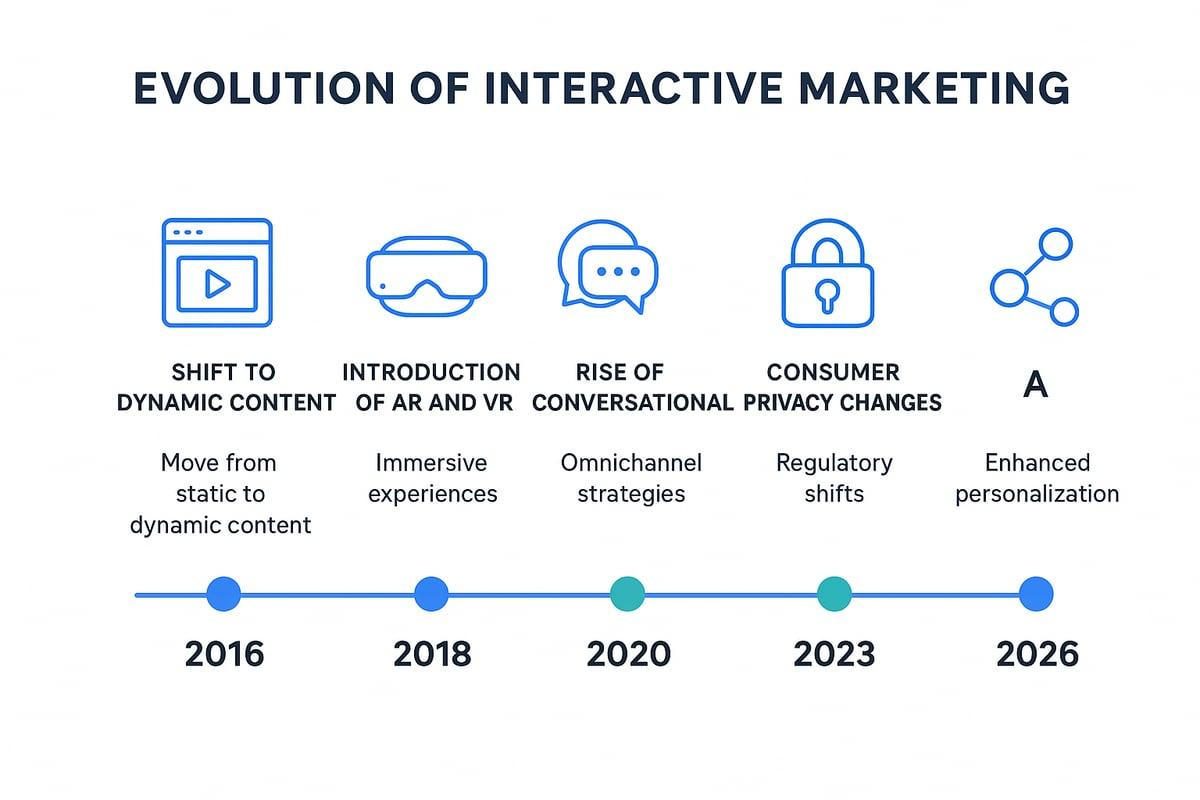
The pace of change in digital marketing is relentless. For any interactive marketing agency aiming for 2026 success, understanding the evolution of interactive marketing is essential. Let’s break down the core trends shaping the future.

Defining Interactive Marketing in 2026
By 2026, the interactive marketing agency landscape will be unrecognisable compared to a decade ago. No longer are brands relying on one way communication. The focus is on dynamic, two way interactions that immerse customers in the brand story.
Immersive experiences are now central. Augmented and virtual reality campaigns create memorable moments, helping brands stand out. Conversational AI and chatbots enable real time engagement, making every customer feel heard. Omnichannel strategies ensure a seamless journey, whether customers are online, in app, or in store.
A staggering 78% of brands plan to boost their interactive content budgets, showing how crucial this approach has become. For agencies, embracing technologies like AR and VR is no longer optional. The Augmented Reality in Marketing guide explores how these platforms are transforming customer engagement, offering a glimpse into what’s next for interactive marketing agency leaders.
Consumer Behaviour and Expectations
Today’s consumers expect more than flashy ads. They want value, relevance, and seamless experiences across every device. The modern interactive marketing agency must deliver on these expectations, or risk losing attention.
People now move fluidly between smartphones, tablets, and physical stores. They expect brands to keep up, providing continuity and personalisation at every touchpoint. Privacy is also top of mind. Customers are more willing to engage if their data is handled transparently and with consent.
Brands like Nike are setting the bar high with interactive AR shopping, blending digital and physical retail. For an interactive marketing agency, success in 2026 will come from meeting these rising expectations and building deep, trust based relationships.
Regulatory and Technological Forces
The regulatory landscape is shifting rapidly. Agencies must navigate evolving privacy laws like GDPR and new UK or EU directives. Apple’s privacy changes have already forced a rethink in how agencies target and measure interactive campaigns.
Technology is both a challenge and an opportunity. AI now powers content curation and personalisation, helping agencies deliver the right message at the right time. The move towards cookieless tracking means first party data has never been more valuable.
An interactive marketing agency must invest in ethical, privacy first solutions. Staying compliant is not just about avoiding fines, but building trust and future proofing campaigns.
Competitive Landscape
Competition in the interactive marketing agency sector is fiercer than ever. Agencies are differentiating themselves through innovation, proprietary technology, and creative approaches to engagement.
Niche agencies are emerging, specialising in areas like gamification or AR experiences. For example, Agency X saw huge success with a gamified loyalty programme, driving both engagement and repeat business.
To stay ahead, an interactive marketing agency should focus on agility and creativity. Those who can adapt quickly to new trends and technologies will set themselves apart in a crowded market.
Core Interactive Marketing Strategies for Agency Success in 2026
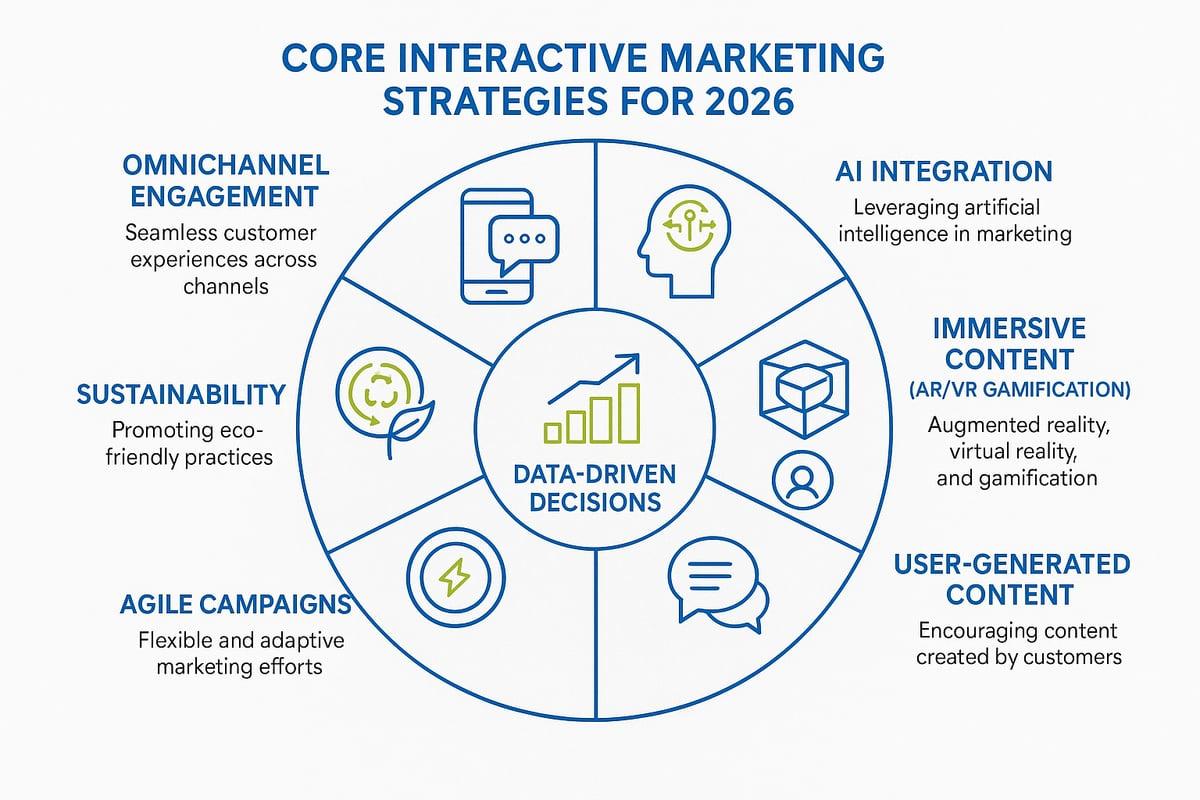
Success in 2026 will belong to the interactive marketing agency that masters innovation, agility, and personalisation. The strategies below are not just buzzwords, they are the core playbook for agencies looking to drive real engagement, measurable results, and lasting client relationships. Let’s break down each essential approach for the year ahead.

Omnichannel Engagement and Personalisation
Today’s customers expect a seamless experience wherever they meet your brand, be it on mobile, social, web, or in-store. For an interactive marketing agency, this means stitching together every touchpoint into a unified, dynamic journey. Personalisation now goes beyond using a customer’s name, it’s about tailoring recommendations, offers, and content in real time using first-party data.
Agencies are increasingly leveraging platforms that unify messaging and analytics across channels. For example, Starbucks’ AI-powered loyalty app is a masterclass in omnichannel engagement, with 40 percent of US sales now coming through this ecosystem. To stay ahead, consider learning from an omnichannel digital marketing agency that’s already making this approach work at scale.
Conversational Marketing and AI Integration
Conversational marketing is all about meeting customers in the moment. Chatbots, voice assistants, and generative AI now power real-time, two-way conversations that qualify leads, answer questions, and nurture relationships around the clock. For the interactive marketing agency, integrating these tools means more than just automation, it’s about creating authentic, frictionless experiences.
With 62 percent of consumers expecting instant responses from brands, agencies must design conversational flows that feel human, anticipate needs, and drive action. The smartest agencies are weaving AI into every stage, from first touch to ongoing loyalty, ensuring no opportunity slips through the cracks.
Immersive Content: AR, VR, and Gamification
Immersive experiences are no longer futuristic, they’re fast becoming a baseline expectation. Augmented reality filters, virtual product demos, and branded games are giving brands bold new ways to engage audiences. An interactive marketing agency can use AR to let customers try products virtually or deploy VR for interactive events that boost dwell time and conversion rates.
Take IKEA’s Place app, which lets users preview furniture in their own homes using AR. Campaigns like this not only wow customers but also provide rich data that fuels future creativity. Gamification, too, turns engagement into a rewarding, shareable adventure.
User-Generated Content and Community Building
Building a thriving community is a powerful way for an interactive marketing agency to amplify brand reach and trust. Encouraging customers to participate through reviews, contests, and sharing their own stories helps turn passive buyers into passionate advocates.
GoPro’s approach is a textbook example: their user-generated content strategy fills social feeds with real customer adventures, driving both engagement and authenticity. Agencies should also tap into micro-influencers and brand fans to spark conversations that feel genuine and grassroots, not forced.
Data-Driven Decision Making
Every interactive marketing agency in 2026 must be obsessed with data. Real-time analytics allow agencies to optimise campaigns on the fly, while predictive modelling helps anticipate customer needs before they even arise. As cookies fade into history, first-party data becomes the new currency for targeting and personalisation.
Agencies that invest in robust data infrastructure can quickly spot what’s working, what’s not, and where to double down. This approach turns guesswork into science, ensuring every pound spent delivers measurable impact for clients.
Agile Campaign Development
Speed and flexibility are the name of the game. Agile methodologies such as rapid prototyping, A B testing, and cross-functional teamwork help an interactive marketing agency stay ahead of trends and adapt to shifting consumer behaviour.
Spotify’s agile approach to campaign rollouts is a great template: ideas move from concept to execution in sprints, with constant feedback loops driving continuous improvement. This lets agencies pivot quickly, test bold concepts, and scale up what works, all while keeping teams energised and aligned.
Sustainability and Ethical Marketing
Modern consumers are looking beyond clever campaigns, they want to know that brands and their interactive marketing agency partners share their values. Aligning campaigns with ESG (Environmental, Social, Governance) priorities, being transparent about data use, and ensuring authenticity in content are now business essentials.
According to the Edelman Trust Barometer, 68 percent of consumers prefer brands with a clear ethical stance. Agencies that lead with integrity and sustainability don’t just protect reputation, they attract loyal clients and talent, future proofing their business for years to come.
Essential Technologies Powering Interactive Agencies in 2026
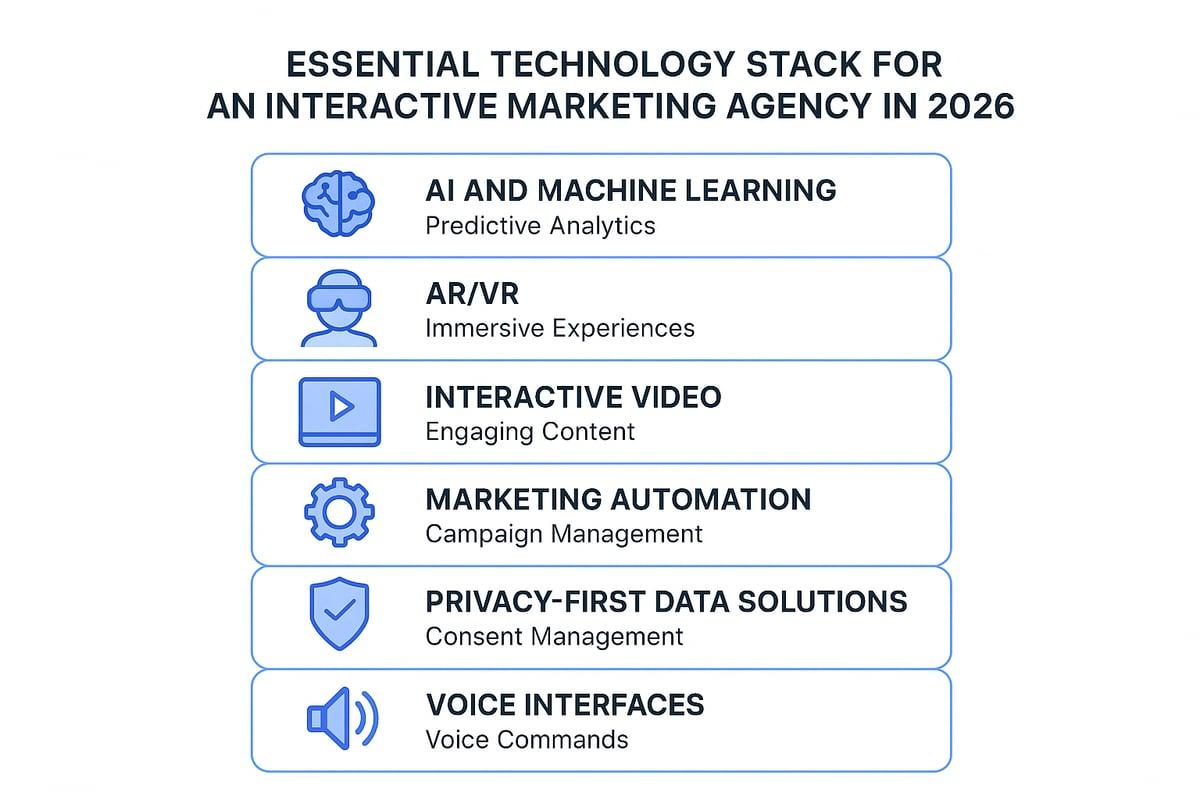
The right technologies are the backbone of every successful interactive marketing agency. In 2026, agencies that outpace the competition will be those who master AI, automation, and next-generation engagement tools. Let’s break down the essential tech stack every interactive marketing agency needs to thrive.

AI and Machine Learning Platforms
AI and machine learning platforms are transforming how an interactive marketing agency operates. Automated content creation, hyper-personalisation, and campaign management are now standard. Predictive analytics help agencies anticipate audience needs and segment users more effectively. For example, ChatGPT-powered tools can spark campaign ideas in seconds. If you want to see how AI-driven analytics are reshaping strategy, check out these AI marketing analytics insights. By integrating AI, agencies can streamline operations and deliver results at scale.
Augmented Reality (AR) and Virtual Reality (VR)
AR and VR are no longer futuristic buzzwords for an interactive marketing agency. These tools deliver immersive product demos, virtual events, and interactive training environments. Statista predicts 1.4 billion AR device users by 2026, making these experiences mainstream. Agencies can use AR to let customers visualise products in their homes or VR to create branded worlds. The result? Longer dwell times, higher engagement, and memorable brand interactions.
Interactive Video and Live Streaming
Interactive video and live streaming are essential weapons in the modern interactive marketing agency’s arsenal. Shoppable videos allow viewers to buy products instantly, while live commerce drives real-time conversions. TikTok Shop is a prime example, blending entertainment and instant purchasing. Completion rates for interactive video regularly exceed 90 percent. These tools turn passive audiences into active participants, boosting both engagement and sales.
Marketing Automation and CRM Integration
Marketing automation platforms and CRM systems are the glue that holds a high-performing interactive marketing agency together. Automated lead nurturing, real-time personalisation, and seamless tracking across channels are now expected. Integrations with tools like HubSpot and Salesforce allow agencies to move leads smoothly through the funnel, from first interaction to conversion. This saves time, reduces manual errors, and helps teams focus on strategy instead of admin.
Privacy-First Data Solutions
With privacy regulations tightening, every interactive marketing agency needs robust, privacy-first data solutions. Cookieless tracking, consent management, and ethical data collection have become non-negotiable. Tools like OneTrust help agencies execute campaigns that comply with GDPR and UK directives. Building trust with customers through transparent data practices is a competitive advantage. Agencies must prioritise secure, compliant tech to maintain credibility and deliver measurable results.
Voice and Conversational Interfaces
Voice search and conversational interfaces are reshaping consumer behaviour. By 2026, Ofcom expects 55 percent of UK households to own smart speakers. Agencies must optimise content for voice, develop branded voice assistants, and integrate chatbots for real-time support. These interfaces make interactions more natural and convenient, helping an interactive marketing agency stand out in a crowded market.
Cross-Channel Analytics and Attribution
Unified dashboards and advanced attribution models are critical for any interactive marketing agency aiming to prove ROI. With multi-touch journeys across web, mobile, and in-store, agencies need tools that track and attribute value at every step. Cross-channel analytics give a clear view of what’s working, allowing for smarter budget allocation. Accurate measurement is the foundation of continuous improvement and client trust.
| Technology | Benefit | Example Use Case |
|---|---|---|
| AI & Machine Learning | Predictive analytics | Automated content generation |
| AR/VR | Immersive experiences | Virtual product demos |
| Interactive Video & Live Stream | Active, shoppable engagement | TikTok Shop, live sales events |
| Marketing Automation & CRM | Seamless personalisation | HubSpot/Salesforce integration |
| Privacy-First Data Solutions | Compliance, trust | OneTrust consent management |
| Voice Interfaces | Natural brand interactions | Voice assistants, chatbots |
| Cross-Channel Analytics | ROI measurement | Unified campaign dashboards |
Building High-Performance Teams and Processes for 2026
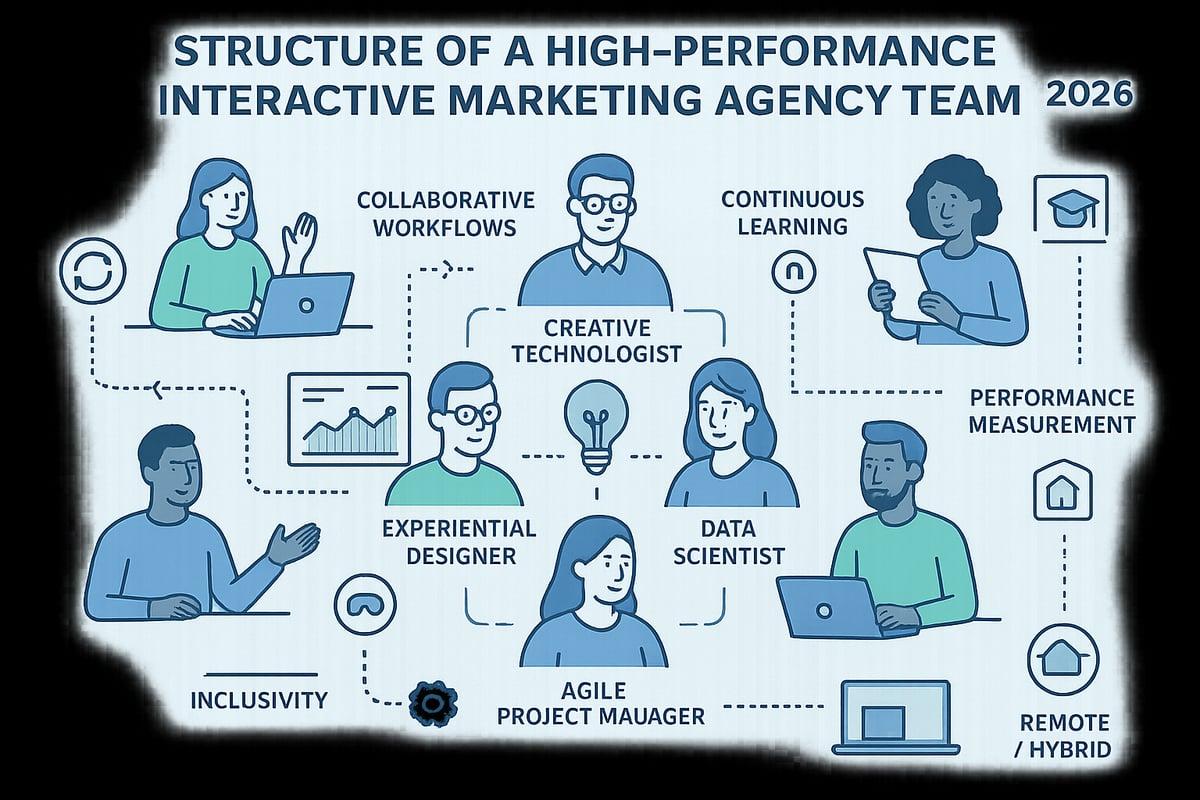
As the interactive marketing agency landscape shifts rapidly, building a high-performance team is non-negotiable. Success in 2026 will depend on how well your agency attracts, develops, and organises talent. Let’s break down what matters most.

Skills and Roles in Demand
The interactive marketing agency of 2026 needs a blend of creative, technical, and analytical talent. Hybrid marketers who can switch between strategy, data, and creative execution are in high demand.
Key roles include:
- Creative technologists
- AI specialists
- Data scientists
- Experiential designers
| Role | Core Skillset |
|---|---|
| Creative Technologist | Tech innovation, creative campaigns |
| AI Specialist | Machine learning, automation |
| Data Scientist | Analytics, predictive modelling |
| Experiential Designer | Immersive content, UX |
Agencies that nurture these skills will stand out in the interactive marketing agency world.
Collaborative and Agile Workflows
Cross-disciplinary teams are now the norm. Agencies benefit from agile methodologies like sprints, stand-ups, and retrospectives. This approach helps teams adapt fast, test ideas quickly, and deliver campaigns that actually convert.
Best practices:
- Use agile project boards and feedback loops
- Foster open communication across departments
- Encourage rapid prototyping and A/B testing
74% of agencies report better results after adopting agile workflows. It’s about working smarter, not just harder.
Continuous Learning and Upskilling
Emerging technologies require continuous training. Agencies must invest in their team’s growth, especially in areas like AI, AR, and automation.
Partnering with tech providers, running in-house bootcamps, and leveraging AI-powered marketing solutions can keep your interactive marketing agency ahead of the curve. Ongoing learning isn’t a luxury, it’s a necessity.
Diversity, Equity, and Inclusion
Diverse teams fuel creativity and innovation. Agencies with inclusive cultures see stronger performance and deliver campaigns that resonate with broader audiences.
Why it matters:
- Broader perspectives drive better ideas
- Inclusive campaigns build trust with consumers
- Diverse teams are 35% more likely to outperform
Fostering equity and belonging isn’t just the right thing to do, it’s a winning business strategy.
Remote and Hybrid Work Models
Remote and hybrid work is here to stay. Interactive marketing agency teams need robust tools for collaboration, from VR meetings to shared digital workspaces.
Maintaining a strong culture with distributed teams means setting clear expectations, encouraging regular check-ins, and making space for creative brainstorming—no matter where people are based.
Performance Measurement and KPIs
High-performing teams set clear goals and measure what matters. Real-time dashboards, transparent feedback, and regular reviews keep everyone aligned.
For any interactive marketing agency, tracking campaign impact, team output, and client satisfaction is crucial. Data-driven performance management ensures your agency stays ahead, adapts quickly, and delivers measurable value.
Measurement, Analytics, and Proving ROI in Interactive Marketing
Staying competitive as an interactive marketing agency in 2026 means proving you deliver real results, not just flashy campaigns. Measurement and analytics are your foundation for demonstrating impact, optimising spend, and winning client trust. Let’s break down how you can set the right objectives, choose the best tools, and ensure your agency is always one step ahead.
Setting Clear Objectives and KPIs
Every successful interactive marketing agency starts with clear objectives and measurable KPIs. Before launching any campaign, work closely with your client to align on what success looks like. Is it lead generation, increased engagement, or direct revenue growth?
Common KPIs include:
- Conversion rate
- Customer lifetime value
- Engagement rate
- Cost per acquisition
By defining these early, your team can focus efforts, avoid wasted spend, and report on what truly matters. Setting the right KPIs makes it easier to show tangible results and build long-term trust.
Advanced Analytics Tools and Platforms
Analytics platforms are the backbone of any interactive marketing agency. Real-time reporting, AI-powered insights, and automation let you react to trends instantly, not after the fact. Modern tools allow you to track every touchpoint, from web to AR, and integrate data for a unified view.
For agencies wanting to scale, marketing automation strategies are crucial. These platforms help automate reporting, trigger personalised content, and manage multi-channel campaigns with precision.
Choosing the right analytics stack is essential for staying agile and keeping your clients ahead of the curve.
Attribution Modelling in a Multi-Touch World
Gone are the days of last-click attribution. Today’s customer journeys are multi-channel, multi-device, and far from linear. Your interactive marketing agency must use advanced attribution models to understand which touchpoints drive real results.
Consider:
- Multi-touch attribution: Credits multiple interactions
- Incrementality testing: Measures true campaign lift
- Cross-device tracking: Follows users across platforms
By adopting these models, you’ll provide more accurate insights, justify spend, and optimise future campaigns for better ROI.
Measuring Engagement and Interactivity
Engagement is the heartbeat of any interactive marketing agency’s campaign. Tracking dwell time, interaction rates, and conversion lift gives you a clear view of what’s resonating with audiences.
Key metrics to monitor:
- Average session duration
- Click-through/interactivity rates
- Social shares and comments
- Conversion lift from interactive content
For deeper insight, explore hyper-personalization and predictive analytics to anticipate user needs and tailor experiences in real time. This approach not only boosts engagement but also creates a measurable impact on conversions.
Demonstrating Value to Clients
Clients want proof their investment with your interactive marketing agency is paying off. Transparent, easy-to-read dashboards are your best ally here. Share real-time updates, highlight key wins, and be honest about what’s working and what isn’t.
Case studies, before-and-after comparisons, and regular performance reviews build trust and encourage ongoing collaboration. When clients see the direct link between your work and their business growth, they’ll stick around.
Overcoming Data Privacy and Compliance Challenges
Data privacy is top of mind for every interactive marketing agency in 2026. Regulations like GDPR and future UK/EU directives mean you must collect and report data ethically.
Adopt privacy-first analytics solutions, prioritise first-party data, and ensure all tracking is consent-based. Regular audits and transparent policies give clients peace of mind and protect your agency’s reputation.
Staying compliant isn’t just a legal requirement, it’s a competitive advantage in an increasingly data-conscious market.
Future-Proofing Your Interactive Marketing Agency: Steps for 2026 and Beyond
To thrive in 2026, every interactive marketing agency must be prepared for rapid change. Future-proofing is more than a buzzword; it's a survival strategy. The landscape is shifting, and agencies that adapt will lead, not follow.
Embracing AI and Automation
AI is reshaping how an interactive marketing agency delivers results. From content creation and campaign management to personalisation, AI and automation now underpin high-performing strategies.
Leaders should integrate AI tools across creative, media buying, and analytics. For example, hyper-personalisation driven by AI can dramatically boost engagement and conversion rates. To see how these technologies are evolving, check out AI-Powered Hyper-Personalization, which explores the tools set to define marketing in 2026.
Automated content generation, chatbots, and predictive analytics are no longer optional. They are essential for agencies wanting to scale without sacrificing quality or agility.
Building Data and Innovation Resilience
First-party data is the new gold for any interactive marketing agency. With privacy regulations tightening and cookies disappearing, agencies must prioritise direct relationships with customers. Tactics like loyalty programmes or gated content help build robust data pipelines.
Experimentation is also vital. Early adoption of new platforms, such as the metaverse or virtual worlds, keeps your agency ahead of the curve. Foster a culture of innovation by encouraging teams to test bold ideas in internal labs.
Continuous learning is critical. Upskill staff in AI, automation, and emerging tech to ensure your agency remains competitive and adaptable.
Strategic Partnerships and Risk Management
No interactive marketing agency can succeed alone. Building alliances with tech providers, creators, and even other agencies opens the door to cutting-edge resources and creative synergies.
Staying compliant is non-negotiable. Proactively monitor regulatory changes, appoint data privacy officers, and update processes to avoid costly missteps.
Finally, scenario planning is your safety net. Develop contingency plans for tech disruption, market shifts, or regulatory upheaval. Agencies that anticipate change recover faster and seize new opportunities.
Future-proofing is ongoing. By embedding these strategies into your interactive marketing agency, you'll build resilience, unlock growth, and remain at the forefront of digital marketing.
If you’re serious about making your agency stand out in 2026, it’s time to put these strategies into action. We’ve covered everything from AI-driven campaigns to creating genuinely interactive experiences that actually convert, not just impress. You don’t have to tackle this alone — sometimes a fresh pair of eyes (and a bit of tough love) can make all the difference to your results. If you fancy a no-nonsense chat about your current approach and how to get more leads and sales, let’s get together for a Get free 45 min consultation.
Change is the only constant in digital marketing. If you run or manage an interactive marketing agency, you already know the pace is only picking up as we head into 2026.
Staying ahead means more than keeping up. It’s about using new strategies, tools, and frameworks that deliver results in a data-driven world.
This guide is built for agency leaders, marketing managers, and business owners who want to thrive—not just survive—in a hyper-interactive future.
You’ll discover how interactive marketing is evolving, the strategies proven to work in 2026, the tech you need, and practical ways to future-proof your agency.
Ready to adapt, grow, and lead the way? Let’s get started.
The Evolution of Interactive Marketing: Trends Shaping 2026
The pace of change in digital marketing is relentless. For any interactive marketing agency aiming for 2026 success, understanding the evolution of interactive marketing is essential. Let’s break down the core trends shaping the future.

Defining Interactive Marketing in 2026
By 2026, the interactive marketing agency landscape will be unrecognisable compared to a decade ago. No longer are brands relying on one way communication. The focus is on dynamic, two way interactions that immerse customers in the brand story.
Immersive experiences are now central. Augmented and virtual reality campaigns create memorable moments, helping brands stand out. Conversational AI and chatbots enable real time engagement, making every customer feel heard. Omnichannel strategies ensure a seamless journey, whether customers are online, in app, or in store.
A staggering 78% of brands plan to boost their interactive content budgets, showing how crucial this approach has become. For agencies, embracing technologies like AR and VR is no longer optional. The Augmented Reality in Marketing guide explores how these platforms are transforming customer engagement, offering a glimpse into what’s next for interactive marketing agency leaders.
Consumer Behaviour and Expectations
Today’s consumers expect more than flashy ads. They want value, relevance, and seamless experiences across every device. The modern interactive marketing agency must deliver on these expectations, or risk losing attention.
People now move fluidly between smartphones, tablets, and physical stores. They expect brands to keep up, providing continuity and personalisation at every touchpoint. Privacy is also top of mind. Customers are more willing to engage if their data is handled transparently and with consent.
Brands like Nike are setting the bar high with interactive AR shopping, blending digital and physical retail. For an interactive marketing agency, success in 2026 will come from meeting these rising expectations and building deep, trust based relationships.
Regulatory and Technological Forces
The regulatory landscape is shifting rapidly. Agencies must navigate evolving privacy laws like GDPR and new UK or EU directives. Apple’s privacy changes have already forced a rethink in how agencies target and measure interactive campaigns.
Technology is both a challenge and an opportunity. AI now powers content curation and personalisation, helping agencies deliver the right message at the right time. The move towards cookieless tracking means first party data has never been more valuable.
An interactive marketing agency must invest in ethical, privacy first solutions. Staying compliant is not just about avoiding fines, but building trust and future proofing campaigns.
Competitive Landscape
Competition in the interactive marketing agency sector is fiercer than ever. Agencies are differentiating themselves through innovation, proprietary technology, and creative approaches to engagement.
Niche agencies are emerging, specialising in areas like gamification or AR experiences. For example, Agency X saw huge success with a gamified loyalty programme, driving both engagement and repeat business.
To stay ahead, an interactive marketing agency should focus on agility and creativity. Those who can adapt quickly to new trends and technologies will set themselves apart in a crowded market.
Core Interactive Marketing Strategies for Agency Success in 2026
Success in 2026 will belong to the interactive marketing agency that masters innovation, agility, and personalisation. The strategies below are not just buzzwords, they are the core playbook for agencies looking to drive real engagement, measurable results, and lasting client relationships. Let’s break down each essential approach for the year ahead.

Omnichannel Engagement and Personalisation
Today’s customers expect a seamless experience wherever they meet your brand, be it on mobile, social, web, or in-store. For an interactive marketing agency, this means stitching together every touchpoint into a unified, dynamic journey. Personalisation now goes beyond using a customer’s name, it’s about tailoring recommendations, offers, and content in real time using first-party data.
Agencies are increasingly leveraging platforms that unify messaging and analytics across channels. For example, Starbucks’ AI-powered loyalty app is a masterclass in omnichannel engagement, with 40 percent of US sales now coming through this ecosystem. To stay ahead, consider learning from an omnichannel digital marketing agency that’s already making this approach work at scale.
Conversational Marketing and AI Integration
Conversational marketing is all about meeting customers in the moment. Chatbots, voice assistants, and generative AI now power real-time, two-way conversations that qualify leads, answer questions, and nurture relationships around the clock. For the interactive marketing agency, integrating these tools means more than just automation, it’s about creating authentic, frictionless experiences.
With 62 percent of consumers expecting instant responses from brands, agencies must design conversational flows that feel human, anticipate needs, and drive action. The smartest agencies are weaving AI into every stage, from first touch to ongoing loyalty, ensuring no opportunity slips through the cracks.
Immersive Content: AR, VR, and Gamification
Immersive experiences are no longer futuristic, they’re fast becoming a baseline expectation. Augmented reality filters, virtual product demos, and branded games are giving brands bold new ways to engage audiences. An interactive marketing agency can use AR to let customers try products virtually or deploy VR for interactive events that boost dwell time and conversion rates.
Take IKEA’s Place app, which lets users preview furniture in their own homes using AR. Campaigns like this not only wow customers but also provide rich data that fuels future creativity. Gamification, too, turns engagement into a rewarding, shareable adventure.
User-Generated Content and Community Building
Building a thriving community is a powerful way for an interactive marketing agency to amplify brand reach and trust. Encouraging customers to participate through reviews, contests, and sharing their own stories helps turn passive buyers into passionate advocates.
GoPro’s approach is a textbook example: their user-generated content strategy fills social feeds with real customer adventures, driving both engagement and authenticity. Agencies should also tap into micro-influencers and brand fans to spark conversations that feel genuine and grassroots, not forced.
Data-Driven Decision Making
Every interactive marketing agency in 2026 must be obsessed with data. Real-time analytics allow agencies to optimise campaigns on the fly, while predictive modelling helps anticipate customer needs before they even arise. As cookies fade into history, first-party data becomes the new currency for targeting and personalisation.
Agencies that invest in robust data infrastructure can quickly spot what’s working, what’s not, and where to double down. This approach turns guesswork into science, ensuring every pound spent delivers measurable impact for clients.
Agile Campaign Development
Speed and flexibility are the name of the game. Agile methodologies such as rapid prototyping, A B testing, and cross-functional teamwork help an interactive marketing agency stay ahead of trends and adapt to shifting consumer behaviour.
Spotify’s agile approach to campaign rollouts is a great template: ideas move from concept to execution in sprints, with constant feedback loops driving continuous improvement. This lets agencies pivot quickly, test bold concepts, and scale up what works, all while keeping teams energised and aligned.
Sustainability and Ethical Marketing
Modern consumers are looking beyond clever campaigns, they want to know that brands and their interactive marketing agency partners share their values. Aligning campaigns with ESG (Environmental, Social, Governance) priorities, being transparent about data use, and ensuring authenticity in content are now business essentials.
According to the Edelman Trust Barometer, 68 percent of consumers prefer brands with a clear ethical stance. Agencies that lead with integrity and sustainability don’t just protect reputation, they attract loyal clients and talent, future proofing their business for years to come.
Essential Technologies Powering Interactive Agencies in 2026
The right technologies are the backbone of every successful interactive marketing agency. In 2026, agencies that outpace the competition will be those who master AI, automation, and next-generation engagement tools. Let’s break down the essential tech stack every interactive marketing agency needs to thrive.

AI and Machine Learning Platforms
AI and machine learning platforms are transforming how an interactive marketing agency operates. Automated content creation, hyper-personalisation, and campaign management are now standard. Predictive analytics help agencies anticipate audience needs and segment users more effectively. For example, ChatGPT-powered tools can spark campaign ideas in seconds. If you want to see how AI-driven analytics are reshaping strategy, check out these AI marketing analytics insights. By integrating AI, agencies can streamline operations and deliver results at scale.
Augmented Reality (AR) and Virtual Reality (VR)
AR and VR are no longer futuristic buzzwords for an interactive marketing agency. These tools deliver immersive product demos, virtual events, and interactive training environments. Statista predicts 1.4 billion AR device users by 2026, making these experiences mainstream. Agencies can use AR to let customers visualise products in their homes or VR to create branded worlds. The result? Longer dwell times, higher engagement, and memorable brand interactions.
Interactive Video and Live Streaming
Interactive video and live streaming are essential weapons in the modern interactive marketing agency’s arsenal. Shoppable videos allow viewers to buy products instantly, while live commerce drives real-time conversions. TikTok Shop is a prime example, blending entertainment and instant purchasing. Completion rates for interactive video regularly exceed 90 percent. These tools turn passive audiences into active participants, boosting both engagement and sales.
Marketing Automation and CRM Integration
Marketing automation platforms and CRM systems are the glue that holds a high-performing interactive marketing agency together. Automated lead nurturing, real-time personalisation, and seamless tracking across channels are now expected. Integrations with tools like HubSpot and Salesforce allow agencies to move leads smoothly through the funnel, from first interaction to conversion. This saves time, reduces manual errors, and helps teams focus on strategy instead of admin.
Privacy-First Data Solutions
With privacy regulations tightening, every interactive marketing agency needs robust, privacy-first data solutions. Cookieless tracking, consent management, and ethical data collection have become non-negotiable. Tools like OneTrust help agencies execute campaigns that comply with GDPR and UK directives. Building trust with customers through transparent data practices is a competitive advantage. Agencies must prioritise secure, compliant tech to maintain credibility and deliver measurable results.
Voice and Conversational Interfaces
Voice search and conversational interfaces are reshaping consumer behaviour. By 2026, Ofcom expects 55 percent of UK households to own smart speakers. Agencies must optimise content for voice, develop branded voice assistants, and integrate chatbots for real-time support. These interfaces make interactions more natural and convenient, helping an interactive marketing agency stand out in a crowded market.
Cross-Channel Analytics and Attribution
Unified dashboards and advanced attribution models are critical for any interactive marketing agency aiming to prove ROI. With multi-touch journeys across web, mobile, and in-store, agencies need tools that track and attribute value at every step. Cross-channel analytics give a clear view of what’s working, allowing for smarter budget allocation. Accurate measurement is the foundation of continuous improvement and client trust.
| Technology | Benefit | Example Use Case |
|---|---|---|
| AI & Machine Learning | Predictive analytics | Automated content generation |
| AR/VR | Immersive experiences | Virtual product demos |
| Interactive Video & Live Stream | Active, shoppable engagement | TikTok Shop, live sales events |
| Marketing Automation & CRM | Seamless personalisation | HubSpot/Salesforce integration |
| Privacy-First Data Solutions | Compliance, trust | OneTrust consent management |
| Voice Interfaces | Natural brand interactions | Voice assistants, chatbots |
| Cross-Channel Analytics | ROI measurement | Unified campaign dashboards |
Building High-Performance Teams and Processes for 2026
As the interactive marketing agency landscape shifts rapidly, building a high-performance team is non-negotiable. Success in 2026 will depend on how well your agency attracts, develops, and organises talent. Let’s break down what matters most.

Skills and Roles in Demand
The interactive marketing agency of 2026 needs a blend of creative, technical, and analytical talent. Hybrid marketers who can switch between strategy, data, and creative execution are in high demand.
Key roles include:
- Creative technologists
- AI specialists
- Data scientists
- Experiential designers
| Role | Core Skillset |
|---|---|
| Creative Technologist | Tech innovation, creative campaigns |
| AI Specialist | Machine learning, automation |
| Data Scientist | Analytics, predictive modelling |
| Experiential Designer | Immersive content, UX |
Agencies that nurture these skills will stand out in the interactive marketing agency world.
Collaborative and Agile Workflows
Cross-disciplinary teams are now the norm. Agencies benefit from agile methodologies like sprints, stand-ups, and retrospectives. This approach helps teams adapt fast, test ideas quickly, and deliver campaigns that actually convert.
Best practices:
- Use agile project boards and feedback loops
- Foster open communication across departments
- Encourage rapid prototyping and A/B testing
74% of agencies report better results after adopting agile workflows. It’s about working smarter, not just harder.
Continuous Learning and Upskilling
Emerging technologies require continuous training. Agencies must invest in their team’s growth, especially in areas like AI, AR, and automation.
Partnering with tech providers, running in-house bootcamps, and leveraging AI-powered marketing solutions can keep your interactive marketing agency ahead of the curve. Ongoing learning isn’t a luxury, it’s a necessity.
Diversity, Equity, and Inclusion
Diverse teams fuel creativity and innovation. Agencies with inclusive cultures see stronger performance and deliver campaigns that resonate with broader audiences.
Why it matters:
- Broader perspectives drive better ideas
- Inclusive campaigns build trust with consumers
- Diverse teams are 35% more likely to outperform
Fostering equity and belonging isn’t just the right thing to do, it’s a winning business strategy.
Remote and Hybrid Work Models
Remote and hybrid work is here to stay. Interactive marketing agency teams need robust tools for collaboration, from VR meetings to shared digital workspaces.
Maintaining a strong culture with distributed teams means setting clear expectations, encouraging regular check-ins, and making space for creative brainstorming—no matter where people are based.
Performance Measurement and KPIs
High-performing teams set clear goals and measure what matters. Real-time dashboards, transparent feedback, and regular reviews keep everyone aligned.
For any interactive marketing agency, tracking campaign impact, team output, and client satisfaction is crucial. Data-driven performance management ensures your agency stays ahead, adapts quickly, and delivers measurable value.
Measurement, Analytics, and Proving ROI in Interactive Marketing
Staying competitive as an interactive marketing agency in 2026 means proving you deliver real results, not just flashy campaigns. Measurement and analytics are your foundation for demonstrating impact, optimising spend, and winning client trust. Let’s break down how you can set the right objectives, choose the best tools, and ensure your agency is always one step ahead.
Setting Clear Objectives and KPIs
Every successful interactive marketing agency starts with clear objectives and measurable KPIs. Before launching any campaign, work closely with your client to align on what success looks like. Is it lead generation, increased engagement, or direct revenue growth?
Common KPIs include:
- Conversion rate
- Customer lifetime value
- Engagement rate
- Cost per acquisition
By defining these early, your team can focus efforts, avoid wasted spend, and report on what truly matters. Setting the right KPIs makes it easier to show tangible results and build long-term trust.
Advanced Analytics Tools and Platforms
Analytics platforms are the backbone of any interactive marketing agency. Real-time reporting, AI-powered insights, and automation let you react to trends instantly, not after the fact. Modern tools allow you to track every touchpoint, from web to AR, and integrate data for a unified view.
For agencies wanting to scale, marketing automation strategies are crucial. These platforms help automate reporting, trigger personalised content, and manage multi-channel campaigns with precision.
Choosing the right analytics stack is essential for staying agile and keeping your clients ahead of the curve.
Attribution Modelling in a Multi-Touch World
Gone are the days of last-click attribution. Today’s customer journeys are multi-channel, multi-device, and far from linear. Your interactive marketing agency must use advanced attribution models to understand which touchpoints drive real results.
Consider:
- Multi-touch attribution: Credits multiple interactions
- Incrementality testing: Measures true campaign lift
- Cross-device tracking: Follows users across platforms
By adopting these models, you’ll provide more accurate insights, justify spend, and optimise future campaigns for better ROI.
Measuring Engagement and Interactivity
Engagement is the heartbeat of any interactive marketing agency’s campaign. Tracking dwell time, interaction rates, and conversion lift gives you a clear view of what’s resonating with audiences.
Key metrics to monitor:
- Average session duration
- Click-through/interactivity rates
- Social shares and comments
- Conversion lift from interactive content
For deeper insight, explore hyper-personalization and predictive analytics to anticipate user needs and tailor experiences in real time. This approach not only boosts engagement but also creates a measurable impact on conversions.
Demonstrating Value to Clients
Clients want proof their investment with your interactive marketing agency is paying off. Transparent, easy-to-read dashboards are your best ally here. Share real-time updates, highlight key wins, and be honest about what’s working and what isn’t.
Case studies, before-and-after comparisons, and regular performance reviews build trust and encourage ongoing collaboration. When clients see the direct link between your work and their business growth, they’ll stick around.
Overcoming Data Privacy and Compliance Challenges
Data privacy is top of mind for every interactive marketing agency in 2026. Regulations like GDPR and future UK/EU directives mean you must collect and report data ethically.
Adopt privacy-first analytics solutions, prioritise first-party data, and ensure all tracking is consent-based. Regular audits and transparent policies give clients peace of mind and protect your agency’s reputation.
Staying compliant isn’t just a legal requirement, it’s a competitive advantage in an increasingly data-conscious market.
Future-Proofing Your Interactive Marketing Agency: Steps for 2026 and Beyond
To thrive in 2026, every interactive marketing agency must be prepared for rapid change. Future-proofing is more than a buzzword; it's a survival strategy. The landscape is shifting, and agencies that adapt will lead, not follow.
Embracing AI and Automation
AI is reshaping how an interactive marketing agency delivers results. From content creation and campaign management to personalisation, AI and automation now underpin high-performing strategies.
Leaders should integrate AI tools across creative, media buying, and analytics. For example, hyper-personalisation driven by AI can dramatically boost engagement and conversion rates. To see how these technologies are evolving, check out AI-Powered Hyper-Personalization, which explores the tools set to define marketing in 2026.
Automated content generation, chatbots, and predictive analytics are no longer optional. They are essential for agencies wanting to scale without sacrificing quality or agility.
Building Data and Innovation Resilience
First-party data is the new gold for any interactive marketing agency. With privacy regulations tightening and cookies disappearing, agencies must prioritise direct relationships with customers. Tactics like loyalty programmes or gated content help build robust data pipelines.
Experimentation is also vital. Early adoption of new platforms, such as the metaverse or virtual worlds, keeps your agency ahead of the curve. Foster a culture of innovation by encouraging teams to test bold ideas in internal labs.
Continuous learning is critical. Upskill staff in AI, automation, and emerging tech to ensure your agency remains competitive and adaptable.
Strategic Partnerships and Risk Management
No interactive marketing agency can succeed alone. Building alliances with tech providers, creators, and even other agencies opens the door to cutting-edge resources and creative synergies.
Staying compliant is non-negotiable. Proactively monitor regulatory changes, appoint data privacy officers, and update processes to avoid costly missteps.
Finally, scenario planning is your safety net. Develop contingency plans for tech disruption, market shifts, or regulatory upheaval. Agencies that anticipate change recover faster and seize new opportunities.
Future-proofing is ongoing. By embedding these strategies into your interactive marketing agency, you'll build resilience, unlock growth, and remain at the forefront of digital marketing.
If you’re serious about making your agency stand out in 2026, it’s time to put these strategies into action. We’ve covered everything from AI-driven campaigns to creating genuinely interactive experiences that actually convert, not just impress. You don’t have to tackle this alone — sometimes a fresh pair of eyes (and a bit of tough love) can make all the difference to your results. If you fancy a no-nonsense chat about your current approach and how to get more leads and sales, let’s get together for a Get free 45 min consultation.