In 2026, the digital landscape is more competitive than ever. Every business is fighting for attention, and standing out means you need to master search engine optimization advertising.
This guide is your playbook for the latest strategies. We’ll show you how to boost visibility, drive targeted traffic, and maximise ROI in an AI-driven world.
Ready to adapt and win? We’ll unpack the evolution of search engine optimization advertising, reveal essential trends, and give you step-by-step tactics to build campaigns that convert. Let’s get started.
The Evolution of SEO Advertising: 2024–2026
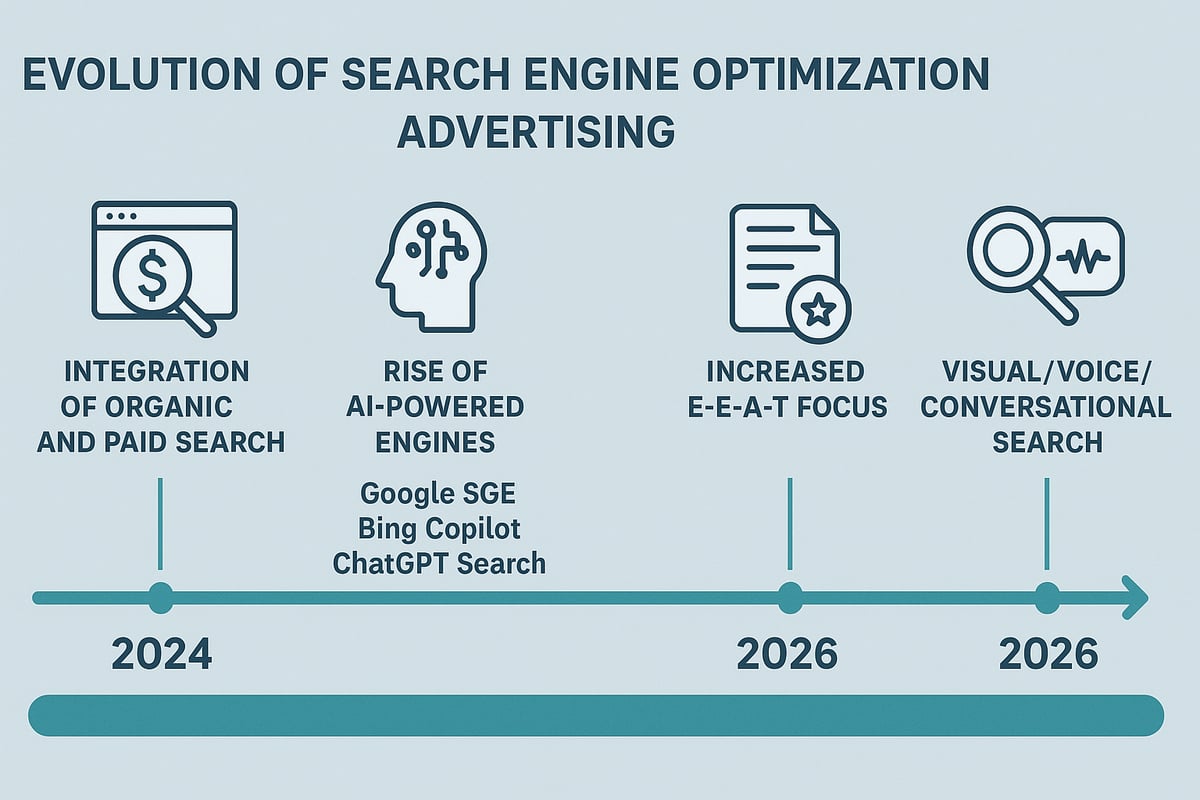
The world of search engine optimization advertising has shifted dramatically from 2024 to 2026. What once worked reliably is now only a piece of a much larger, more complex puzzle. Businesses face a landscape where standing still means falling behind, as new technologies and user behaviours redefine what it means to be visible online.
Blending Organic and Paid Search for Holistic Visibility
One of the biggest changes in search engine optimization advertising is the merging of organic and paid strategies. No longer are SEO and PPC run in silos. Instead, brands now blend keyword targeting, creative messaging, and reporting to ensure their presence across every relevant search result. This holistic approach means campaigns are more resilient to algorithm updates and can capture users at every stage of their journey.
- Unified keyword research for organic and paid campaigns.
- Shared reporting dashboards for clear ROI analysis.
- Consistent branding and messaging across both channels.
A joined-up strategy maximises reach and builds trust, making it essential in 2026's hyper-competitive space.
AI-Powered Search and the Privacy Revolution
AI has become the backbone of modern search engine optimization advertising. Search engines like Google SGE, Bing Copilot, and ChatGPT Search now use advanced machine learning to deliver more personalised, intent-driven results. Advertisers must adapt by leveraging AI-powered tools for real-time keyword optimisation, creative testing, and audience targeting. For a deeper dive into how AI is reshaping SEO, see AI-Powered SEO Strategies.
At the same time, privacy changes have forced a rethink of data strategies. The deprecation of third-party cookies means first-party data is now king. Brands are investing in email lists, loyalty schemes, and CRM systems to build direct relationships and power personalised advertising.
The Rise of E-E-A-T and New Search Experiences
Google and other engines have doubled down on E-E-A-T: Experience, Expertise, Authoritativeness, and Trustworthiness. In search engine optimization advertising, this means ad content and landing pages must demonstrate genuine value and credibility. It's not enough to simply bid on keywords; brands must show why they deserve a user's attention.
The search landscape has also expanded beyond text. Voice, visual, and conversational search are now core elements of advertising campaigns. Optimising for spoken queries, image search, and AI chat responses is critical for staying ahead in 2026.
Leading Brands Adapt: Real-World Examples and Key Stats
Brands like Adidas and John Lewis have set the standard by adopting hybrid SEO/PPC approaches. Adidas uses unified campaigns to dominate brand and product terms, while John Lewis leverages organic content to feed high-intent audiences into paid remarketing funnels.
A recent Statista study found that 70% of marketers in 2025 allocate budgets to both SEO and paid search. This reflects a shift towards integrated strategies that drive both visibility and conversions.
| Year | % of Marketers Using Both SEO & Paid |
|---|---|
| 2024 | 54% |
| 2025 | 70% |
Search engine optimization advertising in 2026 is about agility, smart integration, and embracing AI-driven change. The brands that lead are those who innovate, adapt, and never rely on yesterday’s tactics.
Key SEO Advertising Trends Shaping 2026
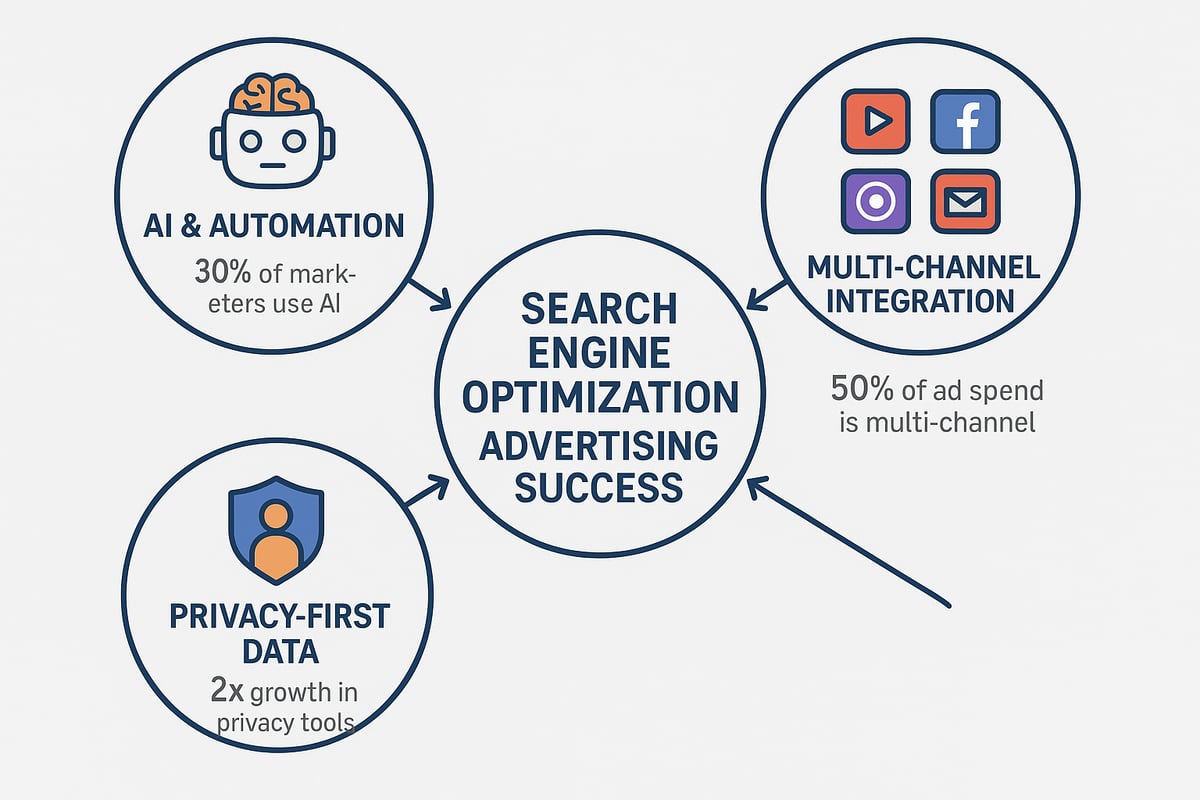
Staying ahead in search engine optimization advertising means understanding what’s driving change. The landscape in 2026 looks nothing like it did just a few years ago. AI, multi-channel integration and privacy-first strategies are not just buzzwords—they’re defining how brands win attention and conversions.
Let’s break down the three biggest trends every marketer should have on their radar.
AI and Automation in SEO Advertising
AI is the engine powering the next wave of search engine optimization advertising. Machine learning now drives real-time keyword and bid optimisation, making campaigns more responsive than ever. Predictive analytics help marketers anticipate shifts in demand and audience behaviours, so you’re always one step ahead.
AI isn’t just optimising bids. It’s generating ad copy, running creative tests, and recommending budget allocations. For example, Google Performance Max campaigns use AI to allocate spend dynamically across channels, squeezing more value from every pound.
According to SEMrush, 65% of top-performing advertisers are now using AI-driven tools. This means if you’re not leveraging AI in your search engine optimization advertising, you’re already behind. Want to see where this is all heading? Explore AI-Driven SEO Trends for 2026 for a deeper dive into programmatic SEO, voice and visual search convergence, and more.
The bottom line: AI is making advertising smarter, faster, and more effective, freeing you to focus on strategy while the algorithms do the heavy lifting.
Multi-Channel Search Integration
Today’s search engine optimization advertising is no longer about picking Google or Bing. It’s about building unified strategies across Google, Bing, Amazon, YouTube, TikTok, and Instagram. Consistent messaging and branding are essential, as customers move seamlessly between platforms before making a decision.
Data sharing between platforms is now standard practice. By integrating insights from multiple sources, you can track the customer journey and attribute conversions more accurately. Direct-to-consumer brands are leading the way, using Google Ads for high-intent searches and TikTok SEO for full-funnel engagement.
Did you know that 55% of consumers use multiple platforms before converting? That stat from Think with Google reinforces why multi-channel isn’t optional—it’s necessary for effective search engine optimization advertising in 2026.
Key takeaways:
- Prioritise consistent creative and messaging
- Leverage cross-channel data for smarter targeting
- Use retargeting to keep your brand top of mind across every touchpoint
The Shift to First-Party Data and Privacy-First Advertising
Privacy changes are shaking up search engine optimization advertising. With cookies on the way out, brands are shifting to first-party data—think email lists, loyalty programmes, and CRM integration. Building trust and getting explicit consent is now central to remarketing and segmentation.
Retailers are leading the charge, using loyalty apps to drive personalised search ad experiences. Consent-based remarketing means you’re targeting people who actually want to hear from you, which boosts relevance and campaign performance.
HubSpot reports that 80% of marketers have seen improved campaign results by focusing on first-party data. For search engine optimization advertising, this means stronger relationships, better targeting, and higher ROI.
What should you do next? Start building your own data assets, invest in CRM, and make privacy a selling point—not a hurdle. The brands that adapt fastest will win the attention and trust of tomorrow’s customers.
Building a High-Impact SEO Advertising Strategy for 2026
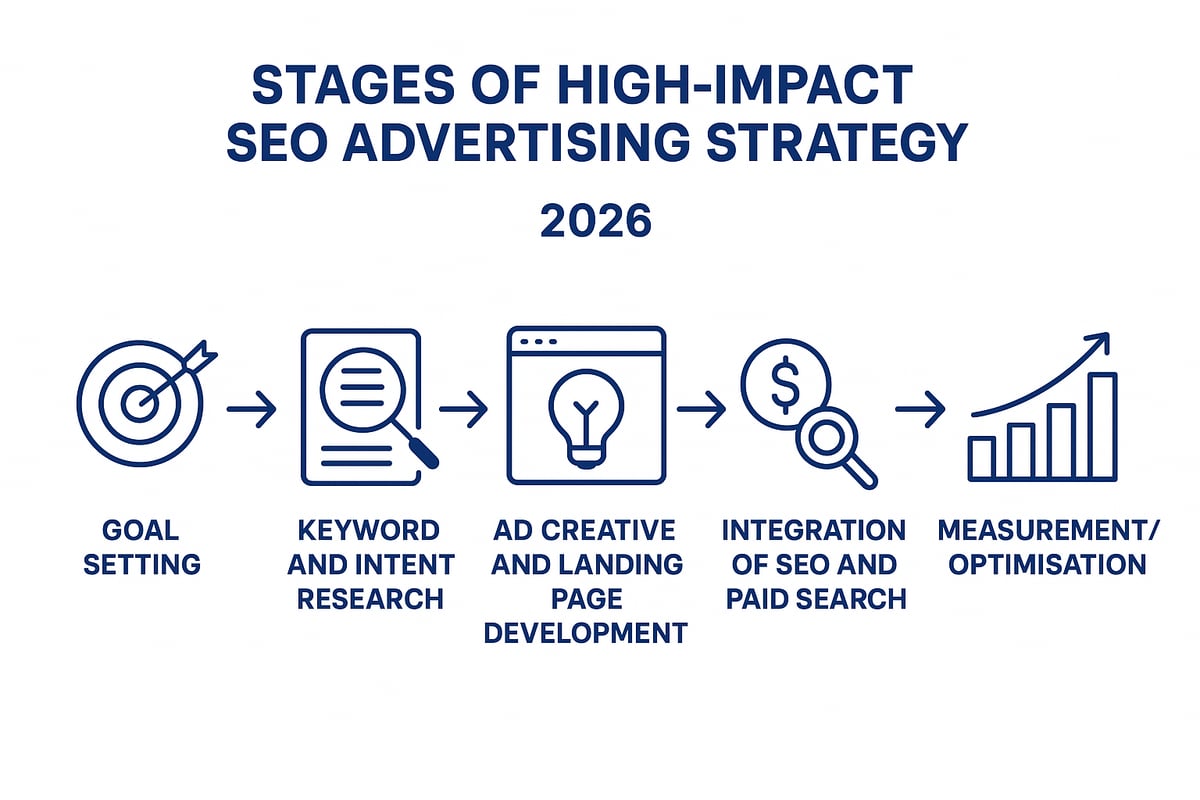
To succeed with search engine optimization advertising in 2026, you need more than just a scattergun approach. The key is a unified, data-driven strategy that aligns your goals, keywords, creative, and tracking. Let’s break down how to build a campaign that gets results, step by step.
Setting Objectives and KPIs
Start by defining what you want to achieve with search engine optimization advertising. Clear objectives set the tone for your entire campaign.
Are you aiming for more leads, sales, or simply greater brand visibility? Set measurable KPIs, such as return on ad spend (ROAS), cost per acquisition (CPA), and organic visibility share. Align SEO and paid advertising goals so you can report on unified outcomes, not just isolated metrics.
Example KPI Table:
| Goal | KPI Example |
|---|---|
| Increase sales | ROAS, CPA |
| Boost organic traffic | Organic visibility |
| Improve brand awareness | Impressions, reach |
With a clear north star, your search engine optimization advertising activity will always be purposeful and measurable.
Advanced Keyword and Intent Research
Keyword research has moved beyond simple volume metrics. In 2026, you need to understand not just what people search, but why they search.
Leverage AI-powered tools to spot emerging keyword trends. Predictive analytics help you anticipate what your audience will look for next. Analyse search intent—are users looking for information, ready to buy, or comparing options? Tools like SEMrush and Ahrefs let you map intent, spot competitor gaps, and identify new opportunities for search engine optimization advertising.
- Use AI for predictive keyword discovery
- Map content to user intent: informational, transactional, navigational
- Identify competitor gaps and untapped opportunities
By focusing on intent, your search engine optimization advertising will connect with users at every stage of their journey.
Crafting Compelling Ad Creative and Landing Pages
Your ad creative and landing pages should speak to both humans and AI-powered search engines.
Write dynamic ad copy tailored to each user segment and intent. Use AI tools to A/B test headlines and calls to action, optimising for clicks and conversions. Make sure your landing pages are fast, mobile-friendly, and built for conversion rate optimisation.
Best practices include:
- Personalised messaging for each audience segment
- Clear, concise headlines and strong CTAs
- User-friendly layouts and fast load times
For ecommerce brands, test different headlines and CTAs to see what resonates. A/B testing is your friend in search engine optimization advertising.
Integrating SEO and Paid Search for Maximum Impact
Gone are the days of running SEO and paid search in silos. Now, the best results come from merging strategies for holistic coverage.
Coordinate organic and paid keyword targeting to avoid overlap and maximise reach. Use paid ads to accelerate the performance of new organic content—think of it as giving your best blog posts a boost. Retarget organic visitors with personalised ad content to keep your brand top of mind.
Integration Tactics:
- Share keyword data between SEO and PPC teams
- Use paid ads to promote high-performing organic content
- Set up retargeting for users who engaged with organic pages
Financial services brands often capture high-funnel interest with SEO, then nurture leads with Google Ads. This joined-up approach to search engine optimization advertising delivers both short-term wins and long-term growth.
Measurement, Attribution, and Continuous Optimisation
Measurement is where many campaigns fall down. Set up end-to-end tracking using GA4, CRM, and call tracking to capture the full impact of your search engine optimization advertising.
Adopt multi-touch attribution models to see how each channel contributes to conversions. Continuous testing—of creative, bids, and audiences—keeps your strategy sharp. For a deeper dive, check out Marketing Attribution Best Practices to ensure your measurement is driving real ROI.
Hospitality brands, for example, use call tracking to link SEO and ads with bookings. Optimise continuously to adapt to changing trends and keep results climbing.
AI-Powered Tools and Platforms for SEO Advertising Success
AI is now the engine room powering modern search engine optimization advertising. The tools available in 2026 are smarter, faster, and more accessible, giving businesses of all sizes an edge. If you are not using AI to supercharge your advertising, you are missing out on opportunities your competitors are already seizing.
AI Tools Transforming Search Engine Optimization Advertising
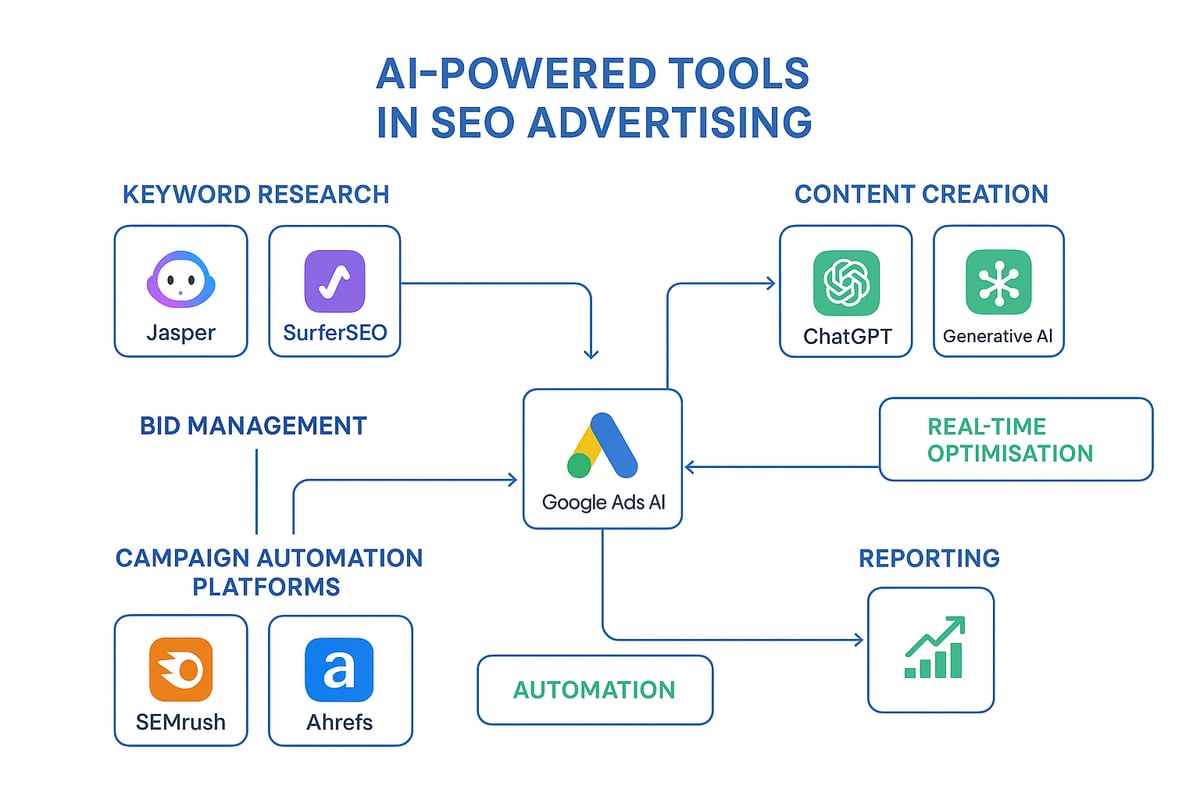
The landscape of search engine optimization advertising has shifted dramatically, thanks to AI-driven platforms. Tools like Jasper and SurferSEO now handle keyword research and content recommendations in seconds, giving you data-backed ideas that would take a human hours to uncover. Google Ads AI automates bid adjustments in real time, ensuring your spend is always optimised for the best results.
These solutions are not just about speed. They use predictive analytics, analysing trends and intent signals to help you capture high-converting audiences before your competitors do. If you want to understand how AI is reshaping everything from keyword targeting to voice and visual discovery, check out AI’s Impact on SEO Strategies for a deep dive into the latest trends.
Automation and Reporting Platforms: The Backbone of Campaigns
Managing search engine optimization advertising across multiple channels is complex. That is where platforms like SEMrush, Ahrefs, and HubSpot come in. These tools centralise campaign management, automate routine tasks, and provide actionable insights through detailed dashboards.
With integrated automation, you can schedule campaigns, analyse competitor moves, and track every click or conversion in one place. Multi-touch attribution models help you see the true ROI of each channel, so you know where your budget is working hardest. This level of control and visibility is essential for high-performing campaigns in 2026.
Generative AI for Content, Copy, and Schema
Generative AI has changed the way we create content for search engine optimization advertising. ChatGPT and similar tools can generate ad copy, FAQs, and even schema markup tailored to different audience segments. This allows for hyper-personalised messaging and better alignment with user intent.
Dynamic content creation means you can test dozens of headlines, calls to action, and product descriptions without breaking a sweat. AI-driven creative testing ensures only the best-performing assets go live, maximising conversion rates and boosting your campaign’s overall effectiveness.
Case Study: AI Scaling Product Ad Campaigns & Manual vs Automated
Consider an ecommerce brand that used AI tools to rapidly scale product ad campaigns. By integrating dynamic landing pages and automated bid management, they achieved faster time-to-market and reduced manual errors. Their team could focus on strategy and creative, while the AI handled optimisation around the clock.
Here is a quick comparison:
| Feature | Manual Management | AI-Automated Management |
|---|---|---|
| Speed | Slow | Instant |
| Accuracy | Human error | Data-driven precision |
| Scalability | Limited | High |
| Creative Testing | Time-consuming | Automated |
| ROI Tracking | Basic | Advanced |
A recent survey found 75 percent of marketers expect AI to manage the majority of campaign optimisation by 2026, showing just how widespread this approach has become.
Selecting the Right AI Tools for Your Workflow
Not every AI tool suits every business. When choosing platforms for search engine optimization advertising, consider integration options, learning curve, and cost. Look for tools with strong support, regular updates, and proven track records in your industry.
Start with a pilot project before rolling out AI across your entire workflow. Track results, gather feedback from your team, and refine your processes as you go. Staying agile and open to new tech will help you outpace the competition and future-proof your campaigns.
Step-by-Step Guide: Launching a 2026-Ready SEO Advertising Campaign
Launching a search engine optimization advertising campaign in 2026 demands a blend of technical knowhow and creative strategy. Let’s break down the step-by-step process, so you can build campaigns that not only reach but convert your audience in an AI-first world.
Step 1: Audit and Benchmark Your Current Performance
Start by analysing where you stand. Review your organic and paid visibility using tools like GA4 and SEMrush. Check for technical SEO issues, broken links, or underperforming ad campaigns. Create a table to summarise your findings and highlight opportunities:
| Area | Current Status | Opportunity |
|---|---|---|
| Organic Traffic | 10,000/month | Improve keywords |
| Paid Traffic | 5,000/month | Lower CPC |
| Technical SEO | 5 errors | Fix for crawlability |
Benchmarking is a must before launching any search engine optimization advertising strategy. It gives you a clear baseline for measuring progress.
Step 2: Define Audience Personas and Search Intent
Next, build detailed audience personas by mining your CRM and analytics data. Who are your best customers? What are their pain points, and what triggers their buying decisions?
Map out their customer journeys. For example, an ecommerce brand might find that “gift buyers” search for inspiration, while “deal hunters” look for discounts. Understanding intent lets you tailor your search engine optimization advertising to meet users at every stage.
- Use persona templates for clarity
- Identify intent: informational, transactional, navigational
- Document in a shared workspace for your team
Step 3: Develop Unified Keyword and Content Strategy
Merge your SEO and PPC keyword research. Use AI-driven tools to spot high-intent, long-tail opportunities that match what your audience is really searching for.
Plan content clusters and ad groups together. This unified approach ensures your search engine optimization advertising covers all touchpoints, from organic listings to paid ads.
- Prioritise keywords by intent and value
- Map content to each keyword group
- Track competitors’ gaps for fresh ideas
Keep your keyword list flexible, adapting as search trends shift.
Step 4: Create and Optimise Ads & Landing Pages
Now, craft ad copy and landing pages that speak directly to each audience segment. Write for both humans and AI-powered search engines, using dynamic elements like personalisation and real-time offers.
A/B test headlines, images, and calls-to-action to see what resonates. For practical advice on boosting conversions, check out Conversion Rate Optimisation Insights.
- Implement schema markup for richer results
- Ensure fast load times and mobile responsiveness
- Use clear, benefit-led messaging
The goal? Every click from your search engine optimization advertising should land on a page built to convert.
Step 5: Launch, Track, and Optimise
Set up robust conversion tracking using GA4, CRM, and call tracking. Launch your campaigns, then monitor performance in real time.
Review cost per acquisition, ROAS, and engagement metrics. Adjust bids, budgets, and creative based on what the data tells you.
- Use dashboards for at-a-glance reporting
- Test new ad variations regularly
- Refine targeting as you learn
Continuous optimisation is the heartbeat of search engine optimization advertising success.
Step 6: Scale with Automation and AI
Once you’ve got a winning formula, scale up using AI-driven tools. Automate bid management, creative testing, and reporting to free up time and boost efficiency.
Expand to new channels and audiences as results grow. To understand how AI is shaping the future of search engine optimization advertising, see AI’s Role in SEO Evolution.
- Set up rules for automated budget allocation
- Let AI surface new keyword or audience opportunities
- Monitor for performance dips and act fast
Scaling smartly ensures your campaigns stay ahead as the landscape evolves.
Measuring ROI and Future-Proofing Your SEO Advertising
Measuring the ROI of your search engine optimization advertising is crucial for understanding what actually drives results. Start by tracking both direct conversions, such as sales or leads from a single click, and assisted conversions, where multiple touchpoints contribute to the final outcome. Without both, you risk missing out on the true value of your campaigns.
| Metric | Direct Conversion | Assisted Conversion |
|---|---|---|
| Definition | Immediate action after ad click | Influenced by multiple interactions |
| Example | User clicks ad and buys | User clicks ad, returns via organic, then buys |
Understanding the full-funnel impact of your search engine optimization advertising requires robust attribution. Multi-touch models reveal how various channels—organic, paid, and social—work together. For those looking to dig deeper, Effective Google Ads Techniques explains how to use Google Ads data for more accurate attribution and smarter budget allocation.
Looking ahead, the landscape of search engine optimization advertising is shifting rapidly due to AI-powered search, voice assistants, and visual discovery tools. Brands that adapt quickly are already gaining an edge. If you want a deeper dive into how AI is changing the rules, check out AI’s Transformation of SEO Practices for insights on semantic search and topical authority.
A future-proof search engine optimization advertising strategy is all about agility and resilience. Diversify your channels, test new formats, and never rely on a single traffic source. For example, many DTC brands now blend AI-driven SEO with privacy-first paid campaigns, ensuring they can pivot as algorithms and user behaviour change.
To stay ahead in 2026, keep learning and experimenting. Here are a few practical tips for keeping your search engine optimization advertising strategy sharp:
- Set up regular campaign reviews and A/B tests
- Join industry webinars and local marketing groups
- Invest in new tools and automation
- Track industry trends and competitor moves
Remember, 68% of marketers say adaptability is the top skill for SEO advertising success in 2026. Make sure your approach is ready for whatever comes next.
If you’re serious about making your SEO advertising work for you in 2026, it’s time to get practical. We’ve covered the strategies, trends and AI tools that’ll drive real results—not just clicks, but leads and sales. If you want to see how this all fits your business or need help cutting through the noise, I’m here to chat. Let’s look at your website, campaigns, and goals together, and I’ll give you honest, actionable advice—no fluff, just what’ll actually move the needle.
Get free 45 min consultation
Let’s make your marketing work smarter, not harder.
In 2026, the digital landscape is more competitive than ever. Every business is fighting for attention, and standing out means you need to master search engine optimization advertising.
This guide is your playbook for the latest strategies. We’ll show you how to boost visibility, drive targeted traffic, and maximise ROI in an AI-driven world.
Ready to adapt and win? We’ll unpack the evolution of search engine optimization advertising, reveal essential trends, and give you step-by-step tactics to build campaigns that convert. Let’s get started.
The Evolution of SEO Advertising: 2024–2026
The world of search engine optimization advertising has shifted dramatically from 2024 to 2026. What once worked reliably is now only a piece of a much larger, more complex puzzle. Businesses face a landscape where standing still means falling behind, as new technologies and user behaviours redefine what it means to be visible online.
Blending Organic and Paid Search for Holistic Visibility
One of the biggest changes in search engine optimization advertising is the merging of organic and paid strategies. No longer are SEO and PPC run in silos. Instead, brands now blend keyword targeting, creative messaging, and reporting to ensure their presence across every relevant search result. This holistic approach means campaigns are more resilient to algorithm updates and can capture users at every stage of their journey.
- Unified keyword research for organic and paid campaigns.
- Shared reporting dashboards for clear ROI analysis.
- Consistent branding and messaging across both channels.
A joined-up strategy maximises reach and builds trust, making it essential in 2026's hyper-competitive space.
AI-Powered Search and the Privacy Revolution
AI has become the backbone of modern search engine optimization advertising. Search engines like Google SGE, Bing Copilot, and ChatGPT Search now use advanced machine learning to deliver more personalised, intent-driven results. Advertisers must adapt by leveraging AI-powered tools for real-time keyword optimisation, creative testing, and audience targeting. For a deeper dive into how AI is reshaping SEO, see AI-Powered SEO Strategies.
At the same time, privacy changes have forced a rethink of data strategies. The deprecation of third-party cookies means first-party data is now king. Brands are investing in email lists, loyalty schemes, and CRM systems to build direct relationships and power personalised advertising.
The Rise of E-E-A-T and New Search Experiences
Google and other engines have doubled down on E-E-A-T: Experience, Expertise, Authoritativeness, and Trustworthiness. In search engine optimization advertising, this means ad content and landing pages must demonstrate genuine value and credibility. It's not enough to simply bid on keywords; brands must show why they deserve a user's attention.
The search landscape has also expanded beyond text. Voice, visual, and conversational search are now core elements of advertising campaigns. Optimising for spoken queries, image search, and AI chat responses is critical for staying ahead in 2026.
Leading Brands Adapt: Real-World Examples and Key Stats
Brands like Adidas and John Lewis have set the standard by adopting hybrid SEO/PPC approaches. Adidas uses unified campaigns to dominate brand and product terms, while John Lewis leverages organic content to feed high-intent audiences into paid remarketing funnels.
A recent Statista study found that 70% of marketers in 2025 allocate budgets to both SEO and paid search. This reflects a shift towards integrated strategies that drive both visibility and conversions.
| Year | % of Marketers Using Both SEO & Paid |
|---|---|
| 2024 | 54% |
| 2025 | 70% |
Search engine optimization advertising in 2026 is about agility, smart integration, and embracing AI-driven change. The brands that lead are those who innovate, adapt, and never rely on yesterday’s tactics.
Key SEO Advertising Trends Shaping 2026
Staying ahead in search engine optimization advertising means understanding what’s driving change. The landscape in 2026 looks nothing like it did just a few years ago. AI, multi-channel integration and privacy-first strategies are not just buzzwords—they’re defining how brands win attention and conversions.
Let’s break down the three biggest trends every marketer should have on their radar.
AI and Automation in SEO Advertising
AI is the engine powering the next wave of search engine optimization advertising. Machine learning now drives real-time keyword and bid optimisation, making campaigns more responsive than ever. Predictive analytics help marketers anticipate shifts in demand and audience behaviours, so you’re always one step ahead.
AI isn’t just optimising bids. It’s generating ad copy, running creative tests, and recommending budget allocations. For example, Google Performance Max campaigns use AI to allocate spend dynamically across channels, squeezing more value from every pound.
According to SEMrush, 65% of top-performing advertisers are now using AI-driven tools. This means if you’re not leveraging AI in your search engine optimization advertising, you’re already behind. Want to see where this is all heading? Explore AI-Driven SEO Trends for 2026 for a deeper dive into programmatic SEO, voice and visual search convergence, and more.
The bottom line: AI is making advertising smarter, faster, and more effective, freeing you to focus on strategy while the algorithms do the heavy lifting.
Multi-Channel Search Integration
Today’s search engine optimization advertising is no longer about picking Google or Bing. It’s about building unified strategies across Google, Bing, Amazon, YouTube, TikTok, and Instagram. Consistent messaging and branding are essential, as customers move seamlessly between platforms before making a decision.
Data sharing between platforms is now standard practice. By integrating insights from multiple sources, you can track the customer journey and attribute conversions more accurately. Direct-to-consumer brands are leading the way, using Google Ads for high-intent searches and TikTok SEO for full-funnel engagement.
Did you know that 55% of consumers use multiple platforms before converting? That stat from Think with Google reinforces why multi-channel isn’t optional—it’s necessary for effective search engine optimization advertising in 2026.
Key takeaways:
- Prioritise consistent creative and messaging
- Leverage cross-channel data for smarter targeting
- Use retargeting to keep your brand top of mind across every touchpoint
The Shift to First-Party Data and Privacy-First Advertising
Privacy changes are shaking up search engine optimization advertising. With cookies on the way out, brands are shifting to first-party data—think email lists, loyalty programmes, and CRM integration. Building trust and getting explicit consent is now central to remarketing and segmentation.
Retailers are leading the charge, using loyalty apps to drive personalised search ad experiences. Consent-based remarketing means you’re targeting people who actually want to hear from you, which boosts relevance and campaign performance.
HubSpot reports that 80% of marketers have seen improved campaign results by focusing on first-party data. For search engine optimization advertising, this means stronger relationships, better targeting, and higher ROI.
What should you do next? Start building your own data assets, invest in CRM, and make privacy a selling point—not a hurdle. The brands that adapt fastest will win the attention and trust of tomorrow’s customers.
Building a High-Impact SEO Advertising Strategy for 2026
To succeed with search engine optimization advertising in 2026, you need more than just a scattergun approach. The key is a unified, data-driven strategy that aligns your goals, keywords, creative, and tracking. Let’s break down how to build a campaign that gets results, step by step.
Setting Objectives and KPIs
Start by defining what you want to achieve with search engine optimization advertising. Clear objectives set the tone for your entire campaign.
Are you aiming for more leads, sales, or simply greater brand visibility? Set measurable KPIs, such as return on ad spend (ROAS), cost per acquisition (CPA), and organic visibility share. Align SEO and paid advertising goals so you can report on unified outcomes, not just isolated metrics.
Example KPI Table:
| Goal | KPI Example |
|---|---|
| Increase sales | ROAS, CPA |
| Boost organic traffic | Organic visibility |
| Improve brand awareness | Impressions, reach |
With a clear north star, your search engine optimization advertising activity will always be purposeful and measurable.
Advanced Keyword and Intent Research
Keyword research has moved beyond simple volume metrics. In 2026, you need to understand not just what people search, but why they search.
Leverage AI-powered tools to spot emerging keyword trends. Predictive analytics help you anticipate what your audience will look for next. Analyse search intent—are users looking for information, ready to buy, or comparing options? Tools like SEMrush and Ahrefs let you map intent, spot competitor gaps, and identify new opportunities for search engine optimization advertising.
- Use AI for predictive keyword discovery
- Map content to user intent: informational, transactional, navigational
- Identify competitor gaps and untapped opportunities
By focusing on intent, your search engine optimization advertising will connect with users at every stage of their journey.
Crafting Compelling Ad Creative and Landing Pages
Your ad creative and landing pages should speak to both humans and AI-powered search engines.
Write dynamic ad copy tailored to each user segment and intent. Use AI tools to A/B test headlines and calls to action, optimising for clicks and conversions. Make sure your landing pages are fast, mobile-friendly, and built for conversion rate optimisation.
Best practices include:
- Personalised messaging for each audience segment
- Clear, concise headlines and strong CTAs
- User-friendly layouts and fast load times
For ecommerce brands, test different headlines and CTAs to see what resonates. A/B testing is your friend in search engine optimization advertising.
Integrating SEO and Paid Search for Maximum Impact
Gone are the days of running SEO and paid search in silos. Now, the best results come from merging strategies for holistic coverage.
Coordinate organic and paid keyword targeting to avoid overlap and maximise reach. Use paid ads to accelerate the performance of new organic content—think of it as giving your best blog posts a boost. Retarget organic visitors with personalised ad content to keep your brand top of mind.
Integration Tactics:
- Share keyword data between SEO and PPC teams
- Use paid ads to promote high-performing organic content
- Set up retargeting for users who engaged with organic pages
Financial services brands often capture high-funnel interest with SEO, then nurture leads with Google Ads. This joined-up approach to search engine optimization advertising delivers both short-term wins and long-term growth.
Measurement, Attribution, and Continuous Optimisation
Measurement is where many campaigns fall down. Set up end-to-end tracking using GA4, CRM, and call tracking to capture the full impact of your search engine optimization advertising.
Adopt multi-touch attribution models to see how each channel contributes to conversions. Continuous testing—of creative, bids, and audiences—keeps your strategy sharp. For a deeper dive, check out Marketing Attribution Best Practices to ensure your measurement is driving real ROI.
Hospitality brands, for example, use call tracking to link SEO and ads with bookings. Optimise continuously to adapt to changing trends and keep results climbing.
AI-Powered Tools and Platforms for SEO Advertising Success
AI is now the engine room powering modern search engine optimization advertising. The tools available in 2026 are smarter, faster, and more accessible, giving businesses of all sizes an edge. If you are not using AI to supercharge your advertising, you are missing out on opportunities your competitors are already seizing.
AI Tools Transforming Search Engine Optimization Advertising
The landscape of search engine optimization advertising has shifted dramatically, thanks to AI-driven platforms. Tools like Jasper and SurferSEO now handle keyword research and content recommendations in seconds, giving you data-backed ideas that would take a human hours to uncover. Google Ads AI automates bid adjustments in real time, ensuring your spend is always optimised for the best results.
These solutions are not just about speed. They use predictive analytics, analysing trends and intent signals to help you capture high-converting audiences before your competitors do. If you want to understand how AI is reshaping everything from keyword targeting to voice and visual discovery, check out AI’s Impact on SEO Strategies for a deep dive into the latest trends.
Automation and Reporting Platforms: The Backbone of Campaigns
Managing search engine optimization advertising across multiple channels is complex. That is where platforms like SEMrush, Ahrefs, and HubSpot come in. These tools centralise campaign management, automate routine tasks, and provide actionable insights through detailed dashboards.
With integrated automation, you can schedule campaigns, analyse competitor moves, and track every click or conversion in one place. Multi-touch attribution models help you see the true ROI of each channel, so you know where your budget is working hardest. This level of control and visibility is essential for high-performing campaigns in 2026.
Generative AI for Content, Copy, and Schema
Generative AI has changed the way we create content for search engine optimization advertising. ChatGPT and similar tools can generate ad copy, FAQs, and even schema markup tailored to different audience segments. This allows for hyper-personalised messaging and better alignment with user intent.
Dynamic content creation means you can test dozens of headlines, calls to action, and product descriptions without breaking a sweat. AI-driven creative testing ensures only the best-performing assets go live, maximising conversion rates and boosting your campaign’s overall effectiveness.
Case Study: AI Scaling Product Ad Campaigns & Manual vs Automated
Consider an ecommerce brand that used AI tools to rapidly scale product ad campaigns. By integrating dynamic landing pages and automated bid management, they achieved faster time-to-market and reduced manual errors. Their team could focus on strategy and creative, while the AI handled optimisation around the clock.
Here is a quick comparison:
| Feature | Manual Management | AI-Automated Management |
|---|---|---|
| Speed | Slow | Instant |
| Accuracy | Human error | Data-driven precision |
| Scalability | Limited | High |
| Creative Testing | Time-consuming | Automated |
| ROI Tracking | Basic | Advanced |
A recent survey found 75 percent of marketers expect AI to manage the majority of campaign optimisation by 2026, showing just how widespread this approach has become.
Selecting the Right AI Tools for Your Workflow
Not every AI tool suits every business. When choosing platforms for search engine optimization advertising, consider integration options, learning curve, and cost. Look for tools with strong support, regular updates, and proven track records in your industry.
Start with a pilot project before rolling out AI across your entire workflow. Track results, gather feedback from your team, and refine your processes as you go. Staying agile and open to new tech will help you outpace the competition and future-proof your campaigns.
Step-by-Step Guide: Launching a 2026-Ready SEO Advertising Campaign
Launching a search engine optimization advertising campaign in 2026 demands a blend of technical knowhow and creative strategy. Let’s break down the step-by-step process, so you can build campaigns that not only reach but convert your audience in an AI-first world.
Step 1: Audit and Benchmark Your Current Performance
Start by analysing where you stand. Review your organic and paid visibility using tools like GA4 and SEMrush. Check for technical SEO issues, broken links, or underperforming ad campaigns. Create a table to summarise your findings and highlight opportunities:
| Area | Current Status | Opportunity |
|---|---|---|
| Organic Traffic | 10,000/month | Improve keywords |
| Paid Traffic | 5,000/month | Lower CPC |
| Technical SEO | 5 errors | Fix for crawlability |
Benchmarking is a must before launching any search engine optimization advertising strategy. It gives you a clear baseline for measuring progress.
Step 2: Define Audience Personas and Search Intent
Next, build detailed audience personas by mining your CRM and analytics data. Who are your best customers? What are their pain points, and what triggers their buying decisions?
Map out their customer journeys. For example, an ecommerce brand might find that “gift buyers” search for inspiration, while “deal hunters” look for discounts. Understanding intent lets you tailor your search engine optimization advertising to meet users at every stage.
- Use persona templates for clarity
- Identify intent: informational, transactional, navigational
- Document in a shared workspace for your team
Step 3: Develop Unified Keyword and Content Strategy
Merge your SEO and PPC keyword research. Use AI-driven tools to spot high-intent, long-tail opportunities that match what your audience is really searching for.
Plan content clusters and ad groups together. This unified approach ensures your search engine optimization advertising covers all touchpoints, from organic listings to paid ads.
- Prioritise keywords by intent and value
- Map content to each keyword group
- Track competitors’ gaps for fresh ideas
Keep your keyword list flexible, adapting as search trends shift.
Step 4: Create and Optimise Ads & Landing Pages
Now, craft ad copy and landing pages that speak directly to each audience segment. Write for both humans and AI-powered search engines, using dynamic elements like personalisation and real-time offers.
A/B test headlines, images, and calls-to-action to see what resonates. For practical advice on boosting conversions, check out Conversion Rate Optimisation Insights.
- Implement schema markup for richer results
- Ensure fast load times and mobile responsiveness
- Use clear, benefit-led messaging
The goal? Every click from your search engine optimization advertising should land on a page built to convert.
Step 5: Launch, Track, and Optimise
Set up robust conversion tracking using GA4, CRM, and call tracking. Launch your campaigns, then monitor performance in real time.
Review cost per acquisition, ROAS, and engagement metrics. Adjust bids, budgets, and creative based on what the data tells you.
- Use dashboards for at-a-glance reporting
- Test new ad variations regularly
- Refine targeting as you learn
Continuous optimisation is the heartbeat of search engine optimization advertising success.
Step 6: Scale with Automation and AI
Once you’ve got a winning formula, scale up using AI-driven tools. Automate bid management, creative testing, and reporting to free up time and boost efficiency.
Expand to new channels and audiences as results grow. To understand how AI is shaping the future of search engine optimization advertising, see AI’s Role in SEO Evolution.
- Set up rules for automated budget allocation
- Let AI surface new keyword or audience opportunities
- Monitor for performance dips and act fast
Scaling smartly ensures your campaigns stay ahead as the landscape evolves.
Measuring ROI and Future-Proofing Your SEO Advertising
Measuring the ROI of your search engine optimization advertising is crucial for understanding what actually drives results. Start by tracking both direct conversions, such as sales or leads from a single click, and assisted conversions, where multiple touchpoints contribute to the final outcome. Without both, you risk missing out on the true value of your campaigns.
| Metric | Direct Conversion | Assisted Conversion |
|---|---|---|
| Definition | Immediate action after ad click | Influenced by multiple interactions |
| Example | User clicks ad and buys | User clicks ad, returns via organic, then buys |
Understanding the full-funnel impact of your search engine optimization advertising requires robust attribution. Multi-touch models reveal how various channels—organic, paid, and social—work together. For those looking to dig deeper, Effective Google Ads Techniques explains how to use Google Ads data for more accurate attribution and smarter budget allocation.
Looking ahead, the landscape of search engine optimization advertising is shifting rapidly due to AI-powered search, voice assistants, and visual discovery tools. Brands that adapt quickly are already gaining an edge. If you want a deeper dive into how AI is changing the rules, check out AI’s Transformation of SEO Practices for insights on semantic search and topical authority.
A future-proof search engine optimization advertising strategy is all about agility and resilience. Diversify your channels, test new formats, and never rely on a single traffic source. For example, many DTC brands now blend AI-driven SEO with privacy-first paid campaigns, ensuring they can pivot as algorithms and user behaviour change.
To stay ahead in 2026, keep learning and experimenting. Here are a few practical tips for keeping your search engine optimization advertising strategy sharp:
- Set up regular campaign reviews and A/B tests
- Join industry webinars and local marketing groups
- Invest in new tools and automation
- Track industry trends and competitor moves
Remember, 68% of marketers say adaptability is the top skill for SEO advertising success in 2026. Make sure your approach is ready for whatever comes next.
If you’re serious about making your SEO advertising work for you in 2026, it’s time to get practical. We’ve covered the strategies, trends and AI tools that’ll drive real results—not just clicks, but leads and sales. If you want to see how this all fits your business or need help cutting through the noise, I’m here to chat. Let’s look at your website, campaigns, and goals together, and I’ll give you honest, actionable advice—no fluff, just what’ll actually move the needle.
Get free 45 min consultation
Let’s make your marketing work smarter, not harder.