


In 2026, the advertising agency web environment is more competitive than ever, with rapid changes making it tough to stand out. Agencies need sites that do more than just look good—they must drive real results.
This guide will show you the strategies every agency needs to succeed, from next-gen UX/UI and AI-driven personalisation to SEO for AI-powered search. We will also cover conversion rate optimisation, integrated analytics, and building on platforms that can handle whatever the future brings.
If you want your advertising agency web presence to stand out and perform, now is the time to act. Let’s dive in and future-proof your agency’s success.
The Evolution of Advertising Agency Websites in 2026
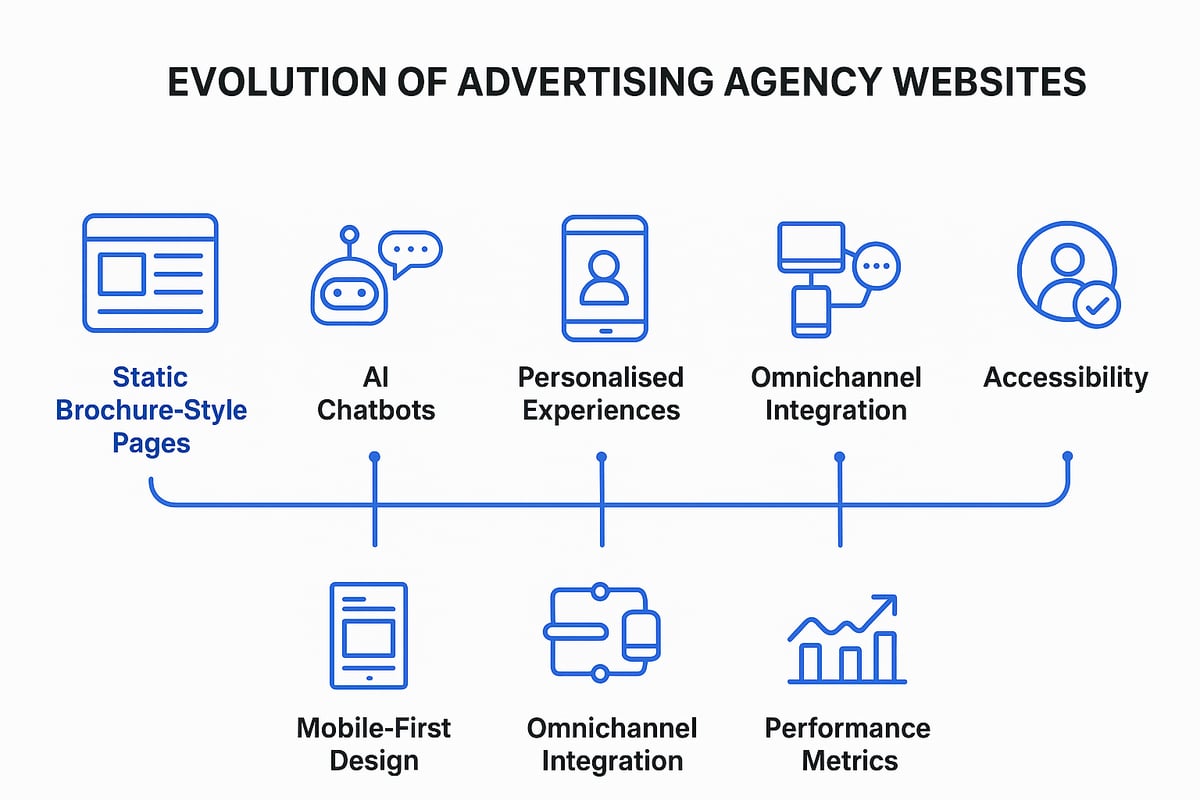
The advertising agency web landscape of 2026 is a far cry from what it was just a few years ago. Static sites that simply showcased credentials are rapidly vanishing, replaced by interactive hubs designed to win clients and drive real business outcomes.
The shift from brochure sites to conversion engines
Not long ago, the typical advertising agency web approach was to display a portfolio and list of services, hoping visitors would get in touch. Today, agencies are redesigning their websites as powerful conversion engines. Interactive features, smart lead capture forms, and live chat are now standard. In fact, agencies that have made this shift report up to 40% more leads after transforming their sites for conversion.
Key trends shaping agency websites
Modern advertising agency web platforms are embracing innovation at every turn. The integration of AI chatbots, personalised content, and marketing automation is now commonplace. Video, interactive content, and immersive storytelling are being used to keep visitors engaged and drive enquiry rates higher. According to HubSpot (2025), 68% of agencies now use AI-driven features. For a deep dive into these strategies, see the conversion-focused agency website strategies that are setting high-performing agencies apart.
The impact of mobile-first and omnichannel experiences
Mobile devices are the primary touchpoint for most users, so a mobile-first approach is now the baseline for any advertising agency web project. Progressive web apps and enhanced mobile UX offer agencies a competitive edge. Omnichannel integration is also key, allowing visitors to move seamlessly between the website, social channels, and messaging apps without any friction.
The rise of privacy and accessibility standards
Strict privacy regulations and accessibility standards are shaping every advertising agency web build. Compliance with WCAG 2.2, GDPR, and similar frameworks is not just a legal requirement but a business necessity. Agencies that ignore these standards risk fines and lost contracts, as clients increasingly demand inclusive digital experiences.
Competitive differentiation in a crowded market
Standing out in the crowded advertising agency web space requires more than just a slick design. Agencies are focusing on unique branding, niche specialisation, and value-driven messaging. Recent data shows that 54% of clients now choose agencies based on distinctive positioning, making this a key factor in winning new business.
The role of performance and speed
Site speed and technical performance have a direct impact on both user experience and conversion rates. Google’s Core Web Vitals are now a critical ranking factor. Agencies that focus on optimising load times and streamlining their advertising agency web presence have seen up to 20% more conversions, proving that technical excellence pays off.
Preparing for the next wave of technology
Looking ahead, the advertising agency web landscape is already experimenting with headless CMS, API integrations, and preparing for the integration of AR, VR, and voice search. Future-proofing is essential, ensuring that agency sites can evolve with new tech and client expectations.
User Experience (UX) and Conversion Rate Optimisation (CRO) Strategies
Creating an effective advertising agency web presence in 2026 is all about blending high-impact user experience with laser-focused conversion strategies. Agencies that get their UX and CRO right are not just showing off—they’re turning browsers into buyers, and visitors into loyal clients.
Principles of high-converting agency websites
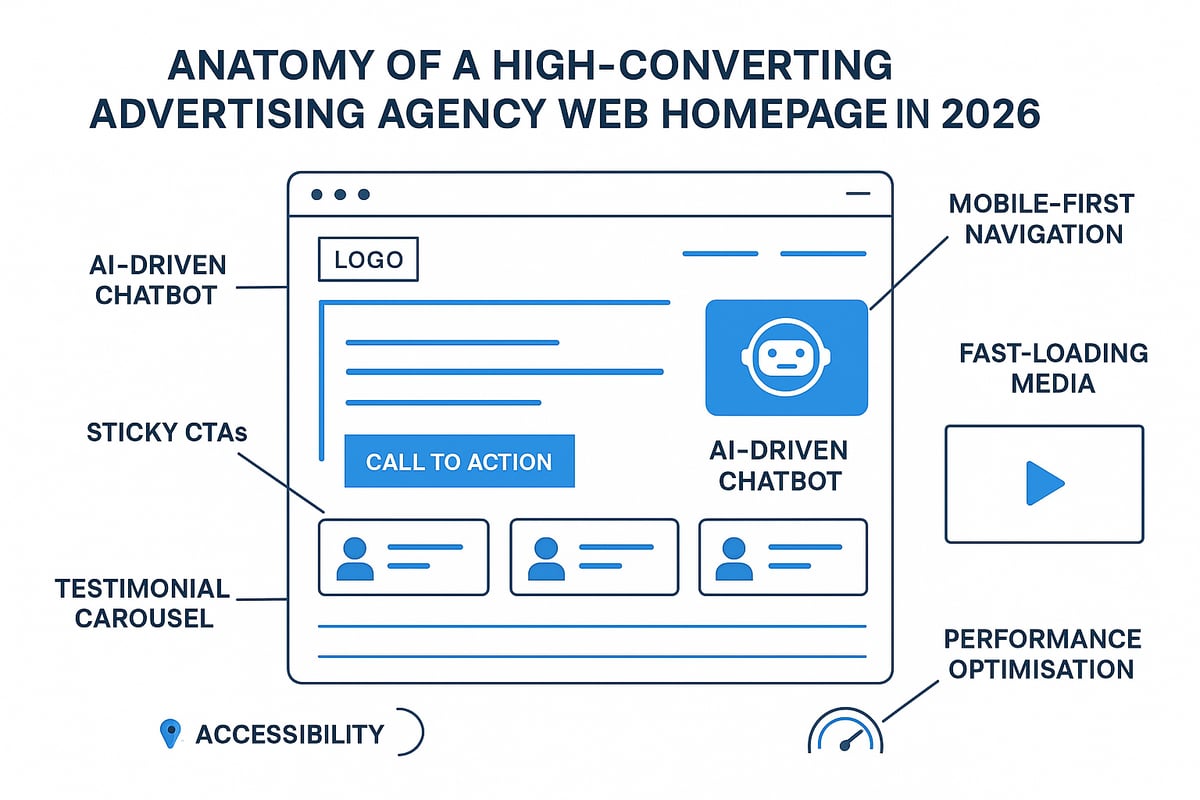
The foundation of a winning advertising agency web strategy is clarity. You need a value proposition that tells visitors who you are and why you matter—fast. Navigation should be intuitive, guiding users from landing to enquiry with zero confusion.
Effective CTAs must stand out and promise real value. Agencies that simplified their site structure saw a 35% jump in conversions. Here’s a quick checklist:
- Clear, benefit-led headlines
- Logical, minimal navigation menus
- CTAs above the fold and repeated naturally
A streamlined approach means more leads and less drop-off on your advertising agency web pages.
Personalisation and AI-driven UX
In 2026, personalisation is not a bonus—it’s the baseline for any advertising agency web that wants to stay ahead. AI-driven chatbots answer queries instantly, and content adapts in real time to visitor interests. According to Salesforce, 75% of users now expect immediate responses.
Agencies are leveraging AI web design for agencies to deliver dynamic experiences, tailoring every touchpoint. Imagine a homepage that shifts its case studies or services based on the user’s industry or previous visits—this is now achievable and expected.
AI handles FAQs, books meetings, and even surfaces the right testimonials, making your advertising agency web feel personal and efficient.
Streamlined user journeys and lead funnels
Mapping user intent is essential for any modern advertising agency web. Start with the landing page and plot every possible route to enquiry. Each step should remove friction, not add it.
Replace clunky forms with step-by-step journeys. For example:
Step 1: Select your service
Step 2: Enter your business size
Step 3: Provide contact info
This approach boosts completion rates and reduces overwhelm, turning more visitors on your advertising agency web into warm leads.
Social proof and trust-building elements
Trust is currency in the advertising agency web world. Prominently display testimonials, case studies, certifications, and awards. Data from LinkedIn shows 82% of B2B buyers trust agencies with strong case study sections.
Consider a table for maximum impact:
| Trust Element | Placement | Effect |
|---|---|---|
| Testimonials | Homepage, footer | Builds credibility |
| Case Studies | Dedicated page | Demonstrates expertise |
| Certifications | About/Sidebar | Shows professionalism |
| Awards | Hero banner | Highlights achievements |
Using these elements strategically across your advertising agency web increases buyer confidence fast.
Mobile-first and accessibility best practices
Every advertising agency web must be designed for mobile first. Touch-friendly layouts, large tap targets, and support for voice navigation set you apart. Accessibility isn’t optional—agencies with accessible sites see a 12% rise in inbound leads.
Use proper alt text, colour contrast, and keyboard navigation. Test your site with screen readers to ensure everyone can engage with your advertising agency web, regardless of ability.
Performance optimisation and technical excellence
Speed is a silent dealbreaker. A sluggish advertising agency web loses visitors before they see your story. Compress images, use lazy loading, and keep your codebase lean.
CDNs deliver content fast globally. Regularly audit your site speed using tools like Google PageSpeed Insights. Even small improvements can drive 20% more conversions for your advertising agency web.
A/B testing and data-driven improvements
Continuous improvement is key. Run A/B tests on headlines, CTAs, and page layouts. Agencies that test monthly consistently outperform peers in conversion rates.
Review analytics, spot drop-off points, and adjust. Make data-driven tweaks to your advertising agency web, and you’ll see compounding gains over time.
SEO and Generative Engine Optimisation (GEO) for Agency Websites
The world of advertising agency web strategy is changing fast. To stay ahead, agencies must master both classic SEO and the new wave of generative engine optimisation (GEO). Let's break down what matters most for 2026, and how you can future-proof your agency's online presence.
The evolution of search: AI-powered engines and voice search
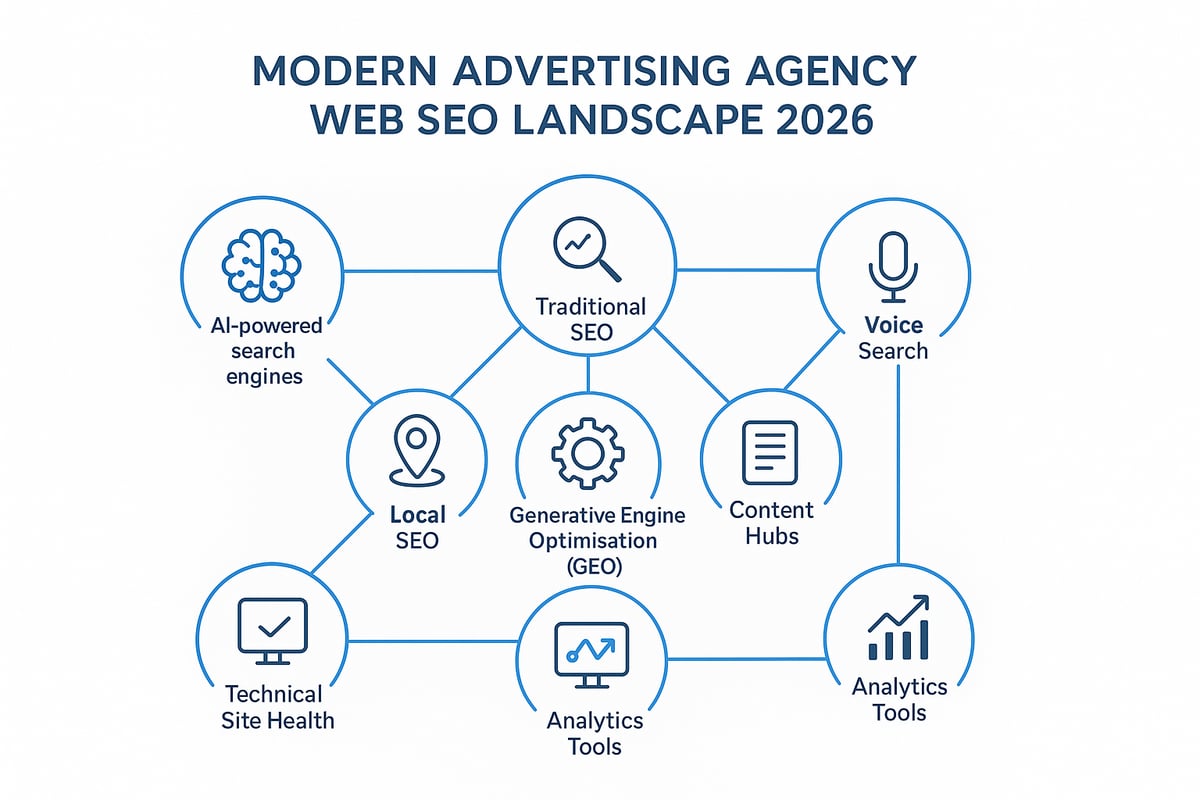
The advertising agency web landscape is now shaped by AI-powered search engines. Platforms like ChatGPT and Perplexity are transforming how people discover agencies. By 2026, 45% of B2B searches are expected to start with AI engines, making traditional SEO alone insufficient.
Voice search is also on the rise. Clients are using smart devices to find services, demanding that your advertising agency web content is conversational and answers direct questions. Agencies that adapt to these changes will win more qualified leads.
Core SEO strategies for 2026
Classic SEO is not dead, but it's evolving. The advertising agency web must focus on E-E-A-T: Experience, Expertise, Authoritativeness, and Trustworthiness. This means highlighting real client results, clear credentials, and genuine thought leadership.
Structured data and schema markup are now essential for visibility in both traditional and AI-powered search. Optimising your site for Google's knowledge graph helps your agency appear in more relevant queries, driving better leads to your advertising agency web.
GEO: Optimising for generative engines
Generative engines summarise and interpret content differently than standard search engines. To make your advertising agency web stand out, you need to create content that answers specific questions and is easy for AI to process.
Topic clusters, FAQs, and well-structured headings increase your chances of being featured in summaries or direct answers. For a deeper dive on this, see Answer engine optimization, which explains how to tailor your content for AI-driven platforms.
Local SEO and Google Business Profile enhancements
Local search is a powerhouse for the advertising agency web. In 2026, 78% of local searches will still result in offline conversions, making it vital to optimise your Google Business Profile.
Ensure your NAP (Name, Address, Phone) details are consistent everywhere. Add fresh images, reply to reviews, and use local keywords to boost your presence. This lets your advertising agency web connect with regional clients at the exact moment they need you.
Content marketing and topical authority
Building a content hub on your advertising agency web is now non-negotiable. Agencies with in-depth pillar pages and resource libraries rank for three times more keywords than those with simple blogs.
Focus on authoritative guides, case studies, and industry insights. This not only attracts organic traffic but also positions your agency as a trusted expert, making clients more likely to choose you over generic competitors.
Technical SEO and site health
A healthy advertising agency web is the foundation of all optimisation. Regular technical audits catch crawl errors, broken links, and mobile issues before they affect rankings.
Mobile-first indexing and Core Web Vitals compliance are mandatory. Fast load times, image optimisation, and clean code all help your site perform better for both users and search engines. Technical excellence ensures your site is always ready for the next update.
Analytics and measurement for SEO success
You can't improve what you don't measure. Set up GA4, Search Console, and AI-powered analytics tools to track every aspect of your advertising agency web performance.
Agencies using predictive analytics can forecast SEO ROI and adjust strategies quickly. Monthly reviews help spot what’s working and what needs fixing, so your advertising agency web stays ahead of the competition.
Integrating Advanced Analytics and Automation
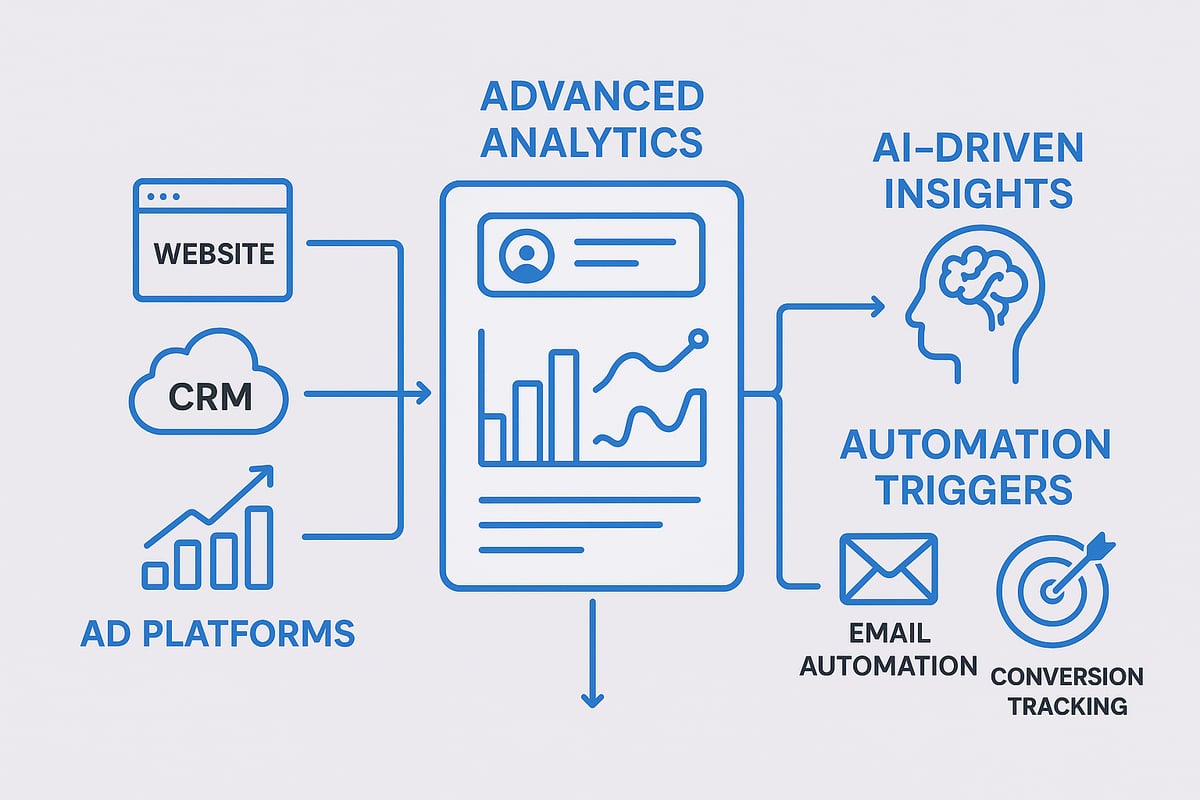
In the fast-paced world of the advertising agency web, actionable data is the lifeblood of smart decisions. Agencies are moving beyond surface-level metrics, focusing instead on what really matters: leads, conversions, and return on investment. Real-time dashboards powered by tools like GA4 enable agencies to pivot quickly, spot opportunities, and address issues before they spiral.
The need for actionable data in agency decision-making
Success in the advertising agency web space requires more than just tracking clicks. Agencies must dig into the data that drives real business value. Real-time insights help teams refine campaigns, allocate budget, and prioritise leads that are most likely to convert. With custom dashboards, agencies can filter noise and zero in on the metrics that actually move the needle.
AI-powered analytics and predictive modelling
Artificial intelligence is transforming how agencies approach analytics. By harnessing machine learning, agencies can spot emerging trends, forecast outcomes, and make proactive decisions. Predictive modelling takes the guesswork out of campaign planning, helping agencies anticipate client needs and act ahead of the curve. For a deeper dive into how AI is reshaping analytics, see AI-driven marketing analytics insights.
Marketing automation for lead nurturing and follow-up
Marketing automation is now a cornerstone of every modern advertising agency web strategy. Automated email sequences, retargeting, and CRM integrations ensure no lead slips through the cracks. Agencies using automation report up to 50 percent higher follow-up rates, keeping prospects engaged at every stage of the funnel.
Key Automation Tools for Agencies
| Tool Type | Benefit |
|---|---|
| Email Automation | Keeps leads warm |
| CRM Integration | Centralises client data |
| Retargeting | Recaptures lost prospects |
Attribution modelling and multi-touch tracking
Understanding the full customer journey is vital for the advertising agency web. Multi-touch attribution enables agencies to track touchpoints across web, social, and email. This approach reveals which channels truly drive conversions and helps optimise spend for maximum ROI. Agencies using attribution models see up to 28 percent better campaign performance.
Integrating web analytics with ad platforms and CRMs
Unified reporting is a game changer for agencies. By connecting web analytics with platforms like Google Ads, Meta, and LinkedIn, agencies cut reporting time and gain a holistic view of performance. CRM integrations ensure that every lead is tracked from first click to closed deal, powering smarter decisions across the advertising agency web.
Privacy, consent, and first-party data strategies
With privacy laws tightening, agencies must adapt their advertising agency web practices. Consent management platforms and a focus on first-party data are now essential. Agencies that prioritise privacy not only avoid fines but also build trust with clients and users. Adapting to cookie deprecation requires new strategies for capturing and activating data compliantly.
Continuous improvement through data-driven experimentation
The best agencies never stand still. They foster a culture of experimentation, using analytics to test, learn, and optimise every element of the advertising agency web experience. Regular A/B testing, content tweaks, and UX refinements keep agencies ahead of the competition and deliver measurable growth for clients.
Future-Proofing Your Agency Website: Platforms, Security, and Scalability
The digital world never stands still, and the advertising agency web scene is no exception. Staying ahead means building a website that is robust, secure, scalable, and ready for whatever comes next. Agencies must choose platforms and strategies that allow their sites to evolve, not just survive.
Choosing the right CMS and tech stack for 2026
Selecting the best CMS and technology stack is the backbone of any advertising agency web build. Flexibility, speed, and future compatibility are critical. Agencies are weighing up classic options like WordPress, e-commerce platforms like Shopify, and moving towards headless CMS for true customisation.
Here’s a quick comparison:
| Solution | Pros | Cons |
|---|---|---|
| WordPress | User-friendly, plugins, SEO | Can be slow, needs patching |
| Shopify | E-commerce, security, support | Limited customisation |
| Headless | Speed, flexibility, API power | More complex, dev required |
For a deeper dive on selecting the right stack, see Choosing a tech stack for web development.
The right choice sets your advertising agency web presence up for seamless updates and integrations as trends evolve.
Security essentials for agency websites
Security is non-negotiable for every advertising agency web project. With threats on the rise, agencies must prioritise SSL certificates, DDoS protection, and regular patching. Secure hosting is a must.
Security checklist:
- SSL certificates for all pages
- DDoS mitigation services
- Automated backups and quick restore options
- Ongoing patch management
- Secure admin access (2FA, limited IPs)
With 43% of agencies facing cyber incidents last year, robust security is what keeps your clients’ trust intact.
Scalability and performance in a growing agency
As your campaigns take off, your advertising agency web infrastructure must scale in real time. Cloud hosting lets you handle traffic spikes without breaking a sweat. CDNs keep assets fast for global users, and modular architectures mean you can add features as you grow.
A scalable site is not just about handling more visitors. It is about delivering a consistently slick experience, whether you have ten or ten thousand users onsite.
Integrating with third-party tools and APIs
Modern advertising agency web setups live or die by integrations. Connecting your site to CRM, marketing automation, analytics, and communication platforms is now standard. Tools like Zapier or Make can automate repetitive tasks, freeing up your team to focus on high-value work.
APIs make it easy to connect new tools as your agency’s needs evolve. This flexibility is a game-changer for growth and efficiency.
Accessibility and compliance as a baseline
Accessibility and compliance are now the baseline for every advertising agency web project. Meeting WCAG 2.2 standards and GDPR regulations is not just about ticking boxes—it wins contracts and avoids costly fines.
Features like keyboard navigation, alt text for images, and clear consent management are essential. Agencies known for robust compliance stand out in a crowded market.
Preparing for emerging technologies
The pace of change in digital is relentless. Forward-thinking agencies are already experimenting with AR/VR, voice search, and conversational interfaces. Around 30% plan to trial AR/VR features by 2026.
Building your advertising agency web presence on flexible platforms lets you incorporate these technologies without a complete rebuild. This keeps your agency ahead of the curve as client expectations shift.
Building for client self-service and easy management
Clients expect control and transparency. A future-proof advertising agency web platform should offer user-friendly CMS options, clear training resources, and intuitive dashboards. When clients can manage content and access reports themselves, your support burden drops, and satisfaction rises.
Agencies investing in these features reduce support tickets and increase retention. It is a win-win for both sides.
If you’re feeling a bit overwhelmed by all the changes coming in 2026 or just want a fresh, honest look at how your agency’s website could actually drive more leads and sales, you’re not alone. We’ve covered everything from AI-powered UX to CRO, SEO, and future-proofing your tech stack—because it’s all about getting real, measurable results. If you’d like some straight-talking advice tailored to your agency, I’m offering a Get free 45 min consultation—no jargon, just practical steps you can actually use to get ahead. Let’s make your site work harder for you.
In 2026, the advertising agency web environment is more competitive than ever, with rapid changes making it tough to stand out. Agencies need sites that do more than just look good—they must drive real results.
This guide will show you the strategies every agency needs to succeed, from next-gen UX/UI and AI-driven personalisation to SEO for AI-powered search. We will also cover conversion rate optimisation, integrated analytics, and building on platforms that can handle whatever the future brings.
If you want your advertising agency web presence to stand out and perform, now is the time to act. Let’s dive in and future-proof your agency’s success.
The Evolution of Advertising Agency Websites in 2026
The advertising agency web landscape of 2026 is a far cry from what it was just a few years ago. Static sites that simply showcased credentials are rapidly vanishing, replaced by interactive hubs designed to win clients and drive real business outcomes.
The shift from brochure sites to conversion engines
Not long ago, the typical advertising agency web approach was to display a portfolio and list of services, hoping visitors would get in touch. Today, agencies are redesigning their websites as powerful conversion engines. Interactive features, smart lead capture forms, and live chat are now standard. In fact, agencies that have made this shift report up to 40% more leads after transforming their sites for conversion.
Key trends shaping agency websites
Modern advertising agency web platforms are embracing innovation at every turn. The integration of AI chatbots, personalised content, and marketing automation is now commonplace. Video, interactive content, and immersive storytelling are being used to keep visitors engaged and drive enquiry rates higher. According to HubSpot (2025), 68% of agencies now use AI-driven features. For a deep dive into these strategies, see the conversion-focused agency website strategies that are setting high-performing agencies apart.
The impact of mobile-first and omnichannel experiences
Mobile devices are the primary touchpoint for most users, so a mobile-first approach is now the baseline for any advertising agency web project. Progressive web apps and enhanced mobile UX offer agencies a competitive edge. Omnichannel integration is also key, allowing visitors to move seamlessly between the website, social channels, and messaging apps without any friction.
The rise of privacy and accessibility standards
Strict privacy regulations and accessibility standards are shaping every advertising agency web build. Compliance with WCAG 2.2, GDPR, and similar frameworks is not just a legal requirement but a business necessity. Agencies that ignore these standards risk fines and lost contracts, as clients increasingly demand inclusive digital experiences.
Competitive differentiation in a crowded market
Standing out in the crowded advertising agency web space requires more than just a slick design. Agencies are focusing on unique branding, niche specialisation, and value-driven messaging. Recent data shows that 54% of clients now choose agencies based on distinctive positioning, making this a key factor in winning new business.
The role of performance and speed
Site speed and technical performance have a direct impact on both user experience and conversion rates. Google’s Core Web Vitals are now a critical ranking factor. Agencies that focus on optimising load times and streamlining their advertising agency web presence have seen up to 20% more conversions, proving that technical excellence pays off.
Preparing for the next wave of technology
Looking ahead, the advertising agency web landscape is already experimenting with headless CMS, API integrations, and preparing for the integration of AR, VR, and voice search. Future-proofing is essential, ensuring that agency sites can evolve with new tech and client expectations.
User Experience (UX) and Conversion Rate Optimisation (CRO) Strategies
Creating an effective advertising agency web presence in 2026 is all about blending high-impact user experience with laser-focused conversion strategies. Agencies that get their UX and CRO right are not just showing off—they’re turning browsers into buyers, and visitors into loyal clients.
Principles of high-converting agency websites
The foundation of a winning advertising agency web strategy is clarity. You need a value proposition that tells visitors who you are and why you matter—fast. Navigation should be intuitive, guiding users from landing to enquiry with zero confusion.
Effective CTAs must stand out and promise real value. Agencies that simplified their site structure saw a 35% jump in conversions. Here’s a quick checklist:
- Clear, benefit-led headlines
- Logical, minimal navigation menus
- CTAs above the fold and repeated naturally
A streamlined approach means more leads and less drop-off on your advertising agency web pages.
Personalisation and AI-driven UX
In 2026, personalisation is not a bonus—it’s the baseline for any advertising agency web that wants to stay ahead. AI-driven chatbots answer queries instantly, and content adapts in real time to visitor interests. According to Salesforce, 75% of users now expect immediate responses.
Agencies are leveraging AI web design for agencies to deliver dynamic experiences, tailoring every touchpoint. Imagine a homepage that shifts its case studies or services based on the user’s industry or previous visits—this is now achievable and expected.
AI handles FAQs, books meetings, and even surfaces the right testimonials, making your advertising agency web feel personal and efficient.
Streamlined user journeys and lead funnels
Mapping user intent is essential for any modern advertising agency web. Start with the landing page and plot every possible route to enquiry. Each step should remove friction, not add it.
Replace clunky forms with step-by-step journeys. For example:
Step 1: Select your service
Step 2: Enter your business size
Step 3: Provide contact info
This approach boosts completion rates and reduces overwhelm, turning more visitors on your advertising agency web into warm leads.
Social proof and trust-building elements
Trust is currency in the advertising agency web world. Prominently display testimonials, case studies, certifications, and awards. Data from LinkedIn shows 82% of B2B buyers trust agencies with strong case study sections.
Consider a table for maximum impact:
| Trust Element | Placement | Effect |
|---|---|---|
| Testimonials | Homepage, footer | Builds credibility |
| Case Studies | Dedicated page | Demonstrates expertise |
| Certifications | About/Sidebar | Shows professionalism |
| Awards | Hero banner | Highlights achievements |
Using these elements strategically across your advertising agency web increases buyer confidence fast.
Mobile-first and accessibility best practices
Every advertising agency web must be designed for mobile first. Touch-friendly layouts, large tap targets, and support for voice navigation set you apart. Accessibility isn’t optional—agencies with accessible sites see a 12% rise in inbound leads.
Use proper alt text, colour contrast, and keyboard navigation. Test your site with screen readers to ensure everyone can engage with your advertising agency web, regardless of ability.
Performance optimisation and technical excellence
Speed is a silent dealbreaker. A sluggish advertising agency web loses visitors before they see your story. Compress images, use lazy loading, and keep your codebase lean.
CDNs deliver content fast globally. Regularly audit your site speed using tools like Google PageSpeed Insights. Even small improvements can drive 20% more conversions for your advertising agency web.
A/B testing and data-driven improvements
Continuous improvement is key. Run A/B tests on headlines, CTAs, and page layouts. Agencies that test monthly consistently outperform peers in conversion rates.
Review analytics, spot drop-off points, and adjust. Make data-driven tweaks to your advertising agency web, and you’ll see compounding gains over time.
SEO and Generative Engine Optimisation (GEO) for Agency Websites
The world of advertising agency web strategy is changing fast. To stay ahead, agencies must master both classic SEO and the new wave of generative engine optimisation (GEO). Let's break down what matters most for 2026, and how you can future-proof your agency's online presence.
The evolution of search: AI-powered engines and voice search
The advertising agency web landscape is now shaped by AI-powered search engines. Platforms like ChatGPT and Perplexity are transforming how people discover agencies. By 2026, 45% of B2B searches are expected to start with AI engines, making traditional SEO alone insufficient.
Voice search is also on the rise. Clients are using smart devices to find services, demanding that your advertising agency web content is conversational and answers direct questions. Agencies that adapt to these changes will win more qualified leads.
Core SEO strategies for 2026
Classic SEO is not dead, but it's evolving. The advertising agency web must focus on E-E-A-T: Experience, Expertise, Authoritativeness, and Trustworthiness. This means highlighting real client results, clear credentials, and genuine thought leadership.
Structured data and schema markup are now essential for visibility in both traditional and AI-powered search. Optimising your site for Google's knowledge graph helps your agency appear in more relevant queries, driving better leads to your advertising agency web.
GEO: Optimising for generative engines
Generative engines summarise and interpret content differently than standard search engines. To make your advertising agency web stand out, you need to create content that answers specific questions and is easy for AI to process.
Topic clusters, FAQs, and well-structured headings increase your chances of being featured in summaries or direct answers. For a deeper dive on this, see Answer engine optimization, which explains how to tailor your content for AI-driven platforms.
Local SEO and Google Business Profile enhancements
Local search is a powerhouse for the advertising agency web. In 2026, 78% of local searches will still result in offline conversions, making it vital to optimise your Google Business Profile.
Ensure your NAP (Name, Address, Phone) details are consistent everywhere. Add fresh images, reply to reviews, and use local keywords to boost your presence. This lets your advertising agency web connect with regional clients at the exact moment they need you.
Content marketing and topical authority
Building a content hub on your advertising agency web is now non-negotiable. Agencies with in-depth pillar pages and resource libraries rank for three times more keywords than those with simple blogs.
Focus on authoritative guides, case studies, and industry insights. This not only attracts organic traffic but also positions your agency as a trusted expert, making clients more likely to choose you over generic competitors.
Technical SEO and site health
A healthy advertising agency web is the foundation of all optimisation. Regular technical audits catch crawl errors, broken links, and mobile issues before they affect rankings.
Mobile-first indexing and Core Web Vitals compliance are mandatory. Fast load times, image optimisation, and clean code all help your site perform better for both users and search engines. Technical excellence ensures your site is always ready for the next update.
Analytics and measurement for SEO success
You can't improve what you don't measure. Set up GA4, Search Console, and AI-powered analytics tools to track every aspect of your advertising agency web performance.
Agencies using predictive analytics can forecast SEO ROI and adjust strategies quickly. Monthly reviews help spot what’s working and what needs fixing, so your advertising agency web stays ahead of the competition.
Integrating Advanced Analytics and Automation
In the fast-paced world of the advertising agency web, actionable data is the lifeblood of smart decisions. Agencies are moving beyond surface-level metrics, focusing instead on what really matters: leads, conversions, and return on investment. Real-time dashboards powered by tools like GA4 enable agencies to pivot quickly, spot opportunities, and address issues before they spiral.
The need for actionable data in agency decision-making
Success in the advertising agency web space requires more than just tracking clicks. Agencies must dig into the data that drives real business value. Real-time insights help teams refine campaigns, allocate budget, and prioritise leads that are most likely to convert. With custom dashboards, agencies can filter noise and zero in on the metrics that actually move the needle.
AI-powered analytics and predictive modelling
Artificial intelligence is transforming how agencies approach analytics. By harnessing machine learning, agencies can spot emerging trends, forecast outcomes, and make proactive decisions. Predictive modelling takes the guesswork out of campaign planning, helping agencies anticipate client needs and act ahead of the curve. For a deeper dive into how AI is reshaping analytics, see AI-driven marketing analytics insights.
Marketing automation for lead nurturing and follow-up
Marketing automation is now a cornerstone of every modern advertising agency web strategy. Automated email sequences, retargeting, and CRM integrations ensure no lead slips through the cracks. Agencies using automation report up to 50 percent higher follow-up rates, keeping prospects engaged at every stage of the funnel.
Key Automation Tools for Agencies
| Tool Type | Benefit |
|---|---|
| Email Automation | Keeps leads warm |
| CRM Integration | Centralises client data |
| Retargeting | Recaptures lost prospects |
Attribution modelling and multi-touch tracking
Understanding the full customer journey is vital for the advertising agency web. Multi-touch attribution enables agencies to track touchpoints across web, social, and email. This approach reveals which channels truly drive conversions and helps optimise spend for maximum ROI. Agencies using attribution models see up to 28 percent better campaign performance.
Integrating web analytics with ad platforms and CRMs
Unified reporting is a game changer for agencies. By connecting web analytics with platforms like Google Ads, Meta, and LinkedIn, agencies cut reporting time and gain a holistic view of performance. CRM integrations ensure that every lead is tracked from first click to closed deal, powering smarter decisions across the advertising agency web.
Privacy, consent, and first-party data strategies
With privacy laws tightening, agencies must adapt their advertising agency web practices. Consent management platforms and a focus on first-party data are now essential. Agencies that prioritise privacy not only avoid fines but also build trust with clients and users. Adapting to cookie deprecation requires new strategies for capturing and activating data compliantly.
Continuous improvement through data-driven experimentation
The best agencies never stand still. They foster a culture of experimentation, using analytics to test, learn, and optimise every element of the advertising agency web experience. Regular A/B testing, content tweaks, and UX refinements keep agencies ahead of the competition and deliver measurable growth for clients.
Future-Proofing Your Agency Website: Platforms, Security, and Scalability
The digital world never stands still, and the advertising agency web scene is no exception. Staying ahead means building a website that is robust, secure, scalable, and ready for whatever comes next. Agencies must choose platforms and strategies that allow their sites to evolve, not just survive.
Choosing the right CMS and tech stack for 2026
Selecting the best CMS and technology stack is the backbone of any advertising agency web build. Flexibility, speed, and future compatibility are critical. Agencies are weighing up classic options like WordPress, e-commerce platforms like Shopify, and moving towards headless CMS for true customisation.
Here’s a quick comparison:
| Solution | Pros | Cons |
|---|---|---|
| WordPress | User-friendly, plugins, SEO | Can be slow, needs patching |
| Shopify | E-commerce, security, support | Limited customisation |
| Headless | Speed, flexibility, API power | More complex, dev required |
For a deeper dive on selecting the right stack, see Choosing a tech stack for web development.
The right choice sets your advertising agency web presence up for seamless updates and integrations as trends evolve.
Security essentials for agency websites
Security is non-negotiable for every advertising agency web project. With threats on the rise, agencies must prioritise SSL certificates, DDoS protection, and regular patching. Secure hosting is a must.
Security checklist:
- SSL certificates for all pages
- DDoS mitigation services
- Automated backups and quick restore options
- Ongoing patch management
- Secure admin access (2FA, limited IPs)
With 43% of agencies facing cyber incidents last year, robust security is what keeps your clients’ trust intact.
Scalability and performance in a growing agency
As your campaigns take off, your advertising agency web infrastructure must scale in real time. Cloud hosting lets you handle traffic spikes without breaking a sweat. CDNs keep assets fast for global users, and modular architectures mean you can add features as you grow.
A scalable site is not just about handling more visitors. It is about delivering a consistently slick experience, whether you have ten or ten thousand users onsite.
Integrating with third-party tools and APIs
Modern advertising agency web setups live or die by integrations. Connecting your site to CRM, marketing automation, analytics, and communication platforms is now standard. Tools like Zapier or Make can automate repetitive tasks, freeing up your team to focus on high-value work.
APIs make it easy to connect new tools as your agency’s needs evolve. This flexibility is a game-changer for growth and efficiency.
Accessibility and compliance as a baseline
Accessibility and compliance are now the baseline for every advertising agency web project. Meeting WCAG 2.2 standards and GDPR regulations is not just about ticking boxes—it wins contracts and avoids costly fines.
Features like keyboard navigation, alt text for images, and clear consent management are essential. Agencies known for robust compliance stand out in a crowded market.
Preparing for emerging technologies
The pace of change in digital is relentless. Forward-thinking agencies are already experimenting with AR/VR, voice search, and conversational interfaces. Around 30% plan to trial AR/VR features by 2026.
Building your advertising agency web presence on flexible platforms lets you incorporate these technologies without a complete rebuild. This keeps your agency ahead of the curve as client expectations shift.
Building for client self-service and easy management
Clients expect control and transparency. A future-proof advertising agency web platform should offer user-friendly CMS options, clear training resources, and intuitive dashboards. When clients can manage content and access reports themselves, your support burden drops, and satisfaction rises.
Agencies investing in these features reduce support tickets and increase retention. It is a win-win for both sides.
If you’re feeling a bit overwhelmed by all the changes coming in 2026 or just want a fresh, honest look at how your agency’s website could actually drive more leads and sales, you’re not alone. We’ve covered everything from AI-powered UX to CRO, SEO, and future-proofing your tech stack—because it’s all about getting real, measurable results. If you’d like some straight-talking advice tailored to your agency, I’m offering a Get free 45 min consultation—no jargon, just practical steps you can actually use to get ahead. Let’s make your site work harder for you.


