
Web design · 14 min read
Choosing a Tech Stack for Web Development
The difference between project success and failure in 2026 often comes down to your core technology choices. As web development moves faster than ever, picking the right tools shapes how your site performs, scales, and how much it costs you in the long run.
By Matt Harrison · Published · Updated · Part of the guides behind Web Design & Build
The difference between project success and failure in 2026 often comes down to your core technology choices. As web development moves faster than ever, picking the right tools shapes how your site performs, scales, and how much it costs you in the long run.
Frameworks, cloud platforms, and AI-driven tools are evolving rapidly, making the landscape both exciting and risky. The wrong call can lead to technical debt, sluggish development, or even security gaps, while a smart decision brings speed, security, and peace of mind.
That’s why choosing a tech stack for web development is more critical than ever. This guide gives business owners, CTOs, and developers a clear, step-by-step approach to getting it right. You’ll learn core stack components, what to look for, the latest trends, real-world examples, and practical steps to make confident choices for your next project.
Understanding the Modern Web Development Tech Stack
The process of choosing a tech stack for web development is more important than ever in 2026. The right combination of tools and frameworks can mean the difference between a scalable, high-performing site and a project plagued by costly setbacks. To make sense of the options, let’s break down what a modern tech stack really involves.
Defining the Tech Stack
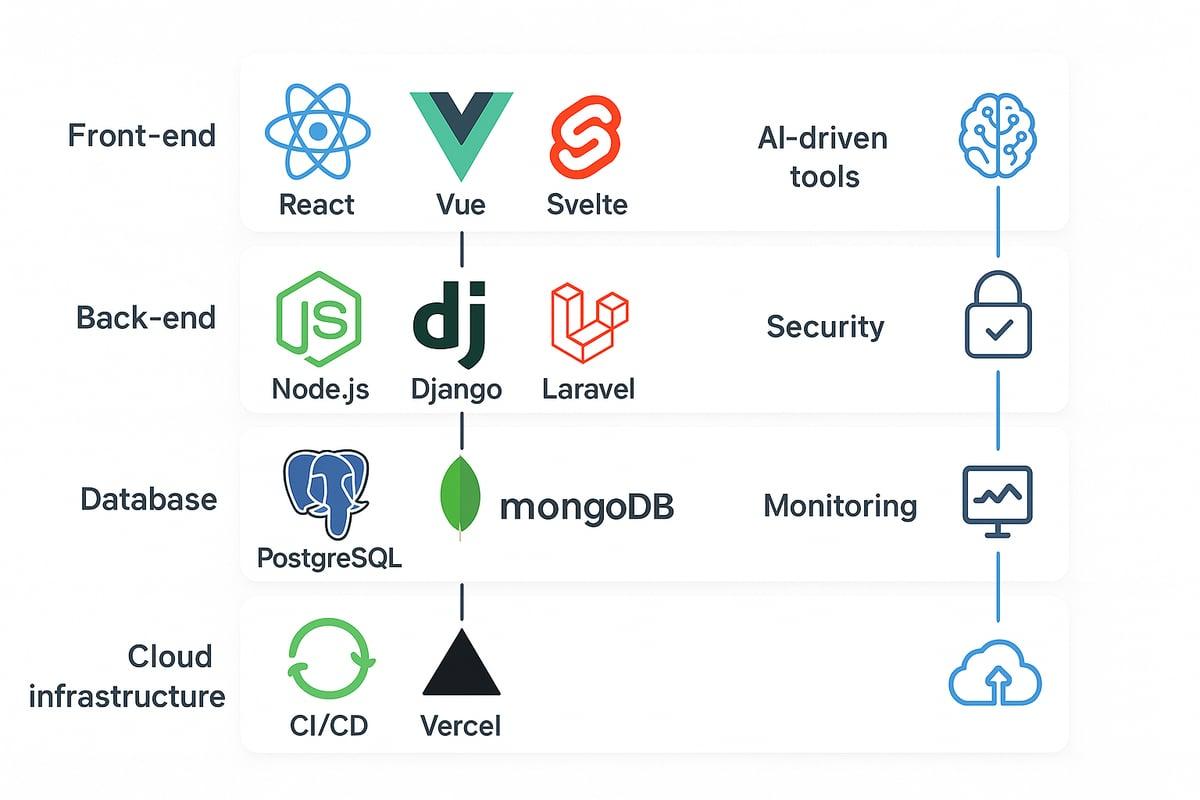
A tech stack is the full set of programming languages, frameworks, libraries, and tools that power a web application. These are typically split into layers, each handling a vital part of the build.
| Layer | Typical Technologies | Example Stack |
|---|---|---|
| Front end | React, Vue, Svelte | React |
| Back end | Node.js, Django, Laravel | Node.js |
| Database | PostgreSQL, MongoDB | MongoDB |
| DevOps/Cloud | AWS Lambda, Vercel, Netlify | Vercel |
For example, the MERN stack — MongoDB, Express, React, and Node.js — is a popular full-stack choice. JAMstack, meanwhile, focuses on JavaScript, APIs, and Markup. Whether you go full stack or specialise, stack cohesion is key for maintainability and performance. When choosing a tech stack for web development, make sure every layer works together smoothly.
Core Components in 2026
By 2026, the essentials for any web project include robust front-end frameworks (React, Vue, Svelte), flexible back-end platforms (Node.js, Django, Laravel), and modern databases (PostgreSQL, MongoDB). The rise of serverless functions and edge computing is reshaping how applications scale and perform.
Cloud-native offerings like AWS Lambda, Vercel, and Netlify are now common, enabling rapid deployments and global reach. GraphQL APIs are also standard for flexible data requests. For more on the leading stacks shaping the industry, see the Top 5 Tech Stacks in 2026.
The Role of AI and Automation
AI-driven development tools are transforming how teams approach choosing a tech stack for web development. Platforms such as GitHub Copilot can generate code on the fly, while AI-based code review catches bugs before they hit production.
Automation is woven into every stage, from testing and deployment to ongoing monitoring. For example, AI-generated code scaffolding allows MVPs to launch in days, not weeks. This speeds up workflows and reduces manual errors, keeping teams focused on innovation.
Security and Compliance Considerations
Security must be a core part of choosing a tech stack for web development. Modern frameworks offer built-in defences aligned with the OWASP Top 10 and support automated vulnerability scanning.
Compliance tools are now integrated, helping teams meet GDPR and CCPA requirements from the outset.
- Automated security checks
- GDPR-ready frameworks
- Role-based access controls
For instance, Next.js comes with enterprise-grade security features, making it a strong choice for regulated industries.
Performance, Scalability, and User Experience
Stack decisions directly impact how fast your site loads, how well it scales, and the quality of the user experience. When choosing a tech stack for web development, consider how your options stack up in real-world benchmarks.
For example, SSR (Server-Side Rendering) often outperforms CSR (Client-Side Rendering) for initial page loads. SvelteKit is gaining popularity for its blazing speed and efficiency, delivering measurable improvements in live projects.
Ultimately, the right tech stack is the foundation for delivering a fast, secure, and scalable web application that users love.
Key Criteria for Choosing a Tech Stack in 2026
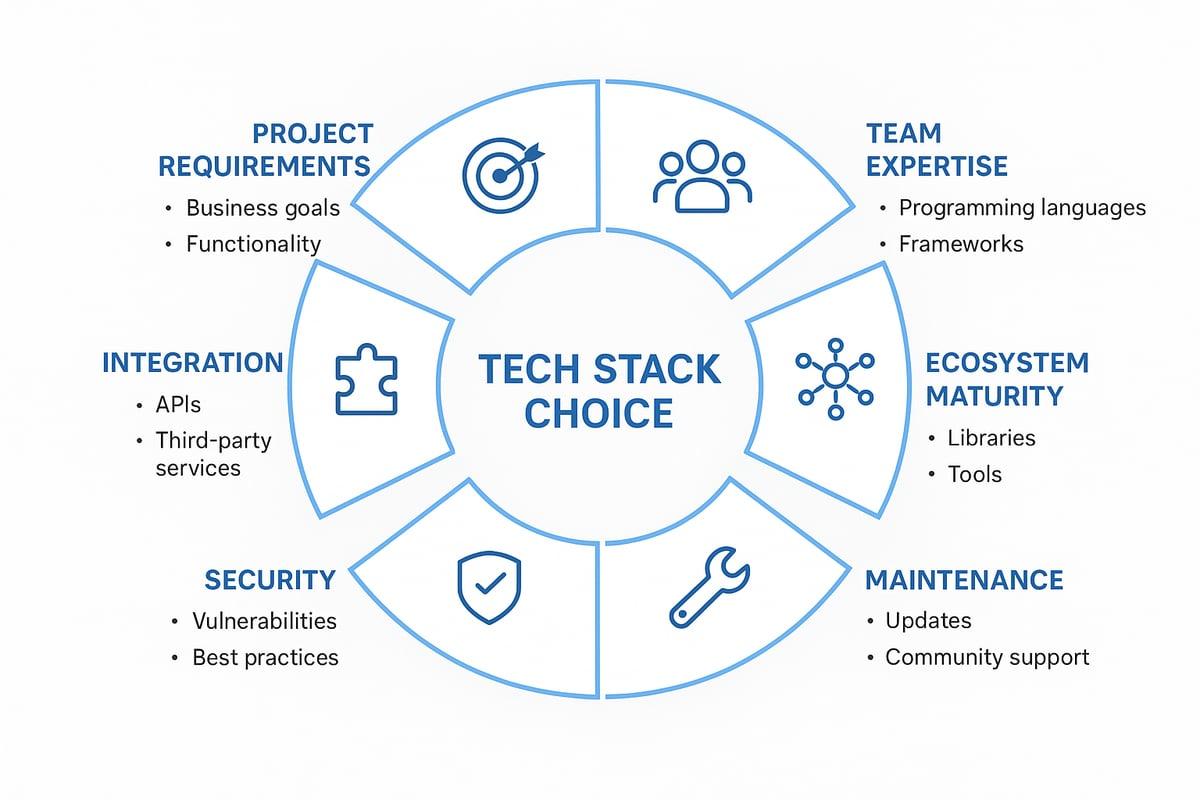
Selecting the right technology stack is a critical decision for any web project. The process of choosing a tech stack for web development in 2026 is about balancing technical needs, business goals, and future-proofing. Let’s break down the main criteria you should consider before you commit.
Project Requirements and Business Goals
Every project has unique needs, so choosing a tech stack for web development must start with a clear understanding of your goals. Are you building an e-commerce platform, a SaaS product, or a content-driven site?
For rapid launches, platforms like Shopify excel in the e-commerce space, while a custom stack might suit a complex SaaS application. Consider scalability, time-to-market, and budget. Rapid prototyping may favour one stack, while long-term ambitions could pull you in another direction.
Matching your stack to business objectives ensures your project stays on track and within scope.
Team Expertise and Resource Availability
A brilliant stack is useless if your team cannot use it efficiently. When choosing a tech stack for web development, look at your current in-house skills. Do your developers know React, Vue, or Laravel, or will you need to hire or train?
Certain languages and frameworks have much larger talent pools. For instance, finding PHP developers is easier and often cheaper than sourcing Go specialists. Outsourcing can bridge gaps but may introduce communication overhead.
Always weigh the cost and availability of expertise before making a final decision.
Ecosystem Maturity and Community Support
The maturity of a tech ecosystem makes a huge difference in long-term success. When choosing a tech stack for web development, ask: does this framework have a thriving community? Is documentation up to scratch? Are there enough plugins or libraries to speed up development?
Popular frameworks like React have vast support networks and resources. On the flip side, adopting bleeding-edge technology might limit your access to help or integrations.
A mature ecosystem means less time wrestling with problems and more time building value.
Long-Term Maintenance and Technical Debt
Sustainable growth hinges on maintainability. Choosing a tech stack for web development is not just about today’s requirements but also tomorrow’s headaches.
Assess how often the stack is updated and whether it offers backward compatibility. Legacy stacks, such as older PHP versions, can lead to technical debt and expensive migrations. In contrast, modern frameworks like Next.js offer regular updates and strong support.
Plan for the future by picking a stack that is easy to maintain and adapt as your needs evolve.
Security, Compliance, and Data Privacy
Security is non-negotiable. Choosing a tech stack for web development means prioritising built-in security features and compliance certifications. If you operate in regulated industries like healthcare or finance, frameworks with robust data handling and compliance tools (such as Django's security middleware) are essential.
Modern stacks often include automated vulnerability scanning and compliance modules for regulations like GDPR or CCPA. Always review security documentation and check for active patching.
A secure stack not only protects your users but also your business reputation.
Integration and Interoperability
No website is an island. When choosing a tech stack for web development, consider how easily your stack integrates with payment gateways, third-party APIs, and analytics tools.
RESTful and GraphQL APIs are now standard for modular, scalable architectures. For example, integrating Stripe payments with a Node.js backend is straightforward and widely supported.
For more insights into how your stack impacts performance and scalability, see these website optimisation strategies.
The right integrations streamline workflows, save time, and future-proof your project.
Step-by-Step Process to Select Your Web Development Tech Stack
Selecting the right tools can feel overwhelming, but following a structured process makes choosing a tech stack for web development far more manageable. Let’s break it down into six actionable steps, each grounded in real-world experience.

Step 1: Define Business Objectives and Project Scope
Start by clarifying what you want to achieve. Is your goal a quick MVP launch, a scalable SaaS platform, or a feature-rich ecommerce site? Gather input from all stakeholders to ensure you understand core requirements, budget, and long-term vision.
When choosing a tech stack for web development, knowing your endgame avoids wasted effort. For example, launching a B2B SaaS with multi-tenancy demands different considerations than a simple marketing site.
List out must-have features, target audience size, and monetisation plans. This groundwork sets the tone for every technical decision that follows.
Step 2: Assess Technical Requirements and Constraints
Now dig into the technical details. Do you need real-time data, advanced integrations, or offline support? Consider expected traffic, performance targets, compliance needs, and any non-negotiable integrations.
Choosing a tech stack for web development means aligning these technical musts with business goals. If building a ticketing platform for high-traffic events, prioritise uptime, speed, and robust APIs from the outset.
This is the moment to document everything—think of it as your project’s blueprint. It will be the reference point for evaluating technologies in the next step.
Step 3: Evaluate and Shortlist Stack Options
With requirements in hand, compare frameworks, languages, and platforms. Create a table with criteria like speed, cost, scalability, and community support.
| Criteria | Option A (Next.js) | Option B (Nuxt.js) |
|---|---|---|
| SSR support | Yes | Yes |
| Language | JavaScript | JavaScript |
| Ecosystem | Mature | Growing |
| Hosting | Vercel | Netlify |
When choosing a tech stack for web development, weigh the trade-offs for each option. For expert help, consider exploring web design and development services that offer guidance on stack selection.
Shortlist two or three stacks, focusing on those that match your team’s strengths and project constraints.
Step 4: Prototype and Test
Build a proof-of-concept or MVP using your shortlisted stack. This is where theory meets practice. Run performance benchmarks, security scans, and usability tests to expose any weaknesses early.
Choosing a tech stack for web development is not just about features on paper. Use tools like Lighthouse to measure speed and accessibility, and stress-test with dummy data.
This hands-on phase reveals if your chosen stack can handle real-world demands or if adjustments are needed before full build-out.
Step 5: Gather Feedback and Iterate
Collect feedback from developers, early users, and stakeholders. Honest input at this stage is gold. Did the prototype meet expectations? Were there unexpected challenges?
Choosing a tech stack for web development is iterative. If initial user testing highlights a need for PWA support or improved accessibility, revisit your shortlist and adapt.
Refining your stack based on real feedback reduces risk and ensures your final product aligns with both business and user needs.
Step 6: Plan for Deployment and Ongoing Maintenance
Finally, prepare for a smooth launch and future growth. Set up CI/CD pipelines for automated deployments, add monitoring tools, and create thorough documentation.
Choosing a tech stack for web development means thinking ahead. Plan for scaling, regular updates, and support processes. For instance, using Vercel enables quick rollbacks if issues arise post-launch.
A well-prepared deployment strategy ensures your app stays robust, secure, and easy to maintain as your business evolves.
Emerging Trends and Future-Proofing Your Tech Stack
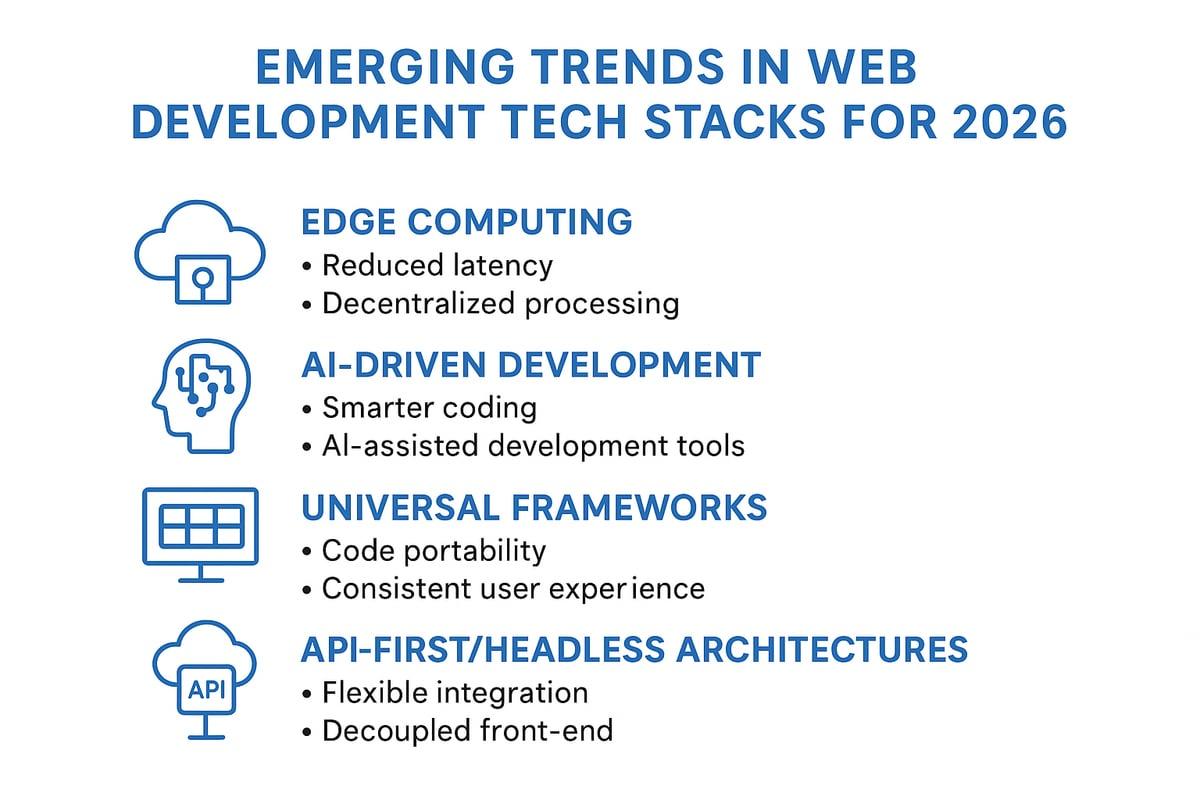
Keeping pace with innovation is vital when choosing a tech stack for web development. The landscape is shifting faster than ever, with new methodologies and tools setting the bar for performance, flexibility, and sustainability. Let’s break down the trends shaping future-proof stacks in 2026.
Rise of Edge Computing and Serverless Architectures
Edge computing and serverless are redefining what’s possible when choosing a tech stack for web development. By running code closer to users, platforms like Cloudflare Workers and AWS Lambda@Edge deliver lower latency and improved scalability. This means your website or app can handle traffic spikes with ease, keeping costs predictable.
Benefits include:
- Global reach without traditional server overhead
- Instant scaling for high-demand events
- Reduced infrastructure management
For example, e-commerce businesses now use serverless functions to handle flash sales, ensuring smooth checkouts even under heavy load. Adopting these technologies keeps your stack ready for whatever growth throws at you.
AI-Driven Development and Automation
AI is no longer a futuristic buzzword. When choosing a tech stack for web development, AI-driven tools like Copilot are already transforming code generation, testing, and bug detection. Automation in deployment and monitoring is becoming the norm, speeding up release cycles and reducing manual errors.
Key advantages:
- Higher developer productivity
- Faster time to market
- Enhanced code quality
Enterprise teams are quickly adopting AI solutions to stay ahead. For more insights on how AI is reshaping web development, see AI Integration in Web Development. Embracing AI in your stack is not optional anymore, it’s essential for staying competitive.
Universal and Cross-Platform Frameworks
Universal frameworks are changing the game for those choosing a tech stack for web development. Tools like Flutter and React Native allow you to build web, mobile, and desktop apps from a single codebase. This approach slashes development time and costs, making it easier to maintain feature parity across platforms.
Consider this:
- Faster MVP launches for startups
- Lower long-term maintenance
- Consistent user experience everywhere
Many startups now opt for Flutter to deliver their MVPs simultaneously on web and mobile, accelerating their go-to-market strategy. One codebase, many platforms, less hassle.
API-First and Headless Architectures
API-first and headless approaches are now standard when choosing a tech stack for web development. Decoupling the front end from the back end gives you flexibility to update user interfaces without disrupting core business logic. Headless CMS solutions like Contentful and Sanity are gaining traction for their ease of integration.
The benefits:
- Omnichannel delivery (web, mobile, IoT)
- Modular, future-proof architecture
- Easier third-party integrations
Retailers are using headless stacks to deliver seamless experiences across online stores, apps, and even in-store displays. For more on these trends, explore Web Development Trends 2026.
Sustainability and Green Coding
Sustainability is now a serious consideration when choosing a tech stack for web development. Developers and businesses are seeking ways to cut energy use and shrink their digital carbon footprint. Stack choices like static site generators and efficient cloud hosting can make a real difference.
Why it matters:
- Lower operational costs
- Improved brand reputation
- Compliance with green standards
For instance, Jamstack sites reduce server usage, slashing emissions while delivering lightning-fast performance. Prioritising green coding ensures your stack is built for the future, not just the present.
Real-World Examples and Case Studies
Real-world success stories show how choosing a tech stack for web development can influence speed, scalability, and ROI. Let’s look at how different organisations have navigated this crucial decision in 2026.
Startups: Rapid MVP Launches
For startups, speed is everything. In 2026, many fintech startups are choosing a tech stack for web development that prioritises rapid MVP launches. JAMstack, with static site generators, serverless functions, and Stripe integration, is a popular choice.
- Stack choices: Next.js, Netlify, AWS Lambda, Stripe
- Benefits: Reduced development time, easy scaling, lower initial costs
By focusing on modular, serverless tools, startups can iterate fast, test ideas, and launch to market ahead of competitors. The flexibility of JAMstack enables quick pivots without legacy overhead.
Enterprises: Scaling and Security
Large media companies have unique priorities when choosing a tech stack for web development. In a recent migration, a global publisher moved to Next.js, AWS, and CDN integration for improved reach and compliance.
- Stack considerations: SSR with Next.js, automated security, global CDN, AWS infrastructure
- Outcomes: Faster load times, robust compliance, higher user engagement
The adoption of meta-frameworks like Next.js, which you can read more about in Meta-Frameworks in 2026, allows enterprises to balance innovation with long-term maintainability. Automated security and compliance features are now must-haves at this scale.
E-commerce: Performance and Conversion Optimisation
Online retailers are laser-focused on performance and conversion. When choosing a tech stack for web development, many opt for Shopify Hydrogen combined with edge functions to ensure fast, reliable shopping experiences.
- Stack benefits: Custom checkout flows, rapid scaling, high conversion rates
- Results: 20 percent increase in conversion, 30 percent faster page loads
Front-end user experience is critical. Retailers often consult resources like UI design best practices to make informed decisions about frameworks and design. The right stack delivers measurable business impact.
Non-Profits and SMEs: Cost-Effective Solutions
For non-profits and small businesses, choosing a tech stack for web development is about balancing flexibility with affordability. A recent charity project used WordPress with cloud hosting and a headless CMS to maximise reach on a modest budget.
- Stack focus: WordPress, Contentful (headless CMS), scalable cloud hosting
- Benefits: Low maintenance, easy content updates, improved donor engagement
This approach empowers small teams to manage content without technical bottlenecks. By leveraging proven platforms, non-profits can focus on their mission rather than infrastructure headaches.
If you’re still feeling a bit stuck on picking the right tech stack after reading this guide, you’re not alone—there’s a lot to weigh up when it comes to performance, scalability and long term results. I’ve helped loads of small businesses and ambitious teams in Birmingham and beyond make smart, cost effective decisions that actually drive sales (not just look shiny). Want to talk through your project, bounce around ideas or get honest, straight talking advice on your options? Let’s put together a plan that works for your business goals—grab your Get free 45 min consultation and let’s get started.
Keep reading
More on web design

Website Design Strategy
Imagine investing thousands in a stunning website, only to watch it flop in 2026’s crowded digital world. The truth is, without a solid website design strategy, even the most beautiful sites can fail to deliver results.
Layouts Web
Web design never sits still. What worked yesterday can look dated tomorrow, making it crucial to keep your finger on the pulse of layouts web trends if you want to stay ahead in 2026.
Advertising Agency Web
In 2026, the advertising agency web environment is more competitive than ever, with rapid changes making it tough to stand out. Agencies need sites that do more than just look good — they must drive real results.
Want this done rather than read?
Tell me what you sell and what isn't working. The audit that starts every engagement is free, and you keep the roadmap either way.