The digital world is moving at breakneck speed, and businesses in 2026 face fiercer competition than ever. Customer expectations are shifting, making it clear that winning new customers is not just important, it is essential for survival.
Omnichannel strategies, artificial intelligence, and laser-focused personalisation are rewriting the rules of customer acquisition. If you want to thrive, you need to master these new tools and approaches.
Getting customer acquisition right offers more than just short-term wins. It means building a foundation for sustainable growth, boosting your revenue, and making your business resilient against market shocks.
Curious about what works now? This guide covers the fundamentals, the modern funnel, strategy, advanced tactics, measurement, and how to keep ahead of 2026’s trends. Let’s dive in and set your business up for customer acquisition success.
The Fundamentals of Customer Acquisition in 2026
Understanding the fundamentals of customer acquisition is non-negotiable for any business aiming to thrive in 2026. With digital disruption at an all-time high, the rules of engagement are evolving. Brands that master the basics will be best placed to build sustainable pipelines and outpace the competition.

Defining Customer Acquisition and Its Role
Customer acquisition is the process of turning prospects into paying customers. In 2026, it is no longer about a quick win or a single transaction, but about building a repeatable and scalable approach that delivers ongoing value. The landscape is shaped by omnichannel touchpoints: think websites, social platforms, email campaigns, paid advertising, and in-person events, all working together to guide prospects along their journey.
The rise of digital-first, omnichannel consumer behaviour has added layers of complexity. Customers expect seamless experiences, moving effortlessly between channels. According to IBM, 82% of people now spend less than ten minutes searching before making a decision. This demands frictionless, intuitive processes at every step.
Success in customer acquisition also relies on close collaboration between marketing and sales teams. When both groups align on messaging and goals, they can create a unified pipeline that avoids leaks and maximises results. Measuring customer lifetime value (CLV) and churn rate is now standard practice, helping teams refine strategies and target high-value prospects.
Importantly, customer acquisition is not a one-off event. It is a continuous cycle of attracting, engaging, converting, and retaining customers. For a deeper dive into the latest strategies and cross-functional approaches, see Gartner's Customer Acquisition: Strategies and Guide to Drive Revenue Growth.
The Customer Acquisition Funnel: Stages and Significance
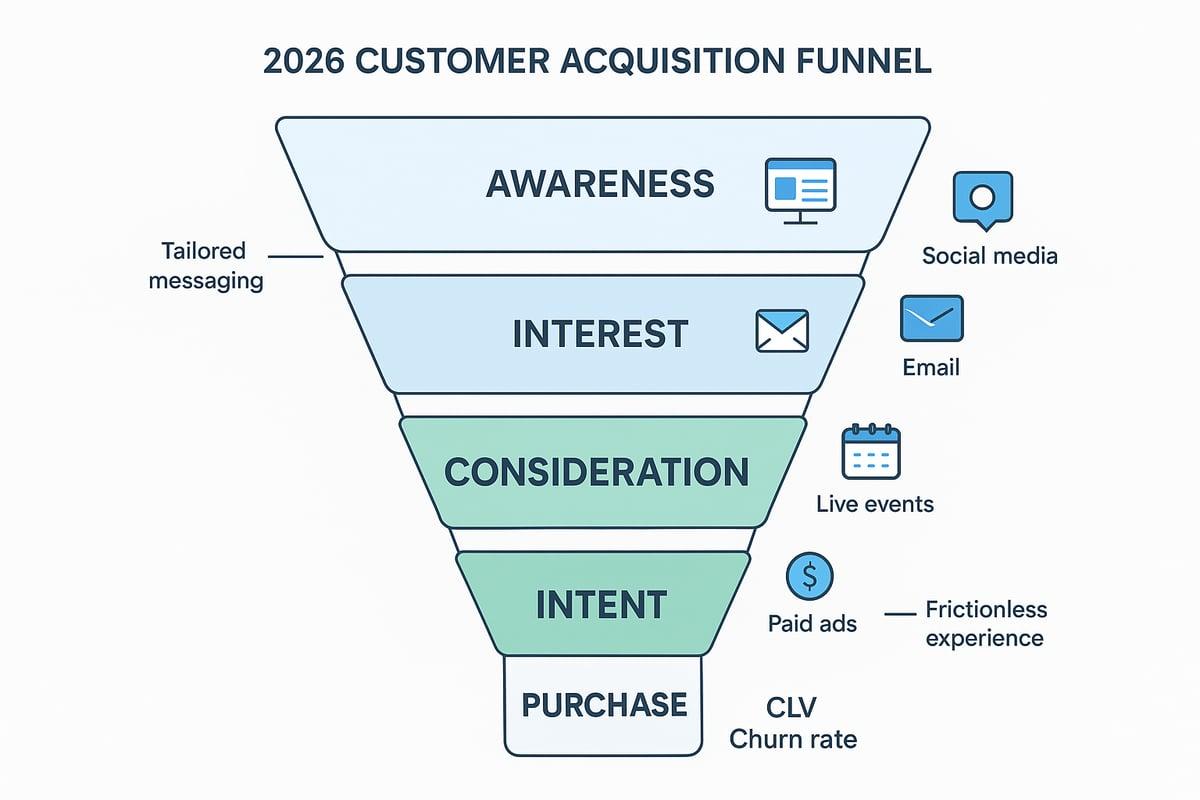
A robust customer acquisition funnel breaks down the journey into clear stages: Awareness, Interest, Consideration, Intent, and Purchase. Each stage needs its own messaging, channels, and tactics to move prospects forward.
Here is a quick breakdown:
| Funnel Stage | Typical Tactics | Example Channels |
|---|---|---|
| Awareness | SEO, blog content, social posts | Google, LinkedIn, Twitter |
| Interest | Educational content, webinars | YouTube, email |
| Consideration | Retargeting, case studies | Paid ads, remarketing |
| Intent | Email nurturing, demos | CRM, direct calls |
| Purchase | Offers, streamlined checkout | E-commerce, in-store |
For example, SEO and content marketing are vital for Awareness, while retargeting ads support Consideration, and personalised email nurturing drives Intent. IBM’s funnel model stresses the importance of customer experience at each stage, ensuring prospects do not drop off due to friction or confusion.
Transitioning smoothly between stages is critical. If your messaging and touchpoints are not aligned, prospects can easily lose interest. Measurement is ongoing: track conversion rates, identify bottlenecks, and optimise every touchpoint.
Retention is often overlooked, but it is the final and essential phase in the customer acquisition lifecycle. Post-purchase follow-ups and loyalty programmes can turn new customers into lifelong brand advocates, maximising both immediate and long-term value.
Building a Winning Customer Acquisition Strategy
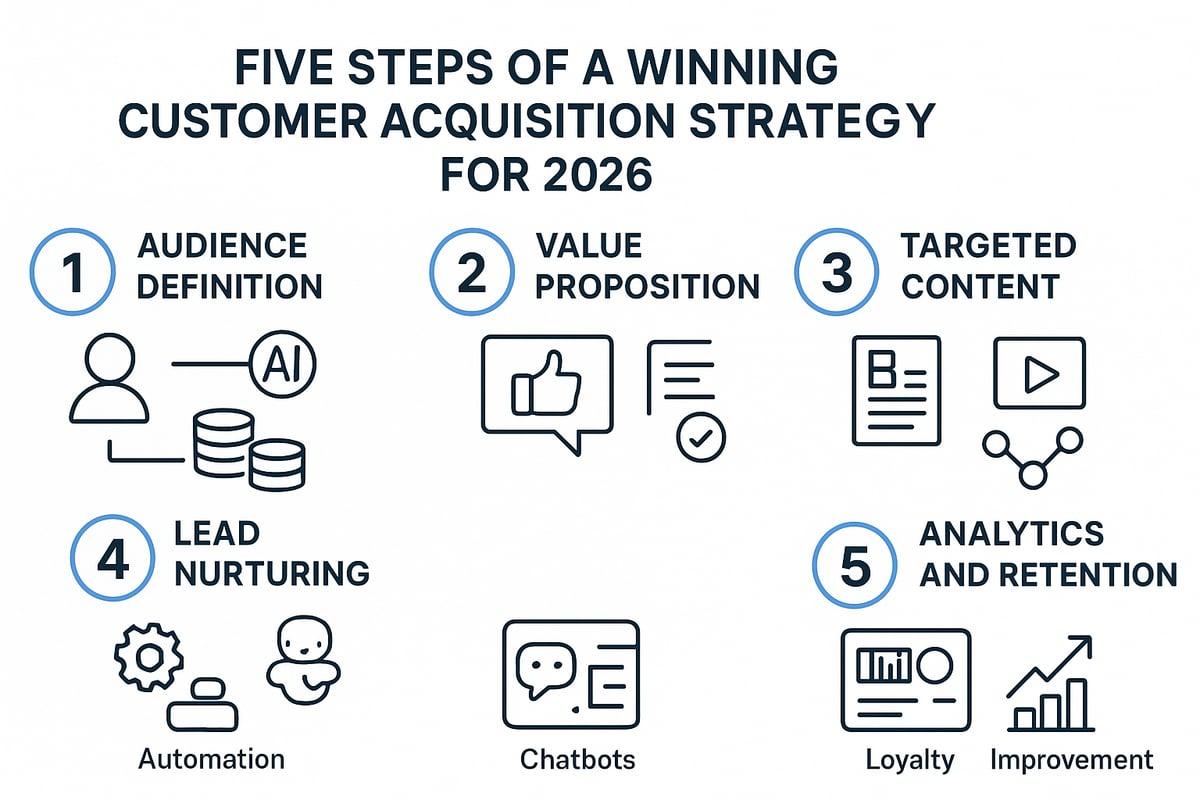
Creating a robust customer acquisition strategy in 2026 means blending timeless marketing wisdom with the latest technology. You need to know exactly who you are targeting, what you offer, and how to deliver value at every stage. Let’s break down the essential steps to help your business win more customers—and keep them coming back for more.

Step 1: Define and Understand Your Target Audience
Every successful customer acquisition journey begins with knowing exactly who you want to attract. This means building detailed buyer personas using both your own data and third-party sources. Look at demographics, behaviours, pain points, and preferences.
For example, you might segment audiences by age, location, or past purchase history. This level of granularity allows you to personalise your campaigns and boost conversion rates. AI tools are a game-changer here, quickly processing large data sets and predicting future behaviours.
IBM highlights how automation and AI can reveal patterns in customer acquisition data that humans might miss. The more you understand your audience, the more effectively you can tailor your content, messaging, and channel choices.
Remember, your customer acquisition strategy should be a living document, always evolving as you learn more about your audience and what drives them to take action.
Step 2: Craft a Compelling Value Proposition
Your value proposition is the heart of your customer acquisition efforts. It’s what sets you apart and convinces prospects to choose you over the competition. The best value propositions directly address your customers’ pain points and desires.
Think about what makes your product or service unique. Is it an innovative feature, exceptional support, or something your competitors simply don’t offer? Make your messaging clear and consistent across every channel.
Testing is crucial. What resonates with one segment might fall flat with another. IBM recommends running cohesive campaigns that reinforce your core value for each audience group.
A strong value proposition not only attracts new customers but also builds loyalty. When people see clear value, they are far more likely to return.
Step 3: Develop Engaging and Targeted Content
Content is the engine that drives customer acquisition through the funnel. You need content for every stage: blog posts for awareness, product demos for consideration, and case studies for decision-making.
Mix up your formats. Use videos, podcasts, social media, and webinars to reach different segments. Personalisation is key—address specific questions and needs for each audience.
AI and automation can help you create and distribute content efficiently. Programmatic advertising and social content, as IBM notes, allow you to deliver the right message at the right moment.
The goal is to keep prospects moving smoothly from awareness to purchase. Well-crafted content answers their questions and builds trust at each step.
Step 4: Implement Lead Nurturing and Conversion Tactics
Turning leads into customers is where many businesses stumble. Lead nurturing is essential for effective customer acquisition. Use email sequences, retargeting ads, and personalised offers to keep your brand front of mind.
For example, send automated emails after a cart is abandoned or follow up with B2B leads via phone. Personalisation increases conversion rates by making every interaction feel relevant.
IBM found that 96 percent of customers who experience high friction simply won’t convert. Seamless journeys are vital. Chatbots and virtual assistants provide instant support, reducing drop-off.
To streamline and scale these tactics, consider marketing automation with AI. These tools help you deliver timely, relevant communication and integrate your efforts across channels.
The right mix of automation and human touch can transform your customer acquisition results.
Step 5: Analyse, Optimise, and Retain
Once you’ve launched your customer acquisition campaigns, it’s time to measure what’s working. Track metrics like conversion rates, cost per acquisition, and customer lifetime value.
A/B testing and performance analytics are your best friends. Use AI to optimise campaigns and make smarter decisions based on real data. IBM recommends continuous auditing and improvement to stay ahead.
Don’t forget retention. Loyalty programmes, post-purchase follow-ups, and exclusive offers for repeat customers add long-term value. For example, automated reminders can keep customers engaged and coming back.
Blending acquisition and retention strategies is the secret to sustainable growth. By constantly analysing and improving, you’ll keep your customer acquisition engine running smoothly.
Advanced Customer Acquisition Tactics for 2026
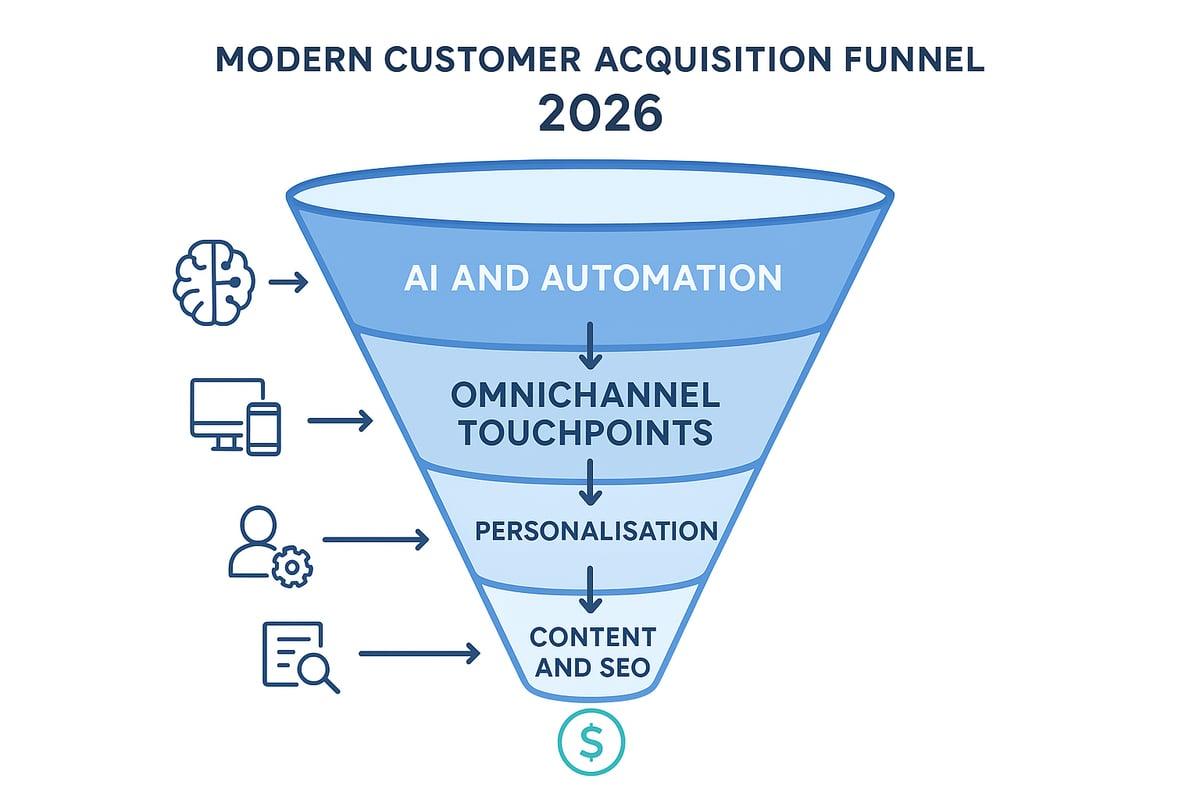
The landscape of customer acquisition in 2026 is evolving rapidly. Businesses need to embrace advanced tactics to stay ahead. Let’s explore the latest strategies, from AI-driven automation to omnichannel experiences, that will define success in the years ahead.

Leveraging AI and Automation
AI is transforming customer acquisition by taking guesswork out of marketing. Predictive analytics, campaign optimisation, and real-time personalisation are now standard. AI-driven ad targeting lets you reach the right audience at the perfect moment. Chatbots and virtual assistants can qualify leads instantly, responding to queries and capturing data 24/7.
Automation tools streamline repetitive tasks, freeing up your team for creative work. Imagine automated recommendations, triggered emails, and dynamic content changing for each visitor. IBM highlights the rise of Robotic Process Automation and AI-powered marketing, which drive efficiency and scale.
Emerging trends include generative AI for content creation and conversational AI for sales. Adoption is soaring, with over half of marketing departments now using AI. For deeper insights, explore AI in Customer Experience: 5 Predictions for 2026, which covers how hyper-personalisation and voice AI are reshaping customer acquisition.
Multi-Channel and Omnichannel Strategies
Today’s customers use multiple touchpoints before making decisions. Multi-channel means being present everywhere, but omnichannel takes it further by connecting these experiences seamlessly. Your customer acquisition strategy should unify messaging across email, social media, search, and even in-store interactions.
Coordinated campaigns boost recognition and trust. For example, a customer might see a product on Instagram, receive a follow-up email, and then visit a physical shop. Marketing automation helps manage these journeys, ensuring every channel works together.
Tracking every interaction is key. Unified data gives you a full view of the customer journey. This leads to higher satisfaction and better conversion rates. Omnichannel excellence is now a must for effective customer acquisition.
Data-Driven Personalisation
Big data is the secret weapon for modern customer acquisition. By analysing behavioural data, you can segment audiences, predict needs, and deliver dynamic offers. Personalised product recommendations and targeted emails are proven to increase engagement and conversions.
IBM notes that customer data is invaluable for refining strategies. But personalisation must respect privacy. Transparent data collection and secure practices are essential for building trust.
AI can automate personalisation at scale, learning from each interaction and adjusting content in real time. The result is a more relevant, memorable experience that keeps customers coming back.
Content Marketing and SEO for Acquisition
Content and SEO work together to power organic customer acquisition. High-quality blog posts, videos, and landing pages answer real customer questions and rank well in search engines. Addressing search intent is vital, as is keeping content fresh and accurate.
IBM considers SEO a foundational tactic. Use keyword research, on-page optimisation, and link building to boost visibility. A table can help you plan:
| Content Type | Funnel Stage | Main Goal |
|---|---|---|
| Blog Post | Awareness | Attract Traffic |
| Product Demo | Consideration | Build Trust |
| Case Study | Intent | Drive Conversion |
Regularly update your content to stay ahead of trends. This builds authority and supports your customer acquisition efforts long term.
Paid Acquisition: PPC, Social, and Affiliate Marketing
Paid channels remain vital for targeted customer acquisition. PPC campaigns on platforms like Google Ads or Meta deliver immediate visibility to high-intent audiences. Social media advertising enables precise targeting based on interests and behaviours.
Affiliate and referral programmes offer cost-effective ways to reach new customers. Influencer partnerships can amplify your message to niche audiences. Always track ROI and adjust budgets for maximum impact.
Integrating paid and organic tactics creates a holistic approach. Monitor performance closely and be ready to pivot as trends shift. Paid strategies, when aligned with your overall customer acquisition plan, drive scalable growth.
Measuring and Optimising Customer Acquisition Success
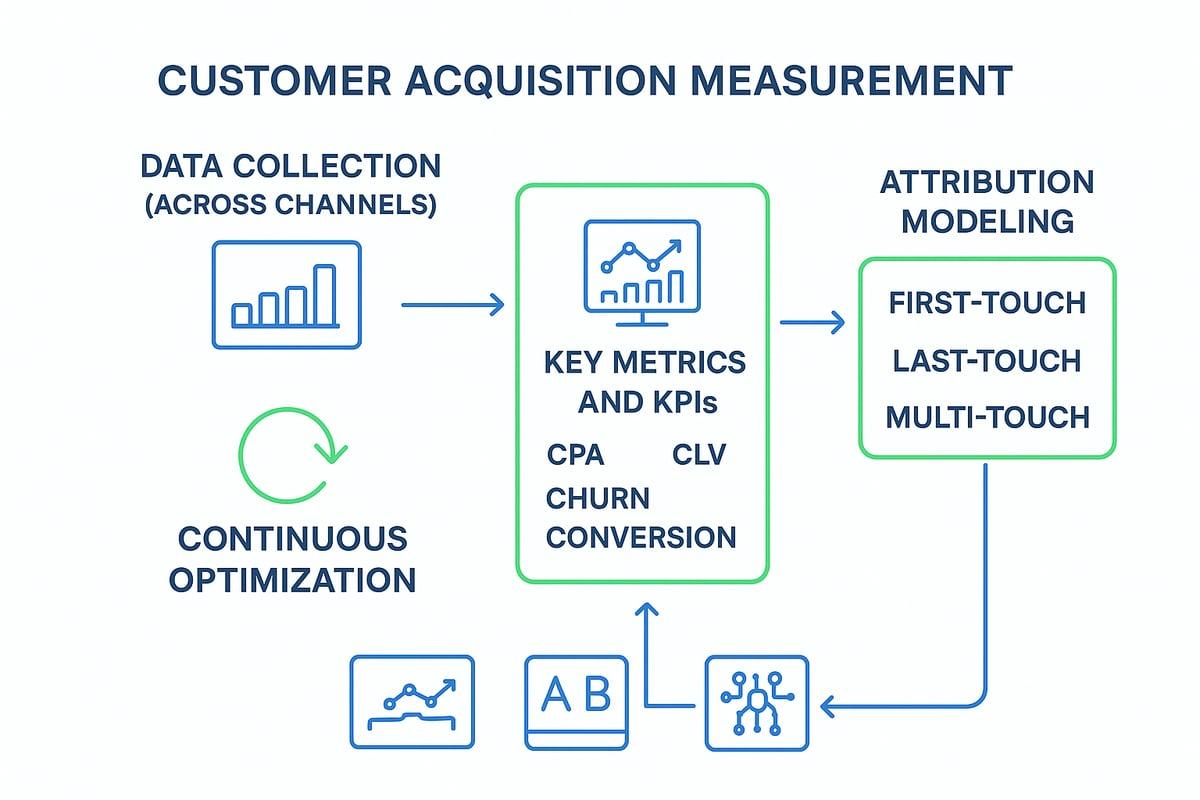
In 2026, tracking and optimising your customer acquisition strategy is non-negotiable. With more data and touchpoints than ever, knowing what works and why separates the winners from the also-rans.
Effective measurement lets you spot leaks in your funnel, cut wasted spend, and double down on what drives real results. Let's break down the process, so you can turn customer acquisition into a predictable growth engine.

Key Metrics and KPIs
Success in customer acquisition starts with the right numbers. If you can't measure it, you can't improve it. Focus on these essential metrics:
| Metric | What It Shows | Formula/Example |
|---|---|---|
| Cost Per Acquisition (CPA) | How much you spend to win a customer | Total spend / Total new customers |
| Conversion Rate | % of prospects who become customers | (Conversions / Visitors) x 100 |
| Customer Lifetime Value (CLV) | Projected revenue from a customer | Avg. spend x Purchase frequency x Retention time |
| Churn Rate | Rate at which customers leave | (Lost customers / Total customers) x 100 |
| ROI | Return on marketing investment | (Revenue – Spend) / Spend |
Use dashboards for real-time tracking. For example, you might reduce CPA by refining targeting or boost CLV with better retention. IBM highlights benchmarking and regular metric reviews as crucial—compare your numbers to industry standards and always look for outliers.
Smart customer acquisition means acting on these insights, not just reporting them. The goal is to spot trends early and react quickly.
Attribution Modelling and Funnel Analysis
Not every customer acquisition touchpoint carries equal weight. Attribution modelling helps you understand which channels and interactions truly move the needle.
Common attribution models:
- First-touch: Credit goes to the first interaction.
- Last-touch: The final touchpoint gets the glory.
- Multi-touch: Shares credit across all key steps.
Funnel analysis maps the journey from awareness to purchase, revealing where prospects drop off. Use this to identify bottlenecks—maybe your retargeting ads drive interest, but your checkout page kills intent.
For deeper insight, advanced analytics tools like Attribution and marketing analytics can show which campaigns deliver the best ROI. Integrating analytics platforms means you get a 360-degree view of your customer acquisition funnel, making it easier to allocate budget where it counts.
IBM recommends regular funnel audits and AI-powered attribution to stay ahead of shifting customer journeys.
Continuous Improvement and Experimentation
Customer acquisition is never “set and forget.” Winning teams test relentlessly. Use A/B and multivariate tests on headlines, calls-to-action, or landing pages. Try new channels, tweak offers, and measure everything.
Collect feedback through customer surveys and user experience tests. Even small changes, like adjusting your signup flow, can lift conversion rates. IBM stresses the power of continuous optimisation, especially when powered by AI.
Adopt AI tools for rapid experimentation and campaign tweaks. Solutions like AI tools for lead capture automate testing and help you learn what converts, faster than any human team.
Build a culture where improvement is constant. The best customer acquisition strategies are agile, data-driven, and never satisfied with “good enough.”
Adapting to Customer Acquisition Trends in 2026
Digital transformation continues at breakneck speed, and customer acquisition is evolving just as quickly. If you want to stay ahead in 2026, adapting to trends is non-negotiable. Let us break down the key shifts you need on your radar.
Embracing New Technologies and Platforms
The rise of AI-powered search engines, like ChatGPT and Perplexity, is rewriting the rules of customer acquisition. Your brand must optimise for generative search, voice assistants, and conversational commerce to stay visible. Ensuring your SEO and content strategies are future-proof is vital, and adopting a mobile-first and video-first approach is now table stakes.
Emerging platforms and channels will shape where and how you engage prospects. For actionable tactics on keeping your digital presence sharp, see these search engine optimisation strategies that drive acquisition in today’s digital-first world.
The Evolving Customer Journey
Customer acquisition journeys are no longer a straight line. Users bounce between devices and channels, expecting instant answers and seamless transitions. Micro-moments, self-service, and contextual experiences define the path to purchase.
Mapping every possible touchpoint is essential. Consider how customers might research on mobile, switch to desktop, and complete a purchase in-store. Blending online and offline experiences keeps your acquisition funnel smooth and reduces drop-offs.
Data Privacy, Trust, and Ethical Marketing
With tighter data privacy laws and rising consumer awareness, trust is currency in customer acquisition. Transparent data collection, secure storage, and clear consent management are now baseline expectations.
Building trust means being upfront about how you use data and respecting customer boundaries. Ethical marketing and responsible AI practices not only keep you compliant but also foster loyalty and long-term relationships.
Skills, Teams, and Culture for Acquisition Success
Winning at customer acquisition in 2026 demands more than just tools. Cross-functional teams—combining marketing, sales, data, and tech—are now the norm. Upskilling in AI, analytics, and digital marketing is essential to keep your edge.
Leadership must champion a culture of experimentation and adaptability. Encourage ongoing training, nurture curiosity, and empower teams to pivot quickly when market dynamics shift.
If you’re serious about turning your marketing efforts into real growth, you know it’s not just about following trends—it’s about building a strategy that actually works for your business. Whether you want more leads, higher conversions, or just a website that finally does its job, you don’t have to go it alone. I’m here to help you cut through the noise and get results that matter. If you fancy a practical chat about how all this applies to your business, let’s have a cuppa and talk shop.
Get free 45 min consultation
The digital world is moving at breakneck speed, and businesses in 2026 face fiercer competition than ever. Customer expectations are shifting, making it clear that winning new customers is not just important, it is essential for survival.
Omnichannel strategies, artificial intelligence, and laser-focused personalisation are rewriting the rules of customer acquisition. If you want to thrive, you need to master these new tools and approaches.
Getting customer acquisition right offers more than just short-term wins. It means building a foundation for sustainable growth, boosting your revenue, and making your business resilient against market shocks.
Curious about what works now? This guide covers the fundamentals, the modern funnel, strategy, advanced tactics, measurement, and how to keep ahead of 2026’s trends. Let’s dive in and set your business up for customer acquisition success.
The Fundamentals of Customer Acquisition in 2026
Understanding the fundamentals of customer acquisition is non-negotiable for any business aiming to thrive in 2026. With digital disruption at an all-time high, the rules of engagement are evolving. Brands that master the basics will be best placed to build sustainable pipelines and outpace the competition.

Defining Customer Acquisition and Its Role
Customer acquisition is the process of turning prospects into paying customers. In 2026, it is no longer about a quick win or a single transaction, but about building a repeatable and scalable approach that delivers ongoing value. The landscape is shaped by omnichannel touchpoints: think websites, social platforms, email campaigns, paid advertising, and in-person events, all working together to guide prospects along their journey.
The rise of digital-first, omnichannel consumer behaviour has added layers of complexity. Customers expect seamless experiences, moving effortlessly between channels. According to IBM, 82% of people now spend less than ten minutes searching before making a decision. This demands frictionless, intuitive processes at every step.
Success in customer acquisition also relies on close collaboration between marketing and sales teams. When both groups align on messaging and goals, they can create a unified pipeline that avoids leaks and maximises results. Measuring customer lifetime value (CLV) and churn rate is now standard practice, helping teams refine strategies and target high-value prospects.
Importantly, customer acquisition is not a one-off event. It is a continuous cycle of attracting, engaging, converting, and retaining customers. For a deeper dive into the latest strategies and cross-functional approaches, see Gartner's Customer Acquisition: Strategies and Guide to Drive Revenue Growth.
The Customer Acquisition Funnel: Stages and Significance
A robust customer acquisition funnel breaks down the journey into clear stages: Awareness, Interest, Consideration, Intent, and Purchase. Each stage needs its own messaging, channels, and tactics to move prospects forward.
Here is a quick breakdown:
| Funnel Stage | Typical Tactics | Example Channels |
|---|---|---|
| Awareness | SEO, blog content, social posts | Google, LinkedIn, Twitter |
| Interest | Educational content, webinars | YouTube, email |
| Consideration | Retargeting, case studies | Paid ads, remarketing |
| Intent | Email nurturing, demos | CRM, direct calls |
| Purchase | Offers, streamlined checkout | E-commerce, in-store |
For example, SEO and content marketing are vital for Awareness, while retargeting ads support Consideration, and personalised email nurturing drives Intent. IBM’s funnel model stresses the importance of customer experience at each stage, ensuring prospects do not drop off due to friction or confusion.
Transitioning smoothly between stages is critical. If your messaging and touchpoints are not aligned, prospects can easily lose interest. Measurement is ongoing: track conversion rates, identify bottlenecks, and optimise every touchpoint.
Retention is often overlooked, but it is the final and essential phase in the customer acquisition lifecycle. Post-purchase follow-ups and loyalty programmes can turn new customers into lifelong brand advocates, maximising both immediate and long-term value.
Building a Winning Customer Acquisition Strategy
Creating a robust customer acquisition strategy in 2026 means blending timeless marketing wisdom with the latest technology. You need to know exactly who you are targeting, what you offer, and how to deliver value at every stage. Let’s break down the essential steps to help your business win more customers—and keep them coming back for more.

Step 1: Define and Understand Your Target Audience
Every successful customer acquisition journey begins with knowing exactly who you want to attract. This means building detailed buyer personas using both your own data and third-party sources. Look at demographics, behaviours, pain points, and preferences.
For example, you might segment audiences by age, location, or past purchase history. This level of granularity allows you to personalise your campaigns and boost conversion rates. AI tools are a game-changer here, quickly processing large data sets and predicting future behaviours.
IBM highlights how automation and AI can reveal patterns in customer acquisition data that humans might miss. The more you understand your audience, the more effectively you can tailor your content, messaging, and channel choices.
Remember, your customer acquisition strategy should be a living document, always evolving as you learn more about your audience and what drives them to take action.
Step 2: Craft a Compelling Value Proposition
Your value proposition is the heart of your customer acquisition efforts. It’s what sets you apart and convinces prospects to choose you over the competition. The best value propositions directly address your customers’ pain points and desires.
Think about what makes your product or service unique. Is it an innovative feature, exceptional support, or something your competitors simply don’t offer? Make your messaging clear and consistent across every channel.
Testing is crucial. What resonates with one segment might fall flat with another. IBM recommends running cohesive campaigns that reinforce your core value for each audience group.
A strong value proposition not only attracts new customers but also builds loyalty. When people see clear value, they are far more likely to return.
Step 3: Develop Engaging and Targeted Content
Content is the engine that drives customer acquisition through the funnel. You need content for every stage: blog posts for awareness, product demos for consideration, and case studies for decision-making.
Mix up your formats. Use videos, podcasts, social media, and webinars to reach different segments. Personalisation is key—address specific questions and needs for each audience.
AI and automation can help you create and distribute content efficiently. Programmatic advertising and social content, as IBM notes, allow you to deliver the right message at the right moment.
The goal is to keep prospects moving smoothly from awareness to purchase. Well-crafted content answers their questions and builds trust at each step.
Step 4: Implement Lead Nurturing and Conversion Tactics
Turning leads into customers is where many businesses stumble. Lead nurturing is essential for effective customer acquisition. Use email sequences, retargeting ads, and personalised offers to keep your brand front of mind.
For example, send automated emails after a cart is abandoned or follow up with B2B leads via phone. Personalisation increases conversion rates by making every interaction feel relevant.
IBM found that 96 percent of customers who experience high friction simply won’t convert. Seamless journeys are vital. Chatbots and virtual assistants provide instant support, reducing drop-off.
To streamline and scale these tactics, consider marketing automation with AI. These tools help you deliver timely, relevant communication and integrate your efforts across channels.
The right mix of automation and human touch can transform your customer acquisition results.
Step 5: Analyse, Optimise, and Retain
Once you’ve launched your customer acquisition campaigns, it’s time to measure what’s working. Track metrics like conversion rates, cost per acquisition, and customer lifetime value.
A/B testing and performance analytics are your best friends. Use AI to optimise campaigns and make smarter decisions based on real data. IBM recommends continuous auditing and improvement to stay ahead.
Don’t forget retention. Loyalty programmes, post-purchase follow-ups, and exclusive offers for repeat customers add long-term value. For example, automated reminders can keep customers engaged and coming back.
Blending acquisition and retention strategies is the secret to sustainable growth. By constantly analysing and improving, you’ll keep your customer acquisition engine running smoothly.
Advanced Customer Acquisition Tactics for 2026
The landscape of customer acquisition in 2026 is evolving rapidly. Businesses need to embrace advanced tactics to stay ahead. Let’s explore the latest strategies, from AI-driven automation to omnichannel experiences, that will define success in the years ahead.

Leveraging AI and Automation
AI is transforming customer acquisition by taking guesswork out of marketing. Predictive analytics, campaign optimisation, and real-time personalisation are now standard. AI-driven ad targeting lets you reach the right audience at the perfect moment. Chatbots and virtual assistants can qualify leads instantly, responding to queries and capturing data 24/7.
Automation tools streamline repetitive tasks, freeing up your team for creative work. Imagine automated recommendations, triggered emails, and dynamic content changing for each visitor. IBM highlights the rise of Robotic Process Automation and AI-powered marketing, which drive efficiency and scale.
Emerging trends include generative AI for content creation and conversational AI for sales. Adoption is soaring, with over half of marketing departments now using AI. For deeper insights, explore AI in Customer Experience: 5 Predictions for 2026, which covers how hyper-personalisation and voice AI are reshaping customer acquisition.
Multi-Channel and Omnichannel Strategies
Today’s customers use multiple touchpoints before making decisions. Multi-channel means being present everywhere, but omnichannel takes it further by connecting these experiences seamlessly. Your customer acquisition strategy should unify messaging across email, social media, search, and even in-store interactions.
Coordinated campaigns boost recognition and trust. For example, a customer might see a product on Instagram, receive a follow-up email, and then visit a physical shop. Marketing automation helps manage these journeys, ensuring every channel works together.
Tracking every interaction is key. Unified data gives you a full view of the customer journey. This leads to higher satisfaction and better conversion rates. Omnichannel excellence is now a must for effective customer acquisition.
Data-Driven Personalisation
Big data is the secret weapon for modern customer acquisition. By analysing behavioural data, you can segment audiences, predict needs, and deliver dynamic offers. Personalised product recommendations and targeted emails are proven to increase engagement and conversions.
IBM notes that customer data is invaluable for refining strategies. But personalisation must respect privacy. Transparent data collection and secure practices are essential for building trust.
AI can automate personalisation at scale, learning from each interaction and adjusting content in real time. The result is a more relevant, memorable experience that keeps customers coming back.
Content Marketing and SEO for Acquisition
Content and SEO work together to power organic customer acquisition. High-quality blog posts, videos, and landing pages answer real customer questions and rank well in search engines. Addressing search intent is vital, as is keeping content fresh and accurate.
IBM considers SEO a foundational tactic. Use keyword research, on-page optimisation, and link building to boost visibility. A table can help you plan:
| Content Type | Funnel Stage | Main Goal |
|---|---|---|
| Blog Post | Awareness | Attract Traffic |
| Product Demo | Consideration | Build Trust |
| Case Study | Intent | Drive Conversion |
Regularly update your content to stay ahead of trends. This builds authority and supports your customer acquisition efforts long term.
Paid Acquisition: PPC, Social, and Affiliate Marketing
Paid channels remain vital for targeted customer acquisition. PPC campaigns on platforms like Google Ads or Meta deliver immediate visibility to high-intent audiences. Social media advertising enables precise targeting based on interests and behaviours.
Affiliate and referral programmes offer cost-effective ways to reach new customers. Influencer partnerships can amplify your message to niche audiences. Always track ROI and adjust budgets for maximum impact.
Integrating paid and organic tactics creates a holistic approach. Monitor performance closely and be ready to pivot as trends shift. Paid strategies, when aligned with your overall customer acquisition plan, drive scalable growth.
Measuring and Optimising Customer Acquisition Success
In 2026, tracking and optimising your customer acquisition strategy is non-negotiable. With more data and touchpoints than ever, knowing what works and why separates the winners from the also-rans.
Effective measurement lets you spot leaks in your funnel, cut wasted spend, and double down on what drives real results. Let's break down the process, so you can turn customer acquisition into a predictable growth engine.

Key Metrics and KPIs
Success in customer acquisition starts with the right numbers. If you can't measure it, you can't improve it. Focus on these essential metrics:
| Metric | What It Shows | Formula/Example |
|---|---|---|
| Cost Per Acquisition (CPA) | How much you spend to win a customer | Total spend / Total new customers |
| Conversion Rate | % of prospects who become customers | (Conversions / Visitors) x 100 |
| Customer Lifetime Value (CLV) | Projected revenue from a customer | Avg. spend x Purchase frequency x Retention time |
| Churn Rate | Rate at which customers leave | (Lost customers / Total customers) x 100 |
| ROI | Return on marketing investment | (Revenue – Spend) / Spend |
Use dashboards for real-time tracking. For example, you might reduce CPA by refining targeting or boost CLV with better retention. IBM highlights benchmarking and regular metric reviews as crucial—compare your numbers to industry standards and always look for outliers.
Smart customer acquisition means acting on these insights, not just reporting them. The goal is to spot trends early and react quickly.
Attribution Modelling and Funnel Analysis
Not every customer acquisition touchpoint carries equal weight. Attribution modelling helps you understand which channels and interactions truly move the needle.
Common attribution models:
- First-touch: Credit goes to the first interaction.
- Last-touch: The final touchpoint gets the glory.
- Multi-touch: Shares credit across all key steps.
Funnel analysis maps the journey from awareness to purchase, revealing where prospects drop off. Use this to identify bottlenecks—maybe your retargeting ads drive interest, but your checkout page kills intent.
For deeper insight, advanced analytics tools like Attribution and marketing analytics can show which campaigns deliver the best ROI. Integrating analytics platforms means you get a 360-degree view of your customer acquisition funnel, making it easier to allocate budget where it counts.
IBM recommends regular funnel audits and AI-powered attribution to stay ahead of shifting customer journeys.
Continuous Improvement and Experimentation
Customer acquisition is never “set and forget.” Winning teams test relentlessly. Use A/B and multivariate tests on headlines, calls-to-action, or landing pages. Try new channels, tweak offers, and measure everything.
Collect feedback through customer surveys and user experience tests. Even small changes, like adjusting your signup flow, can lift conversion rates. IBM stresses the power of continuous optimisation, especially when powered by AI.
Adopt AI tools for rapid experimentation and campaign tweaks. Solutions like AI tools for lead capture automate testing and help you learn what converts, faster than any human team.
Build a culture where improvement is constant. The best customer acquisition strategies are agile, data-driven, and never satisfied with “good enough.”
Adapting to Customer Acquisition Trends in 2026
Digital transformation continues at breakneck speed, and customer acquisition is evolving just as quickly. If you want to stay ahead in 2026, adapting to trends is non-negotiable. Let us break down the key shifts you need on your radar.
Embracing New Technologies and Platforms
The rise of AI-powered search engines, like ChatGPT and Perplexity, is rewriting the rules of customer acquisition. Your brand must optimise for generative search, voice assistants, and conversational commerce to stay visible. Ensuring your SEO and content strategies are future-proof is vital, and adopting a mobile-first and video-first approach is now table stakes.
Emerging platforms and channels will shape where and how you engage prospects. For actionable tactics on keeping your digital presence sharp, see these search engine optimisation strategies that drive acquisition in today’s digital-first world.
The Evolving Customer Journey
Customer acquisition journeys are no longer a straight line. Users bounce between devices and channels, expecting instant answers and seamless transitions. Micro-moments, self-service, and contextual experiences define the path to purchase.
Mapping every possible touchpoint is essential. Consider how customers might research on mobile, switch to desktop, and complete a purchase in-store. Blending online and offline experiences keeps your acquisition funnel smooth and reduces drop-offs.
Data Privacy, Trust, and Ethical Marketing
With tighter data privacy laws and rising consumer awareness, trust is currency in customer acquisition. Transparent data collection, secure storage, and clear consent management are now baseline expectations.
Building trust means being upfront about how you use data and respecting customer boundaries. Ethical marketing and responsible AI practices not only keep you compliant but also foster loyalty and long-term relationships.
Skills, Teams, and Culture for Acquisition Success
Winning at customer acquisition in 2026 demands more than just tools. Cross-functional teams—combining marketing, sales, data, and tech—are now the norm. Upskilling in AI, analytics, and digital marketing is essential to keep your edge.
Leadership must champion a culture of experimentation and adaptability. Encourage ongoing training, nurture curiosity, and empower teams to pivot quickly when market dynamics shift.
If you’re serious about turning your marketing efforts into real growth, you know it’s not just about following trends—it’s about building a strategy that actually works for your business. Whether you want more leads, higher conversions, or just a website that finally does its job, you don’t have to go it alone. I’m here to help you cut through the noise and get results that matter. If you fancy a practical chat about how all this applies to your business, let’s have a cuppa and talk shop.
Get free 45 min consultation