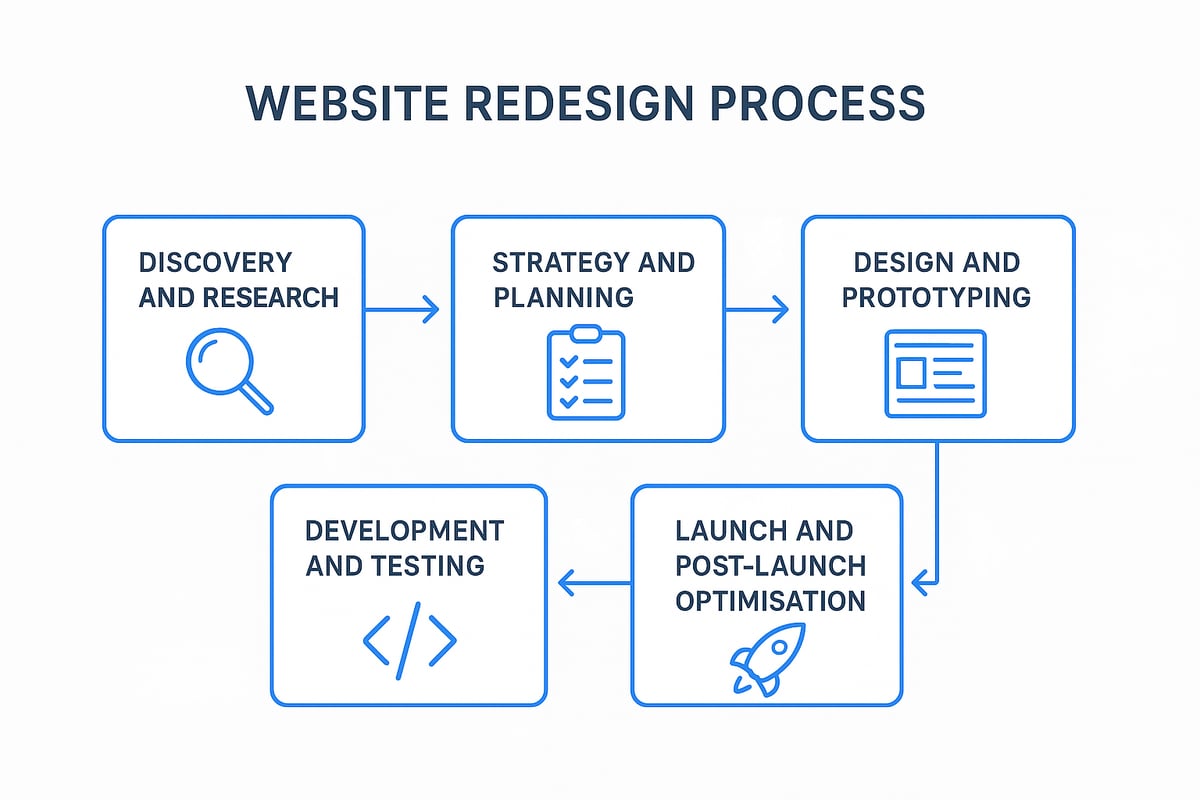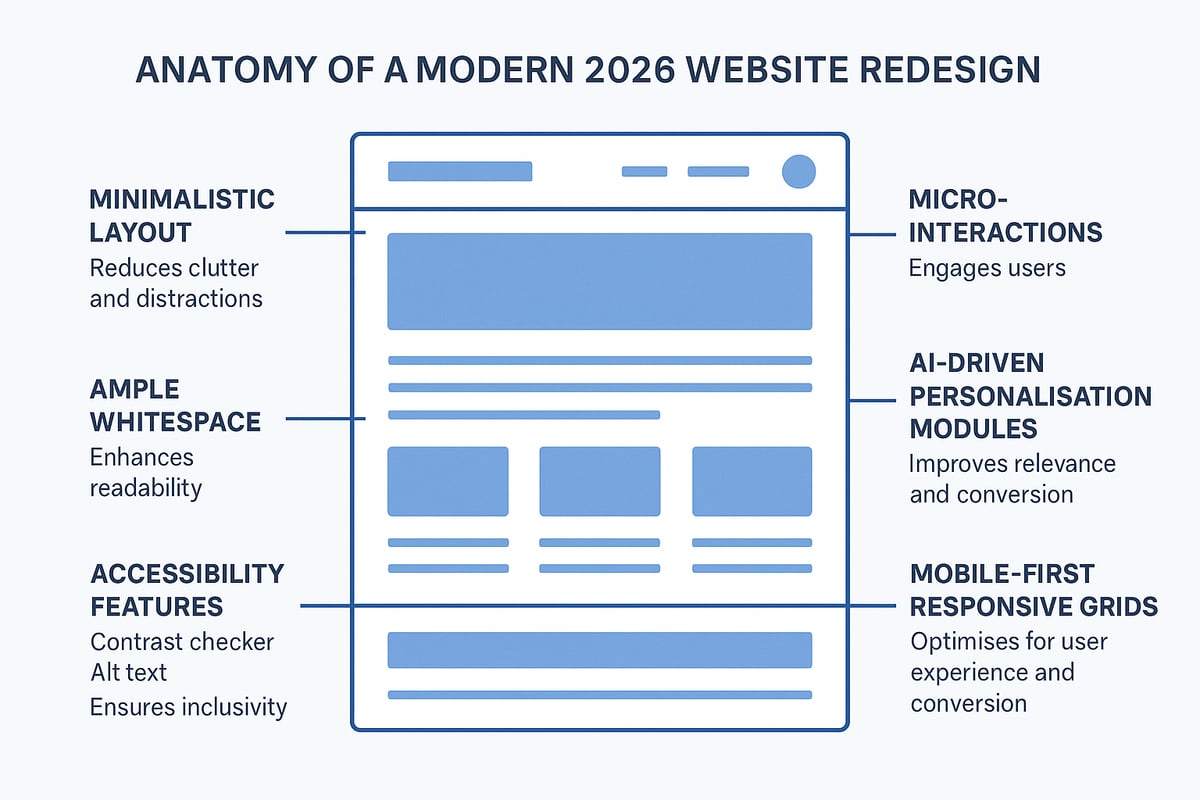

Company Address
The Mercian
218 Broad Street
Birmingham, B15 1FF

Author: Matt Harrison

Event Tracking Guide: Master Analytics in 2026

The world of data-driven marketing is moving at breakneck speed. By 2026, businesses that want a genuine competitive edge must stay ahead of the curve.

Event tracking is now at the heart of understanding how users behave online. It’s the key to optimising digital experiences and unlocking new revenue streams.

If you’re a marketer, analyst, or business owner, mastering event tracking is no longer a ‘nice to have’. It’s essential for making smarter decisions, personalising interactions, and squeezing the most value from every pound spent.

In this guide, I’ll break down everything you need to know. From the basics to advanced analytics, tool selection, and hands-on steps, you’ll learn how to turn event tracking into your secret weapon for 2026.

Understanding Event Tracking: The Foundation of Modern Analytics

Event tracking is the process of capturing and analysing every meaningful interaction users have across your digital platforms. It goes beyond simple page views, recording data points like button clicks, purchases, video plays, and form submissions. Each event is timestamped, giving you a precise behavioural footprint for every user journey. This granular approach forms the backbone of modern behavioural analytics. By tracking these micro-interactions, businesses gain a competitive advantage through a deeper understanding of customer movements across marketing channels. For a comprehensive look at how event tracking drives retention, see this deep dive into event tracking solutions that drive retention.

Understanding Event Tracking: The Foundation of Modern Analytics

What Is Event Tracking?

At its core, event tracking captures specific user activities on your website or app. These activities include actions like clicking a button, submitting a form, viewing a product, or even scrolling to a certain section. Each event is a rich, timestamped data point that tells you exactly what happened and when. Imagine knowing not just that a user visited your site, but also which features they interacted with and which pages they skipped. This level of detail is essential for understanding user journeys and building a data-driven marketing stack. Event tracking is what turns anonymous traffic into actionable insights for your business.

Why Event Tracking Matters in 2026

In 2026, data-driven decision-making is not just a buzzword, it is the expected standard. Event tracking unlocks actionable insights that power personalisation, campaign attribution, and conversion optimisation. With ongoing changes in privacy laws like GDPR and CCPA, businesses need to collect data thoughtfully and transparently. Event tracking can be configured to respect user consent and privacy preferences, keeping you compliant while still delivering value. Companies using event tracking report higher engagement and conversion rates because they can fine-tune products, services, and marketing actions based on real behaviour. Understanding these interactions is crucial for staying ahead.

Key Types of Events to Track

There are several key types of events you should be tracking. User interaction events include clicks, scrolls, downloads, and video plays. Engagement events measure time on page, session repeats, social shares, and comments. Conversion events capture sign-ups, purchases, add-to-cart actions, and each step in the checkout process. Technical events monitor page load times, errors, and JavaScript issues. For example, tracking abandoned carts allows you to retarget users with personalised offers, while monitoring video engagement helps shape your content strategy. By covering these core categories, event tracking provides a holistic view of user behaviour.

Event Tracking vs. Traditional Analytics

Traditional analytics tools often focus on pageviews and sessions, providing a high-level view of traffic. In contrast, event tracking delivers richer, more actionable data by capturing every micro-interaction. This enables advanced techniques like funnel analysis, cohort segmentation, and real-time optimisation. Traditional analytics can miss out on important details, especially when users switch between devices or interact across multiple channels. Event tracking supports multi-channel attribution and helps marketers uncover hidden patterns, optimise user funnels, and troubleshoot workflow breakdowns. With event tracking, you gain a powerful lens for deep customer behaviour analysis.

Core Event Tracking Data Types and Use Cases

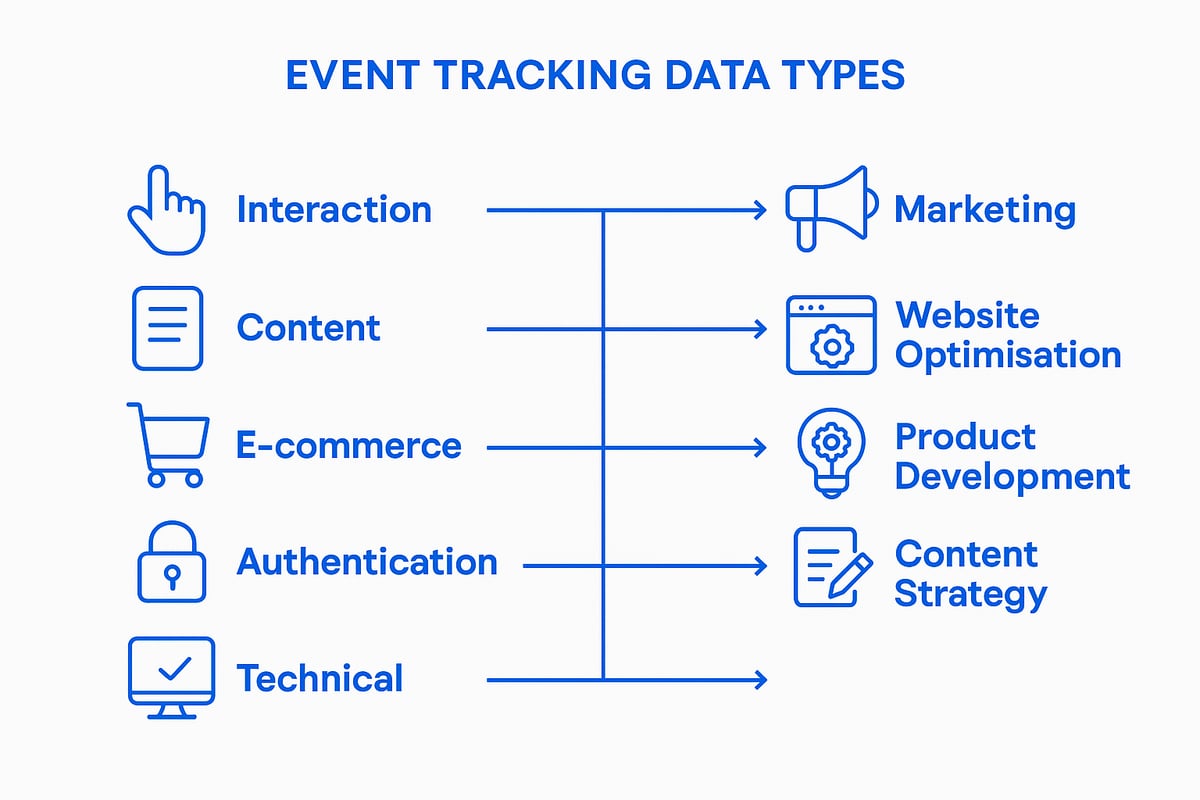
Understanding the diversity of event tracking data types is crucial for unlocking actionable insights. Let’s break down the main categories and see how businesses can use this data to supercharge growth.

Core Event Tracking Data Types and Use Cases

Detailed Breakdown of Event Data Types

Event tracking covers a wide range of user actions and technical signals. Here are the key data types you should know:

  • Interaction-based events: Button clicks, form interactions, scroll depth, and hover actions. These reveal how users engage with specific elements.
  • Content engagement events: Page views, downloads, search queries, likes, shares, and comments. Perfect for understanding what content drives attention.
  • E-commerce events: Product views, add-to-cart, purchases, and checkout abandonment. Essential for tracking the shopping funnel.
  • Authentication events: Sign-up, login, and logout. These highlight user onboarding and retention.
  • Technical performance events: Load times, errors, and network activity. Useful for spotting issues before they hit your bottom line.

For example, an e-commerce site might track add-to-cart and checkout abandonment events to trigger retargeting campaigns. By capturing this range of data, your event tracking foundation will be rock solid.

Marketing and Advertising Use Cases

When it comes to marketing, event tracking is your secret weapon for smarter campaigns. Here’s how it gets results:

  • Measure campaign effectiveness: Track clicks, conversions, and engagement from each channel.
  • Optimise ad targeting: Segment audiences using event data for highly relevant messaging.
  • Personalise communications: Trigger emails or ads based on specific user actions.

For instance, if a user abandons their cart, automated reminders can be sent, boosting your recovery rates. As a result, event tracking lets you tweak campaigns in real time, driving higher engagement and revenue.

Website and App Optimisation Use Cases

Event tracking is invaluable for website and app optimisation. Businesses can:

  • Spot popular content: Analyse page views and scroll depth to see what resonates with users.
  • Identify navigation bottlenecks: Use drop-off and error tracking to fix friction points.
  • Inform A/B testing: Base experiments on real user behaviour data.

By tracking form submission errors, you can improve conversion rates and user satisfaction. For more ideas on using event tracking for performance and UX, check out these website optimisation insights. This approach ensures your site evolves with your audience’s needs.

Product Development and Content Strategy Use Cases

Event tracking is a game changer for product and content teams. Here’s how:

  • Analyse feature usage: See which tools or features get the most love, helping you prioritise development.
  • Measure product adoption: Track sign-ups and engagement events to spot onboarding gaps.
  • Optimise content distribution: Use event data to personalise recommendations and delivery.

Take a streaming platform, for example. By tracking listening habits, it can recommend personalised playlists and boost engagement. Analysing in-app feature usage and user feedback helps businesses refine their products and content for maximum impact.

The Mechanics: How Event Tracking Works in 2026

Understanding how event tracking works in 2026 is the key to unlocking actionable insights for your business. Let’s break down the process, step by step, so you can implement, optimise, and maintain a robust event tracking setup that delivers real value.
The Mechanics: How Event Tracking Works in 2026

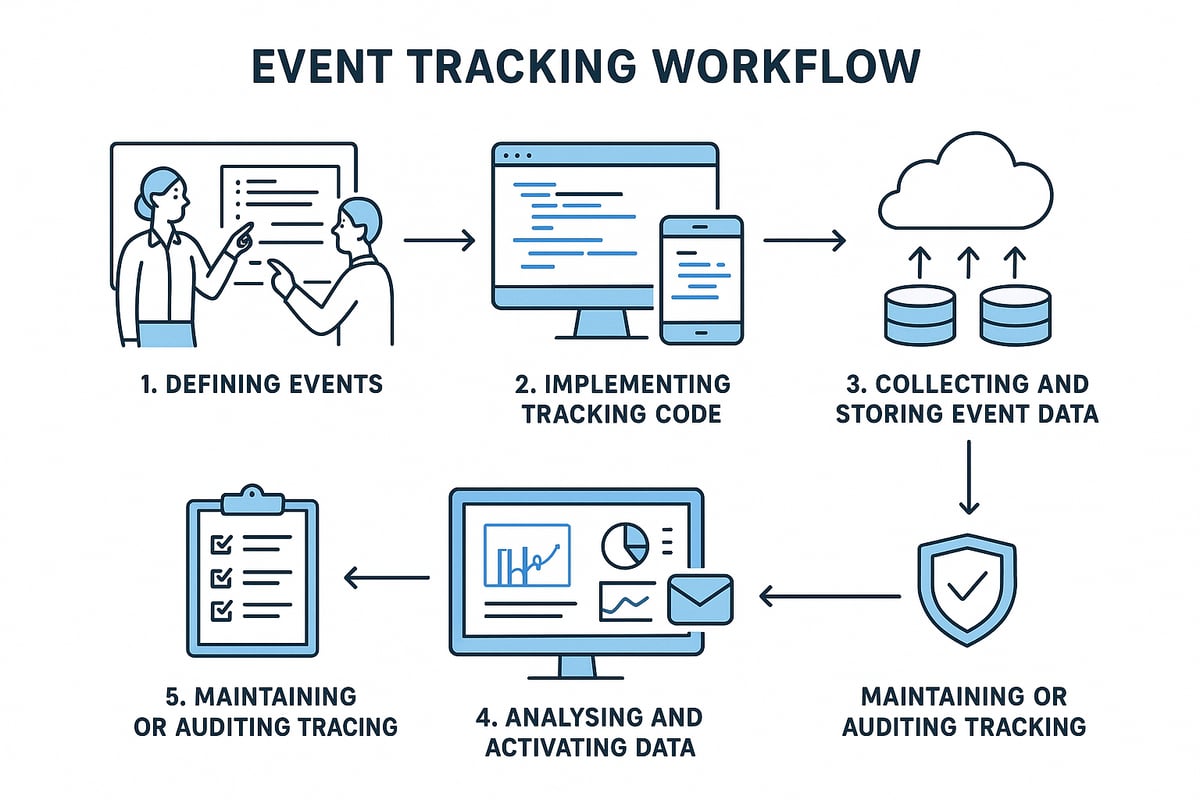
Step 1: Define Your Events

The first step in event tracking is working with stakeholders to identify which user actions matter most to your business goals. Get everyone from marketing, product, and analytics around the table.

Categorise your events into groups like conversions, micro-interactions, and technical actions. This clarity ensures nothing important slips through the cracks.

Document event names, categories, actions, and labels. For example, an online retailer might set:

Event Name Category Action Label
product_view E-commerce View Product ID
add_to_cart E-commerce Add to Cart Product ID
purchase Conversion Complete Purchase Order ID

Consistent documentation means your event tracking foundation will be solid, making future analysis a breeze.

Step 2: Implement Tracking Code and SDKs

Once you’ve defined your events, it’s time to put event tracking in motion by embedding tracking code or SDKs into your website or app.

Choose the right tool for your platform, whether it’s JavaScript for web, native SDKs for mobile, or server-side libraries. Tools like Google Tag Manager give you flexibility to manage events without editing raw code.

Here’s a simple example using JavaScript:

window.dataLayer.push({
  event: 'add_to_cart',
  product_id: '12345'
});

Follow naming conventions and test for consistency. This step ensures every user action you care about is captured reliably by your event tracking setup.

Step 3: Collect and Store Event Data

Every tracked event gets sent to your analytics platform or data warehouse. This happens in real time or in batches, depending on your setup.

A typical event payload includes:

  • Event name
  • Timestamp
  • User ID
  • Device and browser info
  • Custom properties (e.g., product category, campaign source)

Storing this data in cloud-based solutions like BigQuery or Snowflake gives you scalability and security. Your event tracking data becomes the backbone for dashboards, reports, and business decisions.

Step 4: Analyse and Activate Event Data

With all your event tracking data in place, it’s time to extract insights. Use dashboards to visualise events, monitor KPIs, and spot trends.

Go deeper with funnel analysis, cohort segmentation, and user journey mapping. You can trigger automations, like remarketing emails or personalised offers, based on specific user actions. If you’re interested in how AI is taking this even further, check out how AI data analytics for marketers is changing the game for smarter, faster decision-making.

The real magic of event tracking is turning raw data into actions that drive growth.

Step 5: Maintain, Audit, and Optimise Tracking

Event tracking isn’t a set-and-forget process. Regularly review your event taxonomy to make sure it aligns with evolving business needs.

Audit your data for gaps, redundancies, or errors. Fix broken events and keep documentation up to date. Stay compliant with regulations like GDPR by updating consent mechanisms and ensuring data privacy.

Schedule quarterly audits and involve your team in maintaining the integrity of your event tracking. This way, your insights will always be trustworthy and actionable.

Choosing and Comparing Event Tracking Tools for 2026

Selecting the right event tracking tool can make or break your analytics strategy in 2026. With the landscape evolving rapidly, businesses need solutions that deliver real-time insights, scale effortlessly, and respect user privacy. Let’s break down what to look for, compare top platforms, and see how to make the best choice for your organisation.

Choosing and Comparing Event Tracking Tools for 2026

Essential Features to Look For

When evaluating event tracking tools, focus on features that future-proof your data stack. Real-time analytics are crucial for acting on user behaviour as it happens. Scalability matters, especially if your data volumes or event types grow.

You’ll want flexibility to track events across web, mobile, and server environments. Native integrations with marketing, analytics, and warehouse tools save hours during setup. Data governance, privacy controls, and compliance (think GDPR) are no longer optional. Look for role-based access and audit trails to keep things secure.

A reliable event tracking tool should also offer robust APIs or composability, making it easy to adapt as your needs change. This foundation ensures your analytics can support everything from attribution to personalisation.

Leading Event Tracking Platforms: Overview

Let’s compare the leaders shaping event tracking in 2026:

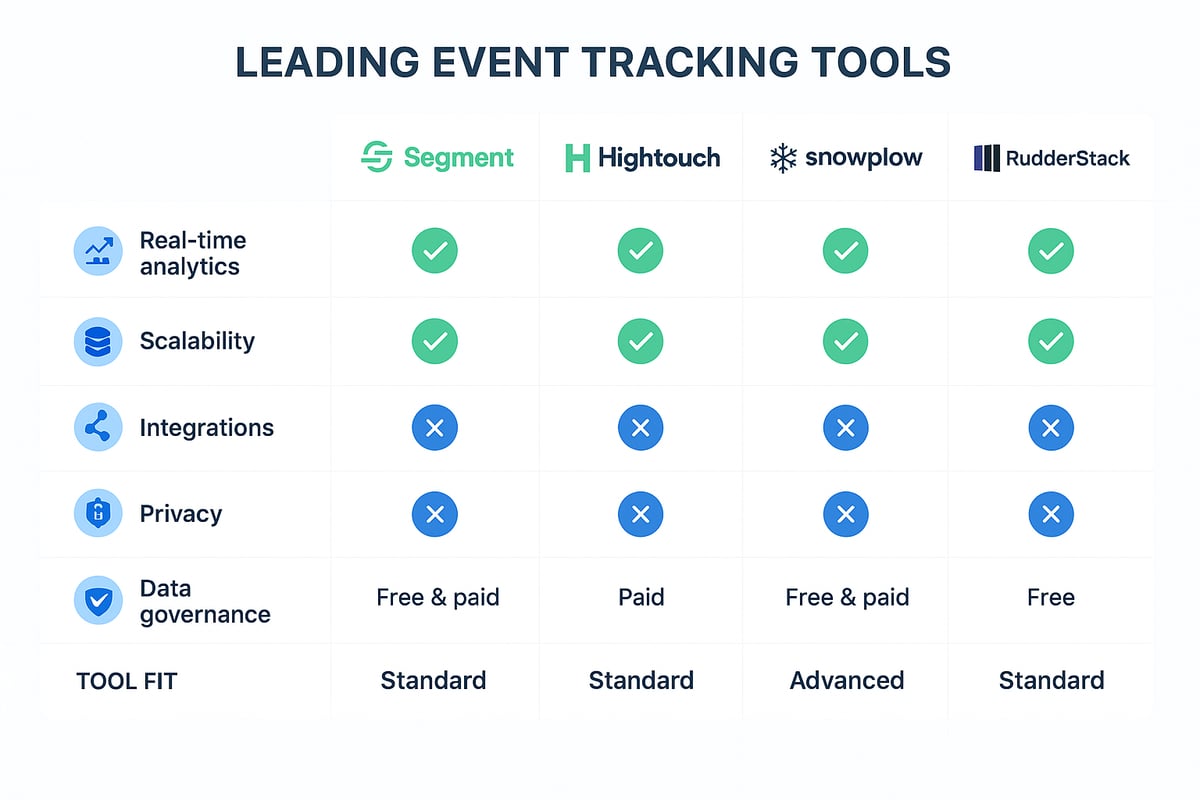
Platform Core Strength Integration Style Privacy Focus Real-Time Data
Segment Full-featured CDP, activation Native, APIs Strong Yes
Hightouch Warehouse-native, composable Data warehouse Good Yes
Snowplow Open-source, customisable Pipelines, APIs Customisable Yes
RudderStack Real-time, 200+ integrations Native, APIs Privacy-first Yes

Segment offers bundled collection and activation, ideal for businesses wanting an all-in-one approach. Hightouch is perfect if you want event tracking that lives natively in your warehouse. Snowplow stands out for those needing custom setups or open-source flexibility. RudderStack impresses with real-time streaming and a privacy-first design.

Differences come down to composability, integration ecosystem, and real-time capability. Assess which aligns best with your event tracking ambitions.

Evaluating Tool Fit for Your Business

How do you know which event tracking tool suits your business? Start with your size and analytics maturity. SMEs may benefit from plug-and-play options like Segment or RudderStack, which require less engineering lift.

Think about your existing data stack. If you already use BigQuery or Salesforce, check for seamless integration. Pricing models differ: Segment and RudderStack offer usage-based plans, while Snowplow’s open-source approach may suit tech-savvy teams.

Evaluate support, documentation, and community resources. A strong community means faster troubleshooting. Prioritise tools that fit your technical resources and long-term event tracking goals.

Implementation and Migration Considerations

Implementing or migrating event tracking tools requires careful planning. Start by mapping your event taxonomy and documenting all required events. If moving from a legacy platform, plan for data migration to avoid losing historical insight.

Minimise disruption by rolling out event tracking in phases. Use staging environments to validate data before going live. Train your teams on new dashboards and workflows to ensure everyone can act on fresh insights.

Documentation and version control are your friends. This keeps your event tracking implementation robust and future-proof as business needs evolve.

How Specialist Agencies Can Help SMEs Master Event Tracking

Many SMEs lack in-house analytics expertise. That’s where specialist agencies step in, bridging the gap with hands-on event tracking setup across platforms like Shopify, WordPress, and Squarespace.

Agencies combine event tracking with CRO, SEO, and paid ads to drive measurable business growth. They provide ongoing training, automate reporting, and help you unlock the full value of your data.

Explore conversion rate optimisation strategies to see how expert guidance can turn your event tracking into higher leads and sales. The right partner will tailor solutions to your goals, ensuring every tracked event moves your business forward.

Advanced Strategies: Extracting Maximum Value from Event Analytics

Event tracking is not just about collecting data, it is about using it to drive real business outcomes. When you master advanced strategies, you can uncover hidden patterns, optimise every touchpoint, and future proof your marketing. Let us dive into how you can extract maximum value from event tracking analytics.

Multi-Channel Attribution and Customer Journey Mapping

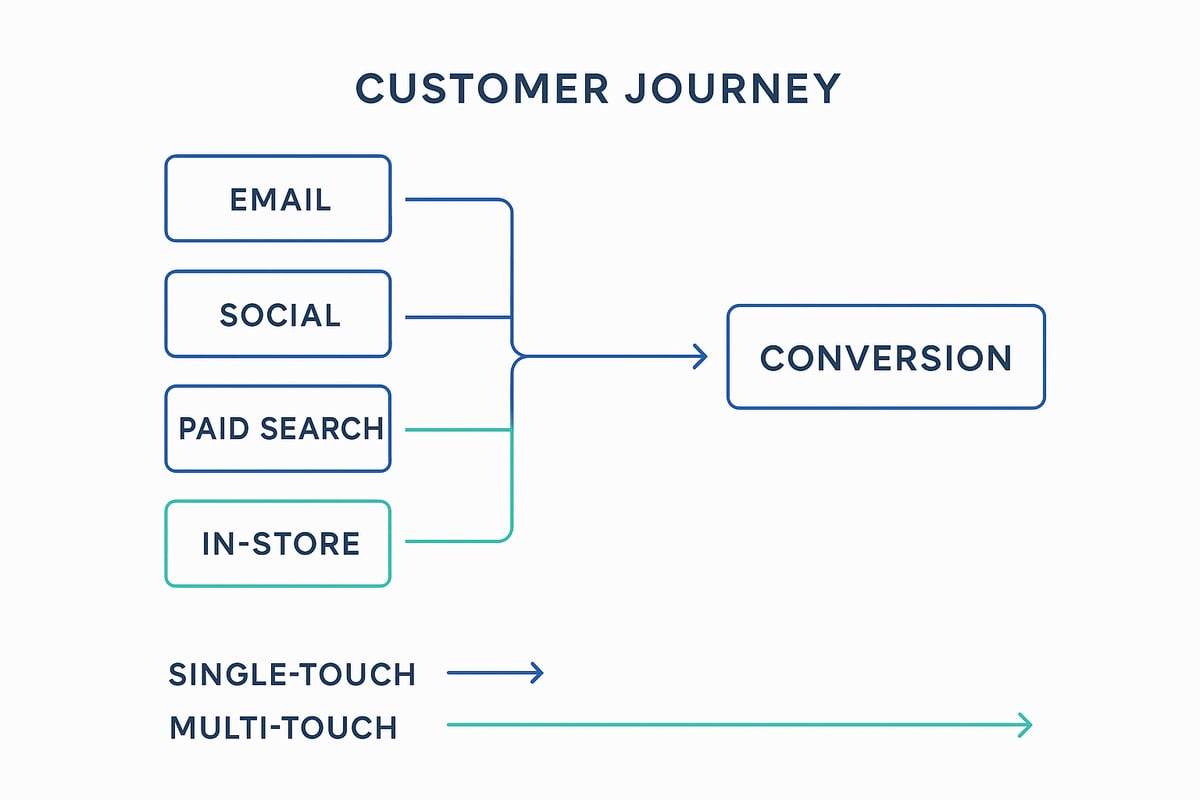
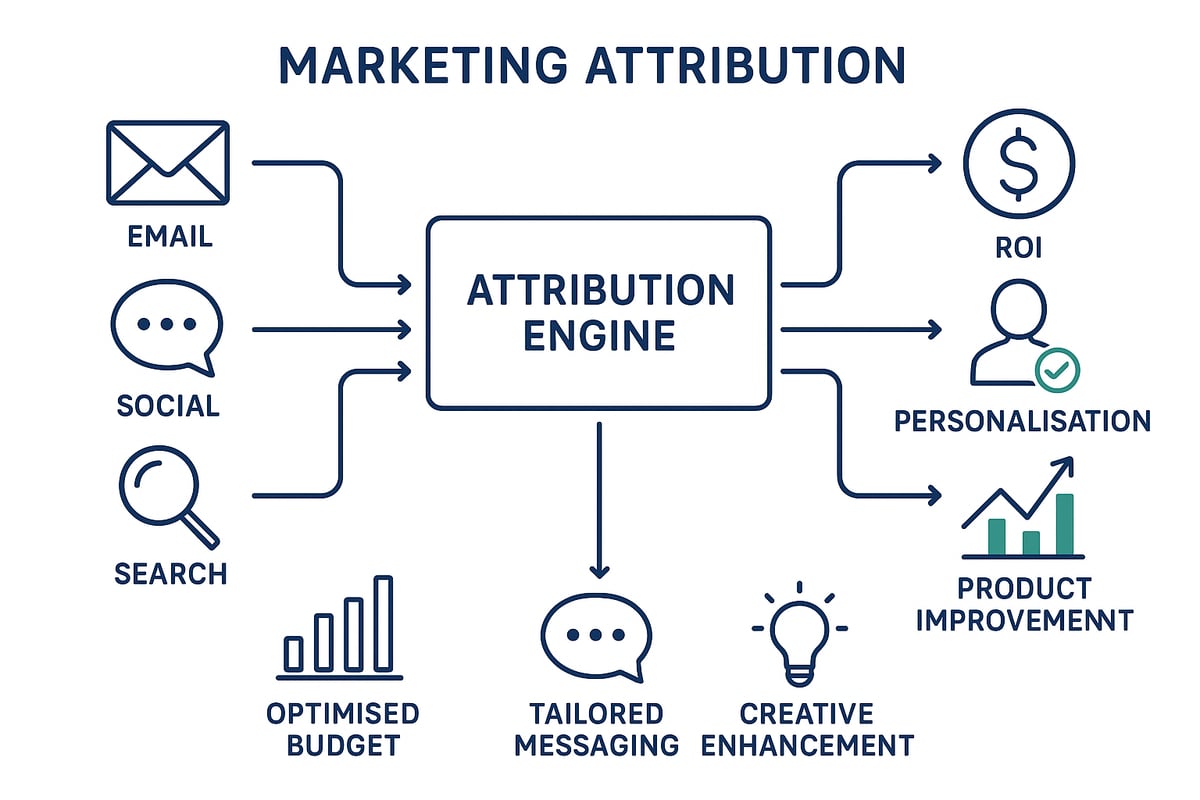
Attribution is all about understanding where your conversions come from. Event tracking lets you connect the dots across ads, email, organic search, and more. By tagging campaigns with UTM parameters and tracking each event, you build a complete map of your customer’s journey.

For example, a retailer might discover that a Facebook ad led to an email signup, which then triggered a purchase days later. With event tracking, every touchpoint is logged and analysed. This means you can stop guessing and start investing in what truly works.

Use visual journey maps and funnel charts to spot drop offs and optimise the entire path to conversion. With event tracking, your marketing is no longer a black box.

Personalisation and Real-Time Experience Optimisation

Personalisation starts with data. Event tracking gives you the behavioural signals you need to tailor content, offers, and experiences to every user. Want to show a targeted popup to someone who abandoned their cart? Or recommend a playlist based on listening history? All of this comes from smart event tracking.

The magic happens when you combine real time triggers with automation and AI. For a deep dive, check out Marketing automation with AI for practical ways to use event data for smarter campaigns.

Segment users by actions, trigger chatbots, or launch dynamic offers—event tracking is your toolkit for delivering the right message at the right time.

A/B Testing, Experimentation, and Product Iteration

If you are not testing, you are guessing. Event tracking powers experimentation by measuring exactly what users do when faced with different versions of a page or feature. Set up A/B or multivariate tests and track conversions, engagement, or drop offs for each variant.

Here is a quick table to illustrate:

Test Variant Event Tracked Result
Original Button Click 4% conversion
New Copy Button Click 5.2% conversion
New Design Button Click 6% conversion

With event tracking, you can iterate quickly, validate ideas, and scale what works. Use code like analytics.track('signup', { plan: 'pro' }) to capture every interaction.

Data Quality, Privacy, and Governance in 2026

Quality data is the backbone of every successful event tracking strategy. Regular audits keep your data clean and actionable. Check for broken events, redundant tags, or missing properties. Use validation scripts and dashboards to monitor data flow continuously.

Privacy is just as important. Event tracking must respect user consent and comply with regulations like GDPR. Anonymise personal data, restrict access, and keep detailed audit logs.

Establish clear data governance policies. Document every tracked event, update your taxonomy, and train your team. This way, your event tracking remains robust and trustworthy as your business grows.

Future Trends: AI and Predictive Analytics in Event Tracking

Looking ahead, AI is set to revolutionise event tracking. Predictive models will spot trends, forecast churn, and automatically segment users based on behaviour. Imagine knowing which customer is likely to buy next week—or which feature will drive the most engagement.

Event tracking data will feed directly into generative AI, powering personalised recommendations and smart content curation. You will see integrations with voice, IoT, and new digital channels, expanding the scope of what you can track.

To stay ahead, invest in platforms that support AI-driven analytics and keep an eye on emerging trends. The future of event tracking is smarter, faster, and more connected than ever.

Step-by-Step Guide: Implementing Event Tracking in Your Organisation

Implementing event tracking in your organisation is a game-changer, but success hinges on a methodical approach. Here’s a proven, step-by-step framework to help you set up event tracking that delivers actionable insights and boosts your bottom line.

Step 1: Align Stakeholders and Define Objectives

Start by bringing together your marketing, product, analytics, and compliance teams. Everyone needs to be on the same page about what event tracking will achieve.

Define your business goals and the key questions you want your data to answer. Are you aiming to boost conversions, improve attribution, or personalise customer experiences? Document your objectives and agree on measurable KPIs.

For example, your e-commerce team might set a clear goal: reduce checkout abandonment by 10%. A shared vision ensures every event tracked serves a purpose.

Step 2: Map User Journeys and Event Taxonomy

With objectives set, visualise user journeys across web, mobile, and even offline touchpoints. List out every interaction that matters, from sign-ups to feature usage and purchases.

Standardise your event taxonomy—names, properties, and categories—to ensure everyone speaks the same data language. Create clear documentation and diagrams. This clarity prevents confusion and keeps your event tracking consistent as your business evolves.

For instance, a SaaS company could map the full onboarding flow, tracking each key action from registration to first feature use.

Step 3: Select and Configure Your Event Tracking Tool

Choose a tool that fits your needs, team expertise, and existing tech stack. Evaluate each platform for features, integrations, privacy compliance, and cost. Set up SDKs, APIs, or a tag manager to collect event data accurately.

Configure where your tracked events will go—analytics dashboards, data warehouses, or marketing tools. Always test integrations in a staging environment before going live. For practical tips, check out these Top 10 Google Analytics Best Practices (2026) You Must Know to avoid common pitfalls.

For example, a retailer can use RudderStack to stream events to BigQuery and Salesforce, ensuring seamless analysis and activation.

Step 4: Implement, Test, and Validate Tracking

Deploy your tracking code incrementally, beginning with the high-impact events that matter most to your business goals. Use debugging tools and built-in validation features to check that every event is firing as expected.

Work closely with QA to test across browsers and devices. Monitor your initial event tracking data flow for anomalies or gaps. Fix any issues immediately so your insights remain reliable.

For example, test form submission events on all devices to guarantee complete, accurate data collection.

Step 5: Train Teams and Establish Ongoing Processes

Empower your teams with training on dashboards, reporting, and troubleshooting. Set up regular audits and reviews to maintain data quality and adapt your event tracking as business needs shift. Encourage feedback loops so the taxonomy evolves.

Implement best practices for data governance and privacy. For deeper insights on efficient event analytics management, see IT Event Analytics: The Complete Guide to Driving Efficiency, Security, and Insight from Your Event Data.

Monthly workshops and clear ownership foster a data-driven culture, ensuring your event tracking always delivers value.

Real-World Success Stories and Lessons Learned

Real-world examples bring the theory of event tracking to life. Let’s explore how leading brands use event tracking to drive results, optimise campaigns, and create better digital experiences. These stories offer practical lessons you can apply to your own analytics journey.

Case Study: Loveholidays’ Event Tracking Transformation

Loveholidays, a major holiday retailer, overhauled their analytics by switching from Google Analytics 360 to RudderStack. This move enabled them to capture granular, real-time event tracking data across their digital platforms.

They implemented a custom JavaScript SDK, ensuring that every critical user interaction, from search to booking, was timestamped and GDPR compliant. The outcome? They saw a 2% increase in conversions, saved £500,000 annually on testing, and achieved 10x faster query response times.

Their new experimentation platform, powered by robust event tracking, allowed for rapid A/B testing and data-driven decision-making. This case highlights how investing in advanced event tracking transforms both performance and compliance.

Case Study: E-commerce Cart Recovery Optimisation

An e-commerce brand used event tracking to pinpoint when users abandoned their shopping carts. By tracking add-to-cart and checkout abandonment events, they triggered automated email and ad campaigns tailored to each user’s journey.

This direct use of event tracking led to a significant uplift in recovered sales and improved customer retention. Marketing teams could see, in real time, which products were most often abandoned and adjust strategies accordingly.

The lesson? Combining event tracking with automation can unlock hidden revenue and turn potential losses into loyal customers.

Case Study: SaaS Feature Adoption and Product Iteration

A SaaS company relied on event tracking to monitor which features users engaged with most. They tracked sign-ups, onboarding steps, and in-app feature usage, providing a clear picture of adoption rates.

With this event tracking insight, the product team prioritised improvements to the onboarding flow and underused features. As a result, activation rates increased, while churn dropped. Targeted interventions based on event data made all the difference.

This story shows how event tracking is essential for continuous product improvement and customer satisfaction in the SaaS space.

Key Takeaways and Best Practices from Industry Leaders

What can we learn from these success stories? Start every event tracking project with clear objectives and bring all stakeholders on board. Prioritise data quality and privacy, especially as regulations evolve. Regular reviews and audits keep your event tracking accurate and relevant.

Leverage automation and emerging technologies to scale insights and action. As highlighted in Event Technology Trends to Watch in 2026, the future of event tracking will be shaped by AI, real-time personalisation, and connected platforms.

Above all, the brands seeing the greatest ROI are those who treat event tracking as an ongoing, strategic investment, not a one-off project.

If you’ve made it this far, you already know how crucial event tracking is for making smarter marketing decisions and driving real growth in 2026. But getting it right isn’t always straightforward, especially when you’re juggling everything else in your business. If you want some honest, practical advice on how to apply these strategies to your own website or campaigns, I’m happy to help. Let’s cut through the noise and work out what’ll actually move the needle for you. Grab your Get free 45 min consultation and let’s make sure your analytics are set up to deliver results.

Split Testing Guide: Master Effective Experiments in 2026

In 2026, digital marketers and business owners face more competition than ever. Data-driven decision-making is now essential for anyone who wants to stay ahead and grow their business.

Mastering split testing gives you a powerful edge. It lets you compare versions of your site, ads, or user journeys, so you can stop guessing and start making changes that actually increase conversions, save budget, and create better customer experiences.

This guide shows you exactly how to master split testing in 2026. We’ll cover the fundamentals, explain the difference from A/B testing, reveal the business value, walk through the step-by-step process with examples, dive into statistical models, help you choose the right tools, and explore future trends.

Understanding Split Testing: What It Is and Why It Matters

Split testing is the backbone of data-driven marketing. If you've ever wondered why some websites seem to convert visitors into customers effortlessly, split testing is usually the secret sauce behind the scenes.

Understanding Split Testing: What It Is and Why It Matters

What is Split Testing?

Split testing is a controlled experiment where you randomly show users different versions of a web page, ad, or email to see which performs best. You might hear terms like split testing, A/B testing, or multivariate testing used together, but they have subtle differences.

A/B testing usually compares just two versions, A and B, while split testing can include more variations or even radically different designs. Multivariate testing goes further, testing combinations of several elements at once.

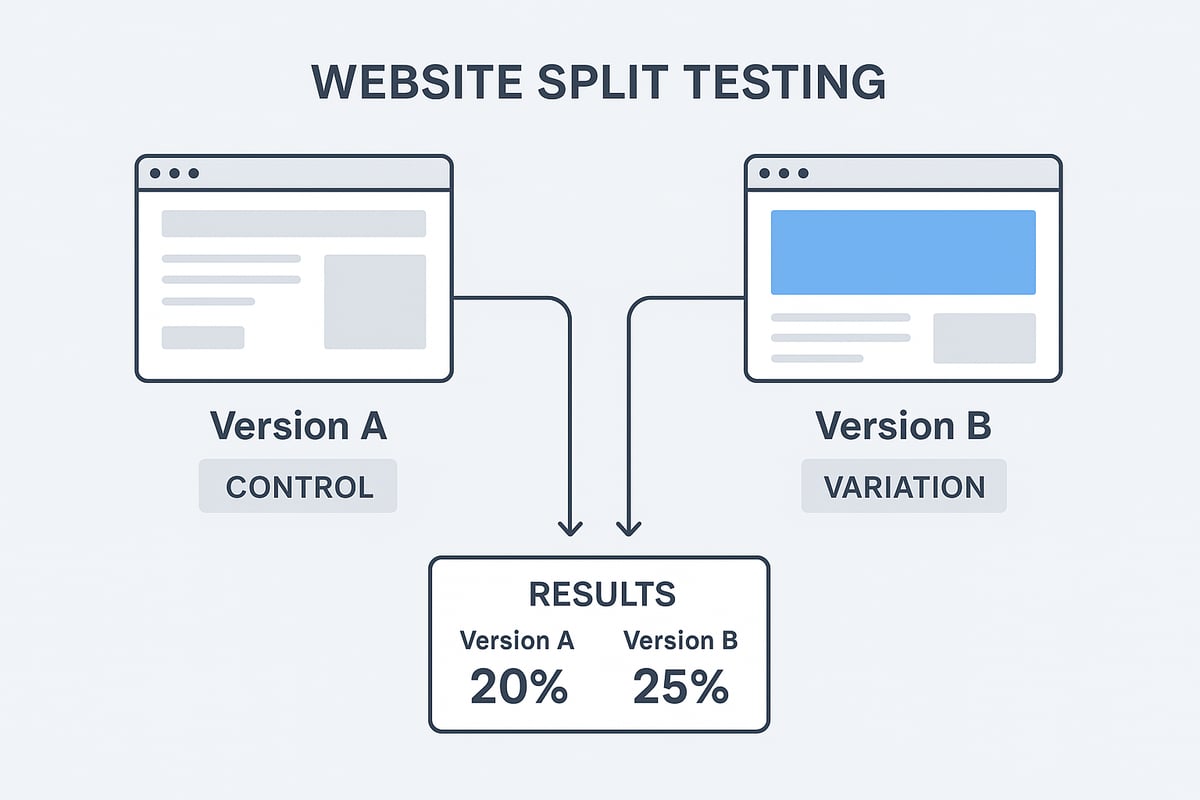
Picture a chocolate ecommerce site testing two banner offers: one with "Free Delivery Over £20" and another with "10% Off First Order." Each visitor sees only one version, unaware they're part of a test. The original is called the control, while the new version is the variation.

Common use cases include landing pages, checkout flows, email campaigns, and ad creatives. Split testing is foundational to conversion rate optimisation strategies, helping you move from guesswork to growth.

Split Testing vs. A/B Testing

You might hear marketers use split testing and A/B testing as if they mean the same thing. Technically, A/B testing is about comparing just two versions: A and B. Split testing focuses on splitting your traffic between multiple versions, whether that's two, three, or more.

Multivariate testing is a step up, letting you test multiple elements—like headline, image, and button text—at the same time. According to Contentsquare, split testing often means comparing completely different layouts, not just small tweaks.

So, when should you use each? Use A/B testing for quick, focused changes, like CTA button colour. Use split testing if you're evaluating big design overhauls. Multivariate testing helps when you want to understand how different elements interact. All of them aim to find the variant that drives the most conversions.

Why Split Testing is Essential for Digital Success

Relying on gut instinct or “best practices” often leads to missed opportunities. Split testing lets you make decisions based on real user behaviour, not the HiPPO (Highest Paid Person’s Opinion) or industry trends that may not fit your audience.

Businesses see measurable gains: higher conversion rates, increased revenue, and lower bounce rates. Take Ben.nl, who boosted conversions by 17.63% just by adjusting where the colour palette appeared on product pages. Even seasoned marketers get it wrong sometimes—split testing lets your audience “vote” with their actions.

In today’s competitive digital landscape, split testing is a proven driver of business growth. It’s how leaders stay ahead.

Common Myths and Misconceptions

Think split testing is only for big brands or high-traffic sites? Think again. Any business, regardless of size, can benefit. Another myth: it’s about throwing random ideas at the wall. In reality, effective split testing starts with evidence-based hypotheses and a clear plan.

Some believe split testing is the entire CRO process. Not true—it’s a key tool, but real optimisation involves research, analysis, and ongoing iteration. As Contentsquare points out, split testing is about validating ideas, not just discovering them.

Bottom line: split testing is scalable, structured, and universally applicable across industries.

Business Impact: Real-World Results

Companies that embrace split testing consistently report better conversion rates and higher revenue. Small changes, such as tweaking a CTA colour or image placement, can lead to impressive results.

Industry benchmarks from platforms like VWO and Contentsquare show that split testing works for ecommerce, SaaS, B2B, and service businesses alike. It’s a staple for anyone serious about digital growth.

Preparing for a Successful Split Test

Getting your split testing process right before you start is where the real magic happens. A little planning upfront saves you wasted time and delivers results that move the needle.

Preparing for a Successful Split Test

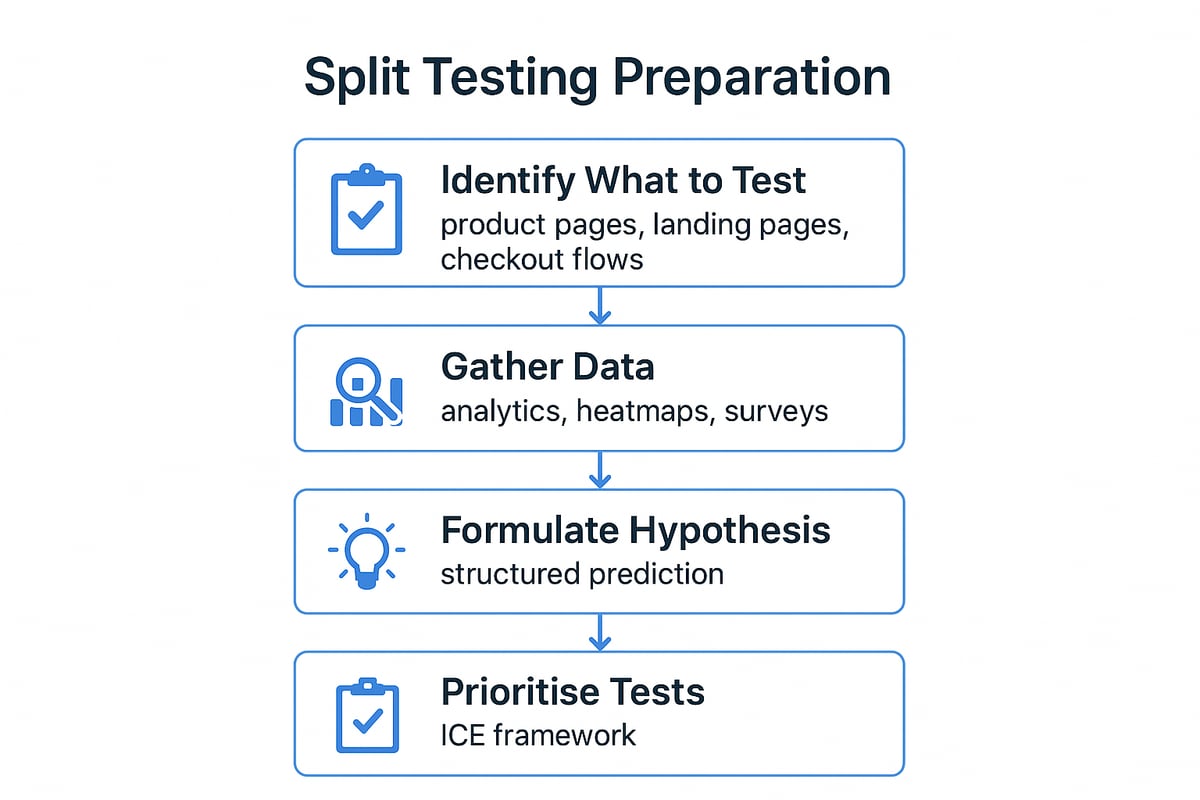
Identifying What to Test: Pages and Elements

Start by pinpointing where split testing will have the greatest impact. Focus on high-value pages like product pages, landing pages, and checkout flows. These are the spots where even small tweaks can lead to a surge in conversions.

Look for elements that directly influence user action. This could be headlines, call-to-action buttons, images, forms, testimonials, or even entire layouts. For inspiration on where to start, check out these Landing page optimisation tips.

Use analytics to spot bottlenecks and high-exit pages. Prioritise elements that influence your main metrics, whether that’s sales, leads, or signups. Remember, split testing is most powerful when it targets areas that drive your business goals.

Gathering Data and User Insights

Effective split testing relies on more than guesswork. Use quantitative data from sources like Google Analytics, heatmaps, and funnel analysis to see where users drop off. Pair this with qualitative insights from customer feedback, surveys, or session replays.

Heatmaps, for example, can show you exactly where attention fades or confusion sets in. Funnel analysis pinpoints stages where users abandon ship. By combining numbers with real user stories, you get a complete picture.

The goal is to base every split testing idea on solid data, not assumptions. Identify recurring patterns and friction points, then use these insights to uncover your biggest opportunities for improvement.

Formulating Evidence-Based Hypotheses

A strong split testing hypothesis is the backbone of any successful experiment. Don’t just test random ideas. Instead, create a clear, evidence-based prediction: “If we change X, we expect Y to happen because of Z.”

Use a framework to keep it structured. Rate your hypothesis by potential impact, confidence, and how easy it is to implement. For example, if data shows users ignore your signup button, you might predict that moving it higher will increase clicks.

Avoid the trap of testing for the sake of it. Focus on changes that are likely to shift the needle on your key metrics. Structured hypotheses ensure your split testing isn’t just busywork, but a strategic lever for growth.

Prioritising Tests for Maximum Impact

With a list of hypotheses in hand, it’s time to prioritise. Score each idea using frameworks like ICE (Impact, Confidence, Ease) or PIE (Potential, Importance, Ease). This helps you work smarter, not harder.

Start with “quick wins” that are simple to implement and likely to show results fast. Plan to test one variable at a time so you can be confident about what caused any change.

Make sure your split testing roadmap is always tied back to business priorities. For example, testing a checkout tweak usually beats fiddling with the footer. Iterative, focused testing builds momentum and delivers compounding gains over time.

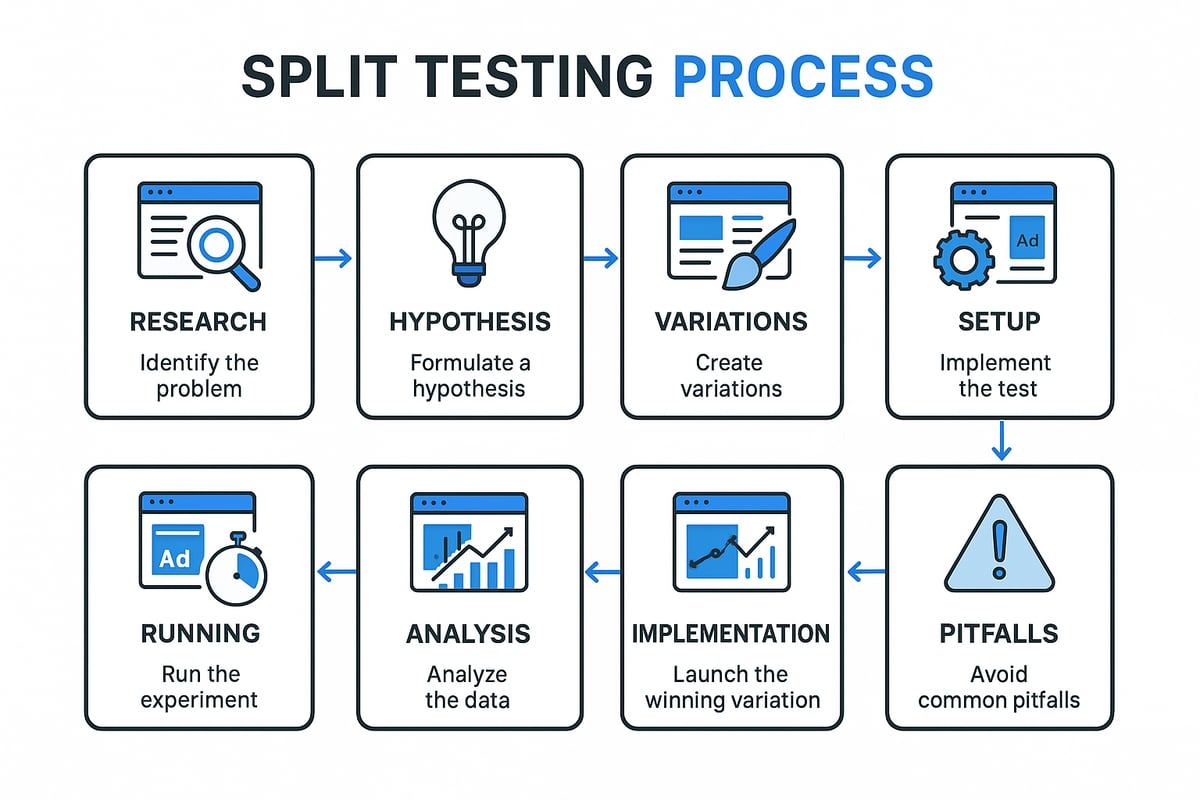
Step-by-Step: Running an Effective Split Test in 2026

Running a successful split testing experiment in 2026 means following a clear, evidence-based process. Each step builds on the last, ensuring you move from strategy to execution with confidence. Let’s break down exactly how to do it.

Step-by-Step: Running an Effective Split Test in 2026

Step 1: Research and Analysis

Begin every split testing journey with deep research. Gather baseline data using analytics tools like Google Analytics, heatmaps, and funnel analysis. Pinpoint where users drop off or fail to convert. For example, Contentsquare’s funnel analysis can reveal friction points in your checkout process.

Pair this quantitative data with qualitative insights. Use customer polls, surveys, or session replays to hear the voice of your users. Look for recurring complaints or questions—these are goldmines for improvement ideas.

Set a clear objective for your test. For instance, aim to increase signups by 10 percent or reduce cart abandonment by 15 percent. This focus ensures your split testing efforts drive business value.

Step 2: Hypothesis Development

Turn your research into actionable hypotheses. In split testing, a hypothesis is a prediction, grounded in data, about how a change will impact user behaviour. Use a framework like: “If we change X, we expect Y because of Z.”

Back up your ideas with real evidence—don’t guess. For example, if analytics show users miss your CTA below the fold, your hypothesis might be: “Moving the CTA higher will boost clicks because more users will see it.”

Align each hypothesis with a business KPI, such as conversions or average order value. Prioritise ideas that are likely to move the needle in your split testing programme.

Step 3: Creating Variations

With your hypothesis in hand, design your test variations. In split testing, the control is your current version, while the variation is the new one you want to try. Use visual editors or work with developers for more complex changes.

Change only one variable at a time for clarity. For example:

  • Update the banner headline
  • Change a button colour
  • Move an image or testimonial

Test both small tweaks and bold redesigns, but always maintain a consistent user experience. Make sure your variations align with your brand and don’t disrupt user trust.

Step 4: Setting Up the Test

Now, set up your split testing experiment in your chosen platform—VWO, Contentsquare, or Optimizely are popular options. Decide how to split your traffic, usually 50/50 between control and variation.

Configure your test parameters:

  • Duration (e.g., two weeks minimum)
  • Sample size (enough to reach significance)
  • Statistical confidence threshold (usually 95 percent)

Ensure randomisation so users only see one version. Keep documentation of test settings for transparency. For a deep dive on setup and best practices, see Split Test Best Practices.

Step 5: Running the Experiment

Once live, monitor your split testing experiment closely. Watch for technical issues, broken links, or slow load times. Let the test run its full course—don’t stop early, or you risk unreliable results.

Check in periodically to ensure there are no anomalies, but avoid making changes mid-test. VWO recommends at least a two-week run, even for high-traffic sites.

Record interim data, but wait for the test to finish before deciding on a winner. Patience pays off in split testing, ensuring your conclusions are sound.

Step 6: Analysing Results and Drawing Conclusions

Once your split testing period ends, dive into the data. Use your tool’s reporting dashboard to compare conversion rates, click-throughs, or revenue between control and variation.

Assess whether the difference is statistically significant. Did the new version deliver a real uplift, or was it just random chance? For example, Ben.nl’s layout tweak led to a validated 17.63 percent conversion increase.

Document all findings, even if the test “failed.” Every split testing experiment offers valuable insights that inform your next move.

Step 7: Implementing and Iterating

If your variation wins, roll it out to all users and watch post-launch metrics. Confirm the improvement is sustained in real-world use.

Use what you’ve learned to fuel your next round of split testing. Build a roadmap of future experiments, targeting new bottlenecks or opportunities.

Share results with your team to foster a culture of learning. Remember, continuous optimisation through split testing leads to lasting gains.

Common Pitfalls and How to Avoid Them

Even experienced marketers can trip up in split testing. Avoid these classic mistakes:

  • Testing too many changes at once—stick to one variable per test
  • Ending tests before reaching statistical significance
  • Ignoring negative or inconclusive results
  • Not segmenting your audience appropriately
  • Overlooking technical glitches or tracking errors

Always QA each variation thoroughly before launch. Use audience segmentation to focus on the right users. Embrace every result as a learning opportunity.

Split testing is not a one-off project—it’s an ongoing process that, when done right, can transform your digital performance.

Statistical Models and Significance in Split Testing

Understanding statistical models is crucial if you want to run split testing that delivers real, actionable results. The models you choose will shape how you interpret your data, how quickly you reach conclusions, and how confident you can be in your findings. Let’s break down the essentials.

Statistical Models and Significance in Split Testing

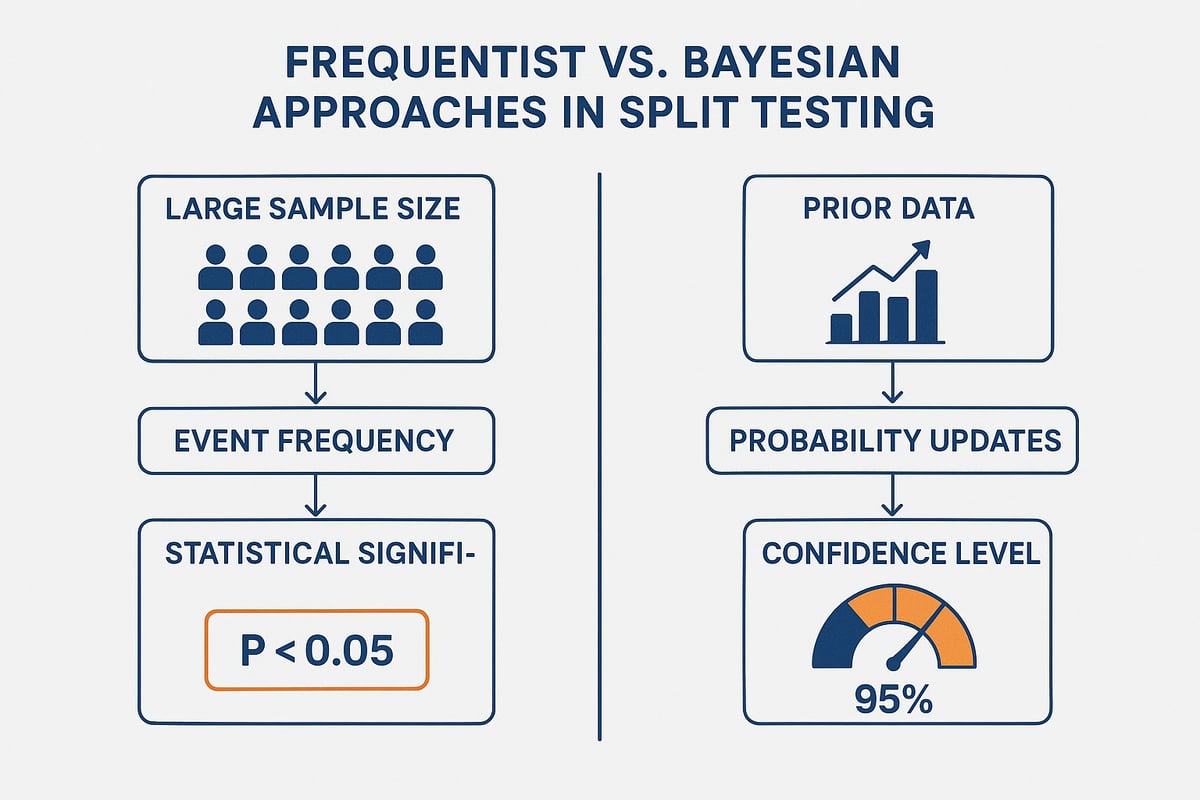
Frequentist vs. Bayesian Approaches

When running split testing, you’ll often hear about Frequentist and Bayesian statistics. The Frequentist model is the traditional choice, relying on event frequency in large samples to draw conclusions. This means you need a lot of data before making decisions. On the other hand, Bayesian methods use probability and prior results, offering insights faster, especially for sites with less traffic.

Here’s a quick comparison:

Model Pros Cons
Frequentist Robust, well-known, widely accepted Slower, needs more data
Bayesian Faster, works with smaller samples Needs careful prior selection

Some recent research, like the Learning Across Experiments and Time: Tackling Heterogeneity in A/B Testing paper, explores how new frameworks can make split testing more reliable, even with practical constraints. Ultimately, your choice depends on your traffic, timeline, and risk tolerance.

Ensuring Statistical Significance

Statistical significance is the bedrock of trustworthy split testing. It tells you whether your results are likely to be real or just due to chance. Most marketers aim for a 95% confidence level, meaning there’s only a 5% probability the results happened randomly.

To ensure significance:

  • Calculate required sample size before launching your test.
  • Set your confidence threshold (usually 95%).
  • Let the test run its full course without peeking at interim results.
  • Use built-in calculators or tools to avoid guesswork.

If you stop a split testing experiment too early, you risk making decisions on incomplete data. Patience is rewarded here, as only properly run tests will give you the confidence to act.

Analysing and Interpreting Results

Once your split testing experiment is complete, it’s time to dig into the numbers. Start by comparing key metrics like conversion rates, click-throughs, and revenue per visitor. Look for clear winners, but also check if the uplift is meaningful for your business goals.

Document both successful and unsuccessful outcomes. For example, a layout tweak that increases conversions by 17% is worth rolling out, but even a flat result provides valuable learning. Present findings in a way that non-technical stakeholders can understand, using charts or simple tables.

Every split testing result, positive or negative, should feed into your ongoing optimisation roadmap.

Learning from Every Test—Even Inconclusive Ones

Not every split testing experiment will produce a clear winner. Sometimes results are inconclusive or even negative. That’s not a failure—it’s part of building a knowledge base. Use these outcomes to refine your hypotheses and improve future experiments.

Create a log of all tests, noting what was tried, what worked, and what didn’t. This habit encourages a culture of experimentation and learning across your team. Remember, continuous split testing—even when the result is “no impact”—drives incremental gains over time.

The best marketers treat every test as a stepping stone towards better business performance.

Choosing the Right Split Testing Tools for 2026

Choosing the right split testing tools is critical for any marketer or business aiming to boost conversions in 2026. With the sheer variety of platforms and features on offer, knowing what to prioritise can save you time, money, and headaches.

Key Features to Look For

When comparing split testing platforms, focus on features that make experimentation efficient and insightful. Look for intuitive visual editors that allow you to set up tests without heavy developer involvement. The ability to run multiple experiments in parallel on isolated audiences is a must for scaling your optimisation efforts.

Seamless integration with analytics platforms, heatmaps, and session replay tools gives you a complete view of user behaviour. Fast and accurate reporting dashboards help you make decisions quickly. AI-driven insights, like those discussed in AI website optimization insights, are becoming standard, making it easier to spot winning variations and automate routine tasks.

Choose tools that fit your team’s skillset and business goals. Prioritise platforms that support mobile and desktop testing, and provide robust segmentation options.

Evaluating Popular Split Testing Platforms

The split testing market is evolving rapidly. Leading platforms such as VWO, Contentsquare, Optimizely, Google Optimize (if still available), and Convert all offer robust testing features, but they differ in pricing, usability, and support.

Here’s a quick comparison:

Platform Visual Editor AI Features Multivariate Mobile Support Free Trial
VWO Yes Yes Yes Yes Yes
Contentsquare Yes Yes Yes Yes No
Optimizely Yes Yes Yes Yes No
Google Optimize Yes Limited Yes Yes Yes
Convert Yes Limited Yes Yes Yes

According to the Split Testing Software Market Size, Growth, Share, & Analysis Report – 2033, demand for AI-powered and privacy-friendly split testing tools is set to surge. Consider factors like ease of setup, customer support, and advanced targeting when making your choice.

Implementation Best Practices

Getting the most from your split testing tool means setting up every experiment with care. Start by ensuring proper tracking and analytics integration, so every user action is captured accurately. Always run thorough QA on all variations, across devices and browsers, before going live.

Train your team on how to use the platform and design effective tests. Use clear documentation and consistent naming conventions to avoid confusion. Monitor tests for technical glitches and review your testing processes regularly to adapt to new business needs.

A well-structured approach keeps your split testing experiments reliable and your results actionable.

Split Testing for Shopify and Ecommerce: Marketing XP’s Approach

For ecommerce brands, especially those on Shopify, split testing is a game-changer. Marketing XP specialises in designing and running split testing experiments that focus on real-world impact, not just theory.

By combining CRO best practices, analytics, and AI-powered insights, Marketing XP helps businesses optimise product pages, checkout flows, and user journeys for maximum conversion. Their hands-on, practical approach ensures every test drives measurable results.

Business owners can also access training and coaching to run their own split testing campaigns, leveraging AI tools for ongoing improvement. If you want specialist support and proven strategies for Shopify split testing, Marketing XP is ready to help you make every visitor count.

The Future of Split Testing: Trends and Innovations for 2026

The world of split testing is evolving at breakneck speed. As we look to 2026, digital marketers and business owners will need to adapt to new technologies and shifting user expectations. Mastering these innovations will ensure your split testing strategy remains ahead of the curve.

AI and Automation in Experimentation

AI is reshaping how split testing is done. Modern platforms now offer automated test creation, predictive analytics, and real-time data analysis. With tools like Contentsquare’s Sense Analyst, marketers can spot high-impact opportunities with minimal manual effort.

Automated segmentation enables you to run targeted experiments for specific user groups. AI-driven insights help you refine your split testing hypotheses and interpret results more quickly. For those interested in leveraging advanced analytics, Data analytics for marketers offers practical guidance on using AI and data to inform every test.

The result? Marketers spend less time on number crunching and more time crafting winning strategies.

Personalisation and Dynamic Testing

Split testing is no longer just about static A/B comparisons. The future lies in hyper-personalised, dynamic testing that adapts in real time to each user. Platforms can now serve multiple variations based on user behaviour, location, or device.

Imagine split testing product recommendations or messaging tailored to returning customers versus first-time visitors. This level of personalisation increases engagement and ROI, as users feel the website is speaking directly to them.

Dynamic split testing does add complexity, but when managed well, the payoff is higher conversion rates and more satisfied customers.

Integrating Split Testing with Broader CRO Strategies

In 2026, split testing is just one piece of a much larger puzzle. Leading businesses combine split testing with UX research, behavioural analytics, and multichannel experiments. The goal is continuous, data-driven improvement across every digital touchpoint.

A holistic approach means involving marketing, product, and design teams in the experimentation process. Regular testing cycles ensure you are always learning, adapting, and iterating for better results.

Integrating split testing with broader CRO strategies supports a culture of experimentation, where every idea is validated by real user data before rollout.

Preparing for Evolving Privacy and Tracking Regulations

Data privacy is becoming a top priority for both users and regulators. As cookies fade out and privacy-first analytics take centre stage, split testing methods must adapt. Server-side testing and compliant analytics tools will be vital for maintaining accurate results while respecting user consent.

Transparent data handling and clear opt-in processes are now essential parts of any split testing programme. Marketers will need to stay informed about regulations and invest in technology that keeps tests reliable and legal.

Embracing privacy-friendly split testing ensures you can keep optimising without risking user trust or falling foul of new laws.

If you’re reading this and thinking “That all sounds great, but where do I actually start to see real results?”—you’re not alone. Split testing can feel overwhelming, especially with all the tools and data out there. The good news is, you don’t have to figure it all out on your own. I help small businesses like yours turn experiments into more leads and sales, not just nice reports. If you want some honest advice tailored to your website or campaigns, grab your Get free 45 min consultation and let’s make your next test one that actually makes you money.

UI Design Guide: Essential Principles for 2026

In 2026, the pace of digital change is relentless. What was once considered good ui design is now just the starting point. Today, creating digital products means delivering seamless, accessible, and genuinely delightful experiences for every user.

This guide is here to equip designers, developers, and product teams with practical insights for mastering ui design in a world shaped by new technology and rising expectations. You'll find a clear framework that covers the latest principles, must-know trends, and actionable steps to future-proof your interfaces.

Ready to discover how to create intuitive, inclusive, and engaging designs? Dive in and learn the strategies you need to stay ahead and deliver products people love.

Understanding UI Design in 2026

UI design is evolving rapidly, shaped by new devices, user behaviours, and expectations. In 2026, ui design is about more than just pretty visuals; it’s the core of how people interact with digital products. Staying ahead means understanding the principles, types, and impact of modern ui design, and how it underpins product success. For a deeper dive into current trends and strategies, you can explore Web design insights and trends.

Understanding UI Design in 2026

Defining UI Design: Beyond Visuals

UI design is the craft of building interactive digital interfaces that users engage with every day. It’s not just about how things look, but how they work and feel. Don Norman describes ui design as the sum of all visual and interactive elements that shape a user’s perception and satisfaction.

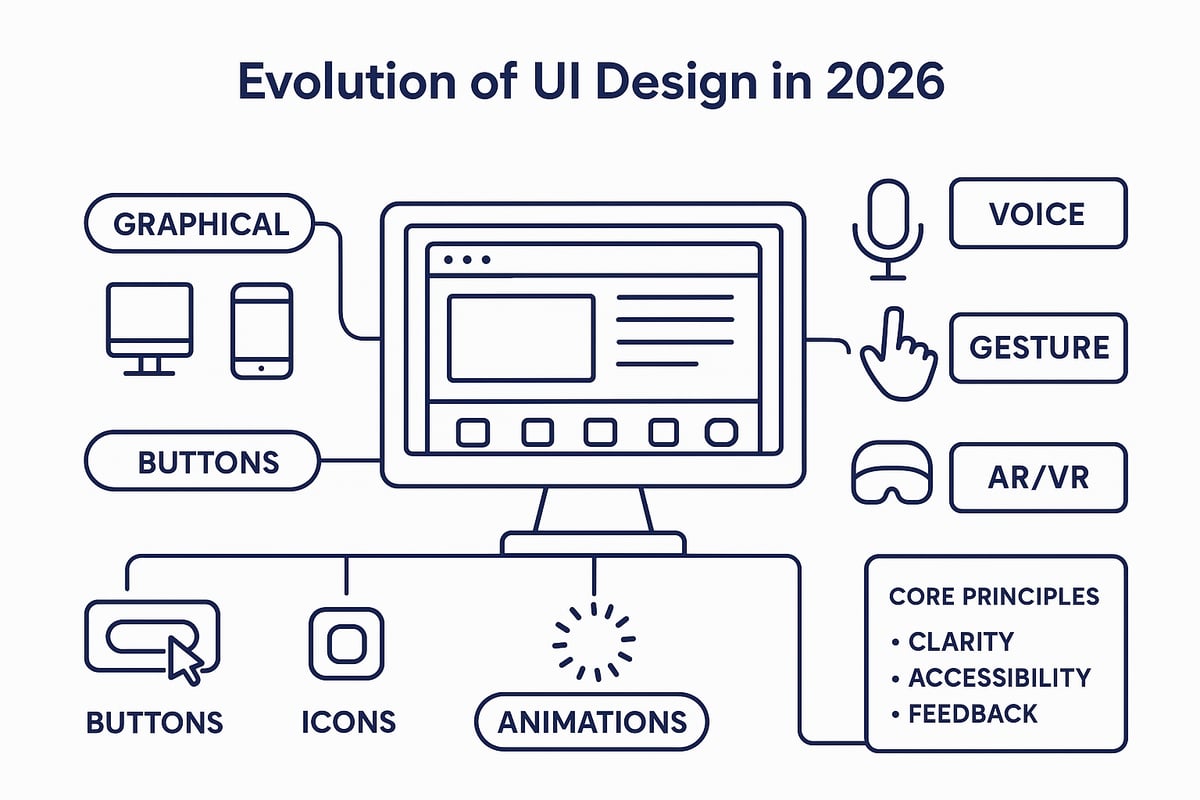
Think about the buttons, icons, layouts, and subtle animations you see on your phone, watch, or even in AR glasses. These details drive usability and emotional connection. Users form their first impressions of a product’s ui design within seconds, making it crucial across all devices, from desktops to wearables and immersive AR/VR platforms. The right design choices can make or break the user’s experience.

Types of User Interfaces in 2026

In 2026, ui design covers a wide range of interfaces. The classic graphical user interface (GUI) is joined by voice user interfaces (VUIs) and gesture-based controls. AR/VR and mixed reality UIs are becoming mainstream. For example, smartphone GUIs, Alexa and Siri for VUIs, and VR hand controllers for gaming all rely on ui design to guide users.

Here’s a quick comparison:

UI Type Example Device Key Feature
GUI Smartphone, PC Visual navigation
VUI Smart speaker Voice commands
Gesture VR headset Motion control
AR/VR Mixed reality Spatial interaction

Multi-modal interfaces, blending voice, touch, and gestures, make digital products more accessible and engaging. AI-driven conversational UIs are also on the rise, adapting to user needs in real time.

The Role of UI in Product Success

UI design plays a critical role in whether users adopt and stick with digital products. It’s the first impression, the handshake between brand and user. A well-crafted ui design communicates brand values, builds trust, and encourages users to take action.

Take Airbnb’s clean layout or Domino’s Zero Click app, where the interface makes task completion effortless. Data shows users prefer interfaces that are easy, fast, and enjoyable. UI design also drives accessibility and inclusion, helping everyone connect emotionally with your product.

UI vs. UX: Collaboration, Not Competition

There’s often confusion between ui design and user experience (UX), but they work hand in hand. UX is the journey, the big picture of how users feel and flow through a product. UI design brings that journey to life with tangible touchpoints, like buttons, forms, and feedback animations.

Collaboration between UI and UX teams leads to seamless products. For example, UX might map the user’s journey, while ui design shapes each interaction. Roles should be based on strengths, not job titles. This partnership ensures the entire user journey feels cohesive and satisfying.

Key Elements of Modern UI Design

Modern ui design relies on a few core elements:

  • Input controls: buttons, dropdowns, toggles
  • Informational components: notifications, progress bars
  • Navigation elements: menus, tabs, breadcrumbs

Consistency, clarity, and feedback are essential. Google’s Material Design sets the bar for clear and consistent ui design, ensuring users always know what to do next.

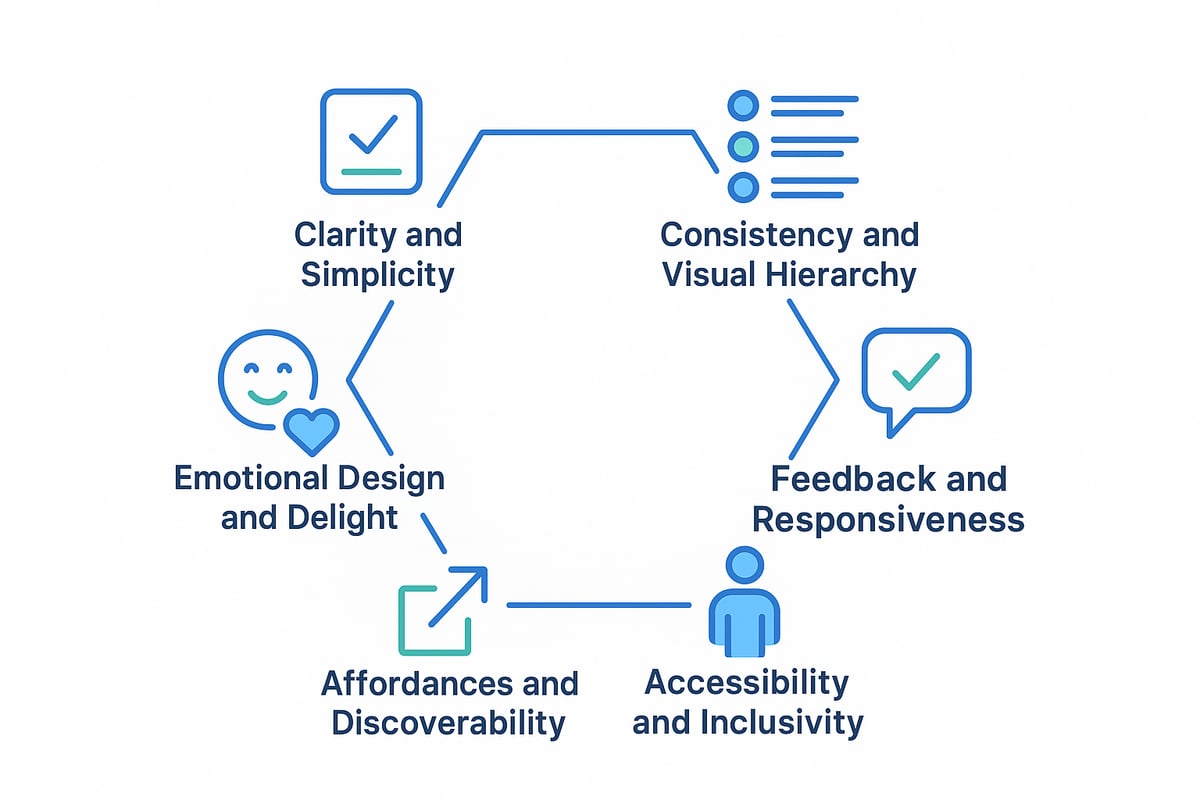
Core Principles of Effective UI Design

Mastering ui design in 2026 means going beyond what looks good. It’s about making interfaces that users can trust, understand, and enjoy. Let’s break down the core principles every designer needs to future-proof their work.

Core Principles of Effective UI Design

Clarity and Simplicity

Clarity is the backbone of ui design. If users can’t figure out what to do next, they’ll leave. Make every action obvious. Use straightforward labels, easy-to-recognise icons, and strip away anything that doesn’t serve a purpose.

  • Use large, readable typography for important information.
  • Stick to a simple colour palette to reduce visual noise.
  • Limit choices on each screen to avoid overwhelming users.

Research shows people focus on getting things done, not deciphering complex interfaces. The best ui design makes the path from start to finish clear and free of clutter. Always ask: can a new user figure this out in seconds?

Consistency and Visual Hierarchy

Consistency builds trust in ui design. When buttons, fonts, and colours behave the same way across screens, users learn faster and feel more confident. Rely on design systems and style guides, such as Material Design or iOS Human Interface Guidelines, to keep things uniform.

  • Repeat spacing, colours, and icon styles throughout.
  • Use size and colour to highlight what matters most.
  • Align elements so the user’s eye flows naturally.

A strong visual hierarchy means users know where to look next. Think of Airbnb’s consistent use of white space and accent colours—users never get lost. Consistency lowers the learning curve and creates a seamless experience.

Feedback and Responsiveness

Effective ui design always shows users what’s happening. Every tap, click, or swipe should get a response. Immediate feedback—like button highlights, loading spinners, or error messages—helps users feel in control.

  • Animate transitions for smoother navigation.
  • Use micro-interactions for small, delightful responses.
  • Always confirm successful actions or flag errors clearly.

Responsive interfaces keep frustration low and engagement high. For more strategies on how feedback can boost usability and conversion, check out these Website optimisation strategies. When users know their actions matter, they stick around.

Accessibility and Inclusivity

Great ui design includes everyone. Design for users with all abilities—visual, motor, cognitive, and hearing. High contrast, scalable fonts, and clear navigation are essential.

  • Test colour contrast and use readable font sizes.
  • Support keyboard-only navigation and screen readers.
  • Add alternative text to images and use ARIA labels.

Reference accessibility guidelines, like those from Material Design. Airbnb’s accessible booking flows show how thoughtful design can welcome more users. Accessibility is not just a legal box to tick—it’s an opportunity for innovation and broader reach.

Affordances and Discoverability

Every interactive element in ui design should look and feel clickable, tappable, or swipeable. Affordances are visual cues that tell users what’s possible, reducing guesswork.

  • Use raised buttons, shadows, or hover effects for clickable items.
  • Make icons clear and descriptive.
  • Group related actions visually to guide discovery.

When users instantly know what they can do, they complete tasks faster. Data shows clear affordances directly improve completion rates. Don’t leave users guessing—make every action obvious.

Emotional Design and Delight

Ui design isn’t just functional—it can spark positive emotions. Thoughtful touches like animations, illustrations, and playful microcopy make experiences memorable.

  • Add delightful success messages or playful empty states.
  • Use animation to reinforce brand personality.
  • Tell a story visually to connect with users.

Emotional design builds loyalty and keeps users coming back. A little delight goes a long way in separating a good interface from a great one.

Step-by-Step Guide to Designing a Modern UI

Designing a successful ui design in 2026 is more strategic than ever. The process is less about guesswork and more about understanding users, testing ideas, and collaborating across teams. Here’s a step-by-step guide to get your ui design ready for the future.

Step-by-Step Guide to Designing a Modern UI

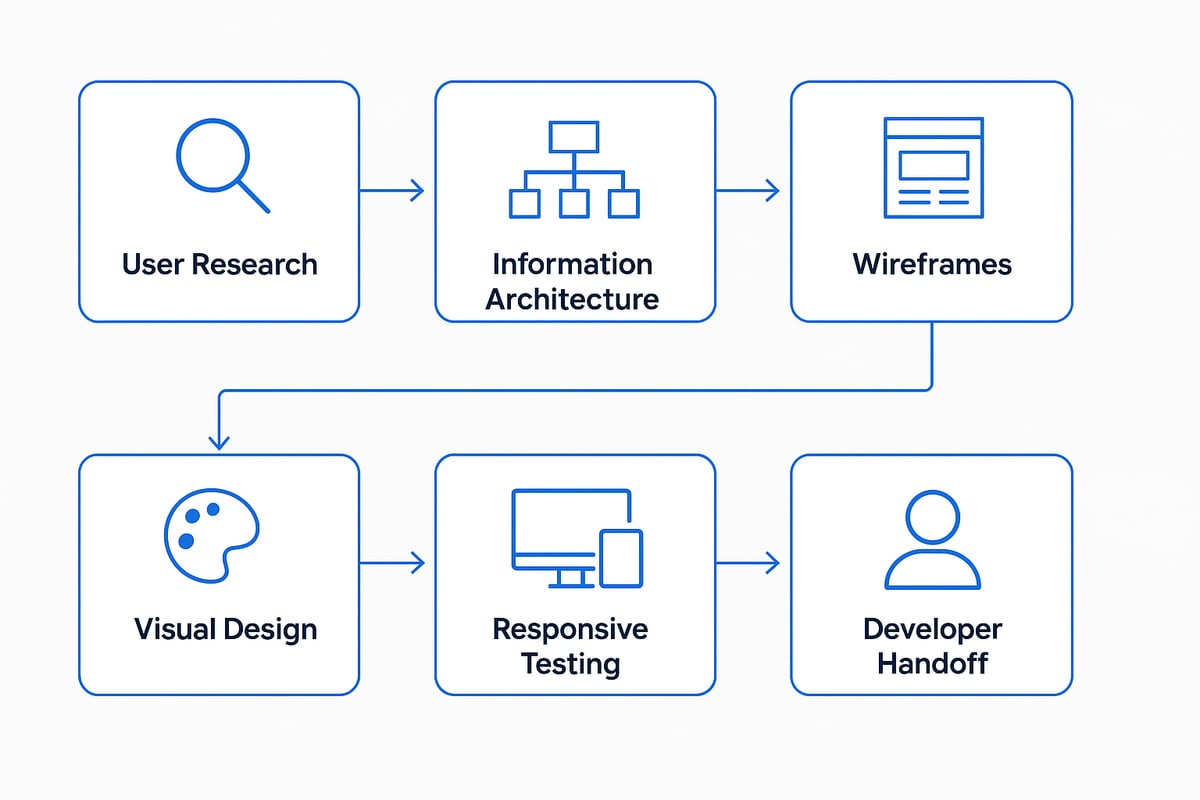
Step 1: Research and Understand User Needs

A great ui design starts with deep user understanding. Begin by conducting interviews, surveys, and analysing analytics to uncover what users truly want.

Build out personas that reflect the diversity of your audience. Map their journeys and pain points using customer journey maps. This will reveal insights into how your ui design can simplify their tasks.

For example, reviewing the checkout flow on an ecommerce site can highlight barriers that slow users down. By focusing on specific needs and frustrations, your ui design becomes more targeted and effective.

Step 2: Define Information Architecture and User Flows

Next, structure your content and features logically. A robust ui design depends on a well-organised sitemap and clear user flows.

Use flowcharts and wireframes to visualise how users navigate. Prioritise essential tasks, cutting out anything that creates friction. For instance, mobile banking apps often focus on streamlining navigation so users can complete tasks quickly.

Align every flow in your ui design with both user goals and business objectives. This clarity reduces confusion and boosts engagement.

Step 3: Design Wireframes and Prototypes

With architecture in place, sketch out low-fidelity wireframes. These help plan the layout and hierarchy of your ui design without getting bogged down by visuals.

Collaborate early and often. Tools like Figma and Sketch enable quick feedback, so you can refine before moving to high-fidelity prototypes. Interactive prototypes bring your ui design to life, letting you test transitions and interactions.

Rapid prototyping means issues are spotted early, saving both time and money while keeping your team aligned.

Step 4: Apply Visual Design Principles

Now it’s time to make your ui design visually appealing and accessible. Choose colour palettes that reflect your brand and ensure high contrast for readability.

Pick fonts that are easy to read and size them appropriately. Icons should be clear and meaningful. Develop a style guide to keep your ui design consistent across screens.

Material Design is a great reference for bold colours and large typography. Always check contrast ratios and spacing to make sure everyone can use your ui design comfortably.

Step 5: Implement and Test Responsiveness

Modern users expect your ui design to work perfectly on any device. Start with a mobile-first approach and expand layouts for larger screens.

Test your ui design on desktops, tablets, mobiles, and even AR or VR devices if relevant. Use adaptive navigation menus to keep things simple on smaller screens.

Tools like BrowserStack or in-browser developer tools can help you spot layout issues early. Responsive ui design ensures users have a smooth experience, no matter where they are.

Step 6: Conduct Usability Testing and Iterate

Usability testing is where your ui design meets reality. Run tests with real users, observing how they interact and where they struggle.

Gather feedback and usage data to identify pain points. Make incremental improvements based on evidence, not assumptions. Techniques like A/B testing allow you to compare different button placements or colour schemes.

For those aiming to boost engagement and conversions, reviewing Conversion rate optimisation tips can provide valuable strategies to refine your ui design further.

Step 7: Handoff and Collaboration with Developers

The final step is seamless collaboration. Prepare clear design assets, specifications, and documentation so developers can bring your ui design to life accurately.

Use shared libraries and design systems to maintain consistency. Figma’s Dev Mode, for example, streamlines the handoff process by translating designs into code-friendly formats.

Keep communication open throughout. Regular check-ins ensure your ui design remains true to your vision and adapts smoothly from design to deployment.

Emerging Trends and Technologies in UI Design

The world of ui design is transforming faster than ever, shaped by new tech, changing user needs, and an expectation for seamless experiences. Staying ahead means understanding the trends redefining how people interact with digital products.

Emerging Trends and Technologies in UI Design

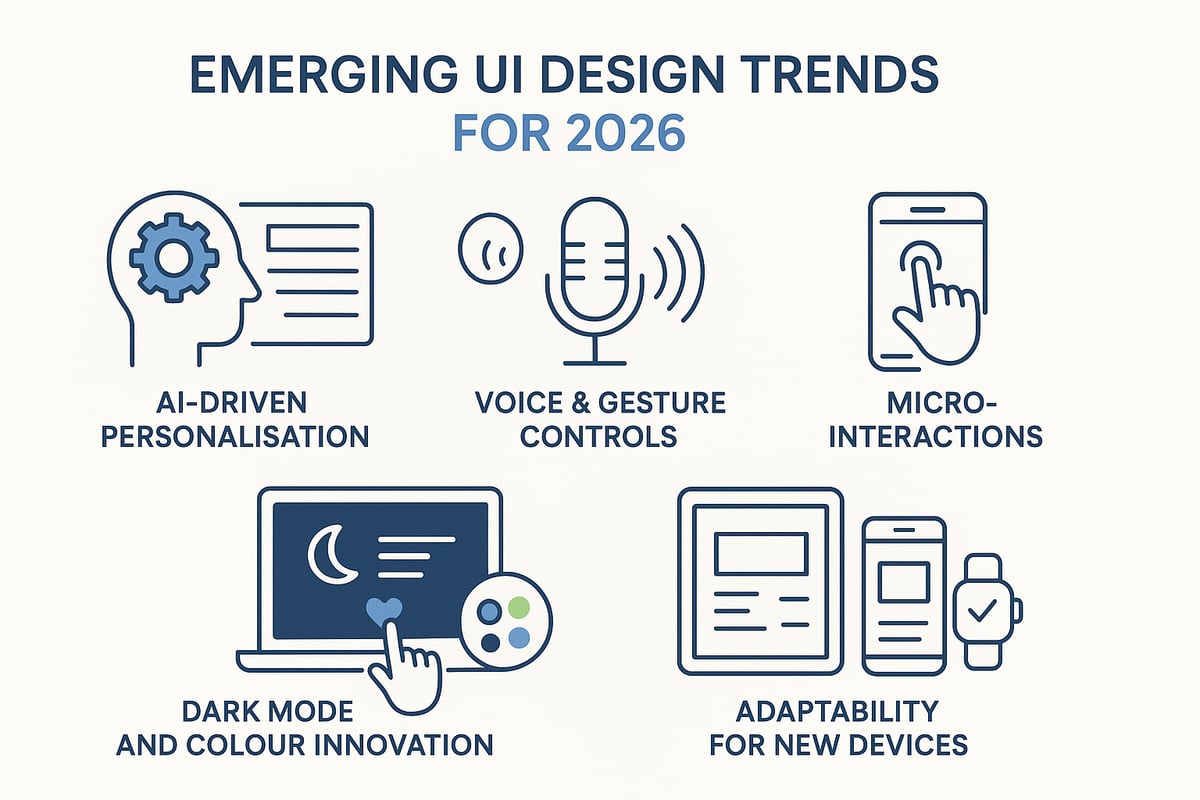
AI and Personalisation in UI

AI is changing the face of ui design, making interfaces smarter and more responsive to individual users. Adaptive layouts, predictive suggestions, and content tailored to behaviour are now commonplace. For instance, Netflix’s recommendation UI is a prime example of how machine learning adapts to user preferences in real time.

Personalised ui design increases engagement but brings challenges like privacy and maintaining user trust. Transparency and user control are key. According to recent studies, users are more satisfied with interfaces that feel tailored to them. For an in-depth look at these innovations, check out AI-driven UI design trends.

Voice, Gesture, and Multi-Modal Interfaces

The evolution of ui design now includes voice user interfaces (VUIs), gesture controls, and multi-modal experiences. Devices like Alexa and Google Home have made voice commands a daily habit for millions. Gesture-based controls are also on the rise, especially in AR/VR environments and smart home tech.

Multi-modal ui design improves accessibility and engagement by letting users interact in ways that suit them best. Data shows a steady increase in adoption rates for both voice and gesture interfaces, making them essential for future-ready products.

Micro-Interactions and Motion Design

Micro-interactions are the tiny animations and feedback cues that bring ui design to life. Think of liking a post, swiping to delete, or watching an animated loading spinner. These small touches enhance usability, guide attention, and make interfaces more enjoyable.

Motion design helps users understand what’s happening, providing visual feedback and reinforcing hierarchy. A well-placed animation can make a task feel effortless and even delightful. The best ui design uses micro-interactions not just for flair, but to improve clarity and flow.

Dark Mode, Colour Trends, and Visual Innovation

Dark mode is no longer a gimmick but a standard expectation in ui design. Custom themes, bold colour palettes, and gradients are also trending, allowing users to personalise their experience. Material Design’s focus on high contrast and clarity has set a benchmark for accessible visuals.

Designers are experimenting with styles like neumorphism and glassmorphism, balancing innovation with usability. The challenge is to keep interfaces not just beautiful but also accessible to everyone. Staying on top of colour and visual trends helps products feel modern and inclusive.

Future-Proofing UI for New Devices and Contexts

The landscape of ui design is expanding beyond traditional screens. Designers now account for wearables, foldables, and immersive devices like AR headsets and smartwatches. Each new device category brings unique challenges and opportunities.

Adaptability is crucial. A ui design that works on a smartwatch must be simple and glanceable, while AR interfaces require spatial awareness. Market projections show rapid growth in these areas, so future-proofing your design approach is more important than ever.

Best Practices and Expert Tips for UI Designers in 2026

The pace of change in ui design is relentless, and only those who adopt best practices will thrive. Let's break down the key strategies every designer should master in 2026 to ensure their interfaces not only look good but deliver measurable results.

Prioritising Usability and Task Completion

At the heart of ui design lies usability. Users want to finish tasks quickly, without obstacles. Focus on creating “invisible” interfaces that let users accomplish their goals with minimal effort.

Consider Domino’s Zero Click app, where a pizza is ordered with a single tap. This approach strips away friction, making the ui design almost disappear. Research consistently shows that when the interface gets out of the way, conversion and retention rates climb.

  • Use clear calls to action
  • Reduce steps in key flows
  • Make feedback immediate

Remember, users judge your ui design by how easy it makes their lives, not how flashy it looks.

Leveraging Design Systems and Guidelines

Consistency is non-negotiable in ui design. Relying on design systems like Material Design or Apple’s Human Interface Guidelines ensures that every element feels familiar and predictable.

Design systems speed up development, boost scalability, and make maintenance far easier. They also help teams avoid reinventing the wheel on every project. For even greater impact, tailor your system to reflect your brand’s unique voice and needs.

  • Adopt or customise a design system
  • Document components and usage rules
  • Keep systems updated as the product evolves

Explore strategies for future-proofing your digital experiences in the Digital strategy for modern websites category, which complements strong ui design foundations.

Ensuring Accessibility from the Start

Accessible ui design is not just a legal requirement, it is a business advantage. Start by building inclusivity into every stage of your process, from wireframes to final code.

Use tools like contrast checkers and screen reader simulators. Follow standards such as WCAG and consider neurodiverse users for truly comprehensive design. For inspiration, look at Airbnb’s accessible booking flows, which set the bar for industry best practice.

  • Provide alternative text for images
  • Ensure keyboard navigation works everywhere
  • Test with real users with diverse abilities

Learn more about designing for neurodiversity and the future of inclusive ui design in Neurodiverse UX design.

Staying Up-to-Date with Trends and User Expectations

Ui design evolves rapidly. To stay relevant, make learning a habit. Follow design leaders, join online communities, and attend webinars to keep your skills sharp.

Monitor emerging trends, such as AI-driven interfaces and voice controls. User expectations shift fast, so adapt your design approach accordingly to maintain a modern, competitive edge.

  • Subscribe to industry blogs and newsletters
  • Engage in Figma, Dribbble, or IxDF communities
  • Run regular competitor analysis

Being proactive in ui design helps you anticipate changes, not just react to them.

Collaborating Across Disciplines

No ui design project succeeds in a vacuum. Effective collaboration between designers, developers, product managers, and researchers is key to delivering seamless digital experiences.

Use shared libraries and cloud-based platforms to keep everyone aligned. Clear communication of design intent avoids misinterpretation and reduces costly rework. Figma’s collaborative features, for example, make it easy for remote teams to work in sync.

  • Hold regular feedback sessions
  • Share documentation and assets early
  • Foster a culture of open dialogue

Collaboration ensures that your ui design meets both user and business needs.

Measuring Success and Iterating

You cannot improve what you do not measure. Define success metrics for your ui design, such as usability scores, conversion rates, and accessibility compliance.

Collect feedback through A/B tests, analytics, and post-launch surveys. Use this evidence to iterate and refine your interface over time. Continuous improvement is the secret to long-term product success.

  • Set clear KPIs from the start
  • Monitor user behaviour and gather insights
  • Make iterative updates based on real data

A data-driven approach ensures your ui design never stands still.

Resources and Tools for UI Designers

No matter how experienced you are, the right resources and tools can make or break your ui design workflow. As we move into 2026, designers are spoiled for choice, but smart selection and continual learning are key. Let’s break down the essentials you need to future-proof your ui design toolkit.

Design Platforms and Prototyping Tools

Modern ui design starts with powerful digital platforms that allow you to ideate, prototype, and collaborate in real time. Figma, Sketch, and Adobe XD lead the pack, each offering unique strengths for responsive layout, interactive prototyping, and seamless developer handoff.

Platform Key Features Collaboration Dev Handoff
Figma Browser-based, live collaboration, plugins Excellent Dev Mode
Sketch Mac-focused, vector editing, plugins Good Export tools
Adobe XD Cross-platform, auto-animate, integrations Good Share specs

Cloud-based tools like Figma enable teams to work together, no matter where they are. For those interested in advanced methodologies, the SpecifyUI research paper explores how generative AI can enhance iterative ui design, opening new doors for automation and precision.

UI Design Systems and Style Guides

Consistency is the backbone of great ui design. Established systems like Material Design, Apple Human Interface Guidelines, and Fluent Design provide robust foundations for clarity, accessibility, and scalability.

Building your own design system? Start with a comprehensive style guide that covers colour palettes, typography, spacing, and components. Here’s a simple example using JSON to define button styles:

{
  "button": {
    "primary": {
      "background": "#1976D2",
      "text": "#FFFFFF",
      "borderRadius": "4px"
    }
  }
}

Leverage open-source UI kits and adapt existing frameworks to fit your brand and product needs. Regularly update your system as your ui design evolves.

Learning and Community Resources

Staying sharp in ui design means embracing lifelong learning. Top courses from Interaction Design Foundation, Coursera, and Udemy keep your skills fresh and relevant. Online communities like Figma Community, Dribbble, and Behance are perfect for inspiration, feedback, and sharing new ideas.

  • Interaction Design Foundation: deep dives into theory and practice
  • Coursera and Udemy: hands-on, project-based courses
  • Figma Community: templates, plugins, and collaborative files

Don’t forget blogs, newsletters, and webinars – they’re your pulse on the latest in ui design trends and best practices. Engage, ask questions, and keep pushing your craft forward.

Ready to put these UI design principles into practice and boost your results for 2026? If you’re feeling stuck or want a second pair of eyes on your website or app, I’m here to help. Whether it’s nailing your user journeys, making your product pages convert, or just making sure your interface is actually helping you get more leads and sales, let’s chat. You don’t need a big agency—just practical advice that makes a difference. Grab your Get free 45 min consultation and let’s make your UI work harder for your business.
Website Redesign Guide: Expert Strategies for 2026 Success

Did you know that 75% of users judge a company’s credibility based on its website design? First impressions count, and in today’s digital world, expectations shift rapidly. If your site looks dated or feels clunky, you could be losing valuable leads and sales to your competitors.

A smart website redesign can give you the edge, boosting user experience, search engine rankings, and conversion rates. This guide is your expert roadmap for a successful website redesign in 2026.

We’ll cover how to spot when it’s time to refresh, strategic planning, design and development best practices, launch steps, and how to keep improving after going live.

Understanding Website Redesign: Definitions, Trends, and Triggers

A website redesign is far more than a fresh coat of paint for your digital presence. It’s a strategic overhaul that touches everything from structure and user experience to the technology under the bonnet. If you think a website redesign is just about changing a few colours, think again.

Understanding Website Redesign: Definitions, Trends, and Triggers

What is a Website Redesign?

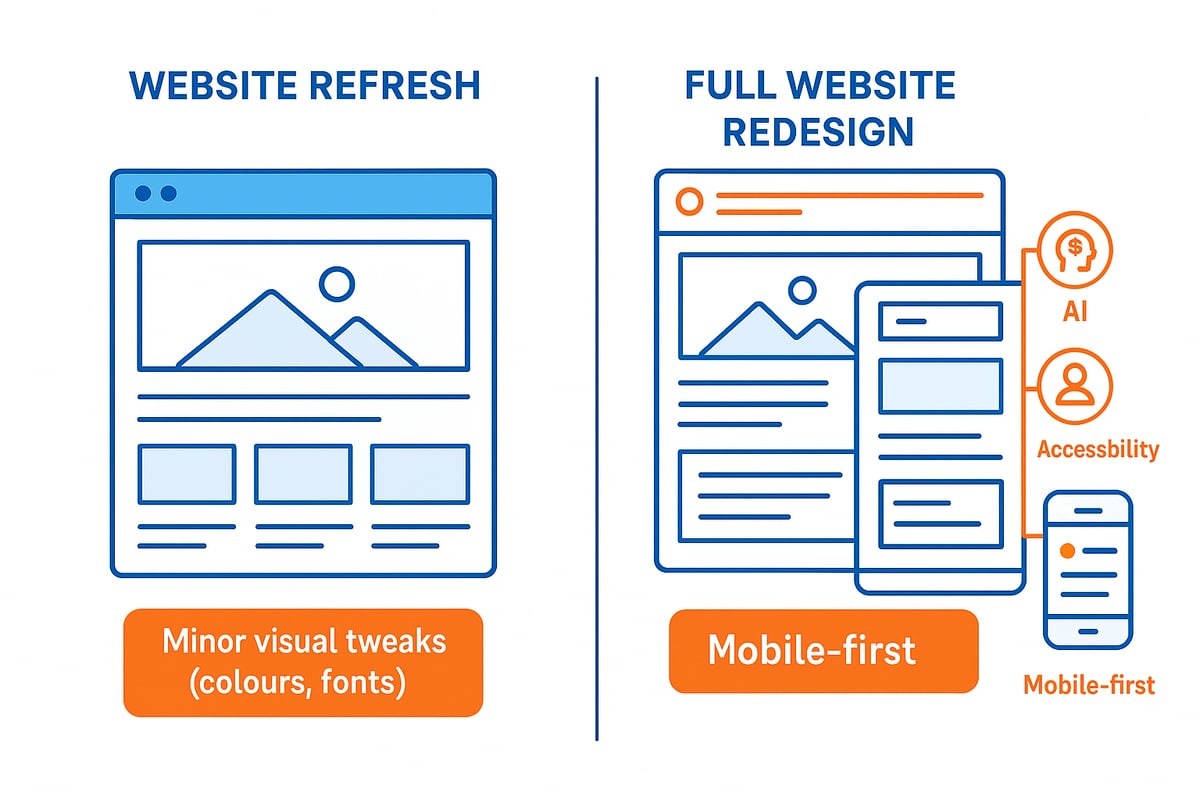
Let’s clear up a common confusion: a website redesign is not the same as a website refresh. Here’s a quick comparison:

Aspect Website Refresh Website Redesign
Scope Minor visual updates Structural, UX, and tech overhaul
Impact Quick, surface-level improvements Deep, strategic transformation
Examples New colours, updated images New navigation, rebuilt layouts

A website redesign typically involves a content overhaul, a fresh navigation structure, updated visual identity, and technical upgrades. In 2026, trends like AI-driven personalisation, baked-in accessibility, and mobile-first design are leading the charge. If you want more detail on what’s coming up, check out these web design insights and trends.

It’s easy to assume a website redesign is just about making things look modern. In reality, it’s about solving user pain points, improving business performance, and supporting long-term growth. For example, Figma’s recent redesign wasn’t just about style. They used user behaviour data to inform every decision, aligning their site with evolving brand values.

Don’t forget, 38% of visitors will stop engaging if your site is unattractive (HubSpot). A website redesign is your chance to address this and set a new standard for your business online.

Signs It’s Time for a Website Redesign

How do you know if your business needs a website redesign? Here are some clear signals:

  • Your design or branding looks dated compared to competitors.
  • The site struggles on mobile, or loads slowly. Remember, 53% of mobile users leave if a site takes more than three seconds to load.
  • SEO rankings are slipping, or traffic is flatlining.
  • Conversion rates are low, and bounce rates are sky-high.
  • Updating content is a pain, or technical issues keep cropping up.
  • User feedback points to confusing navigation or poor usability.
  • You need to meet new legal or accessibility standards, like WCAG 2.2.

Imagine a B2B company with a complex site. Leads are dropping off because navigation is confusing and mobile users can’t find what they need. A website redesign can tackle these pain points, making it easier for visitors to convert.

Listening to users, analysing your data, and benchmarking against industry trends will reveal if a redesign is overdue. If your website is holding you back, it’s time to act.

Strategic Planning for a Successful Redesign

Strategic planning is the backbone of any successful website redesign. Get it right, and you’ll set your business up for more leads, better SEO, and a site that works overtime for you. Let’s break down exactly how to plan your redesign for maximum impact.

Strategic Planning for a Successful Redesign

Setting Clear Objectives and KPIs

Start your website redesign by defining what success looks like. Don’t just say, “We want a better site.” Instead, set clear business objectives and tie them to measurable outcomes. Are you aiming to generate more leads, boost online sales, or reposition your brand?

Use KPIs to track progress. Common examples include:

Objective KPI Example
Lead Generation Form submissions
Sales Online transactions
Brand Awareness Time on site, page views
User Experience Bounce rate, session length

Dive into your analytics and heatmaps to spot where users drop off or get confused. Maybe your bounce rate is too high or conversion rates are lagging. Set targets, like reducing bounce rate by 20 percent post-launch.

Bring stakeholders together for interviews. Collaborate across departments to make sure you’re solving real business problems, not just chasing trends. Remember, a website redesign isn’t about making things look pretty. It’s about driving results that matter.

Conducting Audits and Research

A thorough audit is your foundation for a data-driven website redesign. Review your site’s technical SEO, user experience, content quality, and overall performance. Benchmark your website against competitors to spot gaps and opportunities for improvement.

User research is essential. Run surveys, conduct user testing, and map out key user journeys. Accessibility and compliance checks are also non-negotiable, especially with new standards like WCAG 2.2.

Use tools like Google Analytics, Search Console, and session recordings to see how visitors interact with your site. For a deeper dive into holistic performance, explore website optimisation strategies to ensure your redesign addresses both speed and usability.

Imagine discovering that 60 percent of your traffic is mobile, but mobile conversions lag behind desktop. That’s a clear signal to prioritise mobile UX in your website redesign.

Building the Project Team and Timeline

Your website redesign will only be as good as the team behind it. Assemble a group with the right mix of skills:

  • Project manager
  • UX/UI designer
  • Developer
  • SEO specialist
  • Content creator

Decide if you’ll go in-house, hire an agency, or mix the two. Each approach has its pros and cons—agencies bring expertise, but in-house teams know your brand inside out.

Plan your project in realistic phases: discovery, design, development, testing, and launch. Build in time for risk management and have a back-up plan if things go off course. Communicate regularly with stakeholders, using clear updates to keep everyone aligned.

Take inspiration from Figma’s phased approach—each stage has defined deliverables and milestones. This method reduces stress and ensures your website redesign stays on track.

Working with a Specialist Studio: Marketing XP

For many SMEs, partnering with a specialist studio like Marketing XP can transform your website redesign from overwhelming to organised. Marketing XP’s team brings expertise in conversion-focused design, AI-driven marketing, and hands-on project management.

Their experience covers major platforms like Shopify, WordPress, and Squarespace. One local retailer saw a 40 percent increase in online sales after a strategic redesign led by a small, agile team.

Benefits of working with a studio include:

  • Direct communication with experts
  • Transparent pricing and project scopes
  • Ongoing support after launch
  • Training for your in-house team

A specialist studio ensures your website redesign aligns with your growth goals and gives you the support to keep improving long after launch.

The Step-by-Step Website Redesign Process for 2026

A successful website redesign is never just a visual makeover. It’s a strategic transformation that can boost conversions, improve SEO, and future-proof your business. But where do you start? Here’s a clear, step-by-step process for a website redesign in 2026—so you avoid costly mistakes and see real ROI.

The Step-by-Step Website Redesign Process for 2026

1. Discovery and Research

Every effective website redesign begins with a deep dive into your current site’s strengths and weaknesses. Start by running a comprehensive audit. Review your content, technical SEO, and user experience. Use tools like Google Analytics and Search Console to spot where visitors drop off.

Next, benchmark against competitors. Explore their designs, features, and messaging for inspiration and industry standards. Interview real users, run surveys, and conduct user journey mapping to uncover pain points and opportunities.

Don’t forget to gather feedback from stakeholders across your business. This phase is crucial: data-driven insights help you avoid the common traps that cause 80% of website redesigns to fail. For more on this, see Common Website Redesign Mistakes.

Key actions:

  • Audit content, SEO, technical performance, and UX
  • Compare competitor websites for trends and gaps
  • Map user journeys and personas
  • Collect internal and external feedback

This sets a rock-solid foundation for your website redesign, ensuring you solve the right problems from day one.

2. Strategy and Planning

With research in hand, it’s time to set clear objectives for your website redesign. Align goals to business outcomes, whether that’s more leads, higher sales, or stronger brand positioning. Define measurable KPIs like traffic, bounce rate, conversions, and page speed.

Create a detailed project plan with timelines, milestones, and deliverables. Develop a content strategy: decide what to keep, update, or remove. Plan your SEO migration carefully—redirects, URL structures, and metadata matter for rankings.

Accessibility and compliance should be baked in from the outset. Use phased planning to minimise downtime and risk. Stakeholder alignment at this stage ensures buy-in and smooth execution.

Checklist:

  • Set specific, measurable KPIs
  • Build a clear project timeline
  • Map out your content overhaul
  • Plan technical SEO migration
  • Integrate accessibility and compliance

Strategic planning transforms your website redesign from a guessing game into a roadmap for success.

3. Design and Prototyping

Now comes the creative part of the website redesign—but it must be purposeful, not just pretty. Structure content for clarity and conversion. Prioritise intuitive navigation, persuasive calls-to-action, and smart forms.

Focus on visual design that reflects your brand and resonates with users. Use interactive prototypes to test layouts and flows. Mobile-first and responsive design are essential, as over 60% of traffic now comes from mobile devices.

Run A/B tests on key pages, such as your homepage or checkout, to see what really works. Gather feedback on your prototypes and iterate quickly.

Best practices:

  • Create clear information architecture
  • Use branded imagery and colours
  • Test prototypes with real users
  • Prioritise mobile responsiveness
  • Refine layouts through A/B testing

This approach ensures your website redesign delivers a seamless, engaging experience that drives results.

4. Development and Testing

Transitioning from design to development is where your website redesign takes shape. Hand off design assets to developers using clean, organised workflows. Build with modern frameworks like React or a headless CMS for scalability.

Implement technical SEO from day one: use schema markup, XML sitemaps, and optimise for speed. Rigorously test usability and accessibility, including screen readers and keyboard navigation. Test your site across browsers and devices to catch bugs early.

Iterative QA is key. Fix issues as you find them, and keep stakeholders updated throughout.

Development checklist:

  • Use scalable, modern frameworks
  • Apply technical SEO best practices
  • Conduct thorough accessibility testing
  • Test on all major browsers and devices
  • Run iterative QA and bug fixes

By focusing on robust development and testing, your website redesign will launch smoothly and work as intended for every user.

5. Launch and Post-Launch Optimisation

The launch of your website redesign isn’t the finish line—it’s the start of ongoing improvement. Prepare thoroughly: back up your old site, set up 301 redirects, and update DNS settings.

Monitor performance in real time using Google Analytics and Search Console. Run post-launch QA to catch any missed issues. Collect user feedback and watch your KPIs closely.

Continuous optimisation keeps your website redesign fresh and effective. Update content, refine conversion flows, and resolve technical issues quickly. Schedule regular reviews to future-proof your investment.

Post-launch essentials:

  • Monitor site health and analytics
  • Fix immediate technical issues
  • Gather and act on user feedback
  • Optimise for conversions and SEO
  • Plan for regular updates

A successful website redesign is an ongoing process, not a one-off project. Stay proactive, and your site will keep delivering value in 2026 and beyond.

Design and User Experience: 2026 Best Practices

Staying ahead in website redesign means more than just a new look. It’s about blending the latest design trends with a laser focus on user experience. In 2026, expectations are sky-high, so let’s break down what actually works—and what you should demand from your next project.

Design and User Experience: 2026 Best Practices

Embracing Modern Design Trends

A successful website redesign in 2026 starts with embracing trends that prioritise clarity and usability. Minimalism is still king—think clutter-free layouts, generous whitespace, and only the essentials on display. Micro-interactions, like subtle button animations or hover effects, help guide users without distracting them.

AI-driven personalisation is no longer optional. Dynamic content adapts to each visitor, offering recommendations or tailored messaging. This keeps users engaged and encourages them to explore further. Accessibility is now a baseline, not a bonus. Strong colour contrast, descriptive alt text, and full keyboard navigation should be built in from day one.

Mobile-first design is critical, as over 60 percent of web traffic comes from smartphones. Responsive layouts ensure your website redesign looks sharp and works flawlessly across all devices. Fast load times are vital—users expect images to be optimised, lazy loading for media, and code that doesn’t slow them down.

Figma’s own redesign put clarity and ease of use at the forefront, showing how modern design trends can boost engagement. Visual hierarchy, with clear call-to-action buttons and structured content, helps users find what they need quickly.

Stay up to date with the latest Web Design Trends 2026 to make sure your website redesign delivers a competitive edge.

Enhancing User Journeys for Conversion

A website redesign should make every step of the user journey effortless. Start with navigation—menus should be intuitive, with clear paths to key pages. Don’t bury your value proposition. Keep it above the fold, where visitors see it immediately.

Trust signals matter. Feature testimonials, security badges, and recognisable payment icons to reassure users. Smart forms are a must—limit fields to the essentials and use progressive disclosure to keep the process simple.

Personalisation pays off. Use data to show relevant content or products, making the journey feel bespoke. Regular user testing, surveys, and feedback loops ensure ongoing improvement and prevent costly mistakes.

Shopify stores have shown how refining checkout flows can dramatically reduce abandonment rates. Test, tweak, and optimise each stage of your conversion funnel. For practical advice, see these conversion rate optimisation tips to turn visitors into customers.

The best website redesign projects never stop improving. Use analytics and real user feedback to find bottlenecks and keep refining the experience.

SEO, Analytics, and Performance Optimisation in Redesign

A successful website redesign is about more than just a fresh look. If you want your investment to deliver real results, you need a solid strategy for SEO, analytics, and ongoing performance optimisation.

Let’s break down exactly what you need to do to protect your rankings and drive measurable growth.

SEO Best Practices for Redesign

SEO is the backbone of any website redesign. If you miss a step, you risk losing hard-earned traffic overnight. Start with a robust SEO migration plan. Map all existing URLs and set up 301 redirects to preserve authority. Update metadata, headings, and images to match your new content strategy.

Don't forget structured data. Adding schema markup helps search engines understand your pages and can boost visibility in search results. Site speed matters too. Google’s Core Web Vitals are now a ranking factor, so compress images, use lazy loading, and streamline code.

Mobile SEO is non-negotiable. Over half of all searches now come from mobile devices. Make sure your website redesign delivers fast, responsive experiences on every screen size. After launch, run regular audits in Google Search Console. Watch for crawl errors, broken links, and indexation issues.

To gauge the real value of your efforts, check out Website Redesign ROI Statistics for industry benchmarks and performance data. This helps you measure if your new site truly outperforms the old one.

Leveraging Analytics and Continuous Improvement

Your website redesign should be a launchpad, not a finish line. Set up goals and event tracking in Google Analytics or your preferred platform. This lets you monitor the actions that matter most, such as form submissions, purchases, or downloads.

Use heatmaps and session recordings to see exactly where users click, scroll, or get stuck. These tools are invaluable for uncovering hidden UX issues. Review your KPIs regularly. Are you hitting your targets for traffic, conversions, and engagement?

A/B testing is your secret weapon. Try different layouts, headlines, or call-to-actions to see what converts best. Keep a feedback loop alive with users—surveys and direct feedback often reveal insights that analytics alone can’t.

Content is just as important as design or code. For tips on crafting compelling, search-friendly copy, see this guide to effective website copywriting. Fresh, optimised content keeps both users and search engines happy.

Finally, commit to regular updates. Technical improvements and content refreshes are essential to maintain strong SEO and keep your website redesign working hard for your business.
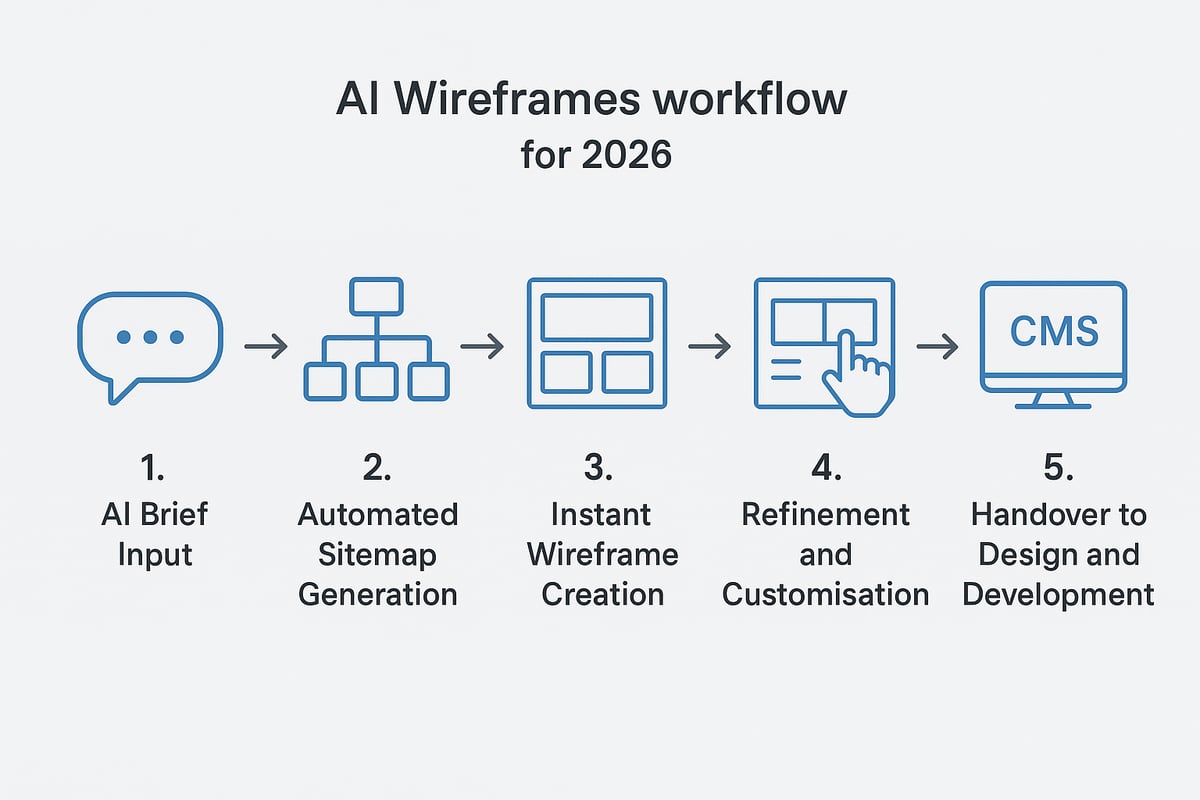
If you’ve made it this far, you’re clearly serious about getting your website working harder for your business. We’ve covered why a smart redesign matters, how user journeys and conversions are everything, and why you can’t afford to ignore modern SEO. But every business is different, and sometimes you just need to talk it through with someone who gets it. If you’d like honest advice—no jargon, no sales pitch—grab your Get free 45 min consultation and let’s see how your website can actually start bringing in more leads and sales.
9 Inspiring Explainer Videos to Watch in 2026

Video is everywhere in 2026, and explainer videos are leading the charge. Did you know people now spend over 80% of their online time watching video content? This article spotlights 9 inspiring explainer videos that set new standards for creativity, clarity, and engagement. What makes explainer videos so effective today? It’s a blend of sharp storytelling, vibrant animation, clear messaging, and a strong brand voice. We’ll walk through standout examples across industries, highlight what makes each one special, and share takeaways for marketers, educators, and business owners ready to level up their own video strategy.

Why Explainer Videos Matter in 2026

Explainer videos have come a long way from simple, hand-drawn animations. Today, they are sophisticated, AI-powered productions that blend storytelling, data, and interactivity. This evolution is changing how audiences absorb information in 2026.

The Evolution of Explainer Videos

Over the past decade, explainer videos have transformed from basic cartoons into multi-layered, AI-driven experiences. As attention spans have shortened, brands have shifted towards snappier, more impactful content that hits the point fast. Personalisation is now the norm, with AI tailoring video content to individual viewers’ needs and behaviours.

Interactive elements, such as clickable hotspots and branching storylines, are commonplace. This makes explainer videos more engaging and memorable. Industry stats back up their power: explainer videos increase conversion rates by up to 80%. No wonder they’re now essential for everything from launching SaaS products to educating customers and onboarding employees.

Explainer videos are also more accessible than ever. Captions, multiple language options, and screen-reader compatibility are standard features, making them suitable for global and diverse audiences.

Key Benefits for Brands and Audiences

The true magic of explainer videos lies in their ability to break down complex ideas for any audience. Whether you’re selling a fintech app or teaching a science concept, these videos simplify the message. They help brands drive sales, onboard users smoothly, and boost brand awareness with memorable visuals and stories.

Top brands use explainer videos for product launches, customer support, and training. The impact is easy to measure: higher retention rates, fewer support queries, and better SEO. Accessibility features like captions and translations make sure no one is left out.

Trends Shaping Explainer Videos in 2026

Several trends are defining explainer videos this year:

  • AI-powered creation and personalisation
  • Real-time data visualisation for up-to-date storytelling
  • Interactive elements that invite viewers to participate
  • A focus on inclusivity, diversity, and authentic narratives
  • Cross-platform optimisation for mobile, social, and web
  • Expansion into new fields such as healthcare, fintech, and sustainability

In 2026, explainer videos aren’t just a marketing tool. They’re a core part of how brands communicate, educate, and build trust with their audiences.

What Makes an Explainer Video Inspiring?

What separates average explainer videos from those that stick in your mind and drive action? It comes down to a blend of story, visuals, and technical polish. Let’s break down the ingredients that make explainer videos truly inspiring in 2026.

Storytelling and Structure

At the heart of the best explainer videos is compelling storytelling. Every effective video starts with a relatable problem, then guides viewers step-by-step towards a solution. This classic structure helps audiences see themselves in the scenario.

Inspiring explainer videos often feature memorable characters or real-life situations. They tap into emotions, whether it’s humour, empathy, or curiosity. The narrative flow keeps viewers hooked from the first second to the final call to action.

Want to connect? Make your explainer videos tell a story that resonates with your target audience. The right script and sequence can transform dry information into an experience people remember.

Visual Creativity and Branding

Visuals do more than decorate—they tell your brand’s story at a glance. In 2026, explainer videos stand out by using innovative animation styles, from hand-drawn frames to slick 3D motion graphics. Consistent use of your brand colours, fonts, and logo ensures instant recognition.

Leading brands are pushing boundaries, using interactive and immersive 3D animations to boost engagement and make complex topics accessible. Interactive and immersive 3D animations in explainer videos are helping brands break through the noise and deliver messages with impact.

Choose visual elements that support your message and reinforce your brand identity. A unique look can make your explainer videos unforgettable.

Clarity, Simplicity, and Engagement

The most inspiring explainer videos are clear and jargon-free. They use concise scripts, on-screen text, and infographics to get the message across fast. Voiceovers add another layer of understanding, especially when paired with eye-catching visuals.

To keep engagement high, top videos sprinkle in humour, surprise, or interactive features. Breaking down complex ideas into bite-sized, visual chunks helps audiences absorb and retain information.

Always ask: does every second of your explainer videos add value for the viewer?

Technical Excellence

Technical quality is non-negotiable for inspiring explainer videos. Crisp audio, professional editing, and smooth transitions all contribute to a seamless viewing experience. Pacing should match your message—fast for simple concepts, slower for complex topics.

Accessibility matters too. Captions, translations, and screen-reader compatibility ensure your explainer videos work for everyone, regardless of ability or language.

High production values show you care about your brand and your audience.

Metrics for Success

How do you know if your explainer videos are truly inspiring? Look at the numbers. Track viewer retention rates, shares, and conversion metrics to see what’s working. Brands that focus on strong storytelling and clarity often see double the engagement compared to generic content.

Review feedback, watch how viewers interact, and keep iterating. The most inspiring explainer videos are the ones that deliver real results for your goals.

9 Inspiring Explainer Videos to Watch in 2026

Explainer videos are everywhere in 2026, but only a handful truly set the bar for creativity, clarity, and impact. The following collection showcases standout examples across tech, SaaS, e-commerce, and more. Each of these explainer videos offers a unique lesson—whether you’re a marketer, educator, or business owner looking to inspire, inform, or convert.

Below, you’ll find a breakdown of each video’s strengths, target audience, and what makes them shine in a crowded digital landscape.

Google Gemini Introduction Video

The Google Gemini introduction is a masterclass in modern explainer videos. It opens with the CEO, then transitions to diverse real-life users. The narrative focuses on how Gemini’s AI can help everyday people, using simple language and avoiding jargon.

9 Inspiring Explainer Videos to Watch in 2026 - Google Gemini Introduction Video

Key Features:

  • Real user scenarios
  • Multiple presenters for inclusivity
  • Accessible explanations

Benefits:

  • Humanises advanced AI
  • Shows versatility across industries
  • Builds trust with non-technical audiences

Target Audience: Tech enthusiasts, businesses, general consumers

Pros:

  • Inclusive representation
  • Clear, relatable messaging

Cons:

  • May lack detail for advanced users

Standout Moment: Demonstrates Gemini’s use in education, business, and daily life, making it one of the most accessible explainer videos in the AI space.

Unique Point: Focuses on real-world impact, not just features. The personal stories make the technology approachable, and the video leverages AI-driven personalization in video marketing to tailor content for different viewer segments.

Certainly.io Explainer Video

Certainly.io’s explainer video is a playful blend of hand-drawn animation and interactive sound design. It immerses viewers in the world of e-commerce, highlighting how their AI chatbot solves pain points that competitors overlook.

9 Inspiring Explainer Videos to Watch in 2026 - Certainly.io Explainer Video

Core Features:

  • Hand-drawn animation and motion graphics
  • Sound effects mimicking shopping experiences

Benefits:

  • Clearly highlights product differentiation
  • Engages with creative visuals

Target Audience: E-commerce teams, sales professionals, startups

Pros:

  • Strong storytelling
  • Memorable sound cues

Cons:

  • Focused on e-commerce, less relevant for other sectors

Example: The video contrasts a frustrating shopping experience with a seamless one powered by Certainly.io, making it clear why explainer videos like this are so effective.

Unique Point: Blends traditional animation with modern sound design for a tactile, memorable effect.

Monday.com “Everything You Can Do” Video

Monday.com’s explainer video is a fast-paced showcase of features and real-world applications. It combines live-action, product walkthroughs, and customer logos to build trust and excitement.

9 Inspiring Explainer Videos to Watch in 2026 - Monday.com “Everything You Can Do” Video

Core Features:

  • Product demo with live-action and screen recordings
  • Social proof from well-known brands

Benefits:

  • Demonstrates practical workflows
  • Appeals to a wide range of industries

Target Audience: Project managers, SMEs, enterprises

Pros:

  • Feature-rich yet concise
  • Visual variety keeps viewers engaged

Cons:

  • Fast pace may require viewers to pause and rewind

Standout Example: Walks through a dashboard setup, showing how teams can adapt Monday.com to their needs.

Unique Point: The blend of formats and industry-specific examples sets it apart from other explainer videos.

Klaviyo Product Tour

Klaviyo’s product tour video leans heavily into strong visual branding and credibility. It walks viewers through the interface, using a friendly voiceover and customer testimonials to build trust.

9 Inspiring Explainer Videos to Watch in 2026 - Klaviyo Product Tour

Core Features:

  • Brand-focused visuals and clear interface walkthroughs
  • Voiceover narration

Benefits:

  • Makes complex marketing automation simple
  • Highlights integrations and real-world use

Target Audience: Marketers, e-commerce brands, CRM users

Pros:

  • Clear visuals, friendly tone
  • Effective use of social proof

Cons:

  • May feel rushed for first-timers

Example: Shows step-by-step how to automate a campaign, a hallmark of effective explainer videos.

Unique Point: Strong visual identity and authentic customer stories.

Toggl Track Explainer Video

Toggl Track takes a minimalist approach, using striking typography and on-screen text. The absence of voiceover makes it accessible in silent environments and easy to follow at any pace.

9 Inspiring Explainer Videos to Watch in 2026 - Toggl Track Explainer Video

Core Features:

  • Text-on-screen and branded typography
  • Paced transitions for clarity

Benefits:

  • Instantly recognisable brand style
  • Clear communication without narration

Target Audience: Freelancers, remote teams, productivity fans

Pros:

  • Accessible, concise
  • Visually distinctive

Cons:

  • Lacks audio for visually impaired users

Example: Italicised text highlights key benefits, proving that explainer videos do not always need a voice to be effective.

Unique Point: Minimalist design puts focus on the message, not just visuals.

Umault Agency Introduction Video

Umault’s agency video is a satirical, live-action journey through the world of corporate marketing. It uses humour and fourth-wall breaks to critique typical agency videos.

9 Inspiring Explainer Videos to Watch in 2026 - Umault Agency Introduction Video

Core Features:

  • Satirical narrative
  • Live-action with creative transitions

Benefits:

  • Memorable and engaging
  • Highlights agency creativity

Target Audience: Marketing teams, agencies, corporate decision-makers

Pros:

  • Clever script, relatable scenarios
  • Breaks the mould of standard explainer videos

Cons:

  • Humour may not land with all viewers

Example: Contrasts bland corporate video tropes with inventive, self-aware storytelling.

Unique Point: Willingness to poke fun at itself sets it apart.

PlayPlay “What is PlayPlay?” Video

PlayPlay’s video is a whirlwind tour of use cases, delivered in under 40 seconds. Text-on-screen and a mix of live and animated footage make it both informative and visually engaging.

9 Inspiring Explainer Videos to Watch in 2026 - PlayPlay “What is PlayPlay?” Video

Core Features:

  • Rapid-fire text and visual transitions
  • Alternates between animation and live footage

Benefits:

  • Communicates value quickly
  • Appeals to busy professionals

Target Audience: Content marketers, social media teams, SMBs

Pros:

  • Short, effective, easy to digest
  • Multiple use cases in seconds

Cons:

  • No voiceover, may lack depth for complex topics

Example: Clearly shows how explainer videos can be both brief and impactful.

Unique Point: Maximises information density without overwhelming viewers.

Airalo “How Does Airalo Work?” Video

Airalo’s explainer video uses a presenter-led, Q&A format to break down how eSIMs work for global travellers. Branded transitions and simple graphics keep things focused and digestible.

9 Inspiring Explainer Videos to Watch in 2026 - Airalo “How Does Airalo Work?” Video

Core Features:

  • Live-action presenter
  • Text-based Q&A segments

Benefits:

  • Educational without being dry
  • Strong brand integration

Target Audience: Travellers, digital nomads, tech adopters

Pros:

  • Clear narrative, accessible format
  • Good balance of depth and simplicity

Cons:

  • Less animation, may feel static

Example: Each key question appears on a branded background, then is answered with a practical demo.

Unique Point: Maintains engagement in a longer format with digestible segments.

Gong Product Overview Video

Gong’s overview video is a polished mix of infographics, screen captures, and voiceover. It simplifies complex SaaS concepts and uses review badges to provide instant credibility.

9 Inspiring Explainer Videos to Watch in 2026 - Gong Product Overview Video

Core Features:

  • Infographics and product visuals
  • Synced voiceover and pacing

Benefits:

  • Breaks down intricate features
  • Strong use of awards and reviews as social proof

Target Audience: Sales teams, SaaS companies, B2B marketers

Pros:

  • Bright, engaging visuals
  • Clear structure and pacing

Cons:

  • Focuses more on features than customer stories

Example: Combines interface walkthroughs with customer review badges, showing how explainer videos can persuade as well as inform.

Unique Point: Blends education and persuasion for maximum impact.


Quick Comparison Table

Video Style Key Benefit Unique Point
Google Gemini Live-action, real users Humanises AI Real-world stories, AI personalisation
Certainly.io Hand-drawn animation Creative differentiation Interactive sound design
Monday.com Live-action, mixed Broad feature showcase Industry flexibility
Klaviyo Interface walkthrough Brand credibility Customer testimonials
Toggl Track Typography/text Minimalism, accessibility No voiceover
Umault Agency Satirical live-action Humour, creativity Breaks conventions
PlayPlay Fast-paced, text Info-dense, brief Under 40 seconds
Airalo Presenter/Q&A Educational, accessible Branded Q&A segments
Gong Infographics, voiceover Simplifies SaaS Review badges, persuasive elements

These nine explainer videos demonstrate the range of styles and strategies that define the best in 2026. By studying what makes each one successful, you can find inspiration to elevate your own explainer videos—whether you want to tell a story, simplify a complex product, or connect with a global audience.

How to Apply These Lessons to Your Own Explainer Videos

Unlocking the full potential of explainer videos is all about applying proven tactics and learning from the best. Whether you are launching your first video or refining your strategy, a few key principles can help you stand out, deliver real value, and drive results.

Tips for Crafting Standout Explainer Videos

Start with a crystal-clear core message. Who are you speaking to, and what do you want them to remember?

Choose a visual style that reflects your brand and resonates with your audience. Keep scripts concise and focused on real-world benefits. For scripting advice, you might want to explore website copywriting best practices.

Mix animation, live-action, and on-screen text to grab attention. Always include captions, translations, and descriptive audio to make your explainer videos accessible to everyone.

Tools and Platforms for Video Creation

The right tools can make or break your explainer videos. Canva, PlayPlay, Adobe After Effects, and Vyond are popular choices for different budgets and skills.

AI-powered platforms can now help with scriptwriting, animation, and voiceovers, making it easier than ever to create professional content. To see how AI is transforming the process, check out AI in marketing automation.

Choose a platform that fits your needs and technical confidence, and do not be afraid to experiment with new tech.

Measuring Success and Iterating

Track how your explainer videos are performing with metrics like viewer retention, conversion rates, and social shares.

A/B testing is your friend: try different versions to see what resonates. Gather feedback from your audience, then use those insights to iterate and improve. For more on boosting outcomes, see these conversion rate optimisation tips.

Regular reviews keep your content relevant and effective.

Common Mistakes to Avoid

Even the best intentions can go awry. Watch out for these pitfalls:

  • Overloading your explainer videos with information or technical jargon.
  • Ignoring brand consistency in visuals, fonts, and tone.
  • Skipping accessibility and localisation options.
  • Forgetting to test and update your content regularly.

Stay focused and keep things simple to get your message across.

Inspiring Your Team and Stakeholders

Share successful explainer videos as benchmarks to set the bar internally. Encourage your team to brainstorm and storyboard together, making room for every creative idea.

Use competitor examples to help justify investment in quality video production. Collaborative feedback helps everyone buy in and pushes your explainer videos to the next level.

The Future of Explainer Videos: What to Expect Beyond 2026

The way explainer videos shape communication is set to transform dramatically in the coming years. By 2026, video will account for over 82% of all consumer internet traffic, according to Cisco. So, what does the future look like for explainer videos, and how can brands stay ahead of the curve?

Next-Gen Innovations

Explainer videos are moving beyond simple animations. The next wave will feature interactive elements, allowing viewers to click, shop, or even explore products in AR or VR. AI will play a major role, tailoring video content to individual viewers based on their preferences and behaviour.

Here’s a snapshot of what’s coming:

Future Feature Description
Interactive Videos Viewers engage directly with content
Shoppable Elements Buy products instantly inside videos
AR/VR Integration Immersive, hands-on explainer experiences
AI Personalisation Custom messages for different audiences

These innovations will ensure explainer videos stay relevant as audience expectations shift.

Authenticity and Effectiveness

As explainer videos become more advanced, the demand for authenticity and inclusivity will grow. Audiences want real stories, diverse voices, and ethical messaging. Brands must also focus on true learning and retention, not just surface-level engagement.

Recent research shows that integrating learning tasks after explainer videos can boost understanding and retention. For marketers and educators, this means combining creative storytelling with purposeful interaction. You can explore this research in Learning tasks reduce illusion of understanding in explainer videos.

Staying Ahead in Digital Strategy

Adapting to new platforms and audience behaviours is crucial. Brands should review industry trends, analyse competitor examples, and continually refine their approach to explainer videos. Integrating these videos into a broader marketing plan is essential for long-term success. For more on this, check out Digital strategy insights.

In summary, explainer videos will remain a cornerstone of digital communication. Embracing innovation, prioritising authenticity, and staying agile will ensure your brand’s explainer videos cut through the noise in a rapidly changing world.

If these explainer videos have got you thinking about how your business could tell its story more clearly and win over more customers, you’re not alone. The right video, built around your unique offer and audience, can seriously boost conversions and set you apart from the competition. If you’re keen to turn inspiration into action but want a bit of expert guidance—whether that’s about video strategy, website tweaks, or using AI to speed up your marketing—let’s have a proper chat. I’m offering a no-strings Get free 45-min consultation to help you figure out what’ll actually move the needle for your business.

Image SEO Guide 2026: Boost Visibility With Proven Strategies

Did you know image searches now account for over 20% of all web queries? Visual content is no longer just an add-on; it is central to how people discover brands, products, and information online.

If you want more traffic, higher rankings, and better engagement, mastering image seo is essential in 2026. This guide brings you the latest, proven strategies to optimise your images for Google and beyond.

Get ready for a step-by-step journey: from technical foundations to advanced AI and visual search tactics, you will learn exactly how to outrank your competition and boost your online visibility.

Understanding Image SEO in 2026: Why It Matters

The world of image seo is evolving at breakneck speed. In 2026, staying ahead means understanding how visual content impacts your rankings, traffic, and user engagement. Let’s break down why image seo is now essential for every site, from ecommerce to publishers.

Understanding Image SEO in 2026: Why It Matters

The Evolution of Image SEO

Image seo has come a long way from simple alt text and basic optimisation. Back in the early 2010s, adding descriptive alt text and compressing images was enough to see gains. Fast forward to 2026, and artificial intelligence, machine learning, and visual search engines have transformed the landscape.

Google’s algorithm now weighs not just the content of the image, but where and how it appears. Platforms like Pinterest, Instagram, and Google Lens have made visual discovery a core part of how users search. According to recent Image SEO statistics 2025, over 62% of Gen Z and Millennials now prefer visual search to text.

Images are now deeply integrated into Google’s SERPs, Google Discover, and shopping results. For ecommerce, local businesses, and publishers, image seo is no longer optional. As search engines become more visual, your images will often be the first thing users see.

How Image SEO Drives Visibility and Traffic

Image seo is a major driver of organic traffic, not just a decorative add-on. When your images are optimised, they can rank in Google Images, appear in rich results, and even feature in Google Discover. This expands your reach and puts your content in front of users who may never visit your site directly.

Optimised images support higher page rankings. Studies show that sites with well-optimised images see up to 30% more organic visits. This is not just about clicks, but also about accessibility. Great image seo ensures your content is accessible for all users, including those using screen readers.

Images can also power featured snippets and knowledge panels. When search engines understand your visuals, you increase your chances of being included in high-visibility search features. In short, image seo is a win for both users and search engines.

Key Ranking Factors for Images in 2026

To succeed with image seo in 2026, focus on a mix of relevance, quality, and context. Search engines evaluate if your image matches the page topic, is high quality, and fits naturally within the content. Mobile-first indexing means your images must load fast and look sharp on all devices.

Core Web Vitals are now a key ranking factor. Fast-loading, responsive images directly impact your rankings. Using structured data and image licensing helps search engines understand your images and display them properly.

Ranking Factor Why It Matters in 2026
Relevance Ensures images match search intent
Quality High-res, clear images rank better
Context Placement near relevant text boosts SEO
Mobile Optimisation Crucial for mobile-first indexing
Structured Data Unlocks rich results and features

Combining these elements, image seo helps your visuals work smarter, not just harder, in the competitive search landscape.

Step 1: Technical Foundations—Image Formats, Sizes & Compression

The technical side of image seo is your bedrock for visibility and fast-loading pages. Choose the right formats, compress images, make them responsive, and deliver them quickly worldwide. Get this foundation right and you’ll see direct benefits in rankings and user experience.

Step 1: Technical Foundations—Image Formats, Sizes & Compression

Choosing the Right Image Formats for 2026

Selecting the best image format is crucial for image seo in 2026. Modern formats like WebP, AVIF, and JPEG XL offer superior compression and quality, making them ideal for most websites. WebP is widely supported, AVIF delivers even smaller file sizes, and JPEG XL is gaining traction for high-resolution needs.

Traditional formats still have their place. Use PNG for sharp graphics and transparency, SVG for logos and icons, and GIF for simple animations. However, avoid overusing outdated formats, as Google now favours next-gen options.

Google’s PageSpeed Insights recommends, “Serve images in next-gen formats.” For consistent crawling and indexing, it’s also key to use the same image URL across your pages, as detailed in Google updates image SEO best practices. This approach streamlines image seo and avoids wasted crawl budget.

Format Best Use Compression Browser Support
WebP Photos/General High Excellent
AVIF High-res/Next Highest Growing
JPEG XL Large/Print Very High Emerging
PNG Graphics Low Universal
SVG Icons/Logos N/A Universal
GIF Simple Anim. Low Universal

Image Sizing and Compression Techniques

Image seo hinges on fast load times. Large, bulky images slow down your site and hurt rankings. Compress every image before uploading. Tools like TinyPNG, ImageOptim, ShortPixel, and Smush automate this, making bulk compression easy for big sites.

Aim for the lowest file size without visible quality loss. Automate compression in your workflow to save time. For example, reducing image sizes can boost page speed by up to 40 percent, directly improving both image seo and user satisfaction.

Here’s a quick checklist for compression:

  • Use bulk tools for large libraries.
  • Set max dimensions that fit your layout.
  • Always preview compressed images before publishing.

Responsive and Scalable Images

With mobile-first indexing, responsive images are a must for image seo. Use srcset and sizes attributes to serve the right image size for every device. This boosts load speed and keeps images crisp on any screen.

For content management systems, most modern themes (WordPress, Shopify, Squarespace) handle responsive images out-of-the-box. If you run an ecommerce site, Shopify recommends 2048x2048px for product images to balance quality and speed.

Example img tag for responsive delivery:

<img src="product.jpg" srcset="product-500.jpg 500w, product-1000.jpg 1000w" sizes="(max-width: 600px) 500px, 1000px" alt="Red leather sofa in living room">

Always check your site’s output to ensure images adapt smoothly across all devices.

Lazy Loading and CDN Integration

Lazy loading delays the loading of images until they enter the viewport, which improves perceived speed and Core Web Vitals. Google recommends this practice for all below-the-fold images, making it an essential part of image seo.

Integrate a Content Delivery Network (CDN) such as Cloudflare or Fastly to deliver images close to your users, reducing latency worldwide. Most CDNs offer image optimisation features, compressing and resizing images on the fly.

Monitor your image seo performance using Google PageSpeed Insights. Fix any flagged issues quickly, and remember, a fast, globally optimised image setup keeps both users and search engines happy.

Step 2: Context, Relevance & Originality—Creating Images That Rank

Creating images that truly rank in 2026 is about more than just uploading pretty visuals. If you want your image seo to drive real results, you need a blend of originality, context, and technical best practice. Let’s break down what it takes to make your images work harder for your brand.

Step 2: Context, Relevance & Originality—Creating Images That Rank

The Power of Original Visual Content

Originality is the foundation of high-performing image seo. Google’s algorithms have evolved to reward unique, high-quality visuals over generic stock images. Why? Because custom content signals expertise, authority, and trustworthiness — the pillars of E-E-A-T.

If you want to stand out, invest in bespoke photography, branded graphics, or custom infographics. For ecommerce, this could mean professional product shoots. For service businesses, think behind-the-scenes shots or team portraits. These images not only boost your image seo but also increase user engagement and sharing rates.

A study by WordStream found that original images can keep visitors on your site longer and encourage more shares. As competition grows, unique visuals are a key advantage for image seo that converts.

Image Placement and Contextual Relevance

Google is getting smarter at understanding how images fit with your content. Placing your image near relevant text, with supporting captions, helps search engines connect the dots. Captions, in particular, are proven to enhance content visibility in AI-driven search engines, as discussed in Caption Injection in Generative Search Engines.

Always ensure your images sit close to the most relevant paragraphs. Use figure and figcaption tags for clarity. Think of captions as your image’s “elevator pitch” — a quick summary that reinforces its purpose for both users and search engines.

Context matters for image seo. Google analyses surrounding text to determine what your image is about, so make sure your copy supports your visuals.

Naming Conventions and File Structure

Technical details matter when it comes to image seo. Start with descriptive, keyword-rich file names. Avoid lazy defaults like IMG_1234.jpg. Instead, use names that describe exactly what’s in the image.

Poor Example Good Example
IMG_1234.jpg red-leather-sofa-living-room.jpg
photo1.png handmade-ceramic-mug-blue-glaze.png

For large sites, keep your folder structure organised. Group images by product, service, or topic. This makes managing and updating images easier, and helps Google crawl your site efficiently.

Avoiding Common Pitfalls

Even the best strategy can be derailed by common image seo mistakes. Avoid using duplicate images across multiple pages, as this dilutes their value. Relying too much on stock photos can make your site feel generic and hurt your rankings.

Always add alt text that accurately describes each image. This is crucial for accessibility, helping screen readers and meeting legal requirements in the UK and EU. Thin content, or images that don’t add value, should be replaced with visuals that support user intent.

Regularly audit your image library for outdated, irrelevant, or duplicate files. By prioritising quality, context, and accessibility, your image seo will deliver lasting results.

Step 3: On-Page Optimisation—Alt Text, Titles, Captions & Structured Data

On-page optimisation is the backbone of successful image seo in 2026. It is not just about what your images look like, but how search engines interpret and display them. Mastering these elements can give your site the edge in crowded search results.

Step 3: On-Page Optimisation—Alt Text, Titles, Captions & Structured Data

Writing Effective Alt Text and Image Titles

Alt text is your direct line to Google when it comes to image seo. It is the main way search engines understand your visuals. Always describe what is in the image, keep it concise, and include a relevant keyword naturally.

For example, instead of "IMG_1234," use "Handmade ceramic mug with blue glaze." This approach is clear for both search engines and users. Avoid stuffing keywords or using vague phrases, as this can harm image seo in the long run.

Image titles should complement alt text. Use them for extra detail or context, especially for complex visuals. Both attributes support accessibility and can improve rankings, making them essential for image seo.

Captions, Surrounding Text, and Semantic Markup

Captions are powerful in image seo. They provide context and help search engines link visuals to on-page content. Place captions close to images and use relevant keywords where it makes sense.

Surrounding text also matters. Google scans the nearby copy to understand the image's subject. Use semantic HTML like <figure> and <figcaption> to clarify relationships between text and images, making your code cleaner and more accessible.

Optimised images are not just about technical tweaks. With Google Images growth statistics, it is clear that well-placed, relevant images drive more visibility and clicks. Make sure every image tells a story and supports your content's main message.

Image Structured Data & Licensing Markup

Structured data is a must for advanced image seo. Add schema.org/ImageObject to your images to unlock rich results and boost trust with users. This markup helps Google understand what your image represents and how it relates to your content.

For licensed images, include metadata about ownership and usage rights. Use JSON-LD or microdata formats to embed this information. Doing so makes your images eligible for enhanced features in Google Images, and increases your chances of being featured in knowledge panels or carousels.

A simple example of JSON-LD for an image:

{
  "@context": "https://schema.org",
  "@type": "ImageObject",
  "contentUrl": "https://example.com/image.jpg",
  "license": "https://example.com/license"
}

Open Graph and Twitter Card Tags for Social Sharing

Social media can drive significant traffic, so optimising images for sharing is vital in image seo. Add og:image and twitter:image meta tags to your pages. These tags ensure your images appear correctly when shared on platforms like Facebook and X (formerly Twitter).

Check image dimensions and file size. Social platforms often crop or compress visuals, which can affect quality. Use recommended sizes, such as 1200x630px for Open Graph, and run tests to see how your images display.

A well-optimised image with the right tags can boost engagement, shares, and clicks. Make this step a routine part of your image seo workflow.

Accessibility and Compliance

Making your images accessible is not just good practice, it is a legal requirement in the UK and EU. Follow WCAG guidelines: every image must have alt text that describes its content and function. Decorative images should use empty alt attributes so screen readers can skip them.

Test your site with tools like axe, WAVE, or Lighthouse to spot and fix accessibility gaps. Image seo is not complete without this step, as search engines reward accessible sites with better visibility.

Regularly review your images for compliance, especially if you update content or add new visuals. Accessible images improve user experience for everyone and help future-proof your site against legal risks.

Step 4: Advanced Image SEO Strategies—AI, Visual Search & Future-Proofing

Staying ahead in image seo now means thinking beyond the basics. The landscape in 2026 is shaped by AI, visual search, and smarter indexing. Let’s look at what it takes to future-proof your strategy and keep your images at the top of Google and beyond.

Optimising for Visual Search Engines and AI

Visual search is revolutionising how users find products and information. Platforms like Google Lens, Bing Visual Search, and Pinterest Lens are interpreting images with unprecedented accuracy. In 2026, AI understands not just the subject, but the context, surrounding text, and even user intent.

To optimise image seo for visual search, ensure your images are clear, relevant, and high quality. Use descriptive file names and alt text. Prepare for multimodal search by pairing strong visuals with informative copy. This positions your content for discovery, no matter how users search.

  • Use images that clearly display your product or subject
  • Ensure metadata (alt text, titles) matches page context
  • Test your images in multiple visual search platforms

By focusing on these fundamentals, you’ll tap into a growing stream of organic traffic through image seo.

Leveraging Structured Data for Enhanced Visibility

Structured data is essential for making your images stand out in search results. By marking up images with schema.org properties, you unlock eligibility for rich results, image carousels, and Google Discover.

Let’s compare some popular structured data types:

Schema Type Use Case Benefit
Product Ecommerce Rich product snippets
Recipe Food blogs Recipe cards, image carousels
Event Local events Event listings, images

For ecommerce, adding detailed product schema can boost click-through rates. Always include image licensing metadata if you want your images to show in Google Images’ “licensable” badge. You can learn more about implementing structured data from Google Search Central.

Integrating these enhancements into your image seo workflow will increase visibility and trust with users.

Image Sitemaps and Indexing Best Practices

Large sites benefit hugely from dedicated image sitemaps. These help Google and other engines discover all your visual assets efficiently. Best practice is to add image entries within your existing XML sitemaps, like so:

<image:image>
  <image:loc>https://www.example.com/image1.jpg</image:loc>
  <image:caption>Blue ceramic mug on wooden table</image:caption>
</image:image>

Monitor your sitemap status in Google Search Console. If images aren’t indexed, check for crawl issues or incorrect file paths. Regular sitemap updates are vital for robust image seo, especially when adding or updating large galleries.

Monitoring, Analytics, and Ongoing Optimisation

Continuous improvement is key to staying competitive in image seo. Use Google Search Console and Analytics to track:

  • Impressions and clicks from Google Images
  • Click-through rate (CTR) for image results
  • Number of indexed images

A/B test different visuals to see which drive the most engagement and conversions. Screaming Frog can crawl your site to audit image tags and structured data. Set up regular reviews to catch any drop in image seo performance and fix issues quickly.

Preparing for the Future of Image SEO

The future of image seo is shaped by rapid advances in AI and new search features. Stay informed about algorithm updates and experiment with generative AI tools for creating unique visuals.

Invest in ongoing training—Google’s own documentation and industry blogs are essential for staying sharp. Build internal checklists and standard operating procedures to keep your team aligned.

By embracing innovation and continuously refining your approach, you’ll ensure your image seo remains effective as search evolves.

Step 5: Image SEO for Ecommerce, Local & Niche Sites

Image seo is not a one-size-fits-all process. The strategies you use should fit your business type and goals. Whether you run an online shop, a local service, or a content-driven site, getting image seo right can give you a clear edge.

Ecommerce Image SEO Best Practices

For ecommerce, image seo starts with quality. Use crisp, high-resolution images that show your products from multiple angles. Shoppers want to zoom in and see details, so offer 360-degree views or close-ups if possible.

Structured data is a must for product images. Mark up each image with schema so Google can display your products in rich results. Platforms like Shopify recommend image sizes of 2048x2048px for sharp product displays. Make sure you compress images without losing quality, as slow-loading pages will hurt rankings and conversions.

  • Use next-gen formats like WebP or AVIF
  • Add descriptive file names and alt text
  • Mark up images with product schema
  • Test image performance in Google Search Console

Successful image seo for ecommerce means your products are more likely to show up in Google Images and shopping results, driving more traffic and sales.

Local SEO and Image Optimisation

For local businesses, image seo is vital for standing out in map packs and local searches. Start by geo-tagging your images with location data. This helps search engines link your photos to your business address.

Your Google Business Profile should feature high-quality, up-to-date images. Include photos of your storefront, team, and products, making sure each image is optimised with relevant alt text and file names.

A local café with strong image seo might see more bookings simply because their images appear in Google Maps and Discover. Always review your images to ensure they reflect your brand and local area.

  • Geo-tag images for local relevance
  • Use consistent branding in all photos
  • Update images seasonally or after renovations

Niche Applications: Publishers, Blogs, and Service Providers

Image seo for publishers and blogs is about making your content stand out. Use compelling featured images for each article. These visuals not only attract clicks but can appear in Google Discover and rich snippets.

Service providers should invest in portfolio or gallery pages. High-quality, original images build trust and showcase your expertise. Always respect copyright and use proper licensing if you include third-party visuals.

For both publishers and service businesses, descriptive alt text and structured data help search engines understand your content. This boosts your chances of ranking in image search and helps users find the right information.

  • Feature images for every post
  • Use schema for articles and galleries
  • Credit and license images properly

Common Mistakes and How to Avoid Them

Many sites miss out on the benefits of image seo by making simple mistakes. Over-compressing images can leave them blurry or pixelated, which turns users away. On the other hand, large unoptimised files slow down your website.

Mobile optimisation is often ignored, but most searches now happen on phones. Make sure your images scale and load quickly on all devices. Regularly audit your image library, removing old or irrelevant files.

A quick table for reference:

Mistake Solution
Over-compression Balance quality and size
Ignoring mobile Use responsive images
Outdated images Schedule regular audits

Avoiding these pitfalls will keep your image seo efforts on track and your site performing well.

Industry-Specific Examples

Let’s look at how image seo drives results across industries. An ecommerce fashion retailer with optimised product images may see a measurable increase in Google Images impressions and sales. A local plumber who uploads geo-tagged before-and-after photos can climb the map pack rankings.

In hospitality, hotels with rich, high-quality photos and strong image seo often get more direct bookings. For professional services, a well-optimised gallery can turn visitors into leads.

The bottom line? No matter your industry, focusing on image seo can boost visibility, engagement, and conversions. If you want a deeper dive, Google’s Search Central Image Best Practices is a great place to start.

Image SEO Tools, Resources & Ongoing Maintenance

Staying ahead in image seo takes more than a one-off optimisation. You need the right toolkit, a smart workflow, and a commitment to continuous improvement. Let’s break down the essentials for keeping your image seo sharp, effective, and future-proof.

Essential Tools for Image SEO Success

To master image seo, equip yourself with industry-leading tools. For compression, TinyPNG, ImageOptim, and ShortPixel help shrink file sizes without sacrificing quality. Analytics is critical, so monitor your images using Google Search Console and Google Analytics to track impressions and clicks.

Structured data matters more than ever. The Google Rich Results Test and Schema Markup Validator make sure your images are eligible for enhanced search features. For accessibility, use axe, WAVE, and Lighthouse to check that every image meets WCAG standards. Here’s a quick comparison:

Tool Type Top Choices Main Benefit
Compression TinyPNG, ImageOptim, ShortPixel Faster load times
Analytics Search Console, Analytics Performance tracking
Structured Data Rich Results Test, Validator Rich snippets, trust
Accessibility axe, WAVE, Lighthouse Legal & user compliance

Keep these tools in your image seo workflow to drive results.

Workflow Tips for Teams and Solo Operators

Whether you’re a solo operator or part of a team, an organised workflow is key for ongoing image seo. Start with batch processing and automation for large image libraries. Tools like ShortPixel and Smush let you compress and optimise images in bulk, saving hours.

Integrate image seo into your content publishing process. Create a checklist for naming, alt text, and structured data. Schedule regular audits to spot outdated images or missed optimisation opportunities. For bigger teams, shared SOPs and cloud-based tools help everyone stay on the same page.

A streamlined workflow ensures your image seo efforts scale as your site grows.

Staying Up-to-Date with Image SEO Trends

Image seo evolves quickly. Stay in the loop by following Google Search Central for the latest updates. Industry blogs like WordStream, Moz, and SEMrush share strategies and case studies that keep you competitive.

Join SEO communities and forums to exchange tips and spot emerging trends. Subscribe to newsletters or set up Google Alerts for “image seo” to catch new developments as they happen.

Keeping your finger on the pulse means your image seo strategy never gets stale.

Training & Upskilling for 2026 and Beyond

To future-proof your image seo skills, invest in ongoing training. Take courses on structured data, AI-driven optimisation, and accessibility. Platforms like Coursera, SEMrush Academy, and Google’s training hub offer up-to-date resources.

Build internal checklists and standard operating procedures to make best practices stick. Encourage your team to experiment with new tools and test what works. Sharpening your image seo know-how today means you’re ready for tomorrow’s challenges.

A culture of learning ensures your image seo always delivers results.

You’ve just seen how image SEO can be the secret weapon for driving more visitors and turning browsers into buyers—especially if you’re running a small or growing business. If you want to see real, measurable results and not just tick boxes, why not get a bit of expert help? I’m offering a free 45 minute consultation where we’ll look at your site together, spot what’s holding you back, and map out practical steps to boost your visibility and sales. No waffle, just honest advice that works—grab your spot here: Get free 45 min consultation

7 Essential Google Maps SEO Tactics for 2026 Success

Google Maps is now the front door to your business in 2026. With user behaviour shifting rapidly, AI-powered search results, and more local competitors than ever, investing in google maps seo is essential to stand out.

If you want more website visits, calls, and foot traffic from nearby customers, ranking higher on Google Maps is non-negotiable. This guide reveals 7 essential, actionable tactics to help you dominate the map and outperform your rivals.

Ready to turn local searches into real sales? Let’s dive into proven google maps seo strategies tailored for the challenges and opportunities of 2026.

Why Google Maps SEO Matters in 2026

Google Maps SEO is not just a buzzword in 2026, it is the backbone of local business discovery. Nearly 90 percent of consumers use Google Maps to find local shops, restaurants, and services, making it the go to platform for local intent searches. With 46 percent of all Google searches focused on local results, your visibility on Maps directly affects your leads and revenue.

Let us look at some numbers:

Metric Statistic
Consumers using Google Maps for discovery 90 percent
Google searches with local intent 46 percent
Daily local business searches on smartphone 58 percent

Businesses that secure a spot in the Local 3 Pack consistently see more clicks, calls, and real world visits than those left further down the listings. These stats, supported by Local SEO Statistics for 2025, underline why Google Maps SEO is essential for growth.

Why Google Maps SEO Matters in 2026

The Role of Google Maps in Local Search

Google Maps SEO plays a vital role in connecting your business with local customers. The platform is now the first stop for most people seeking a nearby product or service. When a user searches, Google Maps prioritises businesses that are relevant, close by, and prominent in their field.

If your business appears in the Local 3 Pack, you will notice a sharp increase in website visits and phone calls. That is because these top spots receive the lion's share of attention. Consistent Google Maps SEO ensures your business is not just found, but chosen.

Evolving Google Maps Ranking Factors

The rules of Google Maps SEO are always evolving. In 2026, Google's algorithm looks beyond just proximity and relevance. Now, engagement metrics, like how often users interact with your listing, and AI driven intent signals play a huge part.

Keeping your business information up to date, gathering fresh reviews, and posting local content are now essential. Listings that are regularly updated and engage with customers stand out from static, ignored profiles. To stay ahead, focus on optimising every element of your Google Maps SEO strategy.

The Competitive Landscape in 2026

Competition for local visibility has never been fiercer. Every business, from independent shops to nationwide franchises, is investing in Google Maps SEO to capture more local leads. Multi location brands are deploying advanced tactics, making it even harder for smaller players to break through.

With more than half of all people searching for local businesses on their smartphones every day, the fight for attention is relentless. To compete, your Google Maps SEO must be smarter and more consistent than ever.

Impact on Mobile and Voice Search

The shift to mobile and voice search has transformed the way customers interact with local businesses. Searches for "near me" and voice activated queries have surged, and Google Maps listings are usually the first results people see.

If your Google Maps SEO is on point, you will capture these high intent customers right when they are ready to buy or visit. Optimising for both mobile and voice ensures your business stays visible, relevant, and accessible in a fast changing digital landscape.

Setting the Foundation: Google Business Profile Optimisation

A solid Google Business Profile (GBP) is the cornerstone of effective google maps seo. If you want your business to appear in local searches, everything starts here. Before diving into advanced tactics, you must get these fundamentals right.

Setting the Foundation: Google Business Profile Optimisation

Claiming and Verifying Your Listing

First, you must claim and verify your Google Business Profile to unlock all the features needed for google maps seo. The process is straightforward: search for your business on Google, claim it, and follow the verification prompts, usually via postcard, call, or email.

Verification is critical. Without it, you cannot update vital info or respond to reviews, which means you lose control over your business’s online presence. According to Google My Business Statistics 2025, verified businesses see significantly more engagement and visibility in local search. Take this step seriously to ensure you’re starting on the right foot.

Completing Every Profile Section

Next, fill out every section of your GBP. This is not the time to cut corners. Add your official business name, address, phone number, website, hours, and select the most accurate business categories. For strong google maps seo, consistency is key.

Check all details match across your website and other listings. Inconsistent NAP (Name, Address, Phone) info can harm your trust and rankings. A quick checklist:

  • Double-check spelling and formatting
  • Align with your website contact page
  • Update immediately if anything changes

A complete, consistent profile helps Google and your customers trust your business.
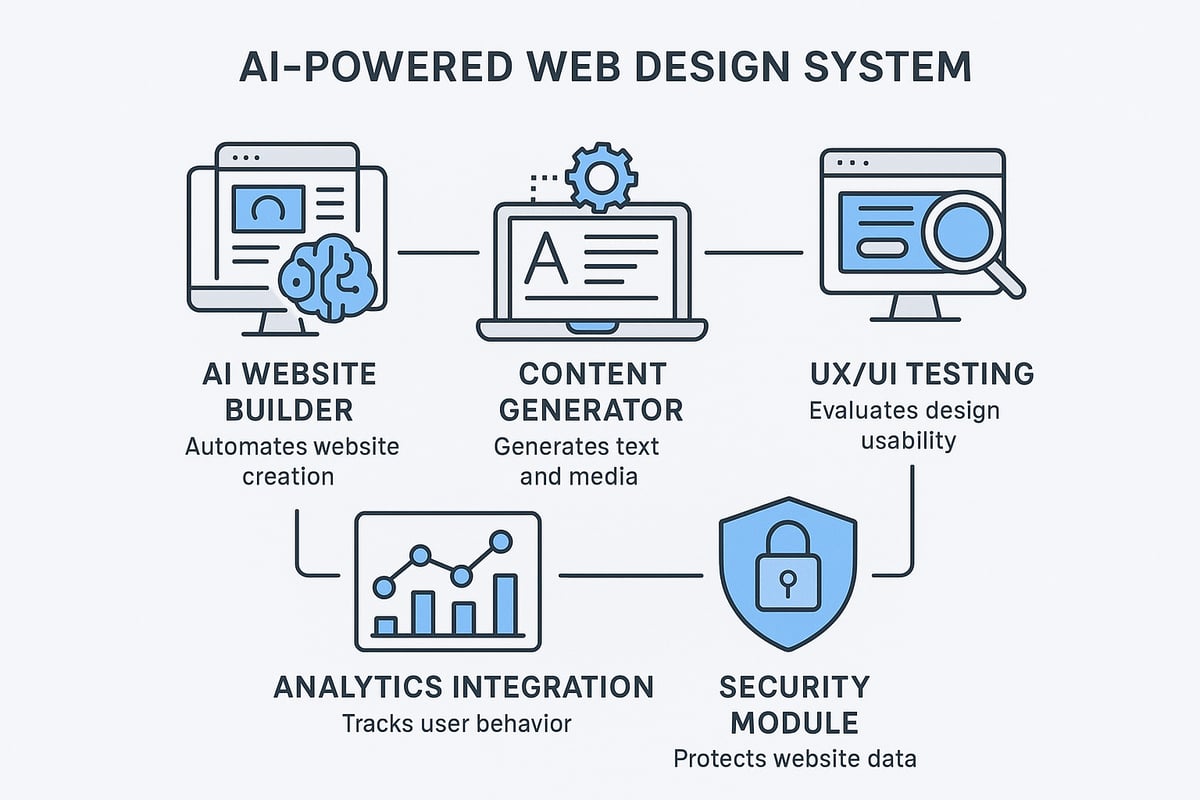
Adding High-Quality Visuals and Media

Visual content is non-negotiable for google maps seo success. Upload professional photos of your premises, products, and team. Add videos or even a virtual tour if possible.

Listings with high-quality images get far more clicks and direction requests. For service businesses, before and after photos can increase engagement. Make sure every image is sharp, well-lit, and accurately represents your brand. This visual investment sets you apart from competitors who neglect their GBP gallery.

Keeping Information Accurate and Updated

Ongoing accuracy is essential for google maps seo. Regularly review and update your business hours, especially for holidays or special closures. Add attributes like “wheelchair accessible” or “LGBTQ+ friendly” to appeal to your target audience.

Outdated or incorrect information can frustrate potential customers and lead to negative reviews. Set a reminder to check your GBP monthly. Remember, Google rewards businesses that keep their details fresh and relevant.

7 Essential Google Maps SEO Tactics for 2026 Success

If you want your business to stand out in local search in 2026, mastering google maps seo is non-negotiable. The competition is fierce, algorithms are smarter, and user expectations are rising. These seven tactics are your roadmap to climbing the Google Maps rankings, attracting more local traffic, and converting digital searches into real-world customers.

7 Essential Google Maps SEO Tactics for 2026 Success

1. Optimise for Local Keywords in Your GBP and Website

Start with local keyword research. What are your customers actually searching for? Use tools like Google Keyword Planner and competitor analysis to identify high-intent phrases, such as "emergency plumber in Birmingham" rather than just "plumber". The right keywords are the bedrock of google maps seo.

Naturally weave these keywords into your Google Business Profile (GBP) description, services, and your website’s landing pages. Avoid keyword stuffing; relevance and clarity win every time. Don't forget to target long-tail queries in your GBP’s "Questions & Answers" section. For example, answer user-submitted questions using phrases like "best vegan bakery in Manchester open now".

Track keyword performance using Google Search Console and Maps Insights. Monitor which terms drive discovery and adjust your strategy accordingly. For those seeking more advanced tactics, explore this Local SEO strategy insights resource for deeper guidance on integrating keywords and local optimisation.

2. Build Local Citations and Consistent NAP Across the Web

Local citations are mentions of your business across the web, including directories like Yelp, Yell, Bing Places, and industry-specific sites. The secret to google maps seo here is consistency. Your Name, Address, and Phone Number (NAP) must match exactly everywhere. Even small differences, like "Suite 10" versus "Ste 10", can cause ranking issues or erode trust.

Use citation management tools to streamline the process and avoid duplicate or outdated listings. Audit your citations regularly, especially after any business changes. Removing old or incorrect entries helps prevent confusion for both Google and your customers.

A quick checklist:

  • List your business on reputable, relevant directories.
  • Double-check NAP details for accuracy.
  • Remove duplicates and update old listings.
  • Audit citations at least twice a year.

Consistent citations are a core trust factor in google maps seo, helping Google verify your legitimacy and boosting your visibility in local results.

3. Encourage and Manage High-Quality Customer Reviews

Reviews are the social proof that can make or break your google maps seo. Encourage satisfied customers to leave reviews using email follow-ups, SMS reminders, or even QR codes at your premises. The easier you make it, the more likely they’ll share their experiences.

Respond to every review, both positive and negative. Addressing criticism with a solution shows you care and can turn a detractor into an advocate. Share your best reviews on your website or social media to build further trust.

Here’s how to build a review engine:

  • Request reviews after every successful job or sale.
  • Use automated tools to send reminders.
  • Respond quickly, thank customers, and resolve issues.
  • Avoid fake or incentivised reviews as Google penalises suspicious activity.

Listings with regular, high-quality reviews consistently outperform competitors in google maps seo and convert more browsers into buyers.

4. Leverage Google Posts and Q&A for Engagement

Google Posts are a free, powerful way to make your business profile more dynamic and appealing. Regularly publish updates, offers, events, or news to keep your listing fresh. Use eye-catching images and clear calls to action to drive traffic or bookings.

Don’t ignore the "Questions & Answers" feature. Proactively answer common customer queries and highlight your key services. This not only improves user experience but also helps target more keywords for google maps seo.

Tips for engagement:

  • Schedule weekly Google Posts to maintain activity.
  • Use professional photos and concise copy.
  • Monitor and answer new questions promptly.
  • Track which posts or Q&As get the most attention using GBP Insights.

Active engagement signals to Google that your business is current and trustworthy, directly supporting your google maps seo goals.

5. Optimise for Proximity, Service Areas, and Multiple Locations

Proximity remains a major ranking factor for google maps seo, but there’s more to it than just your address. Make sure your business location is correctly set in GBP, and define your service areas clearly if you serve multiple regions.

If you have more than one branch, create a dedicated location page for each on your website. Each page should feature unique content, contact details, and an embedded Google Map. This helps reinforce your local relevance for each area.

Key steps:

  • Set accurate address and service areas in GBP.
  • Create location-specific landing pages.
  • Use local schema markup for structured data.
  • Avoid using PO boxes or virtual offices.

Optimising for proximity and service areas ensures your business appears in the right neighbourhoods, giving your google maps seo a significant lift.

6. Build Local Backlinks and Community Authority

Backlinks from local, authoritative sources can supercharge your google maps seo. Partner with nearby organisations, charities, or events to earn mentions and links. Sponsor community activities or contribute expert commentary to local news outlets.

Consider joining business associations and chambers of commerce, as their directories often have strong local authority. Encourage happy customers to mention your business in their own blogs or social posts.

Ways to build local authority:

  • Guest post on local blogs or business sites.
  • Sponsor or participate in community events.
  • Get featured in local publications.
  • Monitor competitors’ backlinks for new opportunities.

Authoritative local backlinks not only boost your prominence in Google’s eyes but also help you connect with your community, strengthening your google maps seo from multiple angles.

7. Monitor, Analyse, and Adapt with Google Maps Insights

Continuous improvement is the name of the game in google maps seo. Use Google Business Profile Insights to track how customers find your listing, what actions they take, and which content drives engagement.

Set up UTM parameters to measure exactly how much website traffic comes from your Maps listing. Regularly review performance, spot trends, and compare against local competitors using third-party analytics tools.

Checklist for ongoing optimisation:

  • Monitor views, clicks, and calls from Maps.
  • Identify which posts, photos, or reviews perform best.
  • Adjust your strategy based on data, not guesswork.
  • Stay updated with Google Maps algorithm changes.

By making data-driven adjustments, you’ll maintain and grow your google maps seo advantage, ensuring your business stays ahead in local search.

Advanced Trends: AI, Voice Search, and the Future of Google Maps SEO

The world of google maps seo is evolving at breakneck speed. If you want to stay ahead, you need to know what's coming. Let’s break down the top trends shaping the future, so you can future-proof your local strategy.

Advanced Trends: AI, Voice Search, and the Future of Google Maps SEO

The Rise of AI in Local Search

Artificial intelligence is now the engine behind google maps seo. Google’s algorithms learn from user behaviour, preferences, and search intent to surface the most relevant local results. You might notice Maps suggesting businesses based on your previous searches or even the time of day.

Personalisation is king. Keeping your business profile context-aware and updated helps you stand out. If you want to dig deeper into how AI is shifting the landscape, check out AI and search trends for the latest insights. The more you align your content and listings with what users actually want, the higher you’ll climb in local rankings.

Voice Search and Conversational Queries

Voice search is no longer a novelty, it’s a necessity for google maps seo. With more people asking their phones or smart speakers for local recommendations, optimising for natural language is crucial.

Think about how your customers speak, not just what they type. Phrases like “best Italian restaurant near me” or “where’s a 24 hour chemist?” trigger Maps results instantly. Add FAQs to your profile and use conversational keywords on your website. If you want to be found in voice search, you need to sound human.

Visual and AR Search Features

Visual search and augmented reality are changing the rules for google maps seo. Google Lens lets users snap a photo of a shopfront or menu, pulling up reviews and details in seconds. AR navigation overlays directions and business info directly onto the street view through a phone camera.

What does this mean for you? Keep your photos, logos, and imagery up to date. Use descriptive image tags so Google can “see” your business. The more visually appealing and accurate your listing, the more likely you’ll capture attention from on-the-go users.
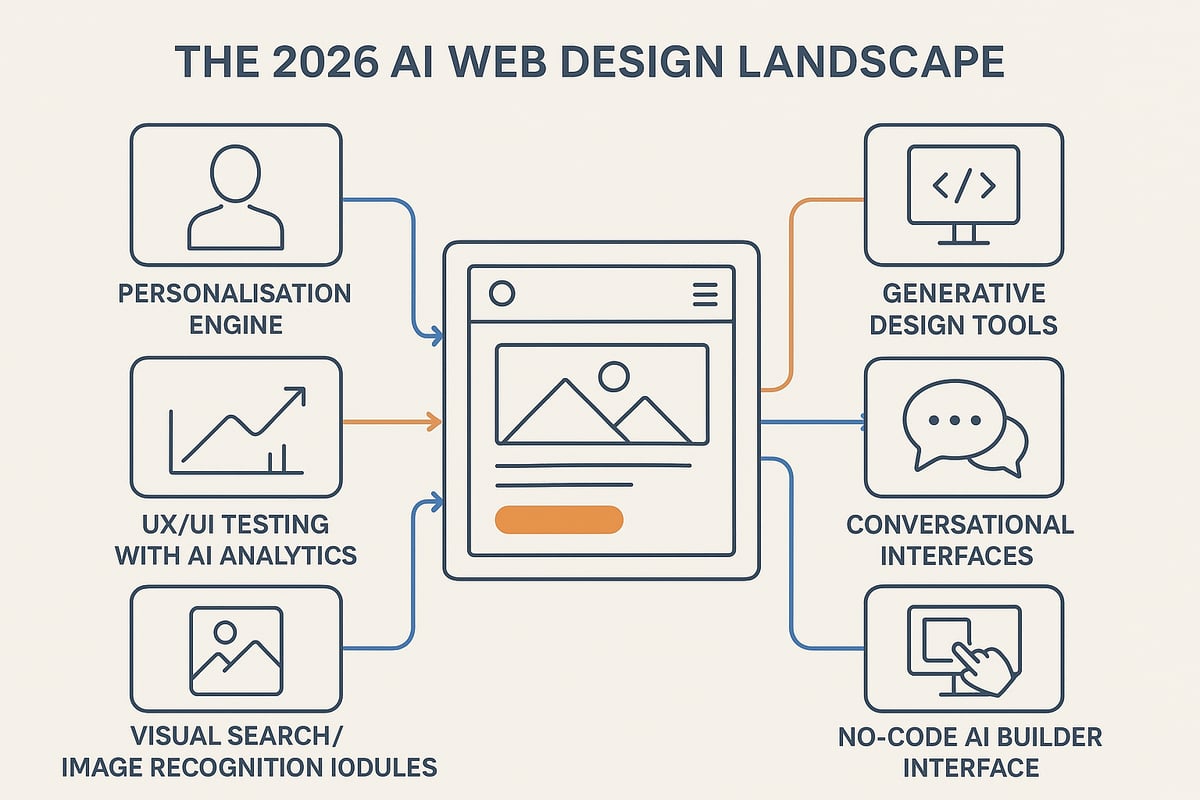
Preparing for Future Algorithm Updates

Google maps seo is a moving target. Algorithm updates are constant, and what works today might be outdated tomorrow. Staying agile is your best defence.

Regularly audit your business profile and website for accuracy and relevance. Watch for Google’s announcements and industry news to spot changes early. Set reminders to refresh your content, check for new features, and monitor your local rankings. Adapt quickly, and you’ll maintain your edge as trends shift.

Common Google Maps SEO Mistakes to Avoid

Even the most promising local businesses can stumble on google maps seo if they fall into common traps. Understanding these mistakes is the first step to safeguarding your hard-earned rankings and reputation. Let’s break down the three most damaging slip-ups and how to avoid them.

Incomplete or Inaccurate Business Information

One of the fastest ways to sabotage your google maps seo is by neglecting your business details. Outdated hours, an old address, or missing contact info frustrate customers and signal unreliability to Google.

  • Closed businesses showing as open can seriously harm your reputation.
  • Customers may show up to find you closed, leading to negative reviews.
  • Inconsistent details across your website and listings lower trust.

Did you know that 80% of consumers lose trust in businesses with incorrect information? Regularly audit your profile and ensure every field is up to date. For a deeper dive, see Optimising website for local search to keep all your local listings consistent.

Ignoring Reviews and Customer Engagement

If you’re not engaging with customer reviews, you’re missing a major google maps seo opportunity. Google rewards businesses that respond to reviews and answer questions, while neglect signals to both users and the algorithm that you’re not invested.

  • Unanswered negative reviews can deter new customers.
  • Ignoring questions leaves potential buyers in the dark.
  • Active engagement boosts both rankings and conversions.

Make it a habit to respond promptly and professionally, even to criticism. Want proof? Check out the Impact of Reviews on Local SEO Rankings to see how review management drives local visibility.

Keyword Stuffing and Spammy Practices

Trying to game google maps seo by cramming keywords or faking locations is a shortcut to trouble. Google’s algorithm is now smart enough to spot manipulative tactics and can suspend your listing if you cross the line.

  • Overusing keywords in your business name or description looks unnatural.
  • Creating fake locations or irrelevant categories can get you penalised.
  • Genuine optimisation always outperforms shortcuts.

Focus on providing clear, honest information. If you stick to best practices and avoid spammy tactics, you’ll build trust with both Google and your customers.

Google Maps SEO Checklist for 2026

Staying ahead with google maps seo means following a clear, actionable checklist. As Google continues to dominate search, as shown by Google’s Search Engine Market Share in 2025, your local presence depends on regular, focused optimisation.

Google Maps SEO Checklist:

  • Claim and verify your Google Business Profile (GBP). This unlocks all features and ensures you can control your listing.
  • Complete every profile section. Fill out your business name, address, phone, hours, website, and categories. Consistency is key.
  • Add high-quality photos and videos. Listings with strong visuals attract more clicks and engagement.
  • Keep your information accurate and updated. Regularly review and update hours, closures, and special services.
  • Research and use local keywords. Optimise your GBP and website with search terms local customers use.
  • Build local citations and quality backlinks. Ensure your business is listed on reputable directories with matching details.
  • Encourage and manage customer reviews. Respond to all feedback, and consider managing business reputation with AI to streamline and protect your online image.
  • Post updates and answer questions. Use Google Posts and the Q&A section to stay active and engage visitors.
  • Optimise for proximity and service areas. Set clear service regions and create location-specific content.
  • Monitor performance with Insights. Track views, actions, and trends, and adapt your strategy as needed.
  • Stay updated on trends and Google algorithm changes. Regular learning keeps your google maps seo effective.

By following this google maps seo checklist, you can maintain visibility, attract more local customers, and adapt to changes in the digital landscape.

Now you know the key tactics for standing out on Google Maps in 2026, it’s time to put them into practice and see some real results. If you want some honest, hands on advice tailored to your business—or you just want to make sure your Maps presence is actually bringing in leads, not just views—I’m here to help. Let’s chat about what’s working, what’s not, and how you can turn your listing into a proper source of new customers. Book your Get free 45 min consultation and let’s sort your local SEO together.

Citation Building Guide: Boost Your Local SEO in 2026

Struggling to get your business noticed in local search results? You’re not alone. In 2026, citation building is the hidden lever many small businesses still overlook, yet it can make all the difference.

This guide is your roadmap to dominating local SEO. We’ll explain exactly what citations are, why they matter more than ever, and how to make sure your business details are always accurate.

You’ll get proven strategies, up-to-date tools, and insider tips for every business size and sector. Businesses with strong citation profiles consistently rank higher and attract more leads.

Ready to transform your local search presence? Follow this guide to unlock your business’s full potential in 2026.

Understanding Local Citations and Their Impact in 2026

Struggling to get your business seen in local search? You’re not alone. The real secret, often missed, is effective citation building. In 2026, it’s not just about being listed—it’s about being listed right, everywhere. Let’s break down what local citations really are, why they matter more than ever, how the landscape has changed, and what the latest data shows.

Understanding Local Citations and Their Impact in 2026

What Are Local Citations?

Local citations are any online mention of your business’s Name, Address, and Phone Number (NAP). These can be structured, like listings on Google Business Profile, Yell, or TrustPilot, where your details fit into specified fields. Or they might be unstructured, such as when a local news article or blog post references your business details within the text.

NAP consistency is crucial. Search engines scan for matching information across all these sources, and even a tiny mismatch can cause confusion. Anyone—not just business owners—can create citations, so errors creep in easily. In 2026, unstructured citations are rising in importance as AI-powered search tools get better at parsing complex, real-world mentions.

Why Citations Matter for Local SEO

Citation building is a core pillar of local SEO. Search engines like Google use citations to cross-check that your business is real and trustworthy. If your NAP is consistent across multiple platforms, you’re more likely to appear in the map pack and local search results.

Citations boost credibility with customers, too. The more places your business appears, the easier it is for locals to find you. With the explosion of mobile and voice search in 2026, citations are more influential than ever. For example, an estate agent who focused on targeted citation building consistently ranked in the top three locally. To dive deeper into how citations and NAP consistency drive rankings, check out Local SEO Ranking Factors in 2025.

The Evolution of Citation Building (2024–2026)

The world of citation building has shifted rapidly. It’s no longer about blasting your details everywhere. Today, quality and accuracy trump sheer numbers. AI and machine learning now validate citations, flagging errors much faster than humans ever could.

Industry-specific directories have surged in value, connecting you with more relevant audiences. Google’s algorithms have grown smarter at spotting spam and rewarding trustworthy listings. Data aggregators play a bigger role, distributing your info widely but demanding careful monitoring. In 2026, new citation sources—like social, voice, and emerging platforms—are shaping the future of local search.

Key Statistics and Data Points

Let’s put the impact of citation building into perspective:

Statistic Source
Consistent NAP on 80%+ of citations = up to 30% higher rankings BrightLocal
46% of all Google searches are local Google, 2025
Inconsistent citations cause a 20% drop in local visibility Ignite SEO
Over 50% of consumers lose trust due to mismatched info Industry research
Citations contribute up to 13% of local pack ranking factors Industry research

The numbers don’t lie—citation building is essential for standing out locally.

Common Misconceptions About Citations

Let’s clear up some myths around citation building:

  • More citations are not always better; quality and accuracy matter most.
  • Unstructured citations, like those from blogs or news articles, now carry more weight.
  • Citation building isn’t a one-off task; it needs regular attention.
  • Not all directories are valuable; low-quality sites can hurt your SEO.
  • Citations and backlinks are different; each serves a unique role in local SEO.

In fact, businesses with hundreds of inconsistent citations often rank below those with fewer, accurate ones. Regular audits and cleanups are vital for keeping your citation building efforts effective.

Step 1: Laying the Foundation—NAP Consistency and Data Accuracy

Building a solid foundation is the first step in any successful citation building campaign. If your business information is incorrect or inconsistent, you’re giving both Google and your customers a reason to look elsewhere. Let’s break down how to get your NAP details right, keep them that way, and set your business up for local SEO success.

Step 1: Laying the Foundation—NAP Consistency and Data Accuracy

The Importance of NAP Consistency

NAP stands for Name, Address, and Phone Number, and it’s the digital fingerprint for your local business. Every time you list your NAP online, you’re helping search engines confirm your legitimacy. The catch? That information must be identical everywhere.

Even a small difference, like a missing suite number or an outdated phone, can lead to confusion. Google cross-references your NAP across hundreds of sources. If it spots mismatches, you risk losing trust and dropping in rankings.

Research shows businesses with perfect NAP consistency are much more likely to land in the coveted local 3-pack. For a deeper dive into why this matters, see the Impact of NAP Consistency on Local SEO. Getting this right is the cornerstone of citation building.

Auditing Your Existing Citations

Before you can fix anything, you need to know what’s out there. Start your citation building process by auditing your current citations. Google your business name, check directories, and log every listing in a spreadsheet.

Tools like BrightLocal, Moz Local, or Whitespark help automate this process. They scan the web, spot duplicates, and flag outdated or incorrect listings. Prioritise fixing high-authority sites first, like Google Business Profile, Yell, and TrustPilot.

Compare your profile against top competitors. Are they listed in places you’re not? Schedule audits at least every quarter. A regular audit is essential for ongoing citation building and staying ahead of the competition.

Correcting and Standardising NAP Data

Once you’ve found the errors, it’s time to fix them. Create a master NAP document—your “single source of truth.” Use this to update every listing, starting with your website, Google Business Profile, and major directories.

Some directories are tricky to edit. Don’t hesitate to contact their support for stubborn listings. Remove duplicates, merge profiles, and make sure your NAP matches across all channels, including social media.

If you have multiple locations, apply the same standardisation process for each. This careful attention to detail strengthens your citation building efforts, boosts your local visibility, and builds trust with customers.

Managing NAP Changes Over Time

Businesses evolve. You might move, rebrand, or change your phone number. Update your master NAP doc and notify all major directories and data aggregators as soon as these changes happen.

Use citation management tools to automate updates where possible. But don’t rely solely on automation—monitor for user-generated edits or rogue listings. Set up alerts for changes, and train your team to spot and report them.

Neglecting this can lead to lost rankings, customer confusion, and negative reviews. Stay proactive with a checklist for ongoing management. Consistent attention to your NAP is a must for long-term citation building success.

Step 2: Building High-Quality Local Citations—A 2026 Blueprint

Looking to master citation building in 2026? You need more than a scattergun approach. Let’s break down exactly where to focus your efforts, with specific strategies for each channel. Get ready to build citations that actually move the needle.

Step 2: Building High-Quality Local Citations—A 2026 Blueprint

Prioritising Core and Industry-Specific Directories

Not all directories are created equal. Start your citation building by targeting the most authoritative general directories: Google Business Profile, Bing Places, Apple Maps, and Yelp. These platforms are trusted by both search engines and consumers.

Next, dig into industry or niche-specific directories. For example, estate agents should list on property portals, while tradespeople should target trade associations. Local directories, such as council business listings, can also carry extra relevance.

Avoid the temptation to submit your business to every directory you can find. Focus on those that are reputable, well-trafficked, and relevant to your sector. According to recent data, niche citations can boost your map pack rankings by 10 to 15 percent. Track which directories actually drive leads, not just listings.

Leveraging Data Aggregators for Efficient Distribution

Data aggregators act as the middlemen of the citation building world. Platforms like Foursquare and Data Axle distribute your business information to dozens of smaller sites and apps, saving you hours of manual work.

Start by submitting your NAP details to the main aggregators. This single action can generate over 30 new citations across the web. The pros? Massive coverage and time savings. The cons? Updates aren't always instant, and occasional errors may slip through.

Always monitor aggregator feeds for accuracy. A single wrong detail can spread quickly. Use aggregator submissions to complement, not replace, your manual citation building efforts.

Claiming and Optimising Review Site Listings

Review platforms are more than just places for customer feedback—they are powerful citation building assets. Claim your business on sites like TrustPilot, Feefo, and Google Reviews. Make sure your NAP and business description are complete and accurate.

Encourage genuine customer reviews to boost both your reputation and your citation profile. Businesses with active review site listings often see up to 25 percent more local traffic.

Remember, reviews and citations work hand in hand. A TrustPilot profile with consistent NAP and regular reviews can help you climb the local rankings. Integrate review site management into your ongoing citation building routine.

Harnessing the Power of Social Media Citations

Social media platforms have become a core part of citation building in 2026. Profiles on Facebook, LinkedIn, and Instagram are authoritative sources of business information. Complete every profile with your NAP, business hours, and a clear description.

Use location features, map pins, and check-in options to reinforce your local presence. For example, a salon’s Facebook page can drive both citations and direct bookings. Consistency across all social channels is essential.

User-generated content, such as check-ins or mentions, can also act as valuable unstructured citations. Social signals are now a secondary ranking factor in local search, so don’t neglect these platforms.

Manual Citation Building—Best Practices and Workflow

Manual citation building is still vital for quality and control. Start by researching where your top competitors are listed. Build a standard submission template with your NAP and business info to keep details consistent.

Keep a detailed record of every citation you submit, including login details and submission dates. Avoid duplicate listings and never submit to spammy or low-quality sites.

Set aside regular time for citation building and follow up on pending submissions. Tracking the live status of your citations helps you spot issues early. For a step-by-step roadmap, check out these SEO strategy insights.

Advanced: Building Unstructured Citations in 2026

Unstructured citations are mentions of your business in places like blogs, news articles, and event listings. These are gaining weight in 2026, especially as AI-powered search tools get smarter.

To build unstructured citations, reach out for guest posting opportunities, sponsor local events, or launch PR campaigns. Monitor for unlinked brand mentions using tools like Google Alerts or Mention, then ask for your NAP to be included.

A local news story featuring your business and full NAP is gold for both search engines and voice assistants. Unstructured citations now account for roughly a quarter of all citation signals in AI-driven local search.

Avoiding Bad Practices and Citation Pitfalls

It’s easy to fall into traps with citation building. Avoid mass submissions to low-quality directories—this can do more harm than good. Always double-check your NAP for accuracy and completeness.

Beware of duplicate or spammy listings, which can trigger search engine penalties. Automated tools that promise quick results often sacrifice quality for speed, so use them cautiously.

Regularly audit your citations and keep a checklist of red flags, such as mismatched info or suspicious sites. Remember, a business penalised after using a cheap citation service loses both rankings and trust. Manual checks and ongoing management are your best defence.

Step 3: Ongoing Citation Management and Monitoring

Local SEO isn’t static. The real winners in 2026 are those who treat citation building as a living, breathing process. Keeping your business data accurate everywhere online is crucial, but it does not happen by accident. Let’s break down how to keep your citations sharp, visible, and working for you all year round.

Step 3: Ongoing Citation Management and Monitoring

The Need for Continuous Citation Management

Citation building is not a one-off project. Your business information can change, directories update their policies, and even customers might edit your listings. If you ignore these shifts, outdated data creeps in and trust erodes.

Regular monitoring keeps your NAP details consistent across the web. Schedule quarterly reviews to catch errors before they cost you rankings or leads. Remember, citation building is the backbone of your local presence, and citation decay is real.

Businesses that manage citations every quarter maintain higher accuracy and outpace competitors in local searches. Think of it as spring cleaning, but for your business’s online identity.

Tools and Services for Citation Tracking

Manual citation building works for startups, but as your business grows, you need efficient tools. Platforms like BrightLocal, Moz Local, and Whitespark simplify audits, automate updates, and flag inconsistencies.

Here’s a quick comparison:

Tool Key Feature Best For
BrightLocal Bulk tracking Agencies & SMBs
Moz Local Update automation Multi-location
Whitespark Audit reports Citation analysis

Choose a platform that fits your needs and budget. Even with tools, manual checks are vital for accuracy. Integrate citation building into your SEO workflow for seamless management.

Removing Duplicates and Resolving Conflicts

Duplicate listings and conflicting information sabotage your citation building efforts. Start by identifying duplicates on major directories—these confuse search engines and customers alike.

Remove or merge unnecessary profiles, prioritising high-traffic sites. Keep a log of changes so you do not repeat work. If you spot conflicting NAP data, update all platforms to match your master record.

Act quickly, as unresolved conflicts can drop your rankings and credibility. Routine checks and proactive management keep your citation building clean and effective.

Citation Management for Multi-Location Businesses

Multi-location businesses face unique citation building challenges. Each branch must have its own accurate NAP details and local landing page.

Create separate documents for each location, and use citation tools capable of handling bulk updates. Assign responsibility for each branch to avoid cross-location errors.

Franchises or chains benefit from a centralised process, but always tailor listings to local specifics. Consistent, location-specific citation building boosts each branch’s visibility on maps and in search.

Responding to User-Generated Edits and Third-Party Changes

Did you know customers and even strangers can edit your online listings? Platforms like Google Business Profile allow user-suggested changes that can alter your NAP, opening hours, or even business name.

Set up alerts and monitor notifications from major directories. Train your team to spot and fix unauthorised changes fast. This is where reputation management and citation building overlap—responding quickly protects your local SEO and trust.

For a deeper look at how AI can help you stay ahead of unwanted edits and maintain data accuracy, explore reputation management with AI.

Step 4: Advanced Strategies—AI, Voice Search, and Future-Proofing Your Citations

Ready to leap ahead of the competition? The local search landscape is evolving fast, and advanced citation building is now about much more than filling out directories. In 2026, AI, voice search, and new platforms are rewriting the rules. Let’s explore how you can future-proof your business and keep your citation building efforts driving results.

The Rise of AI-Powered Search and Citations

AI assistants are now central to how people discover local businesses. Whether it’s ChatGPT, Gemini, or Perplexity, these engines rely on structured and unstructured citation building to surface accurate business info. Your business must be machine-readable, with consistent NAP everywhere, to show up in AI-powered recommendations.

Structured citations in trusted directories still matter, but AI is increasingly weighing unstructured mentions from news, blogs, and social posts. For example, if your café is featured in a local food blog, AI can pull that citation into search results. Generative engine optimisation (GEO) is the new frontier. Want a deep dive? Check out AI-based SEO strategies for practical tips.

Voice Search Optimisation and Citations

Voice search is booming, and citation building is your ticket to being chosen by voice assistants. Devices like Alexa and Google Assistant scan citation data for business recommendations. If your NAP is consistent and your details are marked up with schema, you’re more likely to be suggested when someone asks, “Where’s the best plumber near me?”

Optimising for voice search means keeping your citation building up to date, using structured data, and testing how assistants present your business. Remember, if your info is wrong or missing, you’ll lose out on easy local leads.
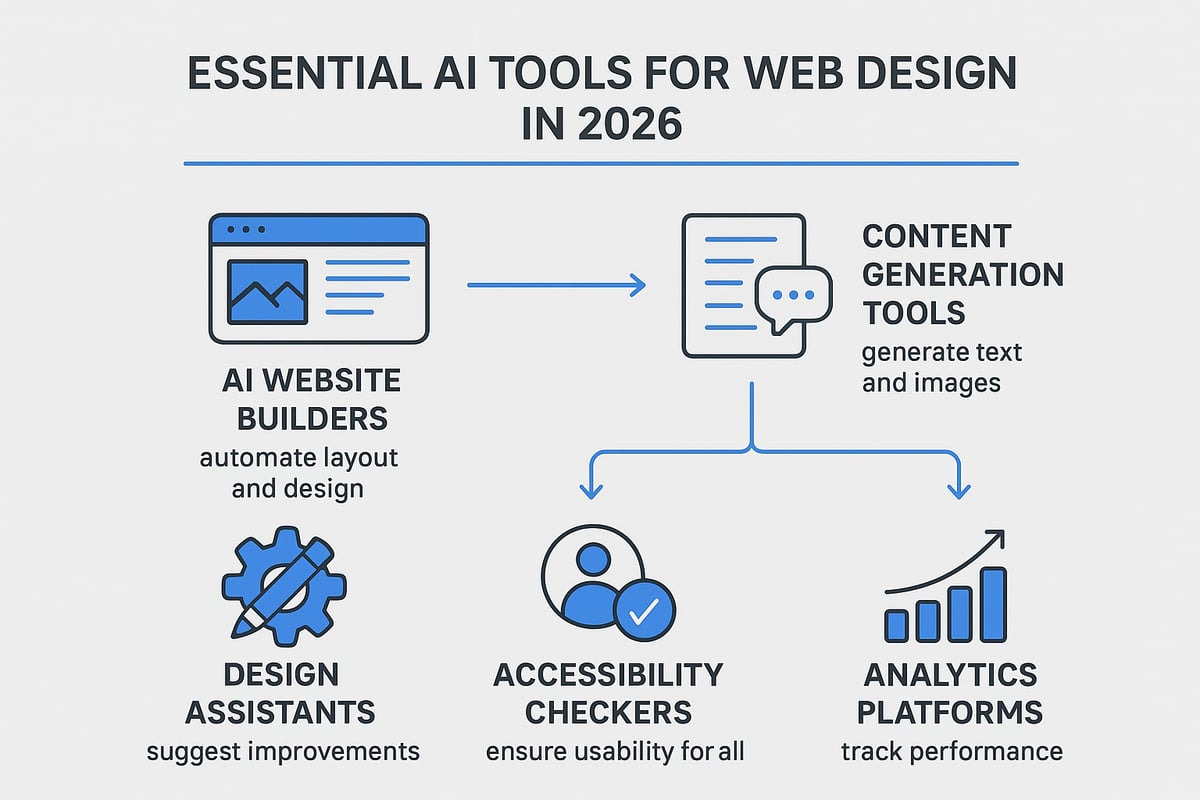
Leveraging Local Content and PR for Unstructured Citations

Unstructured citations are now a major signal for AI and search engines. These are mentions of your business in local news, event listings, blogs, or community sites. Unlike traditional listings, these citations often appear naturally in content.

To boost your citation building, focus on:

  • Creating local stories or guides that mention your business
  • Partnering with local journalists or influencers
  • Sponsoring community events for media coverage

Each unstructured mention strengthens your authority and improves your chances in both AI and traditional search results.

Integrating Citation Building with Overall Local SEO Strategy

Citation building is not a silo. The best results come when you align it with your Google Business Profile, reviews, local content, and reputation management. For example, updating citations when you launch a new service keeps your messaging consistent everywhere.

Here’s how to integrate citation building:

  • Ensure NAP matches across all channels
  • Coordinate updates with new campaigns or offers
  • Use citation data to spot keyword opportunities

Remember, strong citation building supports E-E-A-T (Experience, Expertise, Authority, Trust), which is crucial for winning in local SEO.

Preparing for New Platforms and Trends in 2026

The local search world doesn’t stand still. New directories, social platforms, and AI engines are emerging all the time. Early adoption can give you a serious edge, but only if your citation building is flexible.

Stay ahead by:

  • Watching for new citation sources like short-form video platforms
  • Adapting quickly to Google’s algorithm changes
  • Reviewing industry news for upcoming trends

To dive deeper into how generative AI is reshaping local SEO, see Generative AI and SEO trends. Keep your citation building strategy nimble and you’ll be ready for whatever comes next.

Step 5: Measuring Citation Impact and ROI

Want to know if your citation building efforts are actually paying off? Measuring impact is the only way to prove ROI and make smarter decisions. Let’s break down how to track local SEO gains, analyse competitors, calculate returns, and fix what’s not working.

Tracking Local SEO Performance Metrics

The first step in measuring the impact of citation building is to track the right local SEO metrics. Focus on local rankings, map pack placements, organic traffic, and website conversions. Tools like Google Search Console and Analytics help you establish a baseline and monitor progress over time.

Regularly check if your business appears more often in local searches and if citation building is driving more visits or calls. Performance reports are essential to spot trends and adjust tactics quickly. According to Local SEO Statistics for 2025, businesses that track their citation building see a significant boost in ROI, with up to 15% higher returns compared to those who don't.

Set up monthly or quarterly reports to make sure your citation building work is moving the needle. If you see a traffic spike after a citation campaign, you know you’re on the right track.

Analysing Competitor Citation Profiles

Competitor analysis is a game-changer for citation building. Identify your top local competitors and benchmark their citation counts, sources, and quality. Tools like BrightLocal and Whitespark make it easy to see where they’re listed and spot gaps in your own profile.

Look for high-authority directories or niche sites your competitors use. If you notice a directory missing from your list, add it to your citation building plan. But avoid chasing vanity metrics. It’s not about having more citations; it’s about having better, more relevant ones.

Use competitor insights to refine your strategy. Outranking a rival by targeting directories they’ve missed is a practical way to gain ground in local search.

Calculating the ROI of Citation Building

To justify your investment, calculate the ROI of citation building by assessing both direct and indirect benefits. Direct benefits include higher rankings, more traffic, and increased leads. Indirectly, citation building boosts trust and authority, which leads to more conversions.

Estimate the value of new customers gained from improved visibility. Break down costs: manual efforts versus outsourced services. Automation tools save time, but make sure you’re not sacrificing accuracy. The long-term effect of accurate citation building compounds as you continue to attract new business and strengthen your local presence.

Present your findings to stakeholders or clients using clear data and simple tables. This makes the value of citation building easy to see.

Troubleshooting: When Citations Aren’t Moving the Needle

Sometimes, citation building efforts stall and rankings stay flat. Start by checking for inconsistent NAP data or low-quality directories. Revisit your audit and management process for any gaps.

Look at your recent changes—did a business move or rebrand disrupt your citations? Cross-reference your citation building with other SEO tactics like content, reviews, and backlinks. If you’re stuck, consider expert help or advanced tools.

Adopt a continuous improvement mindset. Local SEO is never a one-off job, so keep refining your citation building strategy for the best long-term results.

You’ve just seen how getting your local citations right can make all the difference to your SEO in 2026—no more missed leads or confusing info holding you back. If you want to skip the trial and error and actually see your local rankings climb, why not have a chat with me first I’ll look at your business with a fresh pair of eyes and show you where you can improve things fast. Book your Get free 45 min consultation and let’s make sure your business stands out for all the right reasons.

Voice Search SEO Guide: Future-Proof Your Strategy in 2026

Imagine your customers no longer typing into search bars, but instead asking questions and expecting answers in seconds. This is the reality of the voice-first era, and it’s closer than you think.

By 2026, over half of all online searches will be powered by voice. If you want to stay visible, your business must adapt quickly. This guide will reveal how to master voice search seo so you’re not left behind.

You’ll discover why voice search is exploding, what sets it apart from traditional SEO, and the latest ranking factors. Ready to future-proof your strategy and win the voice-driven market? Let’s get started.

The Rise of Voice Search: Trends and User Behaviour

Voice search is no longer a novelty, it’s fast becoming the norm. The way people find information online has shifted, and businesses need to keep up or risk being left behind. Let’s explore how this evolution is shaping digital marketing.

The Rise of Voice Search: Trends and User Behaviour

Voice Search Adoption: Growth and Devices

Voice search adoption has skyrocketed in recent years. In 2020, eMarketer reported that 128 million Americans used voice search monthly, and usage is climbing worldwide. Smart speakers like Amazon Alexa and Google Home, smartphones, wearables, smart TVs, and even cars are now equipped for voice commands.

People don’t just stick to one device. They might ask their phone for directions in the morning, check the weather on a smart speaker at home, then use their car’s assistant on the move. This multi-device usage makes voice search seo a moving target. If you want the latest stats and insights on these trends, the Voice Search Trends 2025: Statistics, Industry Insights, and SEO Strategies resource offers a comprehensive breakdown.

Changing Demographics and Accessibility

While younger audiences have driven early adoption, older adults and people with disabilities are quickly catching up. Over 61 million US adults with disabilities use voice technology to simplify everyday tasks, making digital spaces more inclusive.

Temporary injuries or age-related limitations can also push users towards voice search. For many, it’s not just a convenience, but a necessity. Making your content accessible is no longer optional, it’s a core part of voice search seo and inclusive web design.

Local Search and Purchase Intent

Local intent dominates voice queries. In fact, 58 percent of US consumers use voice search to find local business information. Phrases like “best plumber near me” or “coffee shop open now” are common, and they often signal high purchase intent.

These users are ready to act, not just browse. If your business appears in these results, you’re reaching potential customers at the decision-making moment. Optimising for local and conversational keywords is a must for effective voice search seo.

Conversational Search Behaviour

Voice queries are naturally longer, more conversational, and often framed as questions. People speak to their devices like they would to a human, asking things like “What’s the quickest way to the airport?” or “Where can I buy vegan pizza nearby?”

Users expect a direct answer, not a list of blue links. This shift means your content must answer questions clearly and concisely. Adapting to these conversational patterns is central to voice search seo success.

Implications for Businesses

If you’re not optimising for voice, you’re missing out on a fast-growing, high-intent audience. Early adopters are already seeing gains in visibility and accessibility. Voice search seo is not a passing trend, it’s a fundamental change in how people interact with technology.

By adapting now, you secure a competitive edge, improve user experience for everyone, and future-proof your business as digital habits continue to evolve.

How Voice Search SEO Differs from Traditional SEO

Voice search SEO is not just a tweak on your usual approach— it’s a game-changer. While traditional strategies lay the groundwork, optimising for voice demands a fresh mindset, new tactics, and a razor-sharp focus on how people actually speak and search.

How Voice Search SEO Differs from Traditional SEO

Unique Ranking Factors in Voice Search

With voice search SEO, there are no prizes for second place. Smart speakers and assistants typically serve up just one answer, not a whole page of links. This makes featured snippets and answer boxes the holy grail. In fact, over 40% of Google Home results pull directly from featured snippets, according to 31 Fascinating Voice Search Statistics (2024).

To win, you need to:

  • Structure content for quick, direct answers.
  • Use lists, tables, and clear formatting for snippet eligibility.
  • Focus on authority and trust, as assistants favour reputable sources.

Voice search SEO here is about precision, not just presence.

Search Engine Ecosystem Differences

Not all voice assistants rely on the same search engines or data sources. Google Assistant taps into Google, but Alexa and Cortana pull from Bing, each with different algorithms and requirements.

For voice search SEO, you must:

  • Optimise for both Google and Bing ecosystems.
  • Monitor how your content appears on various devices.
  • Keep data consistent across platforms and listings.

This multi-engine reality means your strategy can’t be one-size-fits-all.

Conversational and Intent-Based Queries

Voice queries are typically 76% longer than typed ones, packed with natural language and context. People say, “Where’s the nearest vegan café?” instead of typing “vegan café near me”.

Voice search SEO here means:

  • Researching long-tail, question-based keywords.
  • Writing in a conversational tone.
  • Matching answers to the intent behind each query.

The goal is to sound more like a helpful friend than a faceless website.

Mobile and Local Emphasis

Most voice searches happen on mobiles or smart devices, often with local intent. People want quick, relevant answers while on the move.

To capitalise on this:

  • Optimise your site for mobile speed and usability.
  • Ensure your local listings and Google Business Profile are accurate.
  • Create location-specific content that answers “near me” queries.

Being visible in these moments can drive real-world visits and sales.

Accessibility and Inclusivity

Voice search SEO naturally boosts digital accessibility. It helps visually impaired and mobility-challenged users interact with your content.

To make your site voice-friendly:

  • Use clear navigation and alt text for images.
  • Ensure your content is readable at a Year 9 level or below.
  • Test your website for accessibility compliance.

Prioritising accessibility in voice search SEO expands your audience and builds trust.

Key Takeaways

Traditional SEO is still essential, but voice search SEO requires a different toolkit. You need to:

  • Target the single answer spot.
  • Optimise for multiple search engines.
  • Embrace conversational content and local intent.
  • Focus on accessibility.

Get these right and you’ll be ready for the voice-first future.

2026 Voice Search Ranking Factors: What Matters Most

Voice search seo is evolving quickly, and the ranking factors for 2026 are more demanding than ever. To win the single answer spot and attract high-intent users, you must focus on key priorities that set voice search apart from traditional SEO.

2026 Voice Search Ranking Factors: What Matters Most

Featured Snippets and Rich Answers

Getting your content into featured snippets is now the golden ticket for voice search seo. Over 40 percent of voice results are pulled directly from these snippets, especially on Google Home. To increase your chances, structure your answers with clear headings, lists, and concise responses. Aim for answers within 29 words and make sure your content is easy for AI to extract. If you're keen to dive deeper, explore how AI-based SEO strategies are shaping the future of search and powering snippet selection.

  • Use question-based headings.
  • Provide quick, direct answers.
  • Optimise for tables, lists, and FAQs.

Voice assistants want to give users the best answer fast, so being featured is crucial.

Page Speed and Technical Optimisation

Page speed is a make-or-break factor in voice search seo. Voice assistants favour websites that load in under four seconds. Mobile-first design and responsive layouts are a must, as most voice searches happen on mobile devices. Secure your site with HTTPS and fix any technical errors to stay in the running for top results.

  • Compress images and enable caching.
  • Test your site across devices.
  • Prioritise clean code and fast servers.

Technical excellence keeps your content in the voice search game.

Schema Markup and Structured Data

Schema markup is the secret sauce for voice search seo. Adding structured data like FAQ, HowTo, LocalBusiness, and Product schema helps search engines understand your content. This increases your chances of being chosen as the answer by voice assistants.

  • Use the Schema.org vocabulary.
  • Mark up relevant content types.
  • Regularly test with Google's Rich Results tool.

Structured data bridges the gap between your site and voice technologies.

Authority, Trust, and Relevance

Voice search seo relies on trust. High domain authority, up-to-date information, and positive reviews boost your likelihood of selection. Assistants prefer trusted, well-reviewed sources that answer user intent directly.

  • Build quality backlinks.
  • Keep your content fresh.
  • Encourage honest customer reviews.

Relevance to the user's context and query is what wins the single answer spot.

Local SEO and Google Business Profile

Local intent dominates voice search seo. An optimised Google Business Profile is vital for local queries, and consistent NAP details across directories are non-negotiable. Positive reviews and local content directly impact your visibility.

  • Update business hours and photos.
  • Respond to customer reviews.
  • Target "near me" keywords in content.

Local relevance gives your business a real-world edge in voice results.

Natural Language and Readability

Content for voice search seo should sound natural, like a conversation. Write at a Year 9 reading level or below, using short sentences and simple language. Format answers as if you were speaking directly to the user.

  • Use conversational phrasing.
  • Avoid jargon and complex words.
  • Focus on clarity and brevity.

This approach ensures your answers are easy for both users and assistants to understand.

Accessibility and Inclusivity

Voice search seo boosts accessibility for everyone, especially those with disabilities. Make sure your site includes alt text for images, clear navigation, and is keyboard-friendly. Comply with WCAG standards to broaden your reach.

  • Test for screen reader compatibility.
  • Use high-contrast colours and readable fonts.
  • Simplify navigation menus.

Accessible sites are more likely to be favoured by voice assistants.

Example: Local Restaurant

A local restaurant can dominate voice search seo by combining these factors. For instance, using FAQ schema to answer “Do you offer vegan options?”, keeping the Google Business Profile updated, and ensuring fast mobile performance will increase the chances of being the chosen voice result. Clear calls to action and positive reviews seal the deal.

By focusing on these ranking factors, your business can secure its place in the voice-first future.

Step-by-Step Voice Search SEO Optimisation Strategy for 2026

Ready to make your business stand out in the voice-driven future? This step-by-step voice search seo strategy will help you adapt, compete, and win more customers in 2026. Here’s how to future-proof your online presence and stay ahead of the curve.

Step-by-Step Voice Search SEO Optimisation Strategy for 2026

1. Conduct a Voice Search SEO Audit

Start by assessing your current voice search seo performance. Test your website on various voice assistants like Google Assistant, Siri, Alexa, and Cortana. Use different devices, such as smartphones, smart speakers, and desktops, to identify where your site appears and where it falls short.

List the top queries you want to rank for, then check which ones trigger your pages as voice answers. Are your competitors appearing more often? Use tools like SEMrush, Ahrefs, or voice search simulators to map out gaps in your content, technical SEO, and SERP feature coverage.

Document your findings in a simple table. Track which pages perform well for voice search seo and which need improvement. This audit is your foundation for all future steps.

2. Research Conversational, Long-Tail Keywords

Voice search seo is all about understanding how real people speak. Unlike traditional keywords, voice queries are longer, more conversational, and often phrased as questions. Use tools like AnswerThePublic and Google’s “People Also Ask” to uncover the natural language your customers use.

Focus on long-tail phrases and local intent keywords, such as “Where can I find vegan pizza near me?” or “What’s the best way to clean trainers at home?” Prioritise high-intent, low-competition phrases that signal action or purchase.

Create a spreadsheet of your target questions and conversational queries. Make sure you map each to a relevant page. This research gives your voice search seo a real-world edge.

3. Optimise Content for Featured Snippets

Featured snippets are the holy grail of voice search seo. Over 40 percent of voice results come from these concise answer boxes. To win them, structure your content to answer common questions clearly and directly.

Place the answer at the top of your relevant pages. Use bullet points, numbered lists, or tables to make information easy to scan. Keep answers short—aim for 20 to 30 words. Add FAQ sections to key pages, targeting the exact questions your audience asks.

By focusing on clarity, structure, and brevity, you dramatically boost your chances of being selected as the single voice answer.

4. Implement Schema Markup and Structured Data

Search engines rely on structured data to understand your content for voice search seo. Add schema markup like FAQ, HowTo, Product, and LocalBusiness to your site pages. This helps assistants surface your answers more accurately.

Test your schema with Google’s Rich Results Test tool. Make sure your structured data stays up to date as your content evolves. Well-implemented schema increases your eligibility for featured snippets and other SERP features.

This technical step is crucial for making your site “voice-ready” and giving search engines the context they need.

5. Enhance Local SEO and Google Business Profile

Local intent drives a huge share of voice search seo queries. Start by claiming and optimising your Google Business Profile. Make sure your hours, categories, photos, and contact details are accurate. Encourage customers to leave detailed, positive reviews—these influence voice results.

Check that your NAP (name, address, phone) data is consistent across all directories. Create location-specific content, such as landing pages or blog posts targeting “near me” queries.

Optimised local SEO not only boosts visibility in voice search but also attracts high-intent customers ready to act.

6. Improve Technical SEO and Mobile Performance

Fast, mobile-friendly websites are a must for voice search seo. Compress images, leverage browser caching, and use responsive design for a seamless experience on every device. Secure your site with HTTPS, and regularly fix crawl errors that could block your content from being indexed.

Test your site speed using Google PageSpeed Insights. Aim for load times under four seconds. For more in-depth tips, explore website optimisation best practices.

Don’t forget accessibility: ensure your site works well for users with disabilities, with clear navigation and keyboard support.

7. Create Conversational, Accessible Content

To succeed in voice search seo, your content must sound natural when spoken aloud. Write in a conversational tone, as though you’re answering a friend’s question. Use short sentences, simple words, and clear calls to action.

Add alt text to images and make sure every user can navigate your site easily. Address common questions and pain points directly, so your answers are chosen by voice assistants.

Accessible content not only improves your rankings but also ensures every potential customer can find and understand your business.
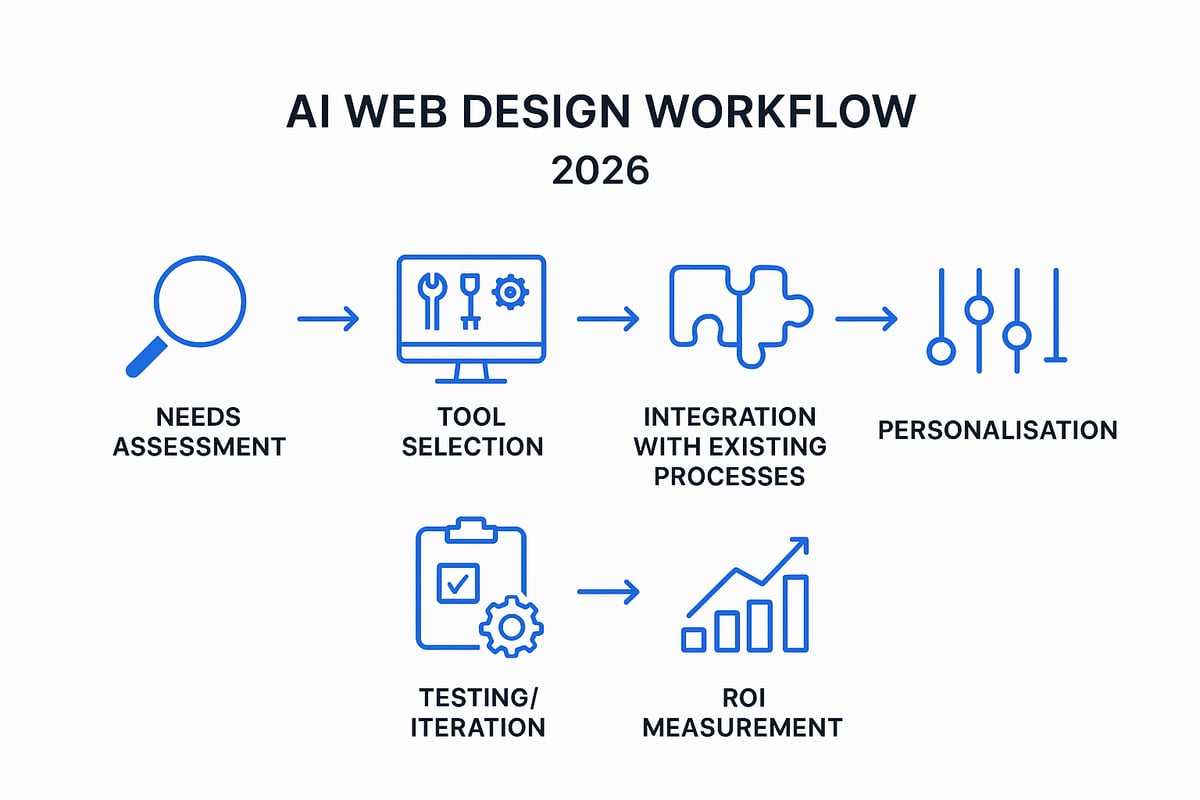
8. Monitor, Test, and Iterate

Voice search seo is not a one-and-done job. Track your rankings, featured snippet wins, and local pack performance using analytics tools. Regularly test your key queries on different devices and platforms.

Update your content and schema as new trends emerge. Stay informed with SEO strategy insights for 2026 to keep your tactics sharp.

Continuous improvement is key. Adapt, experiment, and you’ll stay ahead as the voice-first era evolves.

Advanced Tips and Future Trends in Voice Search SEO

The future of voice search seo is arriving faster than most realise. With AI and voice assistants evolving rapidly, keeping your strategy sharp is essential if you want to stay ahead of the curve. Let’s dive into the trends, tactics, and tech shaping the next era of voice search seo, so your business can lead, not lag.

Preparing for the Next Generation of Voice and AI Search

AI assistants are getting smarter, personalising responses and understanding context like never before. As generative AI starts to shape search results, content must be ready for both citation and summarisation. Businesses should focus on voice search seo that makes their answers clear, concise, and credible.

If you want to future-proof your approach, start by learning about Generative AI and SEO and how it’s changing the game. The next big shift will be “Generative Engine Optimisation” (GEO), so structure your content to be easily picked up, referenced, and voiced by AI tools.

Multi-Platform and Omnichannel Voice Search

People now use voice commands across a range of devices, not just smart speakers. From mobiles and in-car systems to wearables and even smart TVs, your audience expects seamless interactions wherever they are. Voice search seo is no longer about optimising for one device — it’s about meeting users on every channel.

Consistency is vital. Make sure your business information, schema, and NAP data are accurate and identical across all platforms. This increases your discoverability and helps you win the top spot on any device.

Voice Search for Ecommerce and Transactions

Voice commerce is on the rise, with more customers using assistants to research, order, and even pay for products. For ecommerce brands, voice search seo means optimising product pages and FAQs for spoken queries, making it easy for users to find info and complete purchases.

Streamline your calls to action — use phrases like “Order now” or “Book a table” that are simple for voice assistants to interpret. The easier you make the journey, the higher your conversion rates will climb.

Accessibility, Inclusivity, and Legal Compliance

Voice technology is opening digital doors for millions, especially those with disabilities. Accessibility is no longer a nice-to-have — it’s a ranking factor and a legal requirement in many regions. Ensure your voice search seo includes alt text, clear navigation, and content that’s easily understood by everyone.

Comply with standards like WCAG and ADA to boost your reach, reduce legal risk, and foster goodwill. Inclusive design benefits your whole audience, not just those with specific needs.

Analytics and Measurement for Voice Search Success

You can’t improve what you don’t measure. Use analytics tools like Google Search Console and Bing Webmaster Tools to track which queries and devices bring you voice traffic. Monitor featured snippet wins, local pack appearances, and conversions from voice-driven visits.

For the latest market data, check out the 44 Latest Voice Search Statistics For 2025 to benchmark your progress and spot new opportunities. Regular analysis is the backbone of effective voice search seo.

Staying Ahead: Continuous Learning and Adaptation

Voice search seo is always evolving. Algorithms, devices, and user habits change quickly, so you need to keep your finger on the pulse. Review competitor strategies, test new content formats (like audio or video), and stay updated on industry news.

Experiment, measure, and refine your approach. Those who adapt fastest will claim the lion’s share of voice-driven traffic as the landscape shifts.

Example: Future-Proof Local Business

Imagine a Birmingham café that nails voice search seo for “best coffee near me.” By updating their Google Business Profile, adding FAQ schema, and monitoring results, they earned the featured snippet and saw local visits jump by 30 percent. Ongoing tweaks keep them ahead, no matter how voice technology evolves.

Ready to make sure your business isn’t left behind as voice search takes over How you show up in 2026 depends on what you do now—optimising for voice isn’t just about keywords, it’s about giving real answers and making life easier for your customers If you want a practical plan that actually gets results, let’s chat about where you are and what it’ll take to get you ahead Book your Get free 45 min consultation and I’ll help you spot quick wins and map out the steps to future proof your SEO strategy—no waffle, just smart advice tailored to you

SEO Pricing Guide 2026: What to Expect This Year

Wondering how much SEO will cost in 2026? You’re not alone. With the demand for search visibility growing and new technologies shaking things up, SEO pricing is becoming more confusing than ever.

Businesses face changing agency models, the rise of AI-driven search, and shifting expectations around value. It’s easy to feel lost when every provider seems to promise different results for different prices.

This guide cuts through the noise. You’ll get clear, actionable insights, real numbers, and expert tips to help you make smart decisions about your SEO pricing investment.

We’ll break down provider types, explain pricing structures, highlight average costs, and reveal key trends for 2026. Use this guide to budget wisely, avoid surprises, and get the most from your SEO strategy.

Types of SEO Providers in 2026

Choosing the right SEO partner is a big decision, and the landscape is changing fast. The type of provider you pick will shape your results, your experience, and even your bottom line. Let’s break down what’s on offer in 2026.

Types of SEO Providers in 2026

Agencies, Freelancers, and In-House Teams

When it comes to SEO pricing, the provider you choose is crucial. You’ll see three main types: agencies, freelancers, and in-house teams. Each one brings its own flavour and strengths.

Agencies are the go-to for businesses that want a full package. They offer access to teams of specialists, proven processes, and a wide range of services. This makes them ideal for SMEs who need scale and reliability.

Freelancers are often the choice for micro-businesses or start-ups. They’re flexible, cost-effective, and can deliver focused results, but their capacity is naturally limited. If you just need a few tweaks or targeted work, a freelancer can be a good fit.

In-house teams are usually reserved for large enterprises. Building your own SEO department means total control and deep integration with your brand. However, it comes with a hefty investment in staff, training, and tools.

Here’s a snapshot for comparison:

Provider Type Strengths Best Fit 2025 UK Usage (%)
Agency Comprehensive, scalable SMEs, growth-focused 60
Freelancer Flexible, affordable Micro-businesses 30
In-house Full control, integration Large enterprises 10

Agencies offer stability, freelancers provide agility, and in-house teams deliver control. The right choice depends on your business size, goals, and what you’re willing to invest in SEO pricing.

Emerging Provider Models in 2026

SEO pricing is being shaped by new players and models in 2026. Hybrid agencies are on the rise, blending in-house talent with external experts for greater flexibility. Productised SEO firms now offer set packages at fixed prices, making budgeting much simpler and more predictable.

AI-assisted consultancies have burst onto the scene, using advanced tools to deliver faster, data-driven SEO for less. Think of agencies offering “SEO as a Service”, where you know exactly what you’ll get for your money, and delivery is backed by automation and smart technology.

For example, many startups and tech-savvy SMEs are jumping on board with AI-powered agencies. These providers use machine learning and automation to offer transparent, results-focused services. If you want to dig deeper into how AI is changing the game, check out these AI-based SEO strategies.

These models can be great value, especially if you want speed and clarity. However, they might not suit businesses looking for a highly bespoke or hands-on approach to SEO pricing.

Choosing the Right Provider for Your Business

Selecting the right partner comes down to truly understanding your needs. Are you in a fast-growth phase or simply keeping pace with local competition? Do you already have some SEO skills in-house, or are you starting from scratch?

Look closely at a provider’s track record, their transparency, and their communication style. Case studies, testimonials, and clear reporting processes are all green flags. For local businesses, agencies with proven local SEO experience are a real asset.

Remember, 78% of businesses say that clear communication is their top priority when choosing an SEO provider. The cheapest option isn’t always the most cost-effective over time. Make sure your provider aligns with your goals, industry, and the level of investment you’re ready to make in SEO pricing.

SEO Pricing Structures Explained

Understanding seo pricing in 2026 is the first step to making sense of your investment. With more choice than ever, knowing how providers structure their fees helps you budget smartly and avoid surprises.

SEO Pricing Structures Explained

Hourly, Monthly, Project-Based, and Performance Models

When it comes to seo pricing, four main models dominate the UK market. Each suits different business needs and risk appetites.

  • Hourly rates: Flexible, ideal for ad hoc tasks or consultancy. You pay only for time spent, usually £50–£250/hour.
  • Monthly retainers: The most common, covering ongoing optimisation, reporting, and support. Monthly fees range from £600 for small businesses to £6,000+ for enterprise.
  • Project-based: Flat fees for specific work like audits, migrations, or content overhauls. Great for one-off improvements.
  • Performance-based: Payment is tied to results, such as rankings or leads. While attractive, these are less common due to the challenge of attributing results solely to SEO.

Here’s a quick comparison:

Model Flexibility Typical Use Risk Level Sample Cost
Hourly High Small fixes, advice Low £50–£250/hr
Monthly Retainer Medium Ongoing campaigns Medium £600–£6,000+/month
Project-Based Medium Audits, migrations Low £1,000–£10,000
Performance Low Lead/rank targets High Varies (by result)

Most UK agencies (70%) offer monthly retainers as standard. Hourly rates work well for troubleshooting, while monthly retainers are best for ongoing campaigns where steady progress matters. For more detailed breakdowns, see this guide on SEO pricing models in 2026.

Choosing the right seo pricing structure comes down to your goals, risk tolerance, and how much ongoing support you need.

What’s Included in Typical SEO Packages

Most seo pricing packages bundle a core set of deliverables, but specifics can vary. Here’s what you should expect from a comprehensive package:

  • On-page optimisation: Keyword research, meta tags, and improving existing content.
  • Technical SEO: Fixes for site speed, mobile usability, and crawlability.
  • Content creation: Blog posts, landing pages, product copy.
  • Link building: Outreach, digital PR, citation management.
  • Reporting: Monthly analytics, keyword rankings, and progress updates.

For SMEs, packages often range from £600 to £6,000 per month and typically include all these elements. Higher-priced options may also cover conversion rate optimisation (CRO), user experience enhancements, and AI-driven insights.

When reviewing seo pricing, always ask for a list of included services and sample reports. This transparency helps you avoid hidden costs and makes it easier to compare providers.

Understanding Productised and AI-Driven SEO Offerings

Productised and AI-driven models are reshaping seo pricing for businesses that want speed, predictability, and value.

  • Productised SEO: Fixed deliverables like “10 backlinks for £600” or “comprehensive audit for £500.” Clear, easy to budget, and ideal for defined needs.
  • AI-driven SEO: Automation powers research, content creation, and reporting. This can lower costs and speed up delivery, especially for standard tasks.

Here’s what you might see:

Productised Example: "Local SEO starter pack – 5 citations, 1 landing page, £400"
AI-Driven Example: "AI-powered audit – technical fixes, keyword plan, £350"

Forty percent of agencies now use AI tools in their standard packages. Productised and AI-driven seo pricing models are especially attractive to startups and SMEs wanting fast, measurable results.

If you are working with a tight budget or fast-moving goals, these options can give you a head start, but always check for clear deliverables and ongoing support.

SEO Costs in 2026: Budgeting & What to Expect

Getting your head around seo pricing in 2026 is crucial for smart budgeting. With AI-fuelled competition and more complex services, costs are shifting, and knowing what to expect will help you avoid nasty surprises. Let’s break down typical costs, what drives them, and what you should demand from your investment.

SEO Costs in 2026: Budgeting & What to Expect

Average SEO Costs by Business Size and Scope

How much should you budget for seo pricing in 2026? It depends on your business size and how ambitious your goals are. Here’s a quick comparison:

Business Size Typical Monthly Spend What’s Included Example Use Case
Micro-business / Local £50–£600 Basic on-site SEO, GBP optimisation, technical maintenance Local plumber, café
SME £600–£6,000 Full campaigns: content, links, CRO, reporting Regional retailer, agency
Enterprise £6,000+ Multi-site, international, technical SEO, PR National e-commerce brand

A micro-business might only need a few hundred pounds each month to keep their site healthy and visible locally. SMEs often budget four figures to cover content, link building, and conversion optimisation. Enterprises with complex websites and broader reach can expect seo pricing to start at £6,000 and rise quickly.

These ranges line up with recent UK data, showing that as competition and AI tool adoption grow, so does the average investment. The key is to understand exactly what’s included at each price point so you’re not paying for fluff or missing out on essentials.

What Influences SEO Pricing?

Several factors shape seo pricing, and it’s not just about business size. Here’s what will impact your costs:

  • Industry competitiveness: Sectors like law, finance, and e-commerce are fiercely competitive, driving up prices for results.
  • Website size and complexity: Larger or older sites need more work to optimise.
  • Geographic targeting: Local campaigns cost less than national or international projects.
  • Current website health: More issues at the start mean higher upfront costs.
  • Required deliverables: More content, links, or conversion work means higher spend.

For example, an e-commerce shop with thousands of products will pay more than a local bakery. In fact, 65% of agencies charge extra for highly competitive niches, which is confirmed by recent SEO agency statistics 2025.

Transparent scoping is essential. Get a clear breakdown of what’s included, so you can budget accurately. If a provider is vague about their seo pricing, that’s a red flag.

What Should You Get for Your Money?

With so much variation in seo pricing, it’s vital to know what you’re actually buying. At a minimum, you should expect:

  • Clear deliverables: A list of tasks, deadlines, and KPIs.
  • Regular reporting: Monthly analytics and progress updates.
  • Measurable improvements: Growth in rankings, traffic, leads, or sales.
  • Strategic recommendations: Ongoing advice to adapt to Google updates.

A standard monthly package for SMEs, for instance, should include at least one fresh content piece, technical fixes, and a comprehensive report. According to recent data, 80% of clients expect monthly reports as standard.

If you’re not seeing progress or reporting is patchy, reconsider your provider or package. Quality seo pricing isn’t just about the lowest cost, but about real, measurable value for your business.

Key SEO Pricing Trends for 2026

The world of seo pricing is evolving rapidly, with 2026 set to bring even more change. Businesses need to stay ahead of these trends to budget smartly and get the most value from their investment.

Let’s break down the pricing trends shaping the SEO landscape this year.

Key SEO Pricing Trends for 2026

The Impact of AI and Automation on SEO Pricing

AI and automation are rewriting the rules for seo pricing in 2026. Agencies now use advanced AI tools to handle keyword research, content creation, and technical audits. This automation slashes manual hours, especially on repetitive tasks, and makes basic SEO packages more affordable for businesses of all sizes.

For example, many agencies now offer “AI-powered SEO” services at rates up to 20% lower for standard tasks like audits and on-page optimisation. However, while entry-level costs drop, premium services that include in-depth AI analytics or Generative Engine Optimisation (GEO) command a higher price. These advanced solutions deliver smarter insights and bigger competitive advantages.

According to Impact of AI on SEO pricing, around 40% of agencies now use AI for campaign management. This shift means that while automation brings down some costs, expert oversight is more important than ever to ensure quality and strategy.

The bottom line: AI is making seo pricing more accessible, but the best results still depend on human expertise guiding the machines.

Rise of Performance-Based and Productised SEO

Performance-based and productised SEO are gaining momentum as businesses seek simplicity and predictability in seo pricing. More agencies now offer pay-for-performance models, where you only pay for results like increased rankings or leads. This appeals to startups and SMEs wanting to reduce risk and ensure ROI.

Productised SEO, on the other hand, means fixed-scope packages with clear deliverables and prices upfront. Think “10 backlinks for £1,000” or “local SEO audit for £500.” These offerings make it easy to compare providers and budget effectively.

However, there are trade-offs. Performance-based seo pricing sounds attractive, but it can be tricky to track results accurately, especially if leads or sales come from multiple channels. Productised packages are great for straightforward needs, but they may not cover all the nuances of a complex or evolving campaign.

Here’s a quick comparison:

Model Pros Cons
Performance-based Pay for results, lower risk Attribution challenges, less control
Productised Predictable costs, easy to compare May lack flexibility

As productised and performance-based seo pricing rise, it’s important to match the model to your business goals and appetite for risk.

Transparency, Contracts, and Flexibility

Transparency and flexibility are now top priorities in seo pricing. Businesses are demanding clear contract terms, transparent deliverables, and no hidden fees. The old days of 12-month lock-ins are fading. Instead, “cancel anytime” and rolling monthly agreements are becoming the norm.

For example, many agencies now offer flexible monthly plans, allowing clients to scale up or down as needed. This trend is driven by a need for trust and accountability. In fact, 55% of businesses now prefer flexible contracts over long-term commitments, reflecting a shift in expectations.

Clear communication is also essential. Clients want to know exactly what they’re paying for, how progress will be reported, and what happens if things don’t go to plan. Agencies that provide detailed reporting and regular check-ins are winning more business.
In summary, the future of seo pricing is about openness, adaptability, and putting client needs first. The right provider will offer flexible contracts, transparent pricing, and clear communication every step of the way.

How to Choose the Right SEO Package and Provider

Selecting the right SEO package and provider is one of the most important decisions you’ll make for your digital growth. With SEO pricing models evolving quickly, it’s easy to get lost in jargon, endless package tiers, and big promises. Let’s break down how to make a confident, informed choice—so you get the best value from your SEO investment and avoid common pitfalls.

Assessing Your Business Needs and Goals

Before you dive into SEO pricing comparisons, get clear on what success looks like for your business. Are you aiming for more traffic, better leads, increased sales, or simply stronger brand awareness? Pin down your main objectives, as this will shape the type of provider and package you need.
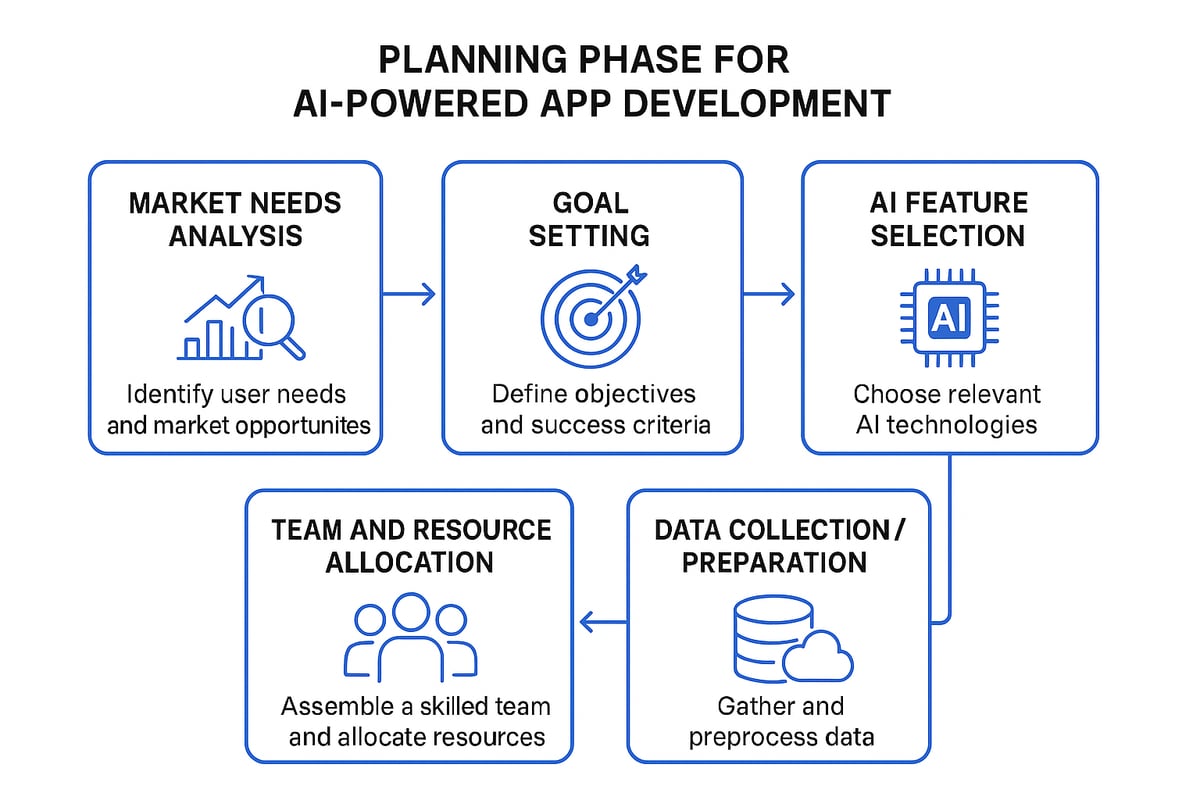
Audit your current website performance and look at your competition. If you’re in a highly competitive niche, your SEO pricing expectations should reflect the resources needed to win. Consider what you can handle in-house versus what you’ll need externally. For example, a new e-commerce shop often needs technical SEO, robust content, and ongoing support from day one.

Think about your growth stage. Over-investing too early can drain your budget, but under-investing in a tough market might mean missing out altogether. Align your SEO pricing spend with your overall marketing maturity and business goals. Always remember, the right package fits your journey—not just your wallet.

Comparing Packages: What to Look For

Not all SEO packages are created equal, and neither are their price tags. To make sense of SEO pricing, compare what’s actually included. Look for specifics: number of keyword targets, content pieces, technical fixes, and backlink opportunities. A simple table can help:

Feature Package A (£1,000/mo) Package B (£1,000/mo)
Content Pieces 4 2
Backlinks 8 10
Technical Audits Monthly Quarterly
Account Manager Yes No

Check the frequency and clarity of reporting. Will you get detailed monthly analytics, or just a vague traffic update? Access to account managers and regular strategy calls can make a big difference to your results.

Don’t be dazzled by technical buzzwords. Ask for sample reports and real-world examples. For further reading on trends and evolving package structures, explore SEO insights and trends. Transparency in SEO pricing is your best friend—look for providers who spell out exactly what you get for your investment.

Red Flags and Questions to Ask Providers

Spotting red flags early can save you from costly mistakes. Be wary of any provider promising “guaranteed #1 rankings” or those who are vague about deliverables. Long-term contracts with steep exit fees are another warning sign—flexibility is increasingly the norm.

Make sure there’s a clear process for communication and reporting. If a provider won’t share case studies or client references, walk away. Here are key questions to ask:

  • What’s included in my SEO pricing each month?
  • Who will actually do the work, and what’s their experience?
  • How do you define and measure success?
  • Can I see sample reports and previous results?

A good provider welcomes tough questions and offers clear, honest answers. In fact, 70% of dissatisfied clients cite poor communication as the main reason for leaving. To see what real-world results look like, check out case studies: SEO results.

Choosing the right SEO package and provider comes down to clarity, transparency, and alignment with your business goals. Take your time, ask the right questions, and let your SEO pricing guide you to long-term growth.

Measuring ROI and Getting Value from Your SEO Investment

Understanding the return on investment from your SEO pricing is crucial for every business. Investing blindly is like driving with your eyes closed: you want to see where your money is going and what it brings back. In 2026, measuring SEO ROI is more important than ever, especially as AI and automation change the landscape.
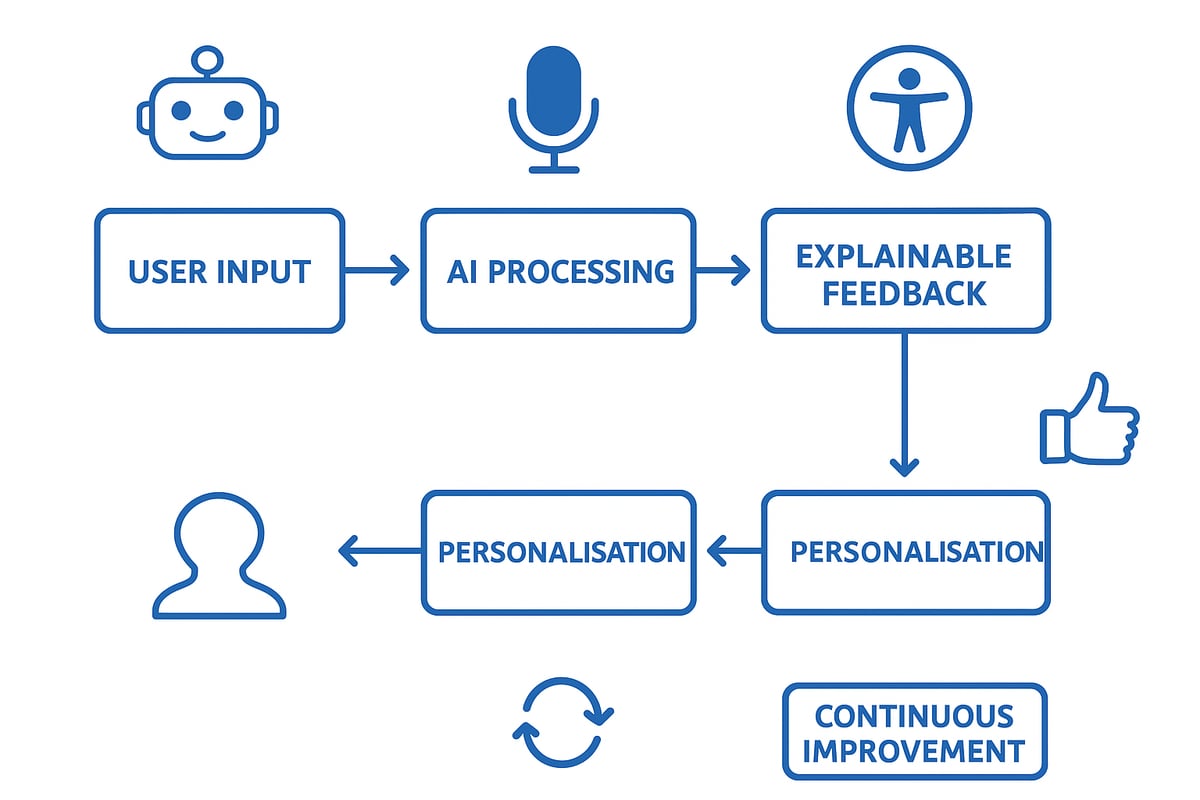
Setting Realistic Expectations for SEO Results

SEO pricing is a long-term game, not a quick win. Most businesses see results in three to six months, but this depends on your market and the level of competition. Think of SEO as planting seeds: you need to nurture them before you can harvest.

If you’re a local business, you might see faster impact from a well-structured SEO campaign. National or enterprise brands, however, should expect a longer runway. The best providers will set honest expectations for how your SEO pricing will translate into results.

Avoid any agency that promises instant rankings. Sustainable SEO growth takes time and steady effort. According to Add People, 80% of SMEs report a positive ROI within 6 to 12 months. This reinforces that patience and consistency pay off.

Consider this table for typical SEO result timelines:

Business Type Expected ROI Timeline Typical SEO Pricing
Local 3-6 months £50–£600/month
SME 6-12 months £600–£6,000/month
Enterprise 9-18 months £6,000+/month

Remember, your SEO pricing should be seen as an investment in steady, compounding growth.

Tracking Key Metrics and Reporting

To truly understand your SEO pricing ROI, you need to measure the right things. Don’t get distracted by vanity metrics. Focus on the numbers that actually move the needle for your business.
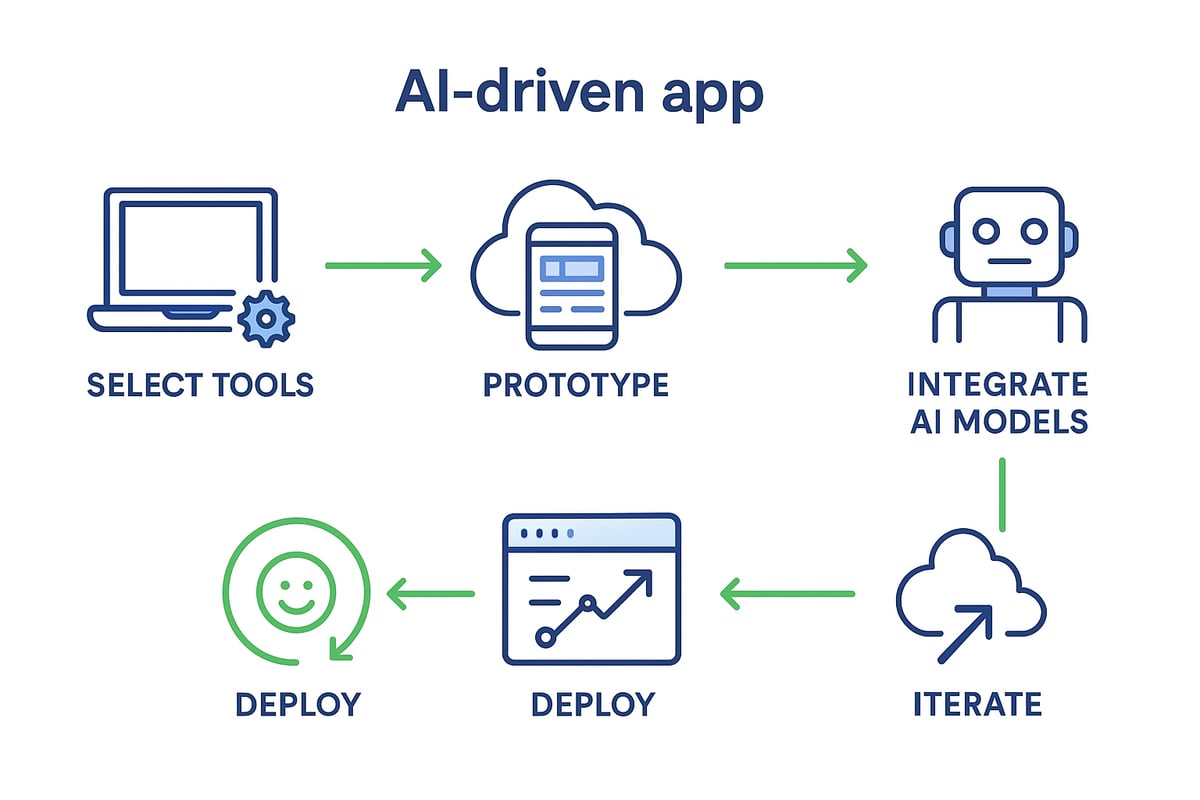
Key metrics to track include:

  • Keyword rankings for your target terms
  • Organic traffic growth from search engines
  • Conversion rates (leads, sales, enquiries)
  • Revenue generated from organic sources

Use tools like Google Analytics, Google Search Console, and your agency’s dashboard to track progress. Your monthly reports should clearly show traffic growth, keyword movement, and, most importantly, business outcomes.

A good SEO provider will tie your SEO pricing directly to measurable results. For example, if you’re paying £1,000 per month, you should expect regular updates on what’s improved and what’s next. According to Polaris Agency, 75% of agencies report monthly on traffic and conversions.

Here’s a quick checklist for your reports:

  • Are you seeing steady traffic increases?
  • Are your priority keywords climbing?
  • Is your organic channel driving more leads or sales?

If the answer isn’t yes, it’s time to review your SEO pricing strategy and provider.

Maximising Value: Tips for 2026

Getting the most from your SEO pricing in 2026 means working smarter, not just harder. Collaboration is key: share your business goals and any changes with your provider so they can adapt your strategy.

Don’t put all your eggs in one basket. Invest in complementary channels such as CRO, content marketing, and paid search for faster results. The best ROI comes from an integrated approach.

Stay informed about the latest trends. AI and automation are transforming SEO, making it faster and more cost-effective. For a deeper dive into how generative AI is reshaping SEO strategies and value delivery, check out Generative AI in SEO.

Here are practical tips to maximise your SEO pricing value:

  • Combine local SEO with paid ads for instant leads and long-term growth.
  • Request regular education from your provider about new trends.
  • Review your package and upgrade as your business grows.
  • Monitor algorithm updates and adapt quickly.

Ultimately, the best providers see themselves as partners, not just service suppliers. They’ll empower you to understand your SEO pricing, focus on ROI, and adjust your strategy as the market evolves.

If you’re feeling a bit lost in the sea of SEO pricing options for 2026, you’re definitely not alone. We’ve covered all the key trends, from AI-driven packages to new flexible contracts, so you can make smarter decisions for your business. But if you want to cut through the guesswork and get advice that actually fits your goals and budget, why not chat with someone who’s been there and done it for small businesses like yours? Book your Get free 45 min consultation and let’s work out what’ll get you real results this year.
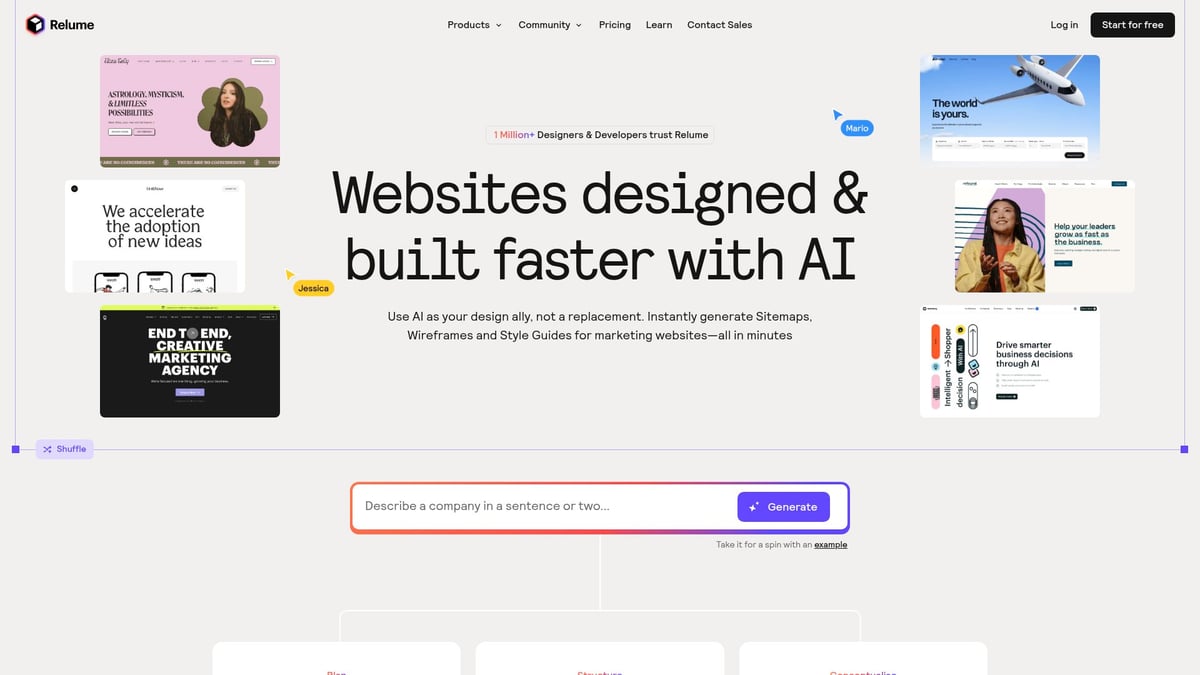
The Essential Guide to AI Reputation Management in 2026

Imagine a single negative review scaring away 22% of your future customers. In 2026, ai reputation management is not just a buzzword, it’s essential to protect your business.
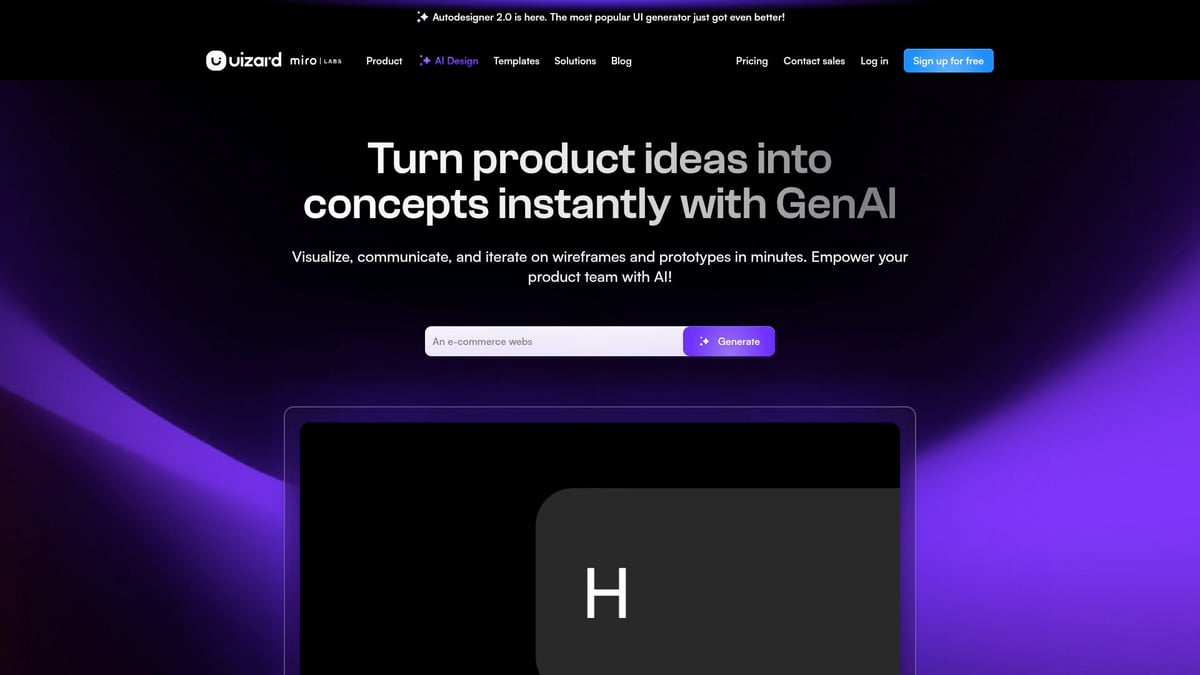
Artificial Intelligence is rewriting the rules, making it possible to monitor, defend, and grow your brand’s online presence at speed and scale. This guide will show you how.

We’ll break down the evolution of reputation management, core AI technologies, practical uses, best practices, key risks, and what’s coming next. Ready to keep your business ahead of the curve? Let’s dive in.

The Evolution of Reputation Management: From Manual to AI-Driven

The world of reputation management has changed drastically in just a few years. What was once a slow, manual process is now a fast-paced, data-driven discipline. Let’s look at how we moved from handwritten notes to algorithms that never sleep.

The Evolution of Reputation Management: From Manual to AI-Driven

The Traditional Approach to Reputation Management

In the past, reputation management was all about manual work. PR teams scanned newspapers, watched TV, and sifted through emails and letters for any mention of the brand. If a negative comment popped up, it could take days or even weeks to spot and respond to it.

The sheer volume of media made it nearly impossible to keep up. This meant businesses often missed the early warning signs of a brewing crisis. Large-scale monitoring required significant budgets and staff, making it tough for smaller brands to compete. ai reputation management was just a distant dream.

The Rise of Digital and Social Media

The explosion of social media platforms put every brand under a global spotlight. Suddenly, anyone could share their opinion in real time, and customers expected instant responses. Influencers and viral posts became powerful forces, both positively and negatively.

This shift meant brands needed to be alert around the clock. A single negative tweet or review could snowball quickly. Poor reputation management could cost businesses top talent and billions in value. As digital noise increased, the need for ai reputation management became clear.

Introduction of AI in Reputation Management

Enter artificial intelligence. AI brought the power to process massive amounts of online data in seconds, scanning news, blogs, forums, and social media for brand mentions. Sentiment analysis tools could now detect not just positive or negative feedback, but also sarcasm, trends, and subtle shifts in tone.

Pattern recognition allowed brands to spot early signs of trouble or opportunities for engagement. Instead of reacting slowly, businesses could now act before issues spiralled out of control. ai reputation management started to offer a real competitive edge.

Key Milestones Leading to 2026

By 2025, 73% of businesses are expected to use AI for customer experience management. The AI market is projected to soar from $214 billion in 2024 to $1,339 billion by 2030. Companies are integrating AI-powered chatbots, recommendation engines, and review management tools as standard practice.

For more on this evolution, the AI’s Impact on Reputation Management whitepaper provides a deep dive into how these milestones are shaping the industry.

The 2026 Landscape

Today, ai reputation management is standard for brands serious about growth and protection. The approach has shifted from damage control to proactive reputation building. Businesses that embrace AI are thriving, using data-driven insights to strengthen trust, respond faster, and turn challenges into opportunities.

The journey from manual monitoring to AI-driven strategies has levelled the playing field, making world-class reputation management accessible to brands of all sizes.

Core AI Technologies Powering Reputation Management in 2026

AI reputation management has rapidly evolved, blending advanced technology with smart business practices. In 2026, a suite of AI-powered tools gives brands the agility to protect and grow their reputation. Let’s break down the essential technologies making this possible.

Core AI Technologies Powering Reputation Management in 2026

Natural Language Processing (NLP) and Sentiment Analysis

Natural Language Processing (NLP) is the backbone of modern ai reputation management. This technology deciphers the intent and emotion behind every customer review, tweet, or comment, even across multiple languages. Real-time sentiment analysis flags negative, neutral, and positive mentions instantly.

For example, NLP can detect sarcasm or subtle criticism in a review, allowing you to respond appropriately. Tools now recognise slang, emojis, and cultural cues, increasing accuracy. Businesses can identify brewing issues before they become crises.

For a deeper dive into how AI trends like sentiment analysis and fake review detection are shaping the landscape, see AI Trends in Online Reputation.

Machine Learning for Pattern Recognition and Trend Analysis

Machine learning algorithms are trained to spot emerging issues and viral trends as they develop. With ai reputation management, these systems analyse vast datasets, identifying patterns humans might miss.

Predictive analytics enable brands to forecast potential crises based on subtle shifts in public perception. If a negative trend starts to gain momentum, AI alerts your team early, giving you a crucial head start.

Automated Review and Response Systems

Responding to thousands of customer reviews manually is a thing of the past. AI reputation management platforms now generate context-aware replies in seconds, maintaining a consistent, on-brand tone.

These systems can handle both complaints and praise, ensuring no feedback slips through the cracks. If a review requires a human touch, AI escalates it, providing all the context needed for a personal response.

Image and Video Analysis

In 2026, visual content matters as much as text. AI reputation management tools scan images and videos for brand mentions and potential misuse. They can detect inappropriate content or viral negative imagery that could harm your brand.

For example, if a damaging photo of your product starts circulating online, AI will flag it before it goes viral, allowing you to act quickly and protect your reputation.

Integration with CRM and Marketing Platforms

Seamless integration with CRM and marketing platforms is now standard in ai reputation management. This means reputation data flows directly into your customer databases, enabling personalised engagement.

If a customer leaves negative feedback, AI can trigger a targeted campaign to win them back. Unified profiles help brands deliver the right message, at the right time, via the right channel.

Real-Time Monitoring and Alerts

Always-on AI agents scan news sites, forums, and every corner of social media for brand mentions. With ai reputation management, you can set custom alerts for specific keywords, influencers, or even competitors.

AI sifts through thousands of mentions in minutes, highlighting only what matters. This level of vigilance ensures you never miss a critical conversation about your brand.

AI-Driven Reporting and Insights

AI reputation management platforms now generate automated, actionable reports for executives and marketing teams. Visual dashboards highlight sentiment trends, ROI, and areas for improvement.

Monthly KPIs and detailed analytics make it easy to track progress and spot new opportunities. With data visualisation, you get a clear picture of your brand’s health at a glance.

Practical Applications: How AI Reputation Management Works in 2026

In 2026, ai reputation management is no longer a futuristic concept—it’s the operational backbone for brands who care about their image. Let’s break down how these systems work in practice, making life easier for businesses and delivering results that manual methods simply can’t match.

Practical Applications: How AI Reputation Management Works in 2026

Automated Review Generation and Requests

One of the most effective uses of ai reputation management is automating review requests. AI analyses transaction data and identifies when customers are most likely to leave positive feedback. It then sends tailored requests at the perfect moment.

  • Personalised messages increase the chance of a response.
  • Timing is based on customer satisfaction signals.
  • AI automatically filters out dissatisfied customers to avoid negative reviews.

This approach not only boosts review volume but ensures a higher percentage of positive ratings. As a result, businesses see their online reputation improve steadily, with minimal manual intervention.

Smart Response and Crisis Management

Speed and empathy are crucial when managing complaints. ai reputation management platforms draft context-aware, brand-appropriate replies to both praise and criticism. They can escalate sensitive issues to human agents, handing over full conversation context.

  • AI monitors tone and urgency.
  • Escalation triggers for complex or high-stakes issues.
  • Suggested responses are reviewed by staff when necessary.

Businesses using ai reputation management report a significant reduction in response times and fewer errors. This means customer trust is rebuilt faster, and small issues are less likely to spiral into full-blown crises.

Proactive Sentiment Tracking and Early Warning Systems

ai reputation management tools offer real-time sentiment analysis across all digital channels. AI flags emerging negativity before it goes viral, allowing brands to act fast. According to AI’s Role in Reputation Management, proactive risk detection and early intervention are now key trends.

  • Instant alerts for sentiment spikes.
  • Trend analysis to spot brewing issues.
  • Customisable dashboards for different teams.

With these capabilities, brands can prevent PR disasters and maintain a positive public image, all thanks to ai reputation management.

Influencer and Advocate Identification

Finding brand advocates used to be a needle-in-a-haystack job. With ai reputation management, AI analyses engagement and purchase data to spot loyal customers and potential influencers.

  • Automated tracking of customer advocacy.
  • Identification of micro-influencers with high engagement.
  • Outreach campaigns triggered by AI insights.

This process helps brands build authentic connections and amplify positive word-of-mouth, while keeping a close eye on shifting sentiment within their communities.

Personalised Customer Engagement

ai reputation management doesn’t just monitor—it acts. AI crafts hyper-personalised offers and responses based on individual behaviour and preferences. This leads to stronger loyalty and increased repeat business.

  • Dynamic messaging tailored to each customer.
  • AI predicts what will resonate most.
  • Offers and incentives sent at the right time.

The result? Customers feel valued, and brands see measurable improvements in satisfaction scores and retention.

Documentation and Compliance Automation

Regulatory compliance can be a headache, but ai reputation management systems automate documentation and audit trails. Every interaction, resolution, and customer touchpoint is tracked and stored securely.

  • Automated GDPR-compliant reporting.
  • Easy retrieval for audits or legal reviews.
  • Consistent record-keeping across teams.

This automation reduces risk and saves time, while ensuring businesses meet all legal and industry requirements.

Multi-Channel Monitoring and Integration

Today’s customers talk everywhere, from Google and Trustpilot to emerging platforms. ai reputation management unifies monitoring across all channels, giving brands a single dashboard for every review, mention, and conversation.

  • Integration with major and niche review sites.
  • Centralised alerts for multi-location businesses.
  • Seamless syncing with marketing and CRM tools.

A unified approach means no missed conversations, faster responses, and a stronger, more resilient brand reputation.

Best Practices for Implementing AI Reputation Management in 2026

Implementing ai reputation management effectively in 2026 demands a strategic, measured approach. With AI tools now woven into the fabric of brand monitoring and response, getting it right can protect your reputation and boost business value. Here’s how to master the essentials.

Best Practices for Implementing AI Reputation Management in 2026

Setting Clear Objectives and KPIs

Before diving into ai reputation management, set clear objectives. What does success look like for your business? Is it a higher average review score, faster response time, or improved sentiment?

Define KPIs that match your industry and brand values. For example, a healthcare provider might focus on patient satisfaction, while a retailer could prioritise review volume and response speed. Make targets measurable and realistic.

Regularly review these KPIs as ai reputation management evolves. Adjust goals to reflect new business priorities or emerging risks. This clarity ensures everyone pulls in the same direction.

Choosing the Right AI Tools and Platforms

Selecting the best tools for ai reputation management is critical. Evaluate platforms for features like natural language processing, integration capabilities, scalability, and data security.

Compare custom-built solutions versus off-the-shelf platforms. Custom options may offer more flexibility but require higher investment. Off-the-shelf tools are quicker to deploy and often come with ongoing support.

Create a comparison table to weigh your options:

Feature Custom Solution Off-the-shelf
Flexibility High Medium
Cost High Low
Speed of Deployment Medium High
Support & Updates Custom Included

Choose a solution that fits your growth plans and integrates with your existing tech stack.

Integrating AI with Human Oversight

While automation is powerful, ai reputation management still needs the human touch. Train your team to interpret AI outputs, especially for sensitive or complex cases.

Balance automation with empathy. For example, let AI draft responses for common queries, but require human review for escalations or nuanced complaints. This hybrid approach ensures accuracy and builds trust.

Regularly assess where automation works best and where human intervention adds value. This keeps your strategy both efficient and authentic.

Ensuring Data Privacy and Security

Trust is the cornerstone of ai reputation management. Strictly follow data protection laws such as GDPR and CCPA. Only collect the data you need, and anonymise sensitive customer information wherever possible.

Use secure, encrypted storage and limit access to authorised personnel. Regularly audit your data-handling processes to spot vulnerabilities.

Communicate openly with customers about how their data is used in ai reputation management. Transparency builds confidence and helps you avoid compliance headaches.

Developing a Crisis Response Protocol

Preparation is key. Use AI to simulate potential reputation threats and test your crisis response. Develop pre-approved response templates for likely scenarios, ensuring you can act fast if an issue arises.

Establish escalation paths for complex problems. AI should alert the right people instantly when it detects a sentiment spike or viral complaint.

Revisit your crisis plans regularly, updating them as new risks emerge. This readiness turns reputation threats into opportunities for positive engagement.

Continuous Learning and Improvement

The landscape for ai reputation management shifts constantly. Feed new data and feedback into your AI models to keep them sharp.

Run A/B tests on response templates and strategies. Use monthly performance reports to spot trends and fine-tune your approach. Small, regular tweaks can yield big improvements over time.

Encourage a culture of learning within your team. Share insights and celebrate wins to keep everyone motivated.

Measuring ROI and Business Impact

Track how ai reputation management affects both your reputation KPIs and core business metrics. Look for links between improved sentiment and increased sales, customer retention, or acquisition.

Quantify cost savings from automation and faster response times. Showcase value to stakeholders using clear, visual reports. For more on market growth and business impact, see the AI in Reputation Management Market Report.

Regular measurement ensures your investment in ai reputation management delivers tangible results.

Risks, Challenges, and Ethical Considerations in AI Reputation Management

Even with the power of ai reputation management, businesses must tread carefully. While AI brings speed and efficiency, it also introduces significant risks and ethical challenges that can impact your brand’s credibility and customer trust.

The Limits of AI Understanding and Empathy

AI has come a long way, but it still struggles to fully understand human emotion, sarcasm, or subtle cultural references. Automated responses can occasionally appear tone-deaf or miss the mark, especially in sensitive situations.

Consider when ai reputation management tools misinterpret a customer’s complaint as positive, or fail to pick up on irony. This can lead to awkward replies and potentially make matters worse, rather than defuse them.

Data Bias and Fairness

AI systems learn from the data they are fed. If that data contains bias, the system can unknowingly perpetuate unfairness.

  • Biased moderation of reviews or feedback
  • Discriminatory outcomes in automated responses
  • Misrepresentation of certain groups

Regular audits and inclusive training data are essential to ensure fair ai reputation management for all users.

Privacy, Consent, and Transparency

With ai reputation management, customer data is constantly being collected and analysed. This raises questions about privacy and consent.

  • Are customers aware their feedback is processed by AI?
  • Is data collection compliant with GDPR and similar laws?
  • How transparent are businesses about their use of AI?

Clear communication and opt-in policies are vital to maintaining trust.

Over-Reliance on Automation

It is tempting to let AI handle every aspect of reputation management. However, too much automation can backfire if complex issues are not escalated to humans. Automated replies may miss nuance or escalate conflict if not carefully monitored.

Businesses must balance efficiency with the need for human judgement. For more on how generative AI can shape brand perception and the importance of oversight, see Generative AI for SEO and branding.

Security Threats and AI Manipulation

AI systems are not immune to attack. Malicious actors can exploit vulnerabilities, planting fake reviews or manipulating sentiment. If ai reputation management tools are not properly secured, your brand could fall victim to fraud or misinformation.

Regular monitoring, validation, and robust security protocols are essential to protect both your business and your customers.

Regulatory and Legal Compliance

The legal landscape for AI is evolving quickly. Regulations like GDPR and new AI-specific laws require businesses to document their processes, justify automated decisions, and safeguard consumer rights.

Keeping your ai reputation management practices compliant will help avoid fines and protect your reputation. Prepare for audits by maintaining clear records of AI activity and decision-making.

Building Trust with Stakeholders

Ultimately, trust is the cornerstone of effective ai reputation management. Stakeholders, from customers to regulators, want assurance that AI is used responsibly and ethically.

Being transparent about AI use, regularly reviewing ethical standards, and prioritising customer interests will help your business build loyalty and credibility in an AI-driven world.

Future Trends: The Next Frontier of AI Reputation Management

The future of ai reputation management is already taking shape, with new technologies poised to redefine how brands connect with their audiences. The next frontier is all about being proactive, hyper-personalised, and ever-present across every touchpoint.

Hyper-Personalisation and Predictive Engagement

AI reputation management is moving towards hyper-personalisation, where every customer interaction feels tailored and timely. AI anticipates what customers need before they even ask, analysing behaviour patterns to predict issues and deliver solutions proactively. This predictive approach helps brands resolve potential complaints or queries, building trust and loyalty. Imagine AI-driven systems sending personalised responses or offers the moment sentiment shifts, ensuring your brand stays ahead.

Multimodal AI: Beyond Text to Voice, Video, and AR

Text is just the beginning. By 2026, ai reputation management will harness multimodal AI to analyse voice reviews, video content, and even augmented reality experiences. Picture AI scanning TikTok videos or AR brand placements for mentions or sentiment, alerting teams to viral trends or risks. This broadens the scope of monitoring, making it possible to catch reputation threats or opportunities wherever they appear, not just in written feedback.

Integration with Generative AI and Large Language Models

Generative AI and large language models are taking automated engagement to the next level. Brands can now deploy AI that generates nuanced, context-aware replies and proactive content strategies, shaping public perception in real time. These models learn from past interactions, improving over time and ensuring messaging feels genuinely human. The result is a more authentic, effective ai reputation management approach that adapts to every situation.

AI-Powered Brand Advocacy and Community Building

Building a loyal community is easier with ai reputation management tools that identify micro-influencers and superfans. AI analyses engagement data to spot these advocates, then helps automate outreach or referral campaigns. This not only amplifies positive word of mouth but also strengthens your brand’s reputation from the inside out. Leveraging AI for advocacy ensures your business has a steady stream of authentic support in the digital landscape.

Real-Time, Global Reputation Management

As brands operate across borders, ai reputation management must keep up with different languages, cultures, and markets. AI tools now offer seamless monitoring and response capabilities worldwide, adapting to local norms and regulations automatically. This real-time global reach means reputation risks are spotted and addressed instantly, no matter where they arise. It also ensures brands remain relevant and trusted in every market they serve.

The Rise of Generative Engine Optimisation (GEO)

Search is changing. With the advent of AI-powered search engines like ChatGPT and Perplexity, ai reputation management must focus on Generative Engine Optimisation (GEO). This means ensuring your brand is visible and accurately represented in AI-driven answer engines, not just traditional search. For practical strategies, see how AI-based SEO strategies can help future-proof your online reputation in this evolving ecosystem.

Preparing for New Regulatory and Ethical Standards

The regulatory landscape is tightening, and ethical expectations are rising. Future ai reputation management frameworks must be flexible enough to adapt to stricter governance and evolving consumer protection laws. This involves transparent data practices, responsible AI deployment, and continual monitoring for compliance. Brands that lead on ethics and transparency will not only avoid penalties but also build lasting trust with customers and stakeholders.

Frequently Asked Questions About AI Reputation Management in 2026

Curious about how AI reputation management works or what it could mean for your business in 2026? Here are the answers to the questions we hear most often.

What is AI reputation management and how does it work?

AI reputation management uses advanced algorithms and machine learning to monitor, analyse, and influence how your brand is perceived online. It processes huge volumes of data from reviews, social media, and news, providing instant insights and automated responses.

How does AI detect and respond to negative reviews in real-time?

AI tools scan platforms continuously, using natural language processing to flag negative sentiment or urgent complaints. When an issue arises, the system can draft smart, context-aware responses or escalate critical cases to human agents for a personal touch.

What are the main benefits for small and medium-sized businesses?

AI reputation management levels the playing field for SMEs. It automates time-consuming tasks, provides 24/7 monitoring, and helps businesses build trust faster. You can respond more quickly to customers, spot trends early, and protect your brand with fewer resources.

Are AI-generated responses as effective as human replies?

In most cases, yes. AI can craft fast, consistent, and empathetic replies across thousands of reviews. However, for sensitive or complex issues, human oversight is still key to ensure nuance and build genuine customer relationships.

How can businesses ensure data privacy and compliance with AI tools?

Choose AI reputation management platforms that comply with GDPR and local regulations. Look for features like data encryption, anonymisation, and clear consent processes. Regular audits and transparent policies are essential to keep customer trust.

What are the costs and ROI of implementing AI reputation management?

Costs vary by platform and scale, but AI-driven solutions often deliver a strong return on investment. They reduce manual workload, prevent crises, and can boost revenue by protecting your online image. Many businesses see value within months.

How can companies prepare for future trends and stay ahead of competitors?

To stay competitive, invest in AI tools that adapt to new channels and data sources. Explore AI competitor analysis methods to understand how others are managing their reputation and to benchmark your own efforts.

What are the common pitfalls and how can they be avoided?

Over-reliance on automation is a risk. Always balance AI with human judgement, especially for high-stakes issues. Regularly review AI outputs, update models, and ensure your team is trained to handle escalations and unique situations.

Which industries benefit most from AI reputation management?

Virtually all industries can benefit, especially those with high customer interaction like retail, hospitality, healthcare, and finance. Any business with an online presence gains from proactive reputation monitoring and management.

How can businesses get started with AI-powered reputation solutions?

Begin by defining your goals and KPIs. Research platforms that offer automated monitoring, sentiment analysis, and integration with marketing tools. For a broader view of how marketing automation supports reputation, see Marketing automation with AI. Start small, measure results, and scale as you build confidence.

Now you’ve seen how AI can transform reputation management for small businesses in 2026—giving you the edge to spot risks early, win back unhappy customers, and build trust at scale. If you’re wondering how this actually looks for your business, let’s chat. I’ll show you exactly where AI fits, what tools will give you results, and how to make sure it brings in more leads and sales (not just tech headaches). Fancy a proper, no-nonsense plan? Book your Get free 45 min consultation and let’s make your reputation work for you.

Essential Guide to AI Data Analytics for 2026 Success

In 2026, the difference between thriving and merely surviving will often come down to how effectively you use ai data analytics. The pace of change in this space is relentless, pushing businesses to adapt or risk being left behind.

This essential guide cuts through the noise, making ai data analytics simple to understand and practical to apply. We’ll break down the fundamentals, showcase transformative real-world uses, and walk you through the steps to successful adoption.

Want to see how ai data analytics can automate your processes, accelerate decision making, and deliver insights you never thought possible? You’ll find proven methods, examples, and strategies that unlock growth, efficiency, and a real competitive edge.

Ready to take action? Equip yourself with the knowledge and tools to make ai data analytics work for your business in 2026 and beyond.

Understanding AI Data Analytics: Foundations and Value

Artificial intelligence is transforming the way we use and understand data. In 2026, businesses that master ai data analytics will be able to unlock insights and drive decisions faster than ever before. But what exactly does this mean in practice, and how can organisations realise its full value?

Understanding AI Data Analytics: Foundations and Value

What is AI Data Analytics?

AI data analytics is the discipline of using artificial intelligence to analyse large, often complex datasets, automate repetitive tasks, and uncover actionable insights. Unlike traditional analytics, which relies on manual processes and static rules, ai data analytics uses machine learning, natural language processing, and automation to boost both speed and accuracy.

The process includes several key components:

  • Data ingestion: Collecting data from multiple sources.
  • Preparation: Cleaning and transforming data for analysis.
  • Modelling: Applying algorithms to find patterns and make predictions.
  • Interpretation: Generating insights from model outputs.
  • Visualisation: Presenting results in clear, interactive dashboards.

A practical example is Google BigQuery’s AI-powered analytics platform, which enables users to forecast trends, analyse sentiment, and even generate SQL queries automatically. This approach reduces manual effort and delivers deeper insights, often in real time.

It’s worth noting that data wrangling can take up to 80% of a typical data science project, according to the Alan Turing Institute. AI data analytics is designed to support, not replace, human analysts, freeing up time for strategic thinking and better decision-making.

The Business Case for AI Data Analytics

The value of ai data analytics for organisations is clear: it improves efficiency, enhances decision-making, and enables businesses to operate at scale. By automating routine tasks like data cleaning and feature extraction, AI lets analysts focus on higher-level questions.

AI-driven analytics excels at identifying patterns and trends that would likely go unnoticed in manual reviews. This leads to smarter, data-backed decisions. Scalability is another major advantage, as ai data analytics can handle huge, complex datasets in real time.

Early adopters report faster innovation cycles and increased market share. For example, retailers using AI for demand forecasting have seen fewer stockouts and higher customer satisfaction.

Benefit Description
Efficiency Automates repetitive analytics tasks
Better decisions Surfaces hidden patterns and trends
Scalability Handles massive datasets instantly
Competitive edge Drives innovation and market growth

The rapid market expansion is evident, with forecasts indicating continued growth in the AI in data analytics market size forecast, underlining its expanding role in business operations.

Challenges and Considerations

Despite the promise, implementing ai data analytics is not without its hurdles. Real-world data is often messy, with quality and integration issues that need robust AI-driven cleaning and preparation.

A significant challenge is the skills gap. Successful adoption depends on having both the right technology and a workforce prepared to use it. Upskilling teams and fostering a data-driven culture are critical steps.

Trust and explainability are also top concerns. Organisations must ensure that AI-driven insights are transparent and actionable. This means building systems where humans understand and can challenge the results, keeping AI as a trusted advisor rather than a black box.

By addressing these challenges head-on, businesses set themselves up to realise the full potential of ai data analytics in 2026 and beyond.

The AI Data Analytics Lifecycle: Step-by-Step for 2026 Success

AI data analytics is not a one-off project, but a dynamic process. To achieve real business value in 2026, you need a clear, repeatable lifecycle. Let’s break down each step, so you know exactly how to go from raw data to actionable insight.

The AI Data Analytics Lifecycle: Step-by-Step for 2026 Success

Step 1: Data Acquisition and Integration

Everything starts with gathering data. In 2026, sources range from internal databases and IoT devices to social media streams. AI data analytics platforms automate data ingestion, reducing manual errors and speeding up the process.

Modern tools can pull data from multiple silos in real time. For example, BigQuery allows seamless import from various sources, making integration almost effortless. According to the Alan Turing Institute, analysts still spend up to 80 percent of their time on data engineering. Automating this phase with AI data analytics not only saves time but also ensures your insights are based on the most current and accurate information.

Step 2: Data Preparation and Wrangling

Once data is collected, it needs to be cleaned, deduplicated, and transformed. Messy data can derail even the best AI data analytics project. AI models such as ptype can automatically infer data types and flag anomalies, even in complex datasets.

Advanced techniques like robust variational autoencoders help identify and repair outliers, ensuring your analysis is reliable. Automated feature engineering is another AI-driven benefit, extracting the most relevant variables for predictive modelling with minimal human input.

Step 3: Model Building and Training

Now comes the heart of AI data analytics: building models that learn from your data. Machine learning algorithms spot patterns and make predictions that would be impossible to detect manually.

Platforms like BigQuery ML and Vertex AI let analysts use familiar SQL to train models, lowering the barrier to entry. Pre-trained foundational models accelerate deployment, so you can move from data to insight faster. Common use cases include customer churn prediction and credit card fraud detection, both of which benefit from the speed and accuracy of AI-driven modelling.

Step 4: Insight Generation and Interpretation

Building a model is one thing, but turning results into action is where AI data analytics shines. AI tools help interpret outputs, surface key trends, and suggest next steps.

Natural language processing enables conversational querying, letting users ask questions and get answers in plain English. For example, Gemini in BigQuery can generate reports that highlight anomalies and forecast trends, making insights accessible to everyone in your organisation.

Step 5: Visualisation and Communication

Clear communication is essential. AI-enhanced visualisation tools like Looker transform complex analysis into intuitive dashboards. Users can request custom visualisations or reports through conversational interfaces, making insights easy to share and act on.

A practical application of this is AI landing page optimisation, where businesses use AI data analytics to track and improve landing page performance in real time. Real-time dashboards monitor campaign results or operational KPIs, ensuring decision-makers always have the latest information at their fingertips.

Step 6: Continuous Improvement and Automation

The AI data analytics lifecycle does not end with a single report. AI models learn and improve as they process new data, creating a feedback loop that drives continuous optimisation.

Routine analytics tasks can be automated, freeing analysts to focus on strategic challenges. Automated alerts for data quality issues or significant trend shifts keep your business agile, ensuring you never miss a critical change. By embedding these improvements, organisations future-proof their analytics and maintain a competitive edge.

Transformative Applications of AI Data Analytics Across Industries

AI data analytics is revolutionising how industries operate, innovate, and compete. From retail and finance to healthcare and manufacturing, the real-world impact is clear. As AI adoption statistics in 2025 show, organisations are rapidly embracing AI to unlock new value and efficiencies. Let’s examine how ai data analytics is making a difference in key sectors.

Transformative Applications of AI Data Analytics Across Industries

Predictive Analytics and Forecasting

Predictive analytics is one of the most powerful applications of ai data analytics. By leveraging machine learning models, organisations can anticipate demand, predict equipment failures, and manage financial risk with unprecedented accuracy. In retail, real-time demand forecasting minimises stockouts and overstocking, boosting customer satisfaction. Manufacturing firms use predictive maintenance to reduce downtime and extend equipment lifespan. Financial institutions rely on ai data analytics for credit scoring and fraud detection. BigQuery ML, for example, enables instant, low-latency predictions that drive operational efficiency.

Sentiment Analysis and Customer Insights

Understanding customer sentiment is vital for business growth. Ai data analytics enables companies to analyse feedback from social media, reviews, and surveys at scale. Advanced AI models score sentiment as positive, negative, or neutral, uncovering trends and pain points that would otherwise be missed. Retailers can quickly adapt product features in response to negative feedback, while service providers identify opportunities to exceed customer expectations. This approach not only informs product development but also enhances marketing strategies.

Image and Video Analysis

The ability to analyse unstructured data such as images and videos is transforming industries. With ai data analytics, healthcare providers can automate diagnostics by detecting anomalies in medical scans. Manufacturers use visual inspection tools to maintain product quality and safety. Security teams benefit from real-time video monitoring, identifying threats before they escalate. Solutions like Vertex AI Vision automate object detection and metadata generation, making it easier to extract actionable insights from visual data.

Automated Data Engineering and Wrangling

Data preparation is often the most time-consuming part of analytics. Ai data analytics automates cleaning, integration, and feature engineering, freeing analysts to focus on strategic tasks. Platforms such as Wrattler integrate AI assistants to handle real-world data wrangling challenges, from deduplication to anomaly detection. The result is faster, more reliable analytics pipelines that scale with business needs. Automated data engineering not only boosts productivity but also improves the quality of insights delivered.

Natural Language-Driven Analytics

Conversational analytics interfaces are making ai data analytics accessible to everyone, not just data scientists. Users can now query complex datasets using everyday language, thanks to advances in natural language processing. Tools like Gemini in BigQuery provide chat-based assistance, generating SQL queries and visualisations on demand. This democratisation of analytics empowers teams across the organisation to make data-driven decisions quickly, without waiting for specialist support.

AI-Enhanced Data Visualisation

Visualising complex results is easier than ever with ai data analytics. AI-powered tools suggest optimal formats and highlight hidden trends, turning raw data into actionable intelligence. Looker’s Gemini integration enables users to build dashboards and reports through simple chat prompts, reducing the learning curve. These dynamic visualisations help stakeholders grasp key insights at a glance, supporting faster, more informed decision-making.

Real-Time Analytics and Decision Support

Real-time analytics is reshaping how businesses respond to emerging trends and risks. AI-powered systems monitor key metrics continuously, triggering instant alerts for anomalies or significant changes. In finance, credit card fraud detection systems flag suspicious transactions as they occur. Retailers track campaign performance in real time, adjusting strategies on the fly. This immediate feedback loop ensures organisations remain agile and responsive in a rapidly changing environment.

Key Technologies and Tools Shaping AI Data Analytics in 2026

Staying ahead in ai data analytics means knowing which technologies truly drive results. In 2026, the landscape is richer than ever, with smarter platforms, assistants, and tools making analytics accessible and powerful for every business.

Key Technologies and Tools Shaping AI Data Analytics in 2026

Machine Learning Platforms and Frameworks

The backbone of modern ai data analytics is robust machine learning platforms. Google BigQuery ML and Vertex AI are leading the charge, allowing analysts to build, train, and deploy models directly within their data environments.

Integration is seamless, connecting data warehouses to cloud infrastructure so you can scale effortlessly. Open-source libraries like TensorFlow and PyTorch give developers the flexibility to customise solutions or plug into pre-built models.

A quick comparison:

Platform Key Feature Use Case
BigQuery ML SQL-based modelling Predictive analytics
Vertex AI End-to-end workflow Real-time forecasting
TensorFlow Deep learning toolkit Custom ML solutions

These platforms empower businesses to unlock the full value of ai data analytics without getting bogged down in technical hurdles.

AI Assistants and Automation Tools

AI assistants are transforming how we engage with ai data analytics. Tools like Gemini in BigQuery automate SQL generation, clean data, and even recommend features for modelling.

Automation is not just about speed. It’s about accuracy and freeing up your team to focus on strategy instead of repetitive tasks. Automated assistants can cut data preparation time by up to 50 percent, accelerating your analytics pipeline.

Gemini offers code completion and chat-based support, so even less technical users can get actionable insights from complex datasets. This shift means ai data analytics is no longer reserved for data scientists alone.

Data Visualisation and Business Intelligence (BI) Tools

Turning raw data into clear, actionable visuals is essential in ai data analytics. BI tools like Looker and Power BI now come with built-in AI-driven features.

Looker’s Gemini integration lets users build reports and dashboards through simple chat prompts. This means you can move from question to insight in moments, no code required.

Key benefits:

  • Automated chart suggestions for optimal data storytelling
  • Real-time dashboards for campaign performance
  • Custom reports generated by conversational requests

By making complex data accessible, these tools ensure ai data analytics delivers business value at every level.

Natural Language Processing (NLP) and Conversational Analytics

NLP is breaking down barriers in ai data analytics, letting users query data with everyday language. AI chatbots and conversational interfaces are now standard in analytics platforms.

For example, Gemini in BigQuery allows users to ask questions like “Show me last quarter’s sales trends” and receive instant answers. This democratises data access, making analytics available to everyone in the organisation.

NLP-driven analytics means faster decision-making and less time spent on manual data exploration. It’s a game-changer for companies that want to empower their teams with ai data analytics.

Data Quality and Feature Engineering Solutions

Data quality is the foundation of reliable ai data analytics. AI models now handle outlier detection, anomaly repair, and data type inference automatically.

Solutions like ptype and robust variational autoencoders (RVAE) ensure that even messy, real-world datasets are cleaned and ready for analysis. The Alan Turing Institute leads in research on automated data engineering, creating tools that streamline the entire process.

Automated feature engineering means your predictive models can be trained faster and more accurately. With these advances, ai data analytics becomes more efficient and trustworthy.

Cloud Infrastructure and Scalability

Cloud-based platforms are fuelling the rise of ai data analytics by offering scalability, security, and seamless integration with AI tools. Google Cloud, for example, provides generous credits for new BigQuery customers to trial advanced analytics solutions.

With cloud infrastructure, businesses can process massive datasets in real time, ensuring that insights are always up to date. The flexibility of the cloud means ai data analytics can grow alongside your business needs.

Looking ahead, the future of ai data analytics will be shaped by innovations highlighted in reports on top data analytics trends in 2026, from AI-powered data governance to augmented analytics and beyond.

Strategies for Successful AI Data Analytics Adoption

Adopting ai data analytics successfully is more than just buying new software. It demands a shift in mindset, the right mix of talent, and a clear plan for change. Here’s how to set yourself up for lasting value.

Building Organisational Readiness

Start with a frank assessment of your current data maturity. Do your teams understand the basics of ai data analytics? Identify gaps in both technical and soft skills, then invest in upskilling. Encourage a culture that values data-driven thinking. Cross-functional collaboration is key, so break down silos and enable open communication. Equip analysts and business users with the tools and training they need to work confidently with ai data analytics. This foundation helps everyone pull in the same direction.

Selecting the Right Tools and Technologies

Choosing the best ai data analytics platform is not about chasing trends. Focus on solutions that integrate with your current systems, support your data sources, and can scale as your business grows. Look for platforms with strong automation and user-friendly interfaces. If you’re in marketing, consider how AI-based SEO strategies could leverage advanced analytics for better results. Table 1 below shows key criteria to compare when evaluating tools:

Criteria Why It Matters
Integration Reduces manual data movement
Scalability Handles future data growth
Usability Empowers business users
Support Ensures smooth implementation

Data Governance, Ethics, and Compliance

Strong data governance underpins any ai data analytics initiative. Make sure your data is secure, private, and used ethically. Stay ahead of regulations such as GDPR by implementing robust compliance checks. Adopt explainable AI models so users can trust the insights they receive. Build audit trails to track decisions and data access. Regularly review policies to ensure your analytics processes meet both legal and ethical standards, keeping your organisation’s reputation intact.

Change Management and Stakeholder Engagement

Effective change management is essential for ai data analytics adoption. Secure executive sponsorship early, then map out stakeholder interests and potential resistance. Run small pilot projects to show quick wins and demonstrate value. Use these results to build momentum and encourage wider adoption. Regularly communicate progress and listen to feedback to refine your approach. This way, you ensure buy-in across the business and make the transition smoother for everyone involved.

Measuring Success and Continuous Optimisation

Define clear KPIs to track the impact of ai data analytics, such as reduced manual effort or improved campaign performance. Establish feedback loops so models improve over time. Embrace automation to free up analysts for higher-value tasks. For marketers, marketing automation with AI can demonstrate tangible gains in efficiency and ROI. Review performance regularly, iterate on your processes, and celebrate wins to keep teams motivated.

Overcoming Common Challenges

Every ai data analytics journey will face hurdles. Data quality issues, integration headaches, and user adoption barriers are common. Tackle these by leveraging AI assistants for data wrangling and analysis. Encourage ongoing learning and support to build confidence in new tools. Remember, the goal is not perfection on day one but continuous improvement. With the right mindset, these challenges become opportunities to refine and strengthen your analytics capability.

Future Trends and Innovations in AI Data Analytics

The pace of change in ai data analytics is accelerating at breakneck speed. As we look to 2026, several key trends are set to redefine how organisations extract value from their data, from automation to explainability.

Generative AI and Advanced Automation

Generative AI is moving beyond chatbots and image creation, becoming a powerhouse for data synthesis, automated reporting, and scenario modelling. In ai data analytics, this means faster production of business reports and insights. Imagine generating marketing content or sales forecasts with just a prompt. Automation also allows repetitive tasks to be handled by intelligent systems, freeing up your team for more strategic work.

Real-Time and Edge Analytics

Real-time analysis is no longer a luxury, it is a necessity. Ai data analytics platforms now deliver instant insights for sectors like retail, finance, and IoT. Edge analytics pushes this further, processing data directly on devices for immediate decision-making. This is vital for scenarios where every second counts, such as fraud detection or supply chain monitoring.

Democratization of AI Analytics

No-code and low-code platforms are making ai data analytics accessible to everyone, not just data scientists. Conversational interfaces and drag-and-drop tools empower business users to build models, run queries, and visualise results without technical barriers. This shift is levelling the playing field for SMEs and large enterprises alike.

Explainable and Responsible AI

As ai data analytics becomes more embedded in business decisions, explainability and transparency are critical. Tools now provide rationale for predictions, helping users understand and trust AI-driven recommendations. Responsible AI frameworks ensure ethical use, reducing bias and increasing accountability.

Industry-Specific AI Solutions

Tailored solutions are emerging for every sector. In healthcare, ai data analytics supports diagnostics and patient care. Manufacturing benefits from predictive maintenance, while retail enjoys advanced demand forecasting. These specialised tools address unique industry challenges and opportunities.

Evolving Data Privacy and Security Standards

With more data comes greater responsibility. Ai data analytics platforms are prioritising robust privacy, security, and compliance features. Automated anonymisation and consent management tools are now standard, helping organisations stay ahead of regulatory changes.

Trend Impact on AI Data Analytics
Generative AI Automated reports and content
Real-Time and Edge Analytics Instant, on-device insights
Democratization AI for all skill levels
Explainable and Responsible AI Trustworthy, transparent outcomes
Industry-Specific Solutions Tailored analytics for each sector
Data Privacy and Security Stronger compliance and governance

By 2026, over 75% of enterprises will operationalise AI, up from less than 10% in 2020 (Gartner). If you want to see how this growth is unfolding across sectors, check out the latest AI adoption in USA – 2025 statistics. The future of ai data analytics is not just bright, it is transformative.

Ready to put these AI data analytics strategies into action and get ahead of the competition in 2026? If you want to see how all this applies to your business in the real world—not just in theory—I’d love to chat. I’ll help you cut through the jargon and focus on what actually drives more leads and sales. Book your Get free 45 min consultation and let’s work out how to turn your data into real results, whether you’re on Shopify, WordPress, or looking to supercharge your whole marketing approach.

12 Must-Try AI Writing Tools for 2026

The world of ai writing tools has exploded in 2026, transforming how businesses, marketers, and writers create content. Demand for efficient, creative, and SEO-optimised writing has never been higher.

With the right ai writing tools, you can save hours, boost quality, and outpace the competition. In this article, I’ll break down 12 must-try platforms, covering their features, pricing, pros and cons, and the best use cases, so you can make the smartest choice for your content needs.

Why AI Writing Tools Are Essential in 2026

The landscape of content creation is evolving at breakneck speed. Businesses, marketers, and writers in 2026 face immense pressure to keep up with demand, stay original, and outperform competitors. This is where ai writing tools have become truly indispensable, driving a new era of productivity, creativity, and smarter SEO.

The Evolution of AI Content Creation

Ai writing tools have come a long way from their humble beginnings as simple text generators. Today’s advanced platforms harness breakthroughs in natural language processing, contextual awareness, and personalisation. Modern tools can generate long-form articles, adapt brand voice, and even create images or videos alongside text.

Adoption has surged, with statistics from 2024 and 2025 showing that over 60 percent of marketers and SMEs now use ai writing tools regularly. The shift is clear: more SEO, social media, and eCommerce content is being produced by AI than ever before. Integrations with marketing platforms and automation software are now standard, making these tools a core part of every content strategy. For the latest adoption data, see these AI in Writing Statistics 2025: Usage, Productivity, and Market Growth Trends.

Key Benefits for Businesses and Creators

The advantages of ai writing tools for businesses and creators are impossible to ignore. First, they automate repetitive writing tasks, freeing up valuable time for strategy and creativity. Second, content quality has improved significantly, with AI now crafting coherent, engaging, and relevant output.

Cost efficiency is another big win. Companies can scale without hiring huge teams or relying on costly freelancers. Built-in SEO features, such as keyword research and metadata suggestions, help content rank higher. Many ai writing tools also offer multilingual support, making it easy to reach global audiences with accurate translations and localised messaging.

Addressing AI Content Concerns

Despite the benefits, some concerns linger around ai writing tools. Issues like originality, plagiarism, and the risk of AI-detected content are hot topics in 2026. Leading platforms have responded by integrating humanisation features, advanced plagiarism checkers, and customisable brand voice settings.

Recent studies show that both search engines and users are more accepting of AI-generated content, provided it meets quality and authenticity standards. Still, human oversight remains crucial. Ethical use, transparency, and regular reviews ensure that ai writing tools enhance rather than undermine your content strategy.

Choosing the Right Tool: What to Look For

Selecting the best ai writing tools for your business means focusing on accuracy, ease of use, integration options, scalability, and quality support. Tools should align closely with your goals, whether you are blogging, writing product descriptions, or running email campaigns.

Compare value for money, considering free and premium models. User reviews and trial periods are invaluable for testing fit before committing. Regular updates and responsive support are must-haves. Look at how top competitors rate their tools for reliability and trust to make an informed decision that drives results.

12 Must-Try AI Writing Tools for 2026

Choosing the right ai writing tools can make or break your content strategy in 2026. Below, you’ll find an in-depth look at 12 standout ai writing tools, each with its own strengths. Whether you’re a solo creator or part of a large team, there’s something here to fit your needs.

Jasper AI

Jasper AI leads the pack for ai writing tools in 2026. It offers a subscription model with several tiers and a free trial for newcomers. The platform boasts over 50 content templates, a dedicated brand voice, SEO mode, and even image generation. With collaborative workspaces, Jasper AI is perfect for marketing teams and agencies looking to scale.

12 Must-Try AI Writing Tools for 2026 - Jasper AI

Key features:

  • 50+ templates for every content type
  • Brand voice for consistency
  • SEO mode for better rankings
  • Image generation for visual content
  • Collaborative editing for teams

Pros:
Versatile, integrates with SurferSEO, and provides robust support.
Cons:
There’s a learning curve, and advanced plans can be pricey.

Example: Enterprise teams use Jasper AI to streamline multi-channel campaigns, ensuring every piece of content stays on-brand and SEO-friendly.

Copy.ai

Copy.ai is one of the most accessible ai writing tools, offering a free plan and affordable upgrades. Its main draw is the minimal input required to generate high-quality drafts for blogs, sales copy, and emails. It also supports over 25 languages, making it ideal for global campaigns.

12 Must-Try AI Writing Tools for 2026 - Copy.ai

Features include:

  • Blog post and sales workflows
  • Email sequences
  • CRM integration
  • Multilingual support

Pros:
Easy to use, wide workflow library, and broad language support.
Cons:
Some content may need human tweaking for depth and uniqueness.

Marketers often turn to Copy.ai for campaign ideation and rapid blog drafting, saving hours each week.

Writesonic

Writesonic stands out in the ai writing tools landscape for its credit-based pricing and scalable plans. It excels at long-form articles, SEO checking, landing page generation, and even AI image creation. Its templates help SMEs and bloggers produce content at speed.

12 Must-Try AI Writing Tools for 2026 - Writesonic

Key features:

  • Long-form article writer
  • Built-in SEO checker
  • Landing page and ad copy generation
  • AI image tools

Pros:
Affordable entry pricing, SEO focus, and template variety.
Cons:
Keyword suggestions can be basic, and some outputs feel generic.

Ecommerce brands use Writesonic to quickly generate product listings and targeted ad copy.

ChatGPT

ChatGPT has become a household name among ai writing tools, with both free and premium plans. Its conversational AI can handle everything from blog drafting to coding and brainstorming. A vibrant plugin ecosystem means endless possibilities for content creators.

12 Must-Try AI Writing Tools for 2026 - ChatGPT

Core features:

  • Prompt-based content creation
  • Code and data analysis
  • Plugin support
  • Regular updates

Pros:
Flexible, natural language understanding, and a strong community.
Cons:
Getting the best results requires prompt engineering, and factual accuracy can vary.

Content creators use ChatGPT for brainstorming, article drafting, and research summaries. For more on practical uses, see ChatGPT applications in marketing.

Google Gemini

Google Gemini is rapidly gaining ground in the ai writing tools market. It offers a free version, with Gemini Advanced available via Google One. The tool integrates seamlessly with Google Workspace, pulling real-time web data for the most current content.

12 Must-Try AI Writing Tools for 2026 - Google Gemini

Notable features:

  • Real-time web access
  • Multi-modal input (text, images)
  • Integration with Docs and Gmail
  • SEO-friendly outputs

Pros:
Always up-to-date, great for SEO, and easy team collaboration.
Cons:
Some features are paywalled, and occasional factual errors appear.

SEO teams rely on Google Gemini for keyword-rich blog content and up-to-the-minute competitor analysis.

Marketing XP: AI Content & SEO Services

Marketing XP is a unique entry in the ai writing tools arena. It’s not a SaaS platform, but a UK-based service combining AI-powered content creation with hands-on SEO strategy. Flat-rate packages start at £600 per month, with no long-term contracts.

What you get:

  • AI-driven content and SEO campaigns
  • Website optimisation
  • AI tool training (including ChatGPT)

Pros:
Personalised service, transparent pricing, and conversion focus.
Cons:
Specialist UK focus, not self-serve.

Businesses use Marketing XP for local SEO, Shopify content, and in-house team training on ai writing tools.

Article Forge

Article Forge automates long-form content creation, ideal for agencies and marketers who need scale. Subscription-based with a free trial, it generates unique, research-backed articles and integrates with SEO tools.

12 Must-Try AI Writing Tools for 2026 - Article Forge

Key features:

  • Bulk article generation
  • SEO integration
  • Multi-language support
  • API access

Pros:
Fast, supports several languages, and offers API.
Cons:
Limited tone customisation, some content needs refinement.

Agencies use Article Forge to produce large amounts of SEO-friendly articles with minimal manual effort.

Wordtune

Wordtune is a favourite among ai writing tools for editing and polishing drafts. The free version provides real-time rewriting, while premium plans add advanced rewriting and team features. It’s perfect for professionals and students alike.

12 Must-Try AI Writing Tools for 2026 - Wordtune

Features include:

  • Real-time rewriting
  • Tone and style adjustment
  • Summarisation
  • Browser extension

Pros:
User-friendly, integrates with Google Docs, boosts productivity.
Cons:
Limited free features, not a full content generator.

Writers use Wordtune to polish emails, reports, and web copy for maximum clarity and engagement.

QuillBot

QuillBot is a go-to among ai writing tools for paraphrasing, grammar, and citations. With a free basic plan and affordable premium, it’s especially popular with students and researchers.

12 Must-Try AI Writing Tools for 2026 - QuillBot

Standout features:

  • Paraphrasing modes
  • Grammar and plagiarism checking
  • Summariser
  • Citation generator

Pros:
Multiple writing styles, easy citation management, low cost.
Cons:
Sometimes creates awkward phrasing, best for short or medium texts.

Academics rely on QuillBot to rephrase research summaries and ensure originality.

Sudowrite

Sudowrite is designed with creative professionals in mind. This subscription-based ai writing tool offers a 14-day free trial and specialises in fiction, story expansion, and brainstorming.

12 Must-Try AI Writing Tools for 2026 - Sudowrite

Innovative features:

  • Creative writing prompts
  • Sensory detail generator
  • Story and character tools
  • Community support

Pros:
Unique for fiction, helps with plot and character development.
Cons:
Not suited for business or technical content.

Authors use Sudowrite to conquer writer’s block and add depth to their stories.

Rytr

Rytr is one of the most versatile ai writing tools for individuals and small businesses. It offers a generous free plan, affordable premium, and supports over 40 use cases, from social posts to emails.

12 Must-Try AI Writing Tools for 2026 - Rytr

Main features:

  • 40+ content scenarios
  • Tone selection
  • Plagiarism checker
  • Team management

Pros:
Simple interface, multilingual, budget-friendly.
Cons:
Shorter outputs, less advanced than premium tools.

Freelancers use Rytr for quick social posts, emails, and ad copy.

Anyword

Anyword is a data-driven powerhouse in the ai writing tools market. It offers a free trial, with premium plans based on performance. Its predictive scoring and A/B testing make it a favourite for advertisers and eCommerce brands.

12 Must-Try AI Writing Tools for 2026 - Anyword

Top features:

  • Predictive performance scoring
  • Copywriting for ads, blogs, landing pages
  • A/B testing
  • Audience targeting

Pros:
Insightful analytics, ad platform integrations, boosts ROI.
Cons:
Premium pricing, needs input data for best results.

Brands use Anyword to test ad copy variations and consistently improve conversions with ai writing tools.

How to Get the Most Out of AI Writing Tools

Getting the most out of ai writing tools is not just about choosing the right software. It’s about building smart habits, clear goals, and workflows that make every piece of content work harder for your business.
Setting Clear Objectives and Workflows

Before diving into ai writing tools, set out what you actually want to achieve. Are you aiming for better SEO, more engagement, or a boost in lead generation? Pin down your goals first.

Next, map out your content workflow:

  • Brainstorm ideas and keywords
  • Draft with your chosen ai writing tools
  • Edit and add your unique touch
  • Get final approval and publish

Assign clear roles within your team. AI is your assistant, not your replacement. Keep measuring results and tweak your approach. For more on aligning tools with SEO goals, check out AI-based SEO strategies.

Combining AI with Human Creativity

Ai writing tools excel at fast research, outlines, and first drafts. But to stand out, you need to add your own voice, stories, and insights. Think of AI as your brainstorming partner, not the finished article.

Use AI to:

  • Generate fresh ideas
  • Break through creative blocks
  • Speed up repetitive tasks

Blend machine efficiency with human flair. According to recent studies, content that mixes AI with human editing sees higher engagement rates. For a deep dive into this balance, read about generative AI for SEO content.

Ensuring Quality, Originality, and Compliance

Quality matters. Always run your ai writing tools content through plagiarism checkers and AI detection tools. Update your prompts and templates regularly to avoid stale, repetitive outputs.

Follow the latest guidelines from Google and other platforms to ensure your content ranks and resonates. Keep your team trained and up to date on best practices. Recent stats show that well-crafted AI content is more widely accepted by both search engines and users, provided you keep a human eye on it.

Integrating AI Tools with Your Marketing Stack

Ai writing tools become even more powerful when connected to your other platforms. Plug them into your CMS, CRM, or analytics dashboard for a seamless workflow.

Automate distribution to social media or email lists. Use APIs for bulk creation or scheduling. Leading tools, like Jasper’s integration with SurferSEO or Copy.ai’s CRM link, help scale your content efforts quickly.

Real businesses are already seeing results, saving time and boosting ROI by letting AI handle the heavy lifting while humans focus on strategy.

Future Trends in AI Writing Tools

The landscape for ai writing tools is evolving at lightning speed. In 2026, what seemed futuristic just a few years ago is now standard. Forward-thinking businesses and creators are tapping into innovations that make content smarter, more interactive, and truly global.

Multi-Modal and Voice-Activated Content Creation

The next wave of ai writing tools is all about multi-modal capabilities. Instead of just text, these tools now support image, video, and audio generation. Want to turn a blog post into a podcast or a social caption into a video? It’s all possible with cutting-edge platforms like Gemini and ChatGPT, which offer both voice-to-text and text-to-voice features.

This shift has made content creation faster and more accessible. According to AI tool adoption jumps to 38%, adoption of these tools has surged in recent years, and businesses are embracing multi-modal content to boost engagement. Expect to see more brands using ai writing tools to create rich, interactive experiences for every channel.

Personalisation, Localisation, and AI SEO

Personalisation is now the gold standard for digital content. Modern ai writing tools generate hyper-personalised copy for different audience segments, using real-time data to match tone and intent. Localisation features have become more sophisticated, allowing brands to reach audiences with region-specific language and cultural relevance.

SEO is also getting smarter. AI-powered recommendations adapt instantly to changing search trends, helping content rank higher and convert better. The AI Global Public Opinion Tracker at USC confirms that global users prefer tools that offer tailored, localised outputs. As ai writing tools continue to evolve, expect even greater emphasis on relevance and personal touch.

Ethical AI and Content Authenticity

With the rise of ai writing tools, transparency and authenticity are in the spotlight. Industry leaders are introducing watermarking, disclosure features, and robust human oversight to ensure content is both ethical and trustworthy. Regulations are starting to shape the way AI-generated content is disclosed, especially for sensitive industries.

Looking ahead, collaboration between humans and AI will define the best content. Brands that embrace ethical standards and blend AI efficiency with human creativity will stand out. The future of ai writing tools is bright, as long as authenticity and integrity remain at the core.

Ready to put these AI writing tools to work for your business but not sure where to start? You don’t have to figure it all out on your own. I’ve helped loads of small businesses in Birmingham and beyond use AI to boost their content and get real results—more leads, better rankings, and more sales. If you want practical advice on which tools will actually move the needle for you (and which are just hype), let’s have a proper chat. Book your Get free 45 min consultation and I’ll show you how to make AI part of your marketing that genuinely converts.

7 Ways an AI Marketing Agency Can Transform Your Brand in 2026

AI is reshaping marketing at breakneck speed, and in 2026, brands face tougher competition than ever before. The race to stand out is relentless.

This is where an ai marketing agency steps in. These agencies leverage cutting-edge technology and data-driven insights to lead a new era of brand transformation.

By partnering with an ai marketing agency, brands unlock real benefits. Think hyper-personalisation, improved efficiency, faster growth, and a constant stream of innovation.

Ready to see how this works in practice? Let’s dive into seven transformative ways an ai marketing agency can elevate your brand, with actionable tips and real-world success stories.

The Rise of AI Marketing Agencies in 2026

The marketing world has changed dramatically in the last decade. AI has gone from a buzzword to the backbone of brand strategy, and the ai marketing agency is now at the heart of this transformation.

Brands have watched as generative AI, predictive analytics, and conversational AI tools reshape the way campaigns are planned, launched, and measured. Traditional agencies struggled to keep up, leading to a new wave of specialists who put AI at the core of every marketing decision. This shift means brands can now access smarter, data-driven strategies that were simply out of reach before.

The Rise of AI Marketing Agencies in 2026

The Evolution of AI in Marketing

Looking back, the journey to the ai marketing agency started with small steps. Early on, marketers used basic automation for email and social media scheduling. The real leap came as machine learning matured, letting brands analyse customer data in real time and predict trends with surprising accuracy.

Generative AI changed the game further, powering everything from content creation to smarter ad targeting. Predictive analytics let agencies forecast shifts in consumer behaviour, while conversational AI tools made chatbots and virtual assistants smarter than ever. This evolution forced agencies to rethink their entire approach, setting the stage for today's AI-first specialists.

Why Brands Are Turning to AI Agencies

The modern brand faces a tidal wave of data and rising consumer demands for personalisation. Competition is fierce, and standing out is tougher than ever. An ai marketing agency offers a way forward, giving brands the ability to process huge datasets, spot patterns, and tailor campaigns with speed and precision.

According to recent studies, over 80% of marketers in 2026 now use AI as part of their daily toolkit. The shift is driven by the need for faster insights, scalable solutions, and the promise of measurable results. Brands no longer settle for guesswork—they want strategies that deliver growth and keep them ahead of the curve.

Core Capabilities of Modern AI Marketing Agencies

What sets a modern ai marketing agency apart? It's the blend of advanced services and seamless integration. Agencies offer AI-driven SEO, content generation, ad optimisation, and customer journey mapping, all powered by the latest tech.

Collaboration is key—agencies combine human creativity with AI’s analytical muscle for standout campaigns. Integration with existing marketing stacks means brands can adopt new AI tools without disrupting workflows. To see a breakdown of these services in action, check out AI-powered marketing services for a deeper dive.

Here's a quick table summarising core capabilities:

Service Benefit
AI-driven SEO Higher rankings, better traffic
Automated content generation Faster production, brand voice
Ad optimisation Improved ROI, lower costs
Customer journey mapping Personalised experiences

Case Study Snapshot

Consider a retail brand that partnered with an ai marketing agency in early 2026. Facing stagnant growth and low engagement, the agency deployed AI tools for hyper-personalisation and predictive analytics. Within six months, the brand saw a 30% increase in online conversions and a sharp rise in customer retention.

The agency’s approach combined data science with creative strategy, proving that AI-driven marketing is not just a trend but a catalyst for real, measurable brand transformation.

7 Ways an AI Marketing Agency Can Transform Your Brand in 2026

The landscape of marketing in 2026 is unrecognisable compared to just a few years ago. The ai marketing agency is now the engine room for ambitious brands, turning data and technology into real results. Let’s dive into the seven transformative ways these agencies are reshaping the future of brand growth.

7 Ways an AI Marketing Agency Can Transform Your Brand in 2026

1. Hyper-Personalised Customer Experiences

Personalisation has moved far beyond using a customer’s first name in an email. In 2026, an ai marketing agency leverages advanced algorithms to analyse vast amounts of customer data, crafting experiences that feel truly bespoke.

AI can track every interaction, from website clicks to social engagement, building rich profiles to understand what each customer wants. Machine learning models then deliver tailored content, product recommendations, and offers at the perfect moment. This level of real-time personalisation is deployed across websites, apps, email, and social media.

Consider AI-powered email campaigns. Instead of blasting generic messages, dynamic content blocks adjust in real-time based on user behaviour, location, or even the weather. The result? Higher open rates, more clicks, and increased sales.

Studies show brands using ai marketing agency solutions for personalisation see conversion rates rise by up to 30%. This isn’t just about more sales, it’s about building lasting loyalty as customers feel understood and valued.

However, pitfalls exist. Over-segmentation can make messages too narrow, while privacy concerns must be carefully managed. Smart agencies strike a balance, using anonymised data and transparent consent to ensure trust.

Key benefits of AI-driven personalisation:

  • Increased customer engagement
  • Improved conversion rates
  • Enhanced loyalty and retention

In summary, an ai marketing agency doesn’t just personalise, it humanises digital marketing at scale, giving your brand a genuine edge.

2. Predictive Analytics for Smarter Decision-Making

Imagine being able to see into the future of your market. With predictive analytics, an ai marketing agency brings brands closer to that reality. AI models crunch historical and real-time data to forecast trends, spot emerging opportunities, and anticipate shifts in consumer behaviour.

Campaign planning becomes more scientific. Instead of relying on gut feeling, brands can use predictive models to allocate budgets, select channels, and time launches for maximum impact. For example, before launching a new product, AI can analyse search trends, competitor moves, and demographic shifts to pinpoint the best go-live date.

The benefits are clear:

  • Reduced guesswork in strategy
  • Smarter allocation of resources
  • Higher campaign ROI

Data from recent years shows that predictive analytics can cut campaign costs by up to 20% while boosting effectiveness. Brands working with an ai marketing agency often find that wasted spend drops as they target only those most likely to convert.

However, the quality of data is critical. Poor or biased data leads to poor predictions. Leading agencies invest in data hygiene, validation, and continuous model training to ensure accuracy.

A quick example: A retail brand used AI analytics to optimise its seasonal campaigns, predicting which products would trend and adjusting stock and ads accordingly. The result was a 25% increase in sell-through and a sharp drop in unsold inventory.

With predictive analytics, an ai marketing agency becomes your brand’s crystal ball, providing the confidence to act quickly and decisively.

3. Automated Content Creation and Distribution

Content is still king, but the way it’s produced and distributed has changed dramatically. An ai marketing agency can generate copy, images, video, and even audio content at scale, ensuring a consistent stream of fresh, relevant material across every channel.

AI-powered tools like ChatGPT and Midjourney allow brands to produce high-quality blog posts, social media graphics, and video scripts in minutes rather than days. This means content calendars are always full, and campaigns can react instantly to market changes.

SEO is also transformed. AI analyses search intent and optimises every piece of content for both traditional search engines and AI-powered platforms. This ensures your brand’s voice is not just heard, but found by the right audience.

For example, a global brand used an ai marketing agency to automate its social media posts, tailoring each message to the platform and target demographic. Production time dropped by 40%, while engagement soared.

Key advantages of AI-driven content:

  • Faster production cycles
  • Consistent brand messaging
  • Improved SEO performance

It’s not all automation, though. The best agencies blend machine efficiency with human creativity, ensuring content remains authentic and on-brand.

AI content creation isn’t about replacing marketers, but about freeing them to focus on strategy, storytelling, and innovation. With an ai marketing agency, your content machine never sleeps.

4. Advanced Audience Targeting and Segmentation

Gone are the days of broad, generic campaigns. An ai marketing agency excels at slicing audiences into micro-segments, uncovering patterns and groups that manual research would miss.

AI algorithms identify emerging trends, interests, and behaviours in real time. This enables brands to build dynamic audiences for both paid and organic campaigns, adapting instantly as the market shifts.

For example, AI-driven lookalike audiences across platforms like Meta and Google Ads allow brands to reach new customers who closely resemble their best existing buyers. This precision leads to more relevant ads, higher click-through rates, and stronger ROI.

Benefits of advanced segmentation:

  • Pinpoint targeting for maximum impact
  • Lower ad spend wastage
  • Enhanced message relevance

A recent study revealed that brands using ai marketing agency targeting saw ad ROI improve by up to 35%. The technology adapts campaigns on the fly, ensuring every pound is spent wisely.

Ethical considerations are crucial. AI must avoid bias and respect privacy. Smart agencies audit their models regularly to ensure fairness and compliance with regulations.

In practice, advanced targeting means your brand is always speaking to the right person, at the right time, with the right message. This is marketing that hits the bullseye, every time.

5. Enhanced Marketing Attribution and ROI Measurement

Tracking what truly drives sales has always been tough. In 2026, an ai marketing agency uses advanced attribution models to map every step of the customer journey, across multiple channels and touchpoints.

AI-powered dashboards provide real-time insights, showing which campaigns, creatives, and channels are delivering results. This enables brands to make fast, data-driven decisions and optimise spend for maximum return.

By integrating with tools like GA4 and CRM systems, agencies can pinpoint the exact drivers of engagement and revenue. For example, a brand might discover that a specific email series, combined with targeted social ads, is the real engine behind conversions.

The numbers speak for themselves. Brands using AI attribution see ROI reporting become up to 40% more accurate, according to a SAS study on AI’s ROI in marketing, with over 93% of CMOs confirming clear value from AI investment.

Key features of AI-powered attribution:

  • Multi-touch journey mapping
  • Accurate, real-time ROI tracking
  • Actionable insights for optimisation

Cross-channel measurement remains a challenge, but leading agencies invest in robust data integration and custom models to overcome this.

With an ai marketing agency, you’ll finally have a clear window into what’s working, what’s not, and where to double down for growth.

6. Continuous Optimisation Through Machine Learning

Marketing isn’t a set-and-forget game. An ai marketing agency uses machine learning to run thousands of micro-experiments, tweaking creative, bids, and audiences to drive incremental improvements every day.

AI can automatically manage bids in ad platforms, test new headlines or images, and spot underperforming assets before they drain your budget. This relentless optimisation leads to steady gains in conversion and efficiency.

For example, AI-optimised landing pages and checkout flows can boost conversion rates by up to 25%. The technology learns from every visitor, adjusting layouts, calls to action, and even colours to find what works best.

Key elements of continuous optimisation:

  • Automated A/B and multivariate testing
  • Real-time creative and bid adjustments
  • Proactive identification of new opportunities

Human oversight remains vital. The best agencies ensure that all changes align with your brand’s tone, values, and compliance requirements.

The result? Brands working with an ai marketing agency see consistently rising performance, lower costs, and the agility to adapt to changing markets without missing a beat.

7. Accelerating Innovation and Competitive Advantage

Innovation is the heartbeat of successful marketing in 2026. An ai marketing agency isn’t just keeping up with trends, it’s setting them. By adopting emerging technologies like voice search, augmented reality, and AI-powered assistants, agencies help brands stay ahead of the curve.

Rapid prototyping allows new ideas to be tested and refined quickly. AI can simulate entire campaigns, predict outcomes, and recommend the best creative direction before a single pound is spent.

For example, early adoption of generative engine optimisation (GEO) has allowed some brands to dominate AI-powered search results, capturing new traffic streams before competitors even notice.

Brands working with an ai marketing agency launch up to 50% more new campaigns annually, thanks to streamlined processes and smarter tools. This pace of innovation keeps your brand visible, relevant, and ahead of rivals.

Of course, moving fast carries risks. Agencies must balance speed with thorough testing and compliance, ensuring new ideas don’t backfire.

In summary, partnering with an ai marketing agency is like strapping a jet engine to your marketing team. You’ll move faster, learn quicker, and grab opportunities before anyone else even sees them.

Choosing the Right AI Marketing Agency for Your Brand

Selecting the perfect ai marketing agency is a decision that can redefine your brand’s future. The right partner blends technology, creativity and strategic insight, helping you unlock real value from your marketing investment. Let’s break down what you need to look for, which questions to ask, and how to avoid common pitfalls.

Choosing the Right AI Marketing Agency for Your Brand

Key Criteria for Selection

When evaluating an ai marketing agency, start with proven expertise in your sector and the latest AI technology. Look for agencies that demonstrate their results with case studies and testimonials. Transparency is essential: a quality agency will clearly explain its approach to data privacy, compliance and reporting.

Consider how the agency integrates AI with your existing marketing stack. Do they offer solutions that align with your business goals, or just generic automation? For more on this, see how marketing automation with AI can drive efficiency and innovation. Finally, prioritise a partner who values human creativity alongside AI-driven insights.

Questions to Ask Potential Agencies

Before signing on, grill any ai marketing agency on their process. Ask how they blend automation with creative strategy. How do they ensure your brand voice remains unique, even with AI-generated content? Find out how they integrate new technologies with your current systems.

Other smart questions include:

  • How do you measure and communicate ROI?
  • What’s your approach to testing and optimisation?
  • How do you handle data privacy and ethics?
    These answers will reveal if the agency is a good fit for your goals.

Red Flags and Pitfalls to Avoid

Not every ai marketing agency delivers on its promises. Be wary of those who overpromise instant results without clear methodology. A lack of transparency in AI tool usage or data handling is a major warning sign.

Avoid agencies that neglect human oversight or undervalue your brand’s unique strategy. Watch for those who don’t offer regular reporting or who can’t explain how their AI works. If an agency can’t show real examples of success, keep looking.

Example Agency Evaluation Checklist

Use this simple checklist when assessing an ai marketing agency:

  • Review their technical expertise and sector experience
  • Ask for recent, relevant case studies
  • Check for transparent data privacy and ethical practices
  • Confirm integration with your existing tools
  • Ensure a clear process for measuring ROI
  • Assess their balance of AI automation with human creativity

Tick these boxes and you’re well on your way to finding a partner who can truly transform your marketing.

The Future of Brand Growth with AI Marketing Agencies

Brands are on the brink of a new era, with the ai marketing agency at the heart of future growth. As technology continues to advance, the ability to adapt quickly will set leaders apart from laggards. The next wave of marketing success hinges on embracing both innovation and adaptability.

The Future of Brand Growth with AI Marketing Agencies

Emerging Trends to Watch

The landscape is changing fast. Conversational search and AI-powered search engines are reshaping how consumers discover brands. Generative engine optimisation (GEO) is becoming a must-have for visibility, demanding new approaches from every ai marketing agency.

AI is also moving into offline and experiential marketing, blending digital insights with real-world engagement. According to the Generative AI for SEO guide, brands that invest in GEO and AI-driven content are already outpacing competitors in search rankings.

The adoption of generative AI in video advertising is also skyrocketing, with 86% of buyers using or planning to use these tools. Staying ahead means tracking these trends and acting fast.

Preparing Your Brand for the AI-Driven Future

Getting ready to work with an ai marketing agency means more than just tech upgrades. Brands should build in-house skills to collaborate with AI partners effectively. Fostering a culture of experimentation will help teams adapt to new tools and strategies.

Ongoing training is crucial. Encourage your team to explore AI solutions, attend workshops, and stay informed about the latest advancements. This preparedness ensures your brand can leverage every opportunity that AI brings, rather than playing catch-up.

Real-World Examples and Predictions

Leading brands are already reaping the rewards of partnering with an ai marketing agency. For example, companies leveraging GEO have seen improved organic traffic and higher conversion rates. Teams embracing AI-powered ad creation are launching more campaigns, reaching wider audiences, and measuring ROI with greater accuracy.

What’s next? Experts predict that AI will soon drive hyper-personalisation across every channel, from digital ads to in-store experiences. Brands that invest now in AI partnerships will be best positioned to ride the next wave of marketing innovation.

If you’re ready to see what AI marketing can really do for your brand, why not take the next step? You’ve seen how the right strategies—like better personalisation, sharper targeting and smarter automation—can mean more leads and more sales. The future’s already here and it’s about working smarter, not just harder. If you want honest advice and practical ideas tailored to your business, let’s have a proper chat. Book your Get free 45 min consultation and let’s figure out how AI can help you grow in 2026.

Google Ads Agency Guide: Success Strategies for 2026

In 2026, the pace of change in digital advertising is relentless. If you run a google ads agency, you know standing still isn’t an option—clients expect results, and the competition is fiercer than ever.

This guide is your blueprint for success. Whether you’re an agency owner, consultant, or part of an in-house PPC team, you’ll find proven frameworks, AI-powered tactics, and future-proof strategies designed to help you thrive.

We’ll unpack the latest Google Ads updates, smarter campaign structures, automation, client management tips, and industry-specific insights. Ready to future-proof your agency and drive real growth? Let’s dive in.

The Evolving Google Ads Landscape in 2026

The world of Google Ads has changed dramatically in recent years. For any google ads agency, keeping pace with these shifts is essential to deliver results. Let’s break down the most important updates shaping 2026, and what they mean for agencies and their clients.

The Evolving Google Ads Landscape in 2026

Key Changes and Trends Shaping Google Ads

The google ads agency landscape in 2026 is defined by rapid change and constant innovation. AI-driven campaign management is now standard, with automated bidding and machine learning powering most optimisation. Privacy rules have made first-party data a top priority, while Google’s ad inventory has expanded to new surfaces like YouTube Shorts, Discover, and Performance Max.

The impact of Google’s generative search and AI Overviews is felt in both paid and organic visibility, shifting focus from keywords to audiences. Voice search and conversational ads are on the rise. With competition and CPCs higher than ever, agencies must stay agile. For deeper context and ongoing updates, see Google Ads insights and trends.

Privacy, Data, and Tracking Updates

With third-party cookies ending, every google ads agency must adapt to a world where only consented user data is permitted. Enhanced conversion tracking and server-side tagging are now the gold standard, helping agencies provide reliable results without breaching privacy laws.

Google’s attribution models have matured, supporting cross-device measurement and giving agencies richer insight into the customer journey. Compliance with GDPR, the UK Data Protection Act, and global privacy regulations is non-negotiable. Many agencies are now deploying server-side Google Tag Manager for robust, privacy-first tracking.

The Role of Automation and AI

Automation is no longer optional. For a modern google ads agency, Smart Bidding is the default, and manual bidding is a thing of the past. AI now assists with ad creative, asset suggestions, and campaign types like Performance Max and Demand Gen.

Machine learning segments audiences with incredible precision, predicting intent and allocating budgets in real time. For example, agencies use AI to shift spend between campaigns instantly, reacting to live data and maximising ROI.

Opportunities and Challenges for Agencies

The rise of automation means a google ads agency must balance machine intelligence with human creativity. Campaign management is more complex, requiring both technical know-how and strategic insight.

Agencies face the challenge of setting clear client expectations in an AI-first world. Upskilling is crucial, as is offering training and consultative services to help clients understand the value of AI. Those who adapt quickly will thrive, while others risk being left behind.

Marketing XP: A Specialist Approach to Google Ads for SMEs

Marketing XP stands out by blending AI-driven tactics with hands-on campaign management and conversion-focused web development. Their approach is practical, transparent, and always focused on delivering measurable leads and sales for SMEs. By combining advanced automation with real expertise, Marketing XP helps clients achieve sustainable growth and better ROI.

Building Future-Proof Google Ads Campaigns: Step-by-Step in 2026

Creating a future-proof strategy is essential for any google ads agency that wants to thrive in 2026. The digital landscape is shifting fast, and agencies need a clear, actionable framework to drive results. Here’s how to build campaigns that scale, adapt, and deliver measurable ROI for every client.

Building Future-Proof Google Ads Campaigns: Step-by-Step in 2026

Step 1: Strategic Account Structure & Planning

A robust foundation is the backbone of every successful google ads agency. Start by structuring accounts for maximum scalability and clarity. Map campaigns to business objectives, ensuring each reflects a stage of the customer journey.

Blend Performance Max and Demand Gen with traditional Search and Shopping, so you capture intent across all touchpoints. Layer campaigns, including branded, non-branded, and competitor targeting, to maximise market coverage.

Use audience signals and custom segments to refine targeting. Schedule regular account audits to spot opportunities for improvement. An organised approach helps your google ads agency stay agile as client needs evolve.

Step 2: Data-Driven Keyword & Audience Targeting

The modern google ads agency knows results come from more than just keywords. Combine classic intent-based research with advanced audience insights. Tap into Google’s predictive audiences and craft custom intent segments that mirror your client’s ideal customer.

Integrate first-party data from CRM or website sources to sharpen targeting precision. Segment campaigns by customer lifecycle stage, so messaging fits where users are in their journey.

Maintain rigorous negative keyword lists and exclusion strategies. This ensures your google ads agency delivers efficient results, reducing wasted spend and boosting campaign relevance.

Step 3: Creative Excellence – Ad Copy, Assets & Extensions

Standing out in 2026 means your google ads agency must master creative across formats. Use AI-powered tools to generate and refine ad copy that resonates with each audience segment.

Employ dynamic assets: images, videos, sitelinks, and callouts add variety and engagement. Test creative constantly through responsive ads, learning what drives the best outcomes.

Lean on Google’s AI suggestions, but always keep the brand voice consistent. Include trust signals and compelling calls to action in every asset. This approach ensures your google ads agency’s campaigns feel both personal and persuasive.

Step 4: Conversion Tracking, Analytics & Attribution

Reliable tracking is non-negotiable for any google ads agency that wants to prove value. Set up enhanced conversions and offline import to capture every lead and sale.

Move to server-side tagging for privacy compliance and robust data. Rely on data-driven attribution models to understand true ROI, especially across devices and touchpoints.

Connect Google Analytics 4 and Search Console for a holistic view. By tracking cross-device journeys, your google ads agency can optimise spend and demonstrate end-to-end impact for clients.

Step 5: Smart Bidding, Budget Allocation & AI Optimisation

With Smart Bidding now the standard, a google ads agency must feed high-quality conversion data into the system. Use strategies like Maximise Conversions, tCPA, or tROAS, ensuring every pound works harder.

Leverage AI tools to adjust budgets in real time, responding to margin and inventory signals. Monitor seasonality and market shifts, keeping a close eye on performance.

For deeper insights on leveraging AI, see these AI strategies for Google Ads. This keeps your google ads agency ahead, turning automation into a competitive advantage.

Step 6: Continuous Testing, Learning & Scaling

Growth for a google ads agency comes from relentless experimentation. Run structured A/B and multivariate tests on ads, landing pages, and audiences.

Use Google Experiments and custom scripts to scale what works and pause what doesn’t. Rely on statistical significance calculators to make confident decisions.

Document every learning and build an internal knowledge base. This culture of testing ensures your google ads agency keeps evolving, always ready to seize new opportunities and deliver client growth.

Leveraging Automation, AI, and Machine Learning for Agency Growth

Staying ahead as a google ads agency in 2026 means embracing automation and AI at every step. The digital marketing landscape is moving at full tilt, and if you are not harnessing the latest tech, you are already a step behind. Let us dive into how agencies can leverage machine learning and automation for real growth and client impact.

Leveraging Automation, AI, and Machine Learning for Agency Growth

Integrating AI Across the Google Ads Workflow

For any google ads agency, integrating AI across campaign management is no longer optional, it is essential. Agencies are automating keyword research, ad copy generation, and reporting, saving hours each week. AI tools now deliver deeper competitor insights and market trends at the click of a button.

Key benefits of AI integration:

  • Accelerated campaign setup and optimisation
  • Real-time budget pacing and anomaly detection
  • Automated creative suggestions and A/B test recommendations

For a practical deep dive, check out this guide on marketing automation and AI. By streamlining repetitive tasks, strategists can focus on what matters: results and growth.

Smart Bidding and Automated Campaign Types

Smart Bidding is now the backbone of every forward-thinking google ads agency. Performance Max campaigns unify search, display, video, and shopping, letting Google’s AI optimise in real time. Demand Gen and Shopping campaigns use rich data to reach users across the funnel.

Smart Bidding essentials:

  • Leverage Maximise Conversions, tCPA, or tROAS based on client goals
  • Feed high-quality first-party data into campaigns
  • Monitor AI decisions, but apply human oversight for best results

One agency scaled a retail client’s revenue by 47% using Performance Max, proving that automation and expertise together deliver results.

AI-Powered Creative and Personalisation

Winning ad creative in 2026 is about personalisation at scale. A google ads agency can now use AI to generate video and image assets tailored to audience segments. Dynamic creative optimisation ensures the right message reaches the right user, every time.

Creative tactics to boost performance:

  • Use Google’s Asset Library and Creative Studio for rapid asset creation
  • Test multiple headlines, descriptions, and CTAs in responsive ads
  • Balance automation with strict brand guidelines for consistency

Personalised ad experiences are driving stronger engagement, making every click count for your clients.

Automation in Reporting and Insights

Reporting has evolved from manual spreadsheets to real-time dashboards. A google ads agency should automate data pulls from Google Ads, Analytics, and CRM systems, providing instant insights and freeing up team resources.

Ways to automate reporting:

  • Build Looker Studio dashboards for live KPI tracking
  • Set up automated alerts for budget shifts or conversion drops
  • Use AI to summarise weekly performance reports for clients

Automated reporting means more time for strategy and less for admin, helping agencies scale efficiently.

Upskilling Teams and Clients for the AI Era

With AI moving fast, a google ads agency must invest in continuous learning. Training staff on new AI tools and automation is non-negotiable. Agencies are creating internal playbooks, running workshops, and even educating clients about the benefits and limitations of AI-driven campaigns.

Upskilling strategies:

  • Host quarterly training sessions for staff and clients
  • Document successful tactics in a shared agency knowledge base
  • Encourage experimentation and learning with new AI features

This approach ensures your agency and clients stay ahead in a rapidly changing PPC world.

Advanced Optimisation & Troubleshooting: Maximising ROI in 2026

Maximising ROI for clients in 2026 means your google ads agency must master advanced optimisation and troubleshooting. From landing pages to attribution, here’s how to keep campaigns sharp, efficient, and resilient in the face of industry shifts.

Advanced Optimisation & Troubleshooting: Maximising ROI in 2026

Conversion Rate Optimisation (CRO) for Google Ads Landing Pages

If your google ads agency isn’t obsessed with CRO, you’re leaving money on the table. Analysing user behaviour with heatmaps and session recordings reveals where prospects get stuck. Run A/B tests on layouts, headlines, and calls-to-action to find what truly converts.

Optimise for mobile first, since most traffic lands there. Add trust signals, like reviews and security badges, to boost credibility. For ecommerce, tightening up checkout flows can lift conversion rates fast. Want proven tactics? Explore these conversion rate optimisation tactics to sharpen your edge.

Remember, even small tweaks can yield big gains. Make CRO a core process in your google ads agency’s workflow.

Attribution, Measurement, and Incrementality

Attribution is no longer a nice-to-have for any google ads agency. With data-driven attribution models, you see which touchpoints drive actual conversions. Google’s conversion modelling and cross-channel tracking show assisted conversions, not just last clicks.

Test incrementality with geo or audience split tests. This isolates the true impact of campaigns, separating paid lift from organic growth. Compare Performance Max against branded search to spot where budgets work hardest.

Integrate Google Analytics 4 and Search Console for a clear view. Accurate measurement lets your google ads agency adjust strategies quickly and prove ROI to clients.

Managing Budget, Scaling, and Efficiency

Scaling profitably is every google ads agency’s challenge. Use dynamic budget allocation to shift spend towards high-performing campaigns in real time. Monitor impression share, lost opportunity, and wasted spend from poor placements or irrelevant keywords.

Cut underperforming segments fast and double down where returns are strong. For ecommerce, increase budgets ahead of seasonal peaks. Expand successful campaigns to new regions or products, but keep efficiency top of mind.

Table: Quick Budget Management Tips

Tactic Impact
Real-time reallocation Higher ROI
Negative keywords Lower wasted spend
Geo-expansion New growth

Smart budget management keeps your google ads agency on top, even as competition heats up.

Troubleshooting Performance Drops and Algorithmic Changes

Performance can drop overnight, so your google ads agency needs a robust troubleshooting playbook. First, check for sudden CPC or conversion rate changes. Use diagnostic tools and scripts to spot anomalies.

Stay alert to Google algorithm updates or policy changes that might affect ad approvals or tracking. If an outage or disapproval hits, act fast to resolve issues and keep clients informed.

List: Troubleshooting Steps

  • Check recent account changes
  • Review disapproved ads or assets
  • Test tracking tags for errors
  • Communicate updates to clients

Proactive troubleshooting keeps your google ads agency’s reputation strong and clients confident.

Case Studies: Real-World Results from Leading Agencies

Success stories show what’s possible for a google ads agency. One agency scaled a £35M annual budget using automated bidding, maintaining efficiency as spend rose. SMEs leveraging AI-powered Google Ads saw a 261% increase in traffic by integrating PPC with SEO.

Not every test works. Agencies have learned from failed experiments, like over-automating or ignoring creative. Leaders share that combining human oversight with AI is key for sustained growth.

These real-world lessons help your google ads agency refine strategies, avoid pitfalls, and deliver measurable results for every client.

Client Management, Reporting, and Retention Strategies for Agencies

In 2026, effective client management can make or break a google ads agency. With rapid changes in automation and AI, agencies must maintain trust, deliver clear value, and adapt reporting to keep clients engaged. Let’s break down the practical steps that top agencies use to retain clients and drive long-term results.

Transparent Communication and Expectation Setting

Transparent communication is at the heart of every successful google ads agency. Start by defining clear KPIs with clients, ensuring everyone knows what success looks like. Set a regular reporting cadence, such as weekly or monthly updates, and use simple dashboards for clarity.

When industry changes hit—think AI rollouts or new privacy rules—educate your clients early. Share proactive updates, not just when results are great, but also when there are dips or learning periods. For example, many agencies use monthly video walkthroughs to explain performance dashboards, making complex data easy to understand.

If performance drops, address it head-on. Honest conversations, backed by data, help build trust and show your commitment to long-term success. Clients appreciate a google ads agency that tells it straight, rather than sugar-coating the story.

Building High-Impact, Automated Reporting

A modern google ads agency relies on automated reporting to keep clients informed and free up team time. Custom dashboards in Looker Studio or Google Data Studio pull in data from Google Ads, Analytics, and CRMs, offering a real-time view of what matters.

Automated alerts flag KPI changes, while tailored reports highlight conversions, ROAS, and CPA. Executive summaries give decision-makers a snapshot without the noise. Real-time dashboards mean clients can check performance whenever they like, reducing the need for constant updates.

By automating reports, agencies cut manual effort and focus more on strategy. For example, agencies are sending instant executive summaries to leadership weekly, giving a competitive edge in client confidence.

Retention Through Value-Added Services and Training

Client retention means more than just good results—it’s about ongoing value. A google ads agency can stand out by offering AI and automation workshops for client teams, helping them understand the tools driving their campaigns. Cross-sell services like SEO, CRO, or creative, so clients see your agency as a growth partner.

Offer regular account audits and strategic reviews, bringing fresh insights and recommendations each quarter. Quarterly business reviews packed with actionable data foster transparency and show commitment to improvement. For context, agencies that stay ahead of AI’s impact on Google Ads strategies are more likely to keep clients engaged and loyal.

Long-term partnerships thrive when clients feel supported, trained, and consistently see new ways to grow with their google ads agency.

Navigating Budgets, Fees, and Pricing Models in 2026

Pricing is evolving for every google ads agency. Transparency is key—clients want to know exactly what they’re paying for, and why. Agencies are moving between flat-rate, percentage-of-spend, and performance-based models.

Here’s a quick comparison:

Model Pros Cons
Flat-rate Predictable cost May not scale with growth
% of spend Scales with budget Can be unclear on value
Performance-based Pay for results Needs clear goal-setting

As automation improves efficiency, agencies are adjusting fees to reflect value, not just time spent. Many now package Google Ads with web or SEO services for SMEs, making it easier for clients to see ROI. Regularly communicate how your agency drives results, justifying costs with clear data and outcomes.

Scaling Agency Operations with Automation

Scaling a google ads agency in 2026 means embracing automation at every level. Onboarding, campaign setup, and reporting can all be streamlined with smart workflows and project management tools. This lets smaller teams manage larger client portfolios without sacrificing service.

For example, some agencies are managing over 800 clients using lean teams, thanks to automation and process optimisation. The secret? Balance growth with a personal touch—automate the routine, but keep client strategy and communication human. This approach ensures every client feels valued, even as your agency grows.

Industry-Specific Google Ads Strategies for 2026

Navigating Google Ads in 2026 means tailoring your approach for every sector. Whether you're working with ecommerce brands, local service providers, B2B firms, or healthcare clients, a google ads agency must adapt strategies to each industry's unique needs.

Ecommerce & Retail

For ecommerce, a google ads agency should lean into Performance Max, Shopping, and dynamic remarketing. These campaign types allow for automated, AI-powered targeting and creative selection, ensuring your products reach ready-to-buy shoppers across Google’s expanding inventory.

Optimising product feeds is essential. Use high-quality images, accurate attributes, and real-time inventory signals to boost relevance. AI can personalise product recommendations, driving up basket size and conversion rates.

Measuring lifetime value and repeat purchases is crucial. The best agencies integrate backend data for smarter bidding and segmentation. For more on leveraging AI in ecommerce campaigns, see Google’s AI-powered ad solutions.

Local Services & Lead Generation

A google ads agency working with local services should maximise Google Business Profile integration and Local Services Ads. These tools help put your clients in front of high-intent searchers directly on Google Maps and Search.

Hyper-local targeting and geo-fencing ensure you’re not wasting budget outside the target area. Call tracking and offline conversion imports give a complete view of lead quality.

Pairing local SEO with PPC can help dominate the map pack. Agencies that use structured data and strong reviews see 4X lead growth for dental, trades, and home service clients.

B2B & Professional Services

B2B campaigns demand a different playbook. A google ads agency must use account-based marketing and custom audience lists to target decision-makers. Long sales cycles mean remarketing and lead nurturing are critical, often using tailored content or webinars.

Integration with LinkedIn and YouTube expands reach to key business audiences. Advanced CRM connections allow tracking from ad click to closed deal, improving lead qualification and reporting.

Agencies in this space regularly see results like 400% lead growth and 60% lower cost per lead by using AI-driven targeting and cross-platform strategies.

Health, Wellness & Medical

For health clients, a google ads agency must follow strict advertising policies. Sensitive audience targeting, compliant ad copy, and careful creative review are non-negotiable.

Scaling private clinics or wellness brands requires a blend of call-only ads, appointment booking, and robust tracking of patient acquisition cost. Using Google’s advanced campaign types, agencies can reach local patients while maintaining privacy and compliance.

Trust signals, such as verified reviews and professional credentials, are critical for conversion. Agencies who master this see significant growth for medical and wellness brands, even in highly regulated markets.

Future Trends and Preparing Your Agency for What’s Next

As the digital world accelerates, staying ahead means your google ads agency must keep a finger on the pulse of emerging trends. From AI innovations to data privacy and omnichannel strategies, the future is both challenging and full of opportunity.

Generative AI and Search: Impacts on Paid Ads

Generative AI is transforming how paid ads appear and perform, especially as Google's AI Overviews take centre stage in search results. For any google ads agency, adapting creative for conversational and voice search is now essential. Agencies are optimising campaigns to remain visible within AI-generated search experiences, not just traditional SERPs.

The surge in AI-driven search ad spending is significant, with projections indicating rapid growth in the next few years. According to AI-driven search ad spending projections, budgets are shifting fast. Agencies that embrace generative engine optimisation (GEO) will future-proof client campaigns.

The Rise of First-Party Data and Consent-Based Marketing

With the end of third-party cookies, a google ads agency must now lean into robust first-party data strategies. Consent-based marketing is the new norm, leveraging CRM and back-end margin data for precise targeting. Agencies are building structured data pipelines to power personalisation and remarketing.

Privacy-first practices are not optional. Navigating regulatory requirements, such as GDPR, is crucial for sustained success. By prioritising consented data, agencies deliver more relevant ads and build trust with both clients and their audiences.

Cross-Channel and Omnichannel Integration

Siloed campaigns are a thing of the past. Today, a google ads agency must align Google Ads with social, email, and content channels for a unified customer journey. Omnichannel attribution helps agencies measure the true value of each touchpoint, driving smarter budget allocation.

Multi-channel approaches are delivering impressive results. For example, agencies report traffic boosts of over 50 percent and significant conversion lifts when campaigns span YouTube, Discover, and Display. Integration is no longer optional, it is the backbone of modern digital marketing.

Continuous Learning and Agency Adaptation

The pace of change in Google Ads will only accelerate. For a google ads agency, investing in ongoing training and staying ahead of Google’s latest AI features is non-negotiable. Building a culture of experimentation, agility, and rapid skill development prepares teams for whatever comes next.

Agencies are now hosting AI and digital marketing workshops for both staff and clients. By fostering continuous learning, agencies remain competitive and ready to tackle new ad formats, betas, and emerging platforms as soon as they arrive.

If you’ve made it this far, you’re clearly serious about getting better results from Google Ads in 2026. We’ve covered everything from AI-powered campaign strategies to building high-converting Shopify sites—practical stuff that actually moves the needle for small and medium businesses. If you want to talk through how these tactics could work for you, or just get honest feedback on what’s holding your ads back, let’s have a proper chat. Book your Get free 45 min consultation and I’ll help you find quick wins and bigger opportunities—no waffle, just advice that makes you more money.

Dashboard Creation Guide: Your Roadmap to Success in 2026

Did you know that by 2026, 90% of high-performing businesses will rely on data-driven decision-making to outpace their competitors? The ability to transform raw numbers into actionable insights is now essential, and dashboards are at the heart of this shift for companies of every size.

Mastering dashboard creation is your secret weapon. It streamlines operations, sharpens performance tracking, and enables smarter, faster decisions. In this guide, you’ll get a clear, step-by-step roadmap for building dashboards that drive success in 2026.

We’ll cover dashboard fundamentals, strategic planning, choosing the right tools, design principles, building and launching, ongoing optimisation, and the trends shaping the future.

Understanding Dashboard Fundamentals in 2026

Data is the new currency of business, and dashboard creation sits right at the heart of this transformation. As we move into 2026, dashboards are no longer static charts gathering dust—they are living, breathing business intelligence hubs. Let’s break down exactly how dashboards are evolving, who uses them, and what you need to know to create dashboards that actually make a difference.

Understanding Dashboard Fundamentals in 2026

The Evolving Role of Dashboards

Dashboard creation has come a long way in the last decade. Instead of being static reports emailed once a month, today’s dashboards are dynamic, interactive, and powered by real-time data. Businesses now expect dashboards to do more than just display numbers—they want insights, predictions, and alerts that drive immediate action.

AI and machine learning are being baked right into dashboard creation. This means that dashboards can now forecast trends, highlight anomalies, and even recommend next steps. For example, a sales dashboard might flag a sudden dip in conversions and suggest possible causes.

You’ll find dashboards everywhere: marketing teams monitor campaign performance, finance reviews cash flow trends, and operations track supply chain efficiency. According to Business Intelligence Market Growth Projections, 75% of businesses now rely on dashboards for daily decision-making. That kind of real-time visualisation is becoming mission-critical for agile business responses.

Types of Dashboards and Their Purposes

There’s no one-size-fits-all when it comes to dashboard creation. Three main types stand out:

Type Purpose Example Use Case
Operational Monitor daily processes Warehouse stock levels
Analytical Explore trends and patterns Customer behaviour analysis
Strategic Track high-level KPIs for executives Quarterly revenue performance

Operational dashboards are all about keeping your finger on the pulse—think live order tracking or IT uptime. Analytical dashboards help you spot patterns and dig into the why behind the numbers. Strategic dashboards, on the other hand, boil complex data down to the essentials for senior leaders.

Knowing which type you need is a crucial first step in effective dashboard creation.

Common Dashboard Users and Their Needs

Different users need different things from dashboard creation. Executives want high-level summaries and quick KPIs. Managers look for performance breakdowns and team metrics. Analysts crave the ability to drill down into granular details. And frontline staff need clear, actionable insights to guide their daily work.

User-centric design is vital. Customisation ensures everyone gets what they need—nobody wants to wade through irrelevant data. The best dashboards adapt to user roles, showing only the most relevant information and features.

Key Components of Modern Dashboards

Let’s unpack the building blocks of modern dashboard creation:

  • Data sources: CRMs, ERPs, web analytics, and more
  • Visualisation widgets: Charts, tables, maps, gauges
  • Filters and drill-downs: Slice data by region, product, or timeframe
  • Alerts: Automated notifications for critical changes
  • Mobile responsiveness: Dashboards that work on any device
  • Cloud-based access: Secure, remote data availability

These components work together to create dashboards that are flexible, interactive, and always up to date. With the right mix, your dashboard creation efforts will drive real business impact in 2026.

Step 1: Planning Your Dashboard Strategy

Effective dashboard creation starts long before you open any software. The planning stage is where you set the foundations for a dashboard that actually delivers results, not just data. Let’s break down how to build a solid strategy from the very start.

Step 1: Planning Your Dashboard Strategy

Defining Clear Objectives and KPIs

Every dashboard creation project must begin with clear objectives. What business questions should your dashboard answer? Pinpoint the decisions it will support. For example, are you tracking daily sales, monitoring customer satisfaction, or measuring campaign ROI?

Set SMART goals—Specific, Measurable, Achievable, Relevant, and Time-bound. This ensures your dashboard creation stays focused and measurable. Here’s a quick table of sample KPIs by industry:

Industry Sample KPI
Ecommerce Conversion rate, basket size
SaaS Monthly recurring revenue
Retail Stock turnover, foot traffic
Marketing Lead cost, engagement rate

Don’t forget to factor in AI when setting goals. AI-powered dashboards can surface trends you’d miss manually. For inspiration, see how AI-powered marketing strategies are transforming dashboard creation and analytics.

Understanding Your Audience and Stakeholders

A dashboard is only useful if it meets users’ needs. Start by identifying everyone who will use your dashboard creation: executives, managers, analysts, or frontline staff. Each group wants different insights and levels of detail.

Gather requirements through interviews, surveys, or workshops. Map out which features each role needs. For example, executives want high-level overviews, while analysts may need granular, filterable data.

Customisation is key. A well-designed dashboard creation process tailors the experience for each user, ensuring relevance and adoption.

Auditing Data Sources and Data Quality

No dashboard creation succeeds without reliable data. First, inventory all data sources: CRM systems, ERP platforms, web analytics, and third-party APIs. List out where each metric will come from.

Assess the quality of your data. Is it clean, complete, and consistent? If not, plan for cleansing and validation. Data privacy is also vital. For 2026, you must comply with GDPR, CCPA, and emerging regulations. Build compliance into your dashboard creation from day one.

Sketching Initial Layouts and User Flows

Before diving into tools, sketch your dashboard creation ideas. Wireframing helps visualise layouts and user journeys, saving time and reducing errors later.

Use simple templates or digital prototyping tools to create drafts. Here’s a typical user flow for a marketing dashboard:

  1. User logs in
  2. Sees top KPIs at a glance
  3. Applies filters for date or channel
  4. Drills into campaign details

Early sketches make it easier to gather feedback and refine your dashboard creation before development begins.

Step 2: Choosing the Right Dashboard Tools and Technologies

Selecting the right technology stack is a pivotal part of dashboard creation. The right tools will empower your team, streamline processes, and drive actionable insights. Let’s break down how to make the best choice for 2026.

Step 2: Choosing the Right Dashboard Tools and Technologies

Evaluating Dashboard Platforms

With so many options available, dashboard creation starts with a careful evaluation of platforms. Here’s a quick comparison of popular choices:

Platform Best For Integration Cost Structure AI Features
Power BI Enterprises, SMEs High Subscription-based Strong
Tableau Data analytics teams High Subscription Moderate
Looker Cloud-first firms High Custom/Subscription Growing
Google Data Studio Startups, marketers Moderate Free Limited
AI-driven platforms Innovators, AI focus Varies Varies Advanced

When choosing, consider how each platform supports dashboard creation for your specific workflow. Look for intuitive interfaces, excellent support, and active communities.

Integration with Data Sources

Modern dashboard creation hinges on seamless data integration. The best tools connect directly to databases, cloud services, and third-party APIs. This ensures your dashboards always display the latest information.

Benefits of robust integration:

  • Real-time updates for agile decision-making
  • Automated data ingestion, reducing manual errors
  • Compatibility with CRM, ERP, and marketing platforms

Prioritise platforms that offer native connectors and flexible API options. This will future-proof your dashboard creation and help keep your analytics ecosystem unified.

Customisation and Scalability Considerations

Every business has unique needs, so dashboard creation thrives on customisation. Off-the-shelf solutions are great for quick wins, but as you scale, custom development may be required.

Consider these aspects:

  • Can you tailor visualisations and layouts to user roles?
  • Does the platform support advanced scripting or custom widgets?
  • How well does it handle growing data volumes and user numbers?

For SMEs, a modular solution offers flexibility without complexity. Enterprises may need scalable, cloud-based platforms with deep customisation for dashboard creation.

Security, Compliance, and Data Governance

Data security is non-negotiable for dashboard creation in 2026. Look for these built-in features:

  • Multi-factor authentication
  • End-to-end encryption
  • Role-based permissions

Compliance is just as important. Ensure your dashboard creation process aligns with GDPR, CCPA, and local regulations. Choose platforms with strong audit trails and data governance frameworks to keep your business protected.

Future-Proofing Your Dashboard Solution

To get the most from dashboard creation, pick tools that evolve with technology. Platforms should offer AI, machine learning, and predictive analytics capabilities. Mobile compatibility is essential for remote teams.

For insights on what’s next, check resources like the BI and Analytics Trend Monitor 2026 to track advances in business intelligence and dashboard creation trends.

Choose solutions that adapt, so your dashboards remain powerful and relevant as your business grows.

Step 3: Designing Dashboards for Maximum Impact

Modern dashboard creation is not just about assembling charts and numbers. It is about telling a clear story with your data. A well-designed dashboard can transform confusion into clarity, helping anyone in your business make faster, smarter decisions. Get the design right, and your dashboard becomes an indispensable asset.

Step 3: Designing Dashboards for Maximum Impact

Principles of Effective Dashboard Design

The foundation of dashboard creation is simplicity. Strip away clutter, highlight what matters, and let users find answers at a glance. Focus on these core principles:

  • Clarity: Every element should have a purpose. Avoid visual noise.
  • Simplicity: Less is more. Use minimal widgets and concise text.
  • Visual Hierarchy: Place the most important metrics where eyes land first. Use size and colour to guide attention.
  • Colour and Accessibility: Pick a limited palette, ensure good contrast, and always design for accessibility.

If you want to go deeper, check out these Dashboard Design Principles for 2025 to see expert analysis on user-centred design and visualisation best practices.

Remember, successful dashboard creation is about making complex data feel simple. Keep asking, “Does this help the user decide faster?”

Data Visualisation Best Practices

Choosing the right visuals can make or break your dashboard creation efforts. The aim is to turn numbers into insights, not confusion.

  • Line charts: Great for trends over time.
  • Bar charts: Compare quantities across categories.
  • Pie charts: Show proportions, but use sparingly.
  • Scatter plots: Reveal relationships between variables.
  • Heatmaps: Highlight patterns and outliers.

Avoid pitfalls like misleading scales or adding decorative fluff. For example, a sales dashboard before-and-after redesign might remove 3D effects, simplify colours, and fix inconsistent axes, making insights pop and speeding up decision-making.

Enhancing Interactivity and User Engagement

Interactivity is at the heart of modern dashboard creation. Empower users to explore data, not just consume it passively.

  • Filters and Drill-Downs: Let users slice and dice the data to suit their needs.
  • Dynamic Elements: Animated updates and tooltips keep users engaged.
  • Personalisation: Allow users to save views, set custom alerts, or receive notifications relevant to their role.

The more tailored the experience, the more likely your dashboard creation will drive real action.

Responsive and Mobile-First Design

In 2026, dashboard creation means designing for every device. Your team could be checking KPIs on a phone while commuting or reviewing trends on a tablet in a meeting.

  • Responsive Layouts: Widgets rearrange and resize smoothly across screens.
  • Touch-Friendly Controls: Buttons and filters must work easily with fingers, not just a mouse.
  • Consistency: Ensure branding and navigation feel the same everywhere.

Neglecting mobile users in dashboard creation can leave vital decision-makers out of the loop.

Testing and Iteration

No dashboard creation is perfect on the first try. Testing is essential to uncover what works and what does not.

  • Usability Testing: Try A/B testing different layouts or features.
  • Feedback Loops: Gather input from real users, not just developers.
  • Iterative Design: Use analytics to spot where users get stuck and tweak accordingly.

Iterate, test, and repeat. Every round of feedback pushes your dashboard creation closer to perfection.

Real-World Case Studies

The impact of thoughtful dashboard creation is real. One retail chain redesigned its sales dashboard, focusing on clarity and mobile usability. The result? An 18 percent jump in conversion rates within three months.

On the flip side, rushed dashboard creation often leads to low adoption. Common missteps include ignoring user feedback or overloading dashboards with irrelevant data, causing confusion and missed opportunities.

Learn from both wins and mistakes. A data-driven, user-focused approach to dashboard creation is the difference between a dashboard that gathers dust and one that drives growth.

Step 4: Building and Launching Your Dashboard

Launching your dashboard creation project is where plans become reality. At this stage, you’ll connect your data, shape your visuals, and ensure every user gets the right access. Get this right and your dashboard will become the heartbeat of your business intelligence, delivering timely, actionable insight.

Setting Up Data Connections and ETL Processes

Every successful dashboard creation begins with reliable data connections. Start by linking your dashboard tool to essential sources like databases, cloud storage, CRMs, and web analytics. Modern platforms simplify this with built-in connectors and API support.

Next, automate your ETL (Extract, Transform, Load) processes. This step ensures your dashboard always has up-to-date, clean data. Schedule regular data refreshes and transformations to handle format changes, missing values, and duplicates. Test each connection before moving forward to guarantee accuracy.

Configuring Visualisations and Widgets

Now, focus on visual impact. Dashboard creation is about bringing data to life, so select visualisations that match your goals. Add charts, tables, heatmaps, or maps—whatever best illustrates your KPIs.

Customise layouts to match user journeys. Arrange widgets so the most important metrics are front and centre, with supporting details nearby. Group related data visually for clarity, and use colour sparingly to highlight trends or issues, not overwhelm the user.

Implementing User Access and Permissions

Security is non-negotiable in dashboard creation. Set up role-based access control so users only see data relevant to their position. For example, executives might need a strategic overview, while sales managers require detailed performance reports.

Define permission structures for every user group—viewers, editors, and admins. Document these settings clearly, and review them regularly as your team grows or changes. This keeps sensitive information safe, while empowering users with the insights they need.

Quality Assurance and Troubleshooting

Before launch, rigorous testing is vital. Check for broken data connections, incorrect metrics, and visual glitches. Simulate different user scenarios to ensure everything works as expected.

Address common challenges such as data lag or outdated figures. Leverage built-in platform analytics to spot bottlenecks. For extra insight into boosting dashboard usability and performance, review AI website optimization insights, which offers practical strategies for enhancing the user experience.

Training Users and Driving Adoption

Great dashboards only deliver value if people use them. Provide clear onboarding materials and run hands-on training sessions. Show users how to personalise views and set up alerts for the metrics that matter most.

Boost engagement with incentives, gamification, or by highlighting success stories. Make it easy for users to offer feedback, so you can keep refining your dashboard creation process based on their needs.

Monitoring Performance and Usage

After launch, monitor how your dashboard performs. Use built-in analytics to track engagement—who’s logging in, what views are most popular, and when users drop off. Set up alerts for critical data changes or performance issues.

Continuous improvement is key. For a structured approach to evolving your dashboard, explore the Iterative Dashboard Refinement Study, which outlines best practices for ongoing optimisation and decision intelligence.

Step 5: Optimising and Evolving Your Dashboard

In 2026, dashboard creation is never truly finished. The most successful businesses treat their dashboards as living assets that evolve with changing needs, technology, and user expectations. Let’s break down the essential steps to keep your dashboards sharp, relevant, and ready for anything.

Continuous Improvement and User Feedback

Dashboard creation is a cycle, not a one-off event. Collecting user feedback is vital. Use surveys, short interviews, or built-in analytics to see how people interact with your dashboards.

  • Identify which features delight users and which ones confuse them.
  • Prioritise updates that solve recurring problems or make workflows smoother.
  • Share improvements openly so users know their input matters.

By making dashboard creation user-centric, you encourage regular use and foster a culture of data-driven decision-making.

Advanced Analytics and AI Integration

Modern dashboards thrive by embracing AI and advanced analytics. Predictive analytics, anomaly detection, and automated insights are no longer futuristic—they’re here. When planning dashboard creation, look for tools that support these capabilities out of the box.

For example, integrating machine learning models can automatically flag unusual trends, saving hours of manual analysis. Staying informed about the latest Generative AI and SEO trends helps you future-proof your dashboard creation and keep your business ahead of the curve.

Scaling and Expanding Dashboard Capabilities

As your business grows, dashboard creation should scale with it. Add new data sources, expand KPIs, and bring in new user groups as needs change.

  • Integrate dashboards with CRM, ERP, or marketing automation platforms.
  • Use modular layouts to support new metrics without cluttering the interface.
  • Regularly review access permissions as your team evolves.

Proactive dashboard creation ensures your insights stay relevant as your organisation expands.

Measuring ROI and Business Impact

To justify ongoing investment in dashboard creation, you need to track its real business value. Set clear metrics from the start, such as cost savings, revenue growth, or improved efficiency.

Metric How to Measure Example Target
Cost Reduction Time saved on reporting 25% less manual work
Revenue Uplift Conversion rate changes +10% YOY growth
Efficiency Gains Decision speed 2x faster response

Companies with strong data cultures are 23x more likely to acquire customers, so robust dashboard creation is a game changer.

Staying Ahead of Dashboard Trends

Dashboard creation in 2026 is fast-moving. Keep learning about new visualisation techniques, data storytelling, and AI advancements.

  • Subscribe to industry blogs and attend webinars.
  • Pursue certification courses to sharpen your skills.
  • Experiment with new features and gather feedback quickly.

Staying curious and proactive ensures your dashboard creation process never falls behind, helping your business adapt and thrive.

If you’ve made it this far, you already know how crucial a clear, actionable dashboard is for making smarter business decisions in 2026. Whether you’re just sketching out ideas or struggling to get the right data in front of your team, don’t go it alone. I’ve helped loads of small businesses in Birmingham and beyond turn messy spreadsheets into dashboards that actually move the needle on leads and sales. Fancy a practical chat about your dashboard goals and how to nail them? Grab your Get free 45 min consultation and let’s make your data work harder for you.

Business Consulting Guide: Strategies for Success in 2026

Business consulting is changing fast, and its influence has never been more vital. As we head towards 2026, businesses face digital transformation, uncertain economies, and shifting markets. Expert advice is now essential for navigating this complex landscape.

Forward-thinking business consulting unlocks sustainable growth, streamlines operations, and secures a competitive edge. This guide offers proven strategies, step-by-step advice, and a clear look at emerging trends.

Read on for a complete overview of consulting fundamentals, industry shifts, business models, actionable strategies, technology integration, and what the future holds.

Understanding Business Consulting in 2026

The world of business consulting is changing at an astonishing pace. Today’s consultants are more than just advisers — they help businesses solve complex challenges, boost efficiency, and drive transformation. Whether you’re a global enterprise or a growing startup, understanding what business consulting means in 2026 is essential for staying ahead.

Understanding Business Consulting in 2026

Defining Business Consulting Today

Business consulting now covers a broad spectrum, from strategic advice and problem-solving to operational improvement and complete business transformation. Unlike the past, where consulting was split between strategic and management focuses, today’s approach is much more integrated.

Strategic consulting shapes long-term vision and market direction, while management consulting focuses on daily operations and processes. Competitor insights show that leading firms blend these areas for maximum value.

Consultants are increasingly involved in digital transformation, ESG (environmental, social, governance), compliance, and risk management. For instance, in finance, consultants help banks update compliance systems. In healthcare, they streamline patient journeys. In retail, they enable digital sales channels.

There’s also a notable rise in independent consultants. In 2024, 16.7 percent of the US workforce operated independently, reflecting a global trend. The shift from traditional advice to asset-based models, where firms provide tools and platforms alongside expertise, is accelerating. This external, unbiased perspective is often the spark that drives true business growth.

Key Types of Business Consulting Services

Business consulting services are diverse, each tailored to specific needs. Here’s a quick comparison:

Consulting Type Focus Area Example of Value Delivered
Strategy Vision, market positioning New market entry plan for a tech firm
Operations Efficiency, process optimisation Cost reduction in supply chain
Technology Digital, AI, cybersecurity Implementing secure cloud systems
Financial Risk, budgeting, profitability Improved cash flow forecasting
Marketing & Branding Growth, acquisition Launching a new product line
Legal & Compliance Regulatory, risk GDPR readiness for healthcare

Strategy consulting helps companies plan for the future. Operations consulting finds ways to save time and money. Technology consulting drives digital transformation and keeps businesses secure. Financial consultants guide risk and profit decisions. Marketing specialists help brands grow, while legal experts ensure compliance.

Each area of business consulting brings measurable results. For example, an operations consultant may cut costs by 15 percent, or a technology consultant may reduce security incidents for a client.

The Evolving Role of Consultants

Consultants in 2026 are no longer just external advisers. They are genuine change agents, working side by side with clients to deliver real outcomes. Data-driven insights and digital tools are now central to every engagement.

Hybrid consulting models, which blend human expertise with digital assets, are on the rise. A leading example is McKinsey Solutions, where scalable software and analytics complement traditional consulting. The integration of AI in business consulting is creating new opportunities for faster, smarter decision-making. For more on this, see AI in business consulting.

Consultants who embrace these evolving roles are best placed to deliver value and drive transformation for their clients.

Major Trends Shaping Business Consulting in 2026

The business consulting landscape in 2026 is evolving at record speed. With rapid shifts in technology, rising demands for sustainability, and new ways of working, consultants must adapt to stay ahead. Let’s break down the top trends reshaping business consulting and how you can leverage them for success.

Major Trends Shaping Business Consulting in 2026

Digital Transformation and Technology Integration

Digital transformation is now the backbone of business consulting strategies. Organisations are seeking tailored digital solutions, automation, and AI-driven insights to stay competitive. Consultants are not just offering advice, but developing bespoke software, proprietary tools, and repeatable methodologies.

Demand for technology consulting is surging, with firms increasingly adopting asset-based and productised models for scalable delivery. According to Tech Consulting Market Growth Projections, the global tech consulting market is set for remarkable growth, driven by businesses needing expert guidance on digital adoption.

AI, data analytics, and automation are now must-haves for every business consulting engagement. Firms that integrate these technologies see faster results and stronger client loyalty.

ESG, Sustainability, and Social Impact

ESG and sustainability are no longer optional in business consulting. By 2026, ESG consulting is a core growth area, with clients seeking expert help to measure sustainability, manage ESG programmes, and achieve net zero targets.

Consultants are guiding businesses through the complexities of ESG reporting, regulatory requirements, and risk assessments. There is a clear shift towards impact-driven consulting, where social value and environmental outcomes are as important as financial returns.

More companies are embedding ESG into their business consulting strategies, using robust frameworks and digital tools to track progress. As regulations tighten, demand for experienced ESG consultants continues to climb.

Remote Consulting and Globalisation

Remote business consulting has become the norm since the pandemic. Consultants now deliver projects across borders, leveraging digital platforms for seamless collaboration.

This global reach allows small and medium-sized enterprises to tap into international expertise without hefty travel costs. Virtual workshops, online diagnostics, and cloud-based project management tools are standard offerings.

Globalisation means consultants must adapt to diverse markets and regulatory environments. Those who master remote delivery and cross-cultural communication will find more opportunities in new regions and industries.

Regulatory Complexity and Risk Management

Navigating regulatory complexity is a growing challenge in business consulting. With changing rules across finance, healthcare, and technology, clients need proactive compliance advisory to stay ahead.

Consultants are supporting businesses through audits, regulatory changes, and risk assessments. They help clients interpret new laws, implement robust controls, and manage exposure to fines or reputational damage.

As governments introduce stricter data protection and ESG rules, business consulting firms must stay updated and agile. Those who provide clear, actionable guidance will become trusted partners in risk management.

The Rise of Independent and Boutique Consultants

The business consulting sector is seeing a boom in independent and boutique consultants. In 2024, 16.7% of the US workforce were full-time independents, reflecting a demand for niche expertise and agile service.

Start-ups and SMEs often prefer working with smaller consultancies for their personalised approach and flexibility. Boutique consultants can quickly adapt to client needs, offer specialist knowledge, and provide cost-effective solutions.

This trend is reshaping the business consulting market, creating more opportunities for solo consultants and small teams. Expect this shift to accelerate as clients seek tailored, responsive support.

Client Expectations and Value Delivery

Clients today expect more from business consulting engagements. There is a clear move towards outcome-based consulting, where value is measured in tangible results and ROI.

Transparency, clear deliverables, and regular reporting are now standard. Consultants use dashboards, KPIs, and automated updates to show progress and impact. This approach builds trust and long-term relationships.

Firms that focus on measurable outcomes, open communication, and rapid delivery will stand out. The future of business consulting is about delivering value clients can see and quantify.

Consulting Business Models and Engagement Structures

Choosing the right business consulting model is a game-changer for both consultants and their clients. The landscape in 2026 is more diverse than ever, with firms adopting new structures to meet shifting needs. Whether you’re a solo expert or part of a global firm, understanding the strengths and limitations of each model is essential.

Consulting Business Models and Engagement Structures

Traditional Firm Model

The traditional firm model is the classic face of business consulting. Large teams work under a single brand, pooling expertise to tackle complex projects. These firms offer broad industry coverage and can mobilise resources quickly.

Pros:

  • Deep talent pool across multiple sectors
  • Strong brand recognition
  • Capacity for large, intricate projects

Cons:

  • High operational costs
  • Need for constant client acquisition
  • Slower to adapt to new trends

Think of the Big Four or top boutique firms. This model suits enterprises needing comprehensive business consulting support.

Independent/Solo Consultant Model

The independent or solo consultant model is gaining traction in business consulting. Here, individuals or small teams offer tailored expertise with a personal touch. They work directly with clients, often in niche markets.

Pros:

  • Greater flexibility in engagements
  • Lower overheads
  • Personalised, agile service

Cons:

  • Limited scalability
  • Earnings tied to billable hours
  • Resource constraints for large projects

In 2024, 16.7 percent of the US workforce operates independently. This model is ideal for startups and SMEs seeking focused business consulting solutions.

Productised Consulting Model

Productised consulting turns business consulting services into fixed-scope, repeatable packages. Think audits, workshops, or strategy templates sold as products. This approach streamlines delivery and makes pricing predictable.

Pros:

  • Recurring revenue potential
  • Fast onboarding for clients
  • Scalable service delivery

Cons:

  • Less flexibility for complex needs
  • Risk of commoditisation
  • May not suit bespoke projects

SaaS-style subscriptions are a popular example. Productised business consulting lets consultants serve more clients without sacrificing quality.

Hybrid and Asset-Based Models

Hybrid and asset-based models blend traditional business consulting with proprietary tech or digital assets. Consultants combine bespoke advice with tools, dashboards, or software to add value.

Benefits:

  • Accelerated delivery times
  • Broader reach through digital offerings
  • Enhanced client outcomes with data-driven insights

A standout example is McKinsey Solutions, where consulting expertise pairs with firm-developed technology. This model is reshaping how business consulting scales in 2026.

Choosing the Right Model

Selecting your business consulting model depends on your target market, expertise, and appetite for growth. Consider whether you want to serve large enterprises or agile startups, and how much you want to invest in technology.

Trends point toward hybrid and productised models for efficiency and expansion. For a deeper look at these shifts and what’s next, see the Professional Services Industry Outlook 2026. Staying adaptable ensures your business consulting approach stays relevant and profitable.

Step-by-Step Strategies for Consulting Success in 2026

Staying ahead in business consulting means having a clear, practical plan for every stage of the journey. Let’s break down the actionable steps that will set you up for success in 2026.

Step-by-Step Strategies for Consulting Success in 2026

Step 1: Assessing Market Needs and Positioning

Start by understanding where the real opportunities lie. In business consulting, this means researching market trends, analysing competitor strategies, and identifying client pain points. Use data analytics and AI tools to spot gaps and forecast demand shifts for 2026.

Define your unique value proposition. Are you an ESG transformation expert or a digital strategy partner? Make it clear why clients should choose you. For more on competitive insights, explore competitor analysis techniques.

Regularly revisit your positioning as the market evolves. Staying agile will keep your business consulting services relevant and in demand.

Step 2: Building Consulting Capabilities and Teams

Your business consulting team is only as strong as its skills. Invest in continuous learning, especially in tech, data, and sector-specific trends. Upskill in areas like AI-driven marketing or compliance automation to stay ahead.

Foster a culture that thrives on innovation and client-centricity. Blend in-house expertise with trusted external partners to offer flexibility and specialised knowledge.

Encourage collaboration and open feedback. A strong, adaptive team responds better to changing client needs and market dynamics, boosting your consulting impact.

Step 3: Designing Effective Engagement Models

Clients want flexibility and clarity from business consulting engagements. Offer a mix of models: retainer, project-based, or outcome-linked. Use productised services, such as fixed-fee workshops or audits, for rapid onboarding.

Here’s a quick comparison:

Model Pros Cons
Retainer Predictable revenue May limit flexibility
Project-based Clear scope, easy billing Less ongoing work
Outcome-linked Aligns with client goals Complex to measure

Always outline deliverables, objectives, and metrics in your proposals for transparency.

Step 4: Integrating Technology and Tools

Modern business consulting demands digital fluency. Adopt project management platforms and collaboration tools to streamline delivery. Automate routine tasks with AI for efficiency and accuracy.

Ensure data security and compliance, especially with sensitive client information. Use scenario planning software to support strategic decisions and demonstrate your tech-savvy approach.

Stay updated on emerging tools. Integrating the right technology will set your consulting practice apart and deliver greater value to clients.

Step 5: Delivering and Demonstrating Value

Clients expect tangible results from business consulting. Set clear KPIs and milestones at the start of every project. Use dashboards and regular status updates to provide transparency and track progress.

Collect and act on client feedback for continuous improvement. For real-world inspiration, check out these case studies of consulting success that showcase how consultants have driven measurable results.

Demonstrating value builds trust and positions you as a long-term partner, not just a one-off advisor.

Step 6: Scaling and Innovating Services

To future-proof your business consulting firm, expand your offerings with asset-based models and digital products. Explore new markets and industry verticals such as fintech, healthcare, or sustainability.

Form strategic alliances to broaden your reach and enhance your capabilities. Innovation is key: keep refining your services to meet the evolving demands of clients facing rapid change.

Monitor industry trends and be ready to pivot. Scalable, innovative solutions will keep your consulting practice thriving.

Step 7: Managing Client Relationships and Retention

Building long-term relationships is crucial in business consulting. Offer proactive support, regular training, and follow-up services to add ongoing value.

Develop trust through transparent communication and measurable outcomes. Position yourself as a trusted advisor by providing insights that anticipate client needs.

Ongoing engagement, such as digital transformation support or strategy reviews, fosters loyalty and repeat business. Strong relationships are the foundation of consulting success in 2026.

Integrating Technology and AI in Consulting Practice

Technology is reshaping business consulting from the ground up. Firms leveraging digital tools and AI are not just keeping pace, they are setting the standard for efficiency, insight, and client results. In 2026, integrating technology into business consulting is no longer optional, it is essential for staying ahead.

The Role of Technology in Modern Consulting

Digital tools are now at the heart of business consulting. Project management platforms streamline workflows, while collaboration tools keep teams and clients connected, regardless of location.

Data analytics plays a pivotal role, allowing consultants to extract actionable insights from complex data sets. Automation is also transforming routine tasks, freeing consultants to focus on higher-value strategy work. As a result, business consulting firms can deliver projects faster and with more accuracy.

AI-Driven Consulting Solutions

Artificial intelligence is rapidly changing the landscape of business consulting. AI tools assist with market research, competitor analysis, and forecasting, giving consultants a data-driven edge.

Virtual assistants and AI-powered chatbots provide responsive client support around the clock. Automation of reporting and proposal generation means consultants can deliver tailored insights at speed. To explore how AI is driving real-time insights and predictive modelling in consulting, see AI-Powered Strategy and Predictive Intelligence.

Cyber Security and Data Protection

With the rise of digital business consulting, cyber security is a top priority. Firms must safeguard sensitive client data, ensuring privacy and integrity at every stage of engagement.

Compliance with data protection regulations such as GDPR is non-negotiable. Many consultants now offer specialist services in cyber risk, particularly for finance and healthcare clients, where data breaches can have severe consequences.

Digital Asset Development and Delivery

Asset-based consulting is gaining ground in business consulting. Firms are developing proprietary dashboards, templates, and analytical tools to deliver value quickly and consistently.

These digital assets enable scalable solutions for clients, speeding up implementation and enhancing outcomes. For example, scenario planning software helps consultants guide clients through complex strategic decisions with clarity.

Future-Proofing Consulting Firms with Technology

To remain competitive, business consulting firms must invest continuously in new technology and digital skills. Adopting AI-powered search and keeping pace with generative engine optimisation is now part of the consultant’s toolkit.

Firms that prioritise digital-first consulting consistently report higher client satisfaction and improved retention. The message is clear: adapt and innovate, or risk being left behind.

Client Acquisition, Value Delivery, and Industry Best Practices

Winning in business consulting goes far beyond landing the first client. It is about attracting the right businesses, delivering real value, and building relationships that last. In 2026, the most successful consultants are those who blend digital savvy with human insight, making each engagement count.

Identifying and Attracting Ideal Clients

The heart of business consulting is knowing exactly who you help best. Define your target industries, client size, and the challenges you solve. Are you aiming for startups hungry for growth, or established enterprises navigating transformation?

Tailor your outreach for each segment. For example, startups often value agile, boutique consultants, while corporates might prefer a proven track record and robust frameworks. Using a digital-first approach is essential. For tips on digital outreach and positioning, see this Digital strategy for consultants guide.

Build authority by sharing insights, hosting webinars, and publishing case studies. Remember, in business consulting, clarity about your unique value proposition attracts the right clients.

Effective Onboarding and Needs Assessment

A structured onboarding process sets the tone for the entire engagement. Start with a discovery call to clarify goals, expectations, and pain points. Use diagnostic tools or pre-engagement surveys to gather actionable data.

Typical onboarding steps:

  • Introductory meeting to align on objectives
  • Stakeholder interviews
  • Review of existing processes and results
  • Baseline assessment using industry benchmarks

Effective onboarding in business consulting ensures both consultant and client are on the same page from day one.

Delivering Measurable Results

Clients want proof that business consulting drives impact. Set clear objectives and define KPIs at the outset. Break projects into milestones and share progress regularly.

Sample KPIs:

Area KPI Example
Revenue Growth % increase in sales
Cost Savings £ saved per quarter
Efficiency Cycle time reduction

Dashboards and regular updates make value visible. In business consulting, measurable results build trust and drive referrals.

Fostering Collaboration and Communication

Open communication is the backbone of business consulting success. Hold weekly check-ins, share status reports, and invite feedback early and often.

Best practices for collaboration:

  • Use shared project management tools
  • Set clear communication protocols
  • Address issues proactively, not reactively

When clients feel heard and involved, business consulting engagements are smoother and more productive.

Building Long-Term Partnerships

Great business consulting is not a one-off transaction. Offer post-engagement support, training, or regular strategy reviews to stay relevant.

Ways to deepen relationships:

  • Follow-up workshops or training sessions
  • Quarterly business reviews
  • Sharing market insights and proactive recommendations

Position yourself as a trusted advisor, always looking for new ways to add value.

Adapting to Industry-Specific Needs

Each sector has its quirks. Customise your business consulting approach for industries like healthcare, finance, or retail. Stay up to date with regulations and market shifts.

For example, ESG consulting is vital for manufacturing, while digital transformation is key in retail. Adaptation is what keeps business consulting relevant and effective in a fast-moving world.

Measuring and Communicating Value

Showcasing results is just as important as delivering them. Collect client testimonials and publish case studies to demonstrate the impact of your business consulting work.

Communicate ROI with clear, data-driven reporting. Share best practices and lessons learned to build credibility and attract new clients.

The Future of Business Consulting: Opportunities and Challenges for 2026

The business consulting industry is poised for significant transformation as we approach 2026. With rapid shifts in technology, sustainability demands, and global markets, firms must be agile and forward-thinking. Let’s explore the key opportunities, anticipated challenges, and the skills needed to thrive in this evolving landscape.

Emerging Opportunities in Consulting

New avenues are opening up for business consulting, driven by trends like ESG, sustainability, digital health, and AI integration. Companies are seeking expert guidance on carbon reporting, ethical supply chains, and automation.

Remote consulting and global networks are expanding reach beyond traditional boundaries. The appetite for asset-based and productised services is also growing, allowing consultants to deliver repeatable value at scale.

For those interested in growth prospects, the Management Consulting Market Size Forecast projects continued expansion well into the next decade.

Anticipated Challenges

However, business consulting faces several hurdles. Navigating regulatory complexity is top of mind, especially in finance and healthcare. Client expectations are rising, with demands for faster and more measurable results.

Technological disruption is accelerating, and AI-powered competition is emerging. Consultants must adapt quickly to shifting tools and client needs. These challenges underscore the importance of resilience and adaptability in the sector.

Skills and Capabilities for Future Success

Building the right skills is crucial for business consulting success in 2026. Continuous learning and digital literacy are non-negotiable. Teams need expertise in AI, data analytics, and cyber security.

Agility is essential, allowing consultants to pivot as market demands change. Upskilling in sector-specific knowledge, such as ESG or fintech, gives a competitive edge. Collaborative, adaptive teams will lead the way in delivering client value.

Key skills for 2026:

  • AI and analytics expertise
  • Cyber security awareness
  • ESG and sustainability knowledge
  • Agile project management
  • Industry-specific regulatory insight

The Evolving Client-Consultant Relationship

Client relationships in business consulting are evolving from transactional to strategic. Organisations now seek holistic, integrated solutions that combine strategy, technology, and sustainability.

Multi-year transformation programmes are becoming common, with phased delivery and ongoing support. Consultants are expected to act as long-term partners, offering proactive insights and continuous value, not just one-off advice.

Staying Ahead in a Competitive Landscape

To stay ahead, business consulting firms must foster innovation and invest in the latest technology. Prioritising client outcomes, rather than just deliverables, will set leading firms apart.

Monitoring industry trends and adapting services proactively is crucial. Firms embracing digital and ESG consulting are already seeing above-average growth, positioning themselves as leaders for 2026 and beyond.

If you’re looking to put these strategies into action and genuinely move your business forward in 2026, sometimes it helps to have a no-nonsense expert in your corner. You don’t need a massive agency—just someone who knows how to turn web visitors into paying customers, boost your search rankings, and use AI to make your marketing work smarter. If you want practical advice, tailored to your business, let’s have a proper chat about your goals and challenges.
Get free 45 min consultation
No pressure, just honest insights to help you grow.

The Essential Guide to Marketing Audit Success in 2026

In 2026, the pace of change in marketing is enough to make your head spin. AI tools, stricter privacy rules, and the pressure to connect with customers everywhere are rewriting the playbook. If you want to keep your business ahead, a marketing audit is no longer optional. It's the secret weapon that lets you spot wasted spend, stay compliant, and turn data into results.

This guide breaks down everything you need to know about the marketing audit process for 2026. You’ll get proven frameworks, smart tools, and step-by-step advice that cuts through the jargon. We’ll show you what to review, how to do it, and how to use your findings to drive real growth.

Ready for a clear roadmap that keeps you ahead of the curve? Let’s get started.

What Is a Marketing Audit and Why Does It Matter in 2026?

Understanding the true value of a marketing audit is more urgent than ever. With constant shifts in technology and customer expectations, businesses need clarity on what works, what wastes money, and what needs fixing. Let's break down what a marketing audit is, why it matters in 2026, and how to avoid common mistakes.

What Is a Marketing Audit and Why Does It Matter in 2026?

Defining the Marketing Audit

A marketing audit is a systematic, objective review of all marketing activities, channels, and processes. Unlike a simple analysis, a marketing audit dives deeper, evaluating the entire marketing ecosystem for effectiveness, efficiency, and alignment with business goals.

There are two main types:

  • Full-function audits, which cover every aspect of marketing.
  • Targeted audits, focusing on specific areas such as SEO, content, or paid media.

For example, a thorough marketing audit might reveal that while your paid search ads perform well, your content marketing lags behind. This sort of insight is only possible with a comprehensive review. According to SmartBug Media, 70% of marketers see regular audits as critical to boosting ROI. For a step-by-step approach tailored to 2026, check out the Year-End Marketing Audit Guide.

The Evolving Marketing Landscape in 2026

The marketing world in 2026 is shaped by AI-powered tools, stricter privacy regulations, and the complexity of omni-channel customer journeys. AI now influences everything from campaign targeting to performance measurement.

Privacy laws like GDPR, CCPA, and new regional rules have changed how marketers collect and track data. Brands that fail to adapt risk missing key insights due to fragmented information. Consider a business with disconnected platforms: their marketing audit exposes lost leads and wasted spend, highlighting the need for unified data.

Why Audits Are Mission-Critical

A marketing audit is now the foundation for agile, data-driven decisions. It uncovers wasted budget, missed opportunities, and even compliance risks before they become costly problems.

When marketing aligns with business goals and customer needs, results follow. For example, Mailchimp found that regular audits significantly improved campaign performance, leading to smarter investments and better growth. In 2026, skipping a marketing audit is like driving blindfolded.

Common Misconceptions and Pitfalls

Many still see a marketing audit as a one-off or just a box to tick. This approach misses the point. Unlike a basic analytics report, a marketing audit digs beneath surface-level data to find actionable insights.

Watch out for these pitfalls:

  • Relying on vanity metrics instead of performance drivers.
  • Confusing a marketing audit with a standard data review.
  • Treating the process as optional, not essential.

Companies that make these mistakes often fail to spot underlying issues that block growth.

Key Audit Outcomes

A successful marketing audit delivers objective evidence for strategy shifts. It provides a prioritised action plan for growth and ensures all stakeholders are aligned.

For instance, an audit might reveal that focusing on one high-performing channel delivers quick wins, while addressing deeper issues requires longer-term investment. These findings drive real change and measurable ROI, helping you stay ahead in a fast-moving marketplace.

The Step-by-Step Marketing Audit Process for 2026

A successful marketing audit in 2026 is built on a clear, systematic process. Let’s break down each step, so you can move from uncertainty to actionable insight.

The Step-by-Step Marketing Audit Process for 2026

Step 1: Define Audit Objectives and Scope

Start your marketing audit by pinpointing your business goals and the audit’s purpose. Are you looking to review the entire marketing function, or just digital channels? Align your objectives with strategic priorities—lead generation, brand awareness, or campaign performance.

Involve key stakeholders early. Their insights ensure your audit covers what matters most. For example, a B2B company might focus on lead generation through LinkedIn and email, while a retailer could zero in on ecommerce conversion rates.

Clarity at this stage sets the foundation for a focused, effective marketing audit.

Step 2: Gather and Organise Data

Next, collect data from every relevant source. This includes your CRM, analytics tools, ad platforms, email marketing, social media, and offline campaigns. Data quality is critical. Use AI-powered solutions to automate data collection, clean up duplicates, and spot errors quickly.

Don’t forget compliance. Ensure all data is gathered with proper consent and privacy in mind. Streamlining this stage is easier than ever with Marketing automation and AI insights, allowing you to focus on analysis rather than admin.

A thorough, well-organised data set makes the rest of the marketing audit seamless.

Step 3: Analyse Marketing Channels and Tactics

Dive into each channel’s performance. Review SEO, PPC, email, social, content, and offline results. Are you tracking the right metrics? Look for gaps—maybe your PPC spend is high, but conversions are low, or your email engagement is lagging.

Cross-channel attribution is vital. Map the customer journey to see how each touchpoint contributes to results. Spot redundancies and underperforming assets, then flag them for further review.

This stage of the marketing audit uncovers where your spend is working, and where it’s wasted.

Step 4: Evaluate Strategy, Messaging, and Positioning

Now, step back and look at your overall strategy. Is your value proposition clear across every channel? Are you speaking directly to your target segments? Consistency matters—conflicting messages can tank conversion rates.

Benchmark your efforts against competitors and industry best practices. Use competitor analysis tools to spot gaps or opportunities in your positioning.

A marketing audit at this stage helps you see the big picture and fine-tune your messaging for maximum impact.

Step 5: Assess Technology, Tools, and Processes

Audit your martech stack thoroughly. List every platform—automation, CRM, analytics, and AI tools. How well do they integrate? Are there redundant or outdated tools draining your budget?

Evaluate workflows. Is your team using the tech efficiently, or are there bottlenecks? Streamlining three overlapping platforms into one can save time and money.

This step of the marketing audit ensures your tech supports, not hinders, your growth.

Step 6: Compliance, Accessibility, and Risk Review

Check your marketing for regulatory compliance—GDPR, CCPA, and any relevant local laws. Review data security, user consent, and accessibility standards. Are your cookie banners working? Is your website accessible to all users?

Uncovering gaps here can prevent costly fines and reputational damage. This part of the marketing audit is often overlooked, but it’s mission critical in 2026.

Step 7: Summarise Findings and Prioritise Recommendations

Wrap up your marketing audit by creating a clear, actionable summary. Highlight key findings and rank them by impact and effort required. Use dashboards and visuals to communicate results to stakeholders.

Prioritise quick wins that improve ROI fast, alongside longer-term strategic changes. Clear recommendations ensure your audit translates into real business growth.

A well-structured marketing audit process gives you the roadmap to transform insight into measurable results.

Key Areas to Review in a 2026 Marketing Audit

A successful marketing audit in 2026 means diving deep into every corner of your strategy, from SEO to compliance. Each key area reveals hidden opportunities and costly mistakes. Let’s break down the essential components you must review to ensure your marketing audit delivers actionable insights and real value.

Key Areas to Review in a 2026 Marketing Audit

Digital Presence and Website Performance

Your website is the hub of your marketing audit. In 2026, technical SEO, site speed, and mobile usability are non-negotiable. A thorough marketing audit should examine:

  • Technical SEO health (site structure, crawlability, schema)
  • On-page and off-page factors
  • Website UX (page speed, mobile responsiveness, conversion paths)
  • Content quality, freshness, and relevance

For example, a marketing audit often uncovers slow mobile load times that increase bounce rates and lose revenue. AI tools, like those highlighted in Generative AI for SEO audits, can now automate much of this discovery, flagging issues before they impact performance.

Paid Media and Advertising Effectiveness

A marketing audit must scrutinise your paid channels to find wasted spend and scaling opportunities. In 2026, this means reviewing:

  • ROI on Google Ads, Meta, and AI-driven platforms
  • Audience targeting and segmentation
  • Creative testing and variation
  • Budget allocation across channels

Imagine uncovering a campaign with high impressions but no conversions. Your marketing audit should flag this for immediate optimisation, ensuring every pound is working hard.

Email and CRM Performance

Email and CRM are still critical, and your marketing audit should dig into both. Focus on:

  • List segmentation and deliverability
  • Automation workflows and triggers
  • Lead nurturing and scoring
  • Unsubscribe and bounce rates

A marketing audit may reveal that a welcome sequence is causing high unsubscribe rates. This insight lets you quickly adjust messaging and timing, turning disengagement into loyalty.

Social Media and Content Marketing

Social and content drive awareness and engagement. A marketing audit checks:

  • Platform engagement, reach, and conversion metrics
  • Consistency of brand voice and visual identity
  • Posting frequency and content mix

If your marketing audit finds inconsistent posting or off-brand visuals, you risk losing your audience’s trust. Fixing this can boost engagement and conversions across channels.

Data, Attribution, and Analytics

A robust marketing audit demands accurate tracking and attribution. In 2026, you need to:

  • Ensure complete GA4, CRM, and CDP tracking
  • Map multi-touch customer journeys
  • Identify gaps in attribution models
Tool Key Metric Tracked Benefit
GA4 Multi-channel paths Holistic view of journeys
CRM Lead quality Sales alignment
CDP Cross-device identity Unified customer profile

A marketing audit might expose gaps in your attribution that skew ROI calculations, making it impossible to know what’s really working.

Compliance, Accessibility, and Ethical Marketing

Regulations are tightening, and your marketing audit must ensure you’re compliant and accessible. Review:

  • GDPR, CCPA, and local privacy policies
  • Accessibility standards (WCAG, alt text, readable fonts)
  • Ethical data use and consent management

Missing cookie consent or unclear privacy policies are common findings in a marketing audit. Fixing these protects your reputation and avoids costly fines.

Tools, Templates, and Resources for a Modern Marketing Audit

Choosing the right resources for your marketing audit can make the difference between a box-ticking exercise and a real growth catalyst. With hundreds of tools on the market, knowing what to use, and when, is half the battle. Let’s break down the essentials for a 2026-ready audit toolkit.

Tools, Templates, and Resources for a Modern Marketing Audit

Audit Checklists and Frameworks

A successful marketing audit starts with a robust checklist or framework. Use comprehensive checklists to ensure no area is overlooked, from digital channels to offline touchpoints. Popular frameworks like SWOT, PESTLE, and the 7Ps provide structure for deeper analysis. For those who want a jump start, Mailchimp’s marketing audit checklist is a great example of a ready-made template that covers all the key bases.

Data and Analytics Platforms

Modern marketing audit success hinges on data accuracy and insight. Tools such as Google Analytics 4, Looker Studio, and CRM dashboards provide the backbone for tracking performance. AI-powered analytics platforms can now surface trends that used to hide in plain sight. For a deeper dive into how AI transforms marketing audit processes, explore AI-powered marketing strategies to see real-world applications.

Martech and Automation Auditing Tools

Keeping your martech stack lean is vital for an effective marketing audit. Use auditing tools to inventory your platforms, map integration points, and spot overlaps. Workflow mapping utilities help visualise how data moves between systems, while stack usage trackers highlight redundant or outdated tools. For example, many teams discover unused features in their automation platforms, opening the door to cost savings and streamlined processes.

Reporting and Visualisation Tools

Clear reporting is what turns audit findings into action. Dashboards built in platforms like Looker Studio or Power BI make it easy to present complex data to any audience. Use executive summary templates for quick wins, and detailed visualisations to tell the story behind the numbers. Visualising channel performance side by side can reveal hidden strengths and weaknesses at a glance.

Training and Continuous Improvement Resources

A marketing audit is not a one-off event, so ongoing learning matters. Tap into online courses, webinars, and certifications from providers like HubSpot and Google. Industry benchmarks and annual best practice guides keep your audit approach sharp. The top teams schedule annual refreshers and use every audit as a chance to raise the bar for future results.

Turning Audit Insights into Actionable Growth Strategies

Transforming your marketing audit from a static report into real business growth is the true test of success. The process does not end with findings, it begins with action. Here is how to turn your audit insights into a clear roadmap for progress.

Prioritising Recommendations for Maximum Impact

After a marketing audit, not every recommendation is equal. Some changes deliver instant results, while others take time. Use frameworks like the Eisenhower Matrix or a simple quick wins vs long-term investment table to rank actions by impact and effort.

Action Type Impact Effort Priority
Quick Wins High Low 1
Strategic Plays High High 2
Easy Fixes Low Low 3
Time-Consuming Low High 4

Focus first on optimising channels with the highest ROI. For best results, align your post-audit plan with Marketing Plan Best Practices 2026 to ensure that every action supports your business goals.

Stakeholder Communication and Buy-In

A marketing audit only drives change if stakeholders understand and support the findings. Use clear, visual dashboards to translate data into stories everyone can grasp. Present both quick wins and strategic shifts, showing how each move gets you closer to your objectives.

Bring different teams into the conversation early. When everyone sees their role in the plan, resistance drops and momentum builds. Regular updates keep buy-in strong and allow for course corrections as new data arrives.

Implementing Changes and Tracking Progress

Turning marketing audit recommendations into results means action, not just agreement. Break big changes into manageable phases with owners and deadlines. Assign KPIs to each step, so you can measure what matters, not just what is easy to track.

Hold monthly review sessions to check progress. Are the numbers moving as expected? If not, adjust quickly. This approach keeps your strategy agile and ensures every improvement is tied to real-world outcomes.

Continuous Audit Cycles for Ongoing Improvement

A single marketing audit is not enough in 2026. The best teams set regular intervals for review—quarterly or bi-annually. Leverage automation and AI to monitor key metrics and trigger alerts if anything veers off track.

Staying ahead of the curve means adapting to new marketing channels, tech, and regulations. For more on how AI and automation are reshaping audits, check out Auditing Trends for 2026. Make continuous improvement a habit, not a one-off event.

Case Studies: Audit Success Stories

Real-world results show the power of an effective marketing audit. One B2C retailer slashed 20 percent from their ad spend in six months after acting on audit findings. Another business saw a 30 percent improvement in campaign ROI by focusing on underperforming channels and reallocating budget.

These successes are not rare. The key is using audit insights to drive targeted, measurable action. When you commit to this process, your team can expect tangible growth, not just theoretical gains.

Overcoming Common Barriers to Audit Implementation

You might face hurdles—tight budgets, change resistance, or lack of expertise—when rolling out marketing audit recommendations. For small businesses, bringing in external consultants can bridge skills gaps and speed up progress.

Larger organisations may need to focus on change management, ensuring every department is aligned. The solution is always the same: clear communication, realistic timelines, and ongoing support. With the right approach, every business can turn audit insights into growth.

If you’re reading this and thinking “Right, I know my marketing could be working harder but I’m not sure where to start,” you’re not alone. A proper marketing audit in 2026 is about more than just ticking boxes—it’s about uncovering what’s holding you back and finding real ways to get more leads and sales. If you’d like a practical chat about your website, ads or where you’re losing conversions, I’m here to help. Let’s cut through the noise together—book your Get free 45 min consultation and I’ll show you what’s really possible for your business.

Website Copywriting Guide: Master Your Message in 2026

In 2026, website copywriting is the critical factor that separates a site that converts from one that fades into the background. Most businesses struggle to connect with their audience because their message is either unclear or simply out of date.

With rapid changes in AI tools, SEO, and how people use the web, mastering your website copywriting is no longer optional—it’s essential. Imagine your website as a lead-generating machine, speaking directly to your ideal customers and driving real results.

This guide will show you, step by step, how to craft compelling website copy for 2026. You’ll learn about strategy, structure, brand voice, conversion tactics, and how to keep your message future-proof. Ready to master your message and turn visitors into loyal customers? Let’s dive in.

The Foundations of Website Copywriting in 2026

Modern website copywriting is not just about filling a page with words. It's the art and science of using language to guide visitors, spark action, and build trust online. Let’s break down what makes it so vital in 2026.

The Foundations of Website Copywriting in 2026

What is Website Copywriting?

Website copywriting means crafting persuasive, action-driven text for every page of a website. Unlike content writing, which focuses on attracting traffic or building relationships, website copywriting is about getting results.

Think of your site as a digital salesperson: every word should move visitors closer to a goal, whether that’s making a purchase, joining a mailing list, or booking a call. Competitors who treat copy as an afterthought risk missing out on conversions. As others say, “Words on your website are what drive conversions.” Effective website copywriting guides users through their journey, keeping them engaged and nudging them to act.

Why Website Copywriting Matters More Than Ever

With over 1 billion websites online, standing out has never been harder. Users now spend just 53 seconds on a page, so your website copywriting needs to grab attention fast.

Copy is at the heart of your digital sales funnel. Strong website copywriting pre-qualifies leads, boosts conversions, and helps filter out those who aren’t a good fit. For example, when Hairstrong rewrote their site, they saw a 266% conversion lift. Good website copywriting is your silent sales force, always working.

Website Copy vs. Other Copywriting Channels

Website copywriting is different from social, email, or print. Here, you must balance information, persuasion, and SEO. Your audience is broader and more varied, so the copy must be clear and accessible.

Websites have navigation, microcopy in buttons, and forms that demand clarity. SEO is a unique consideration, shaping how your website copywriting is structured. Every word, from main pages to microcopy, should serve a purpose and help users take the next step.

The Role of Strategy, Brand, and User Experience

Effective website copywriting starts with strategy. It’s not just what you say, but how you say it, and where it appears. Your copy should reflect your brand’s personality and be in sync with visuals and navigation, creating a seamless user experience.

Direct-response techniques and storytelling are powerful tools. Every word in website copywriting must earn its place, supporting conversion goals. Review, edit, and test your copy regularly to ensure it’s working as hard as you do.

Key Trends in Website Copywriting for 2026

In 2026, website copywriting is shaped by rapid change. AI-generated and AI-assisted copy are on the rise, letting brands personalise messages and use a more conversational tone. SEO is evolving, now with optimisation for AI search engines like ChatGPT and Perplexity.

Accessibility and inclusivity are front and centre, making sure everyone can connect with your message. Copywriting is becoming more data-driven, using analytics to refine every line. For a deeper look at what’s ahead, check out these emerging trends in AI copywriting expected to transform how we write online.

Step 1: Understand Your Audience and Their Journey

Understanding your audience is the cornerstone of effective website copywriting. If you skip this step, your message lands flat and your site won’t convert. Let’s break down how to truly get inside your customer’s mind and guide them from first click to loyal customer.

Step 1: Understand Your Audience and Their Journey

Researching Your Target Audience

Start by getting crystal clear on who you’re writing for. Effective website copywriting means knowing your audience’s demographics, psychographics, and motivations.

Build detailed buyer personas using real data. Don’t just guess—interview customers, listen to sales calls, and review support tickets. Use tools like surveys, Google Analytics, and social listening to uncover pain points, objections, and dreams.

For example, a brand like Mill shapes their website copywriting to directly target home-owning suburban adults, using language and references that resonate with that group.

Mapping the Customer Journey Online

A strong website copywriting strategy maps the full online journey. Every visitor travels through stages—awareness, consideration, decision, and action.

Ask yourself: What does your user need to think, feel, and believe at each stage? Use journey mapping to plan your copy and calls-to-action, ensuring every page nudges visitors closer to their goal.

Align your messaging with user intent at each touchpoint. This approach turns passive readers into active leads or customers.

Voice of Customer (VoC) Research

The best website copywriting sounds like your customers—not your boardroom. Mine reviews, testimonials, and support queries to gather the real language people use.

Sprinkle these phrases and concerns throughout your copy. For instance, when Pexels highlights “free” in their search microcopy, it instantly signals value to users.

Voice of customer research builds trust and boosts relevance, ensuring your website feels authentic and approachable.

Segmentation and Personalisation

Not every visitor is the same. Modern website copywriting uses segmentation to tailor messages by need, location, device, or behaviour.

Personalise headlines, offers, and testimonials for each segment. Use dynamic content where possible to keep engagement high. Targeted copy pre-qualifies leads and increases conversion rates.

Break your audience into groups and speak directly to each one for maximum impact.

Avoiding Assumptions and Bias

Don’t fall into the trap of writing for yourself. Website copywriting must focus on your ideal customer’s needs, not your own preferences.

Test your copy with real users for clarity. Strip out jargon and insider language unless your audience expects it. For non-experts, keep things simple and direct.

Constantly review your assumptions to avoid missing the mark or alienating potential customers.

Data-Driven Insights

Use data to sharpen your website copywriting. Analytics reveal where users drop off or lose interest. Identify high-exit pages, then A/B test headlines, calls-to-action, and value propositions.

Iterate your messaging based on performance, not gut feeling. AI-powered tools are making this process smarter and faster—learn more about how analytics and AI shape Insights on AI website optimization.

Let the numbers guide your improvements so your copy always works harder for you.

Building Empathy and Connection

Empathy is the secret weapon of website copywriting. Show users you understand their struggles and goals. Use storytelling to position your brand as the guide, not the hero.

Make your reader the centre of the story. When visitors feel seen and understood, they’re far more likely to trust your brand and take action.

Step 2: Craft Your Brand Messaging and Voice

Getting your brand message right is the beating heart of effective website copywriting. When your words echo your brand’s essence, you build trust, stand out, and make every visitor feel like you’re speaking directly to them.

Let’s break down the key ingredients for a website copywriting approach that’s genuinely memorable and uniquely yours.

Step 2: Craft Your Brand Messaging and Voice

Defining Your Core Value Proposition

Your core value proposition is the promise at the centre of your website copywriting. It’s what you offer, why it matters, and how you’re different, all in one punchy statement.

Don’t fall into the trap of vague claims. Be specific. Instead of “quality service for everyone,” try “Next-day, local meat delivery for busy families.” That’s how Walden Meat nails their homepage—visitors know exactly what they get in seconds.

When you’re clear and direct in your website copywriting, you make it easy for visitors to say, “Yes, this is for me.” Always ask yourself: could a stranger understand and remember what you do after a quick skim?

Building Brand Personality and Voice

Website copywriting isn’t just about what you say, but how you say it. Your brand personality sets the tone for every word on your site. Are you playful, authoritative, or straightforward?

Poppi, for example, uses a lively, youthful voice that matches its bold visuals. This consistency helps them stick in people’s minds. Decide on your tone early and stick to it, so whether it’s a blog post or a product page, your website copywriting feels unmistakably yours.

Remember, a memorable personality is key for conversions. Ask: does your copy sound like a real person, not a robot?

Aligning Copy with Visual Identity

Great website copywriting works hand in hand with visual identity. Your words should reinforce your brand’s colours, imagery, and style. If your site is bright and bold, your copy should be too.

Take Poppi’s neon colours and ’70s-inspired fonts—paired with witty, energetic copy, it’s a complete experience. Always check that your copy complements the site design, not clash with it. This unified approach makes your website copywriting more powerful and engaging.

Collaborate with your designer to ensure every headline, button, and snippet feels right within the visual context.

Differentiation and Positioning

To win with website copywriting, you must stand out. Highlight what makes you unique and focus on the transformation you offer. Address objections head-on and show visitors why you’re the best choice.

Share proof points—awards, testimonials, or case studies of website copy success to build credibility. Make it obvious how you solve problems better than the competition. Your copy should answer, “Why us?” at every turn.

Use the language your audience uses and avoid industry jargon unless it fits your brand. Stand out by being clear, authentic, and specific in your messaging.

Emotional Triggers and Storytelling

Emotional connection is the secret sauce in website copywriting. Use words that spark feelings, whether it’s excitement, trust, or relief. Storytelling helps you move beyond features and into real impact.

Share customer success stories or your founder’s journey to draw readers in. Reference powerful, emotion-driven phrases to nudge visitors toward action. When people see themselves in your stories, they’re more likely to engage and convert.

Make your brand the guide, and your customer the hero—every story should reinforce that relationship.

Consistency and Authenticity

Consistency is non-negotiable in website copywriting. Your voice should be steady from home page to contact form. Don’t try to sound “too professional” if it’s not who you are—people spot inauthenticity a mile away.

Authentic copy builds trust and makes your site more relatable. Set clear guidelines for tone and word choice, and review your site regularly for drift.

If your brand evolves, update your copy to reflect those changes. Consistency keeps your brand recognisable and reliable.

Brand Voice Guidelines for Teams

When more than one person is writing your website copywriting, guidelines are essential. Document your preferred tone, style, and vocabulary. List “do’s and don’ts” to keep things on track.

Do Don’t
Use conversational language Use jargon unnecessarily
Focus on benefits Talk only about features
Stay on-brand Imitate competitors

Review these guidelines often and update as your brand grows. This ensures every page, no matter who writes it, sounds like you.

Step 3: Structure Your Website for Clarity and Conversions

A well-structured website is the backbone of effective website copywriting. Without clear page purposes, logical flow, and scannable elements, even the best copy falls flat. Structure is what transforms your copy from words on a page into a seamless, conversion-driving experience.

Step 3: Structure Your Website for Clarity and Conversions

Essential Pages and Their Purpose

Every high-performing site starts with the core five: Home, About, Product/Service, Contact, and Blog. Each page plays a unique role in your website copywriting strategy.

  • Home: Delivers your core value at a glance and directs visitors where they need to go.
  • About: Builds trust, shows your human side, and makes your brand relatable.
  • Product/Service: Explains benefits, answers questions, and persuades users to act.
  • Contact: Removes barriers and makes reaching out effortless.
  • Blog: Establishes authority and attracts organic traffic.

If you skip any of these, your website copywriting won’t have the foundation needed to guide users or convert them. For more on how structure and design work together, see Website design and strategy.

Page-by-Page Copywriting Strategies

Each page type demands a tailored approach to website copywriting. The home page should open with a bold headline and value proposition, followed by clear navigation and strong social proof. On the About page, focus on the reader’s needs and use empathy to foster a connection.

Product or Service pages require a features-to-benefits framework, clear answers to objections, and relevant testimonials. The Contact page must be simple, inviting, and direct—no fluff, just a clear next step. For the Blog, blend education and SEO, but always tie back to conversion.

Getting these strategies right ensures your website copywriting supports the user journey from every angle.

Headings, Subheadings, and Skimmability

Most web users skim, not read. That’s why effective website copywriting uses bold, direct headings and clear subheadings. Break content into bite-sized sections, using bullet points and short paragraphs.

Consider this: if someone only reads your headings, will they get your message? Use headings to tell the story, so even scanners know what matters. This approach not only improves engagement, but also boosts SEO and accessibility.

Writing for Mobile and Accessibility

In 2026, your website copywriting must be as sharp on mobile as it is on desktop. Use short paragraphs, simple sentences, and plenty of white space. Make sure font sizes are readable, and colour contrast is strong.

Don’t forget accessibility. Add descriptive alt text, avoid jargon, and use plain language. Accessible copy isn’t just ethical—it opens your website to a wider audience, improving both reach and conversions.

Microcopy and Navigation

Microcopy is the unsung hero of website copywriting. These tiny phrases guide users through forms, buttons, and menus. A button that says “Get Your Free Guide” is far more effective than just “Submit.”

Good microcopy reassures, clarifies, and reduces friction. Use it to highlight benefits, ease concerns, and make each step feel effortless. Even a single word tweak can lift conversion rates.

Limiting and Editing Your Copy

Less is more in website copywriting. Users typically read only a fifth of the text on long pages. That means every word needs to earn its place.

Edit ruthlessly. Remove fluff, jargon, and anything that doesn’t drive action. Revisit your copy with fresh eyes, trim it down, and test different versions. Remember, the most powerful copy is often the simplest.

Formatting for Emphasis and Engagement

Well-formatted website copywriting keeps users engaged and focused. Use bold and italics to highlight key points, and break up text with images, testimonials, or calls to action.

A table can help summarise features or compare products, while bullet points make benefits pop. Structured formatting isn’t just about looks—it makes your message memorable and actionable.

Marketing XP: Website Copy That Converts

For SMEs ready to level up their website copywriting, Marketing XP blends AI-driven strategy, SEO, and expert copy to drive real results. Whether you’re on Shopify, WordPress, or need local lead generation, their approach ensures your message is clear, engaging, and conversion-focused.

Benefit from tailored brand messaging, CRO-focused structures, and ongoing optimisation for Google and AI search. If you want your website to turn visitors into customers, this is your next step.

Step 4: Conversion Optimisation and SEO for Website Copy

Want your website to actually convert visitors? It's not just about slick design. Website copywriting is the engine that powers conversions and search visibility. Let's break down the essentials for turning browsers into buyers and making your site stand out in 2026.

Writing Powerful Headlines and CTAs

Headlines are the first thing your audience sees. They need to grab attention and instantly communicate value. In website copywriting, your headline should answer, "What's in it for me?" in under three seconds.

Use action verbs and benefits. Instead of "Our Services," try "Boost Your Sales with Expert Marketing." CTAs must be clear and compelling. Avoid the bland "Submit" or "Learn More." Opt for specifics like "Get Your Free Quote" or "Start Saving Today."

Test different headlines and CTAs. What works for one page might flop on another. Consistent refinement is how you squeeze every drop of value from your website copywriting.

Example CTA: 
Unlock Your Free Consultation

Features vs. Benefits: Sell the Outcome

A common website copywriting mistake is listing features and forgetting the benefits. Features describe what your product does. Benefits explain how it makes life better for your customer.

Here's a quick comparison:

Features Benefits
24/7 Customer Support Never feel stuck or ignored
Fast Delivery Get what you need, when you need it
Mobile App Manage your account on the go

Always translate features into outcomes. Instead of "Now with AI integration," say, "Save hours every week with smart automation." Make the user see themselves winning.

Social Proof and Trust Elements

Trust is the backbone of website copywriting. Visitors need proof that you deliver. Include testimonials, reviews, trust badges, and recognisable logos.

Add stats if you can: "Tripled revenue in 6 months" or "Rated 4.9/5 by 1,200+ users." Use real photos and names for testimonials, not stock images.

  • Client logos build instant credibility.
  • Awards and certifications show expertise.
  • Social proof reassures visitors they're not the first to try you.

Position trust elements near CTAs to nudge users at the moment of decision.

Addressing Objections and Reducing Friction

Every visitor has doubts. Website copywriting should pre-empt objections before they become dealbreakers.

Common tactics:

  • Answer FAQs directly on key pages.
  • Offer transparent pricing and clear guarantees.
  • Use microcopy to reassure users at checkout or in forms.

For example, "No credit card required" or "Cancel anytime" can reduce anxiety. The smoother and safer the journey, the higher your conversions. For more practical advice, explore these Conversion rate optimisation tips.

SEO Best Practices for 2026

SEO is evolving fast. Today, website copywriting must serve both human readers and AI-powered search engines.

  • Use target keywords naturally in headings and body text.
  • Optimise for voice search and featured snippets.
  • Structure content for skimmability and semantic search.

Stay on top of emerging trends. For instance, AI-driven search engines like ChatGPT and Perplexity are changing what's possible. To stay ahead, check out the Top 3 Copywriting Trends To Watch in 2026.

Internal Linking and User Flow

Guide your visitors with smart internal links. Website copywriting should ensure every page has a clear next step.

  • Use descriptive anchor text, not just "click here."
  • Link to related products, services, or blog posts.
  • Make sure users never hit a dead end.

A logical flow keeps users engaged and helps search engines crawl your site more effectively. Internal linking is a win-win for UX and SEO.

Analytics, Testing, and Iteration

Guesswork doesn't cut it. Website copywriting must be data-driven. Set up analytics to track key actions: clicks, form submissions, scroll depth.

Run A/B tests on headlines, CTAs, and value propositions. Review the data, learn what works, and tweak your copy regularly.

A simple process:

  1. Launch a hypothesis (e.g., "Will a shorter headline boost signups?")
  2. Test and measure results.
  3. Iterate for continuous improvement.

Legal and Ethical Considerations

Great website copywriting is always honest and compliant. Avoid exaggerations or misleading claims. Make sure your copy meets advertising standards and privacy regulations.

  • Use disclaimers where necessary.
  • Be transparent about offers and pricing.
  • Never promise what you can't deliver.

Ethical copy builds trust and protects your brand for the long haul.

Step 5: Future-Proofing Your Website Copywriting

Website copywriting in 2026 is about agility. What works today might not tomorrow. To stay ahead, you need to future-proof your message, your process, and your mindset.

This final step guides you through embracing tech, personalisation, accessibility, and measurement—so your website copywriting stays sharp as digital trends shift.

Embracing AI and Automation

AI is transforming website copywriting from research to optimisation. Use AI tools to generate headlines, draft landing pages, and analyse user behaviour. However, human oversight is essential for authenticity and emotional resonance.

Keep an eye on new AI-powered search engines, as they influence how your copy is found. To stay ahead of curve, explore Several Copywriting Trends That Will Grow in 2026 for insights on the evolving AI landscape.

Blend machine efficiency with human creativity. AI saves time, but your voice and expertise drive connection.

Personalisation and Dynamic Content

Personalisation is now expected. Dynamic website copywriting adapts to user location, device, or previous actions. Tailor headlines, offers, and testimonials to different audience segments.

Test personalised variations to see what converts best. According to The Future is Personalized: Copywriting & Brand Strategy Trends for 2026, micro-communities and hyper-personal messaging are shaping the future of website copywriting.

Start small with dynamic welcome messages or localised offers, then expand as your tech stack grows.

Accessibility and Inclusivity

Accessible website copywriting ensures everyone can engage with your site. Use clear language, proper heading structure, and alt text for images. Make sure your copy is readable for people with disabilities and those using assistive tech.

Avoid jargon and stereotypes, and use inclusive language. Accessibility isn’t just ethical—it widens your market and improves SEO.

Regularly audit your site for readability and compliance. Small changes can make a huge difference in user experience.

Continuous Learning and Skill Development

The best website copywriting pros never stop learning. Stay sharp by following industry blogs, joining copywriting communities, and attending webinars.

Invest in training on analytics, AI, and UX writing. As technology and user expectations evolve, so must your approach.

Set aside time each month to review trends, test new tools, and update your skills.

Templates, Frameworks, and Tools

Frameworks like AIDA, PAS, and StoryBrand help structure your website copywriting for clarity and persuasion. Use templates to streamline drafting without sacrificing originality.

Leverage tools for grammar checking, SEO analysis, and readability scoring. These resources save time and ensure your copy is polished and effective.

Choose tools that integrate with your workflow and support your website copywriting goals.

Collaboration with Designers and Developers

Website copywriting is a team sport. Work closely with UX designers to ensure your words fit the visual layout. Collaborate with developers to make sure microcopy, forms, and navigation are seamless.

Regular feedback loops help you spot friction points and improve the overall user journey. A collaborative approach leads to higher conversions and a better brand experience.

Measuring Success and ROI

To prove the value of website copywriting, track key metrics like conversions, bounce rate, and time on page. Set clear KPIs before launching new copy.

Use analytics to attribute revenue or leads to copy changes. Case studies often show businesses tripling their revenue after a strategic website copywriting overhaul.

Review your results regularly and use the data to inform your next round of updates.

Adapting to Changing User Behaviours

User habits shift fast. Monitor how visitors search, browse, and interact with your site. Update your website copywriting to reflect new technologies, devices, and preferences.

Stay open to feedback and be ready to pivot your messaging. The brands that thrive are those who adapt quickly and put the user first.

You’ve seen just how much impact clear website copy can have on your leads, sales, and brand trust. If you’re feeling stuck or want an honest, expert eye on your messaging, why not get a bit of help? I love digging into what works (and what doesn’t) for growing businesses, especially when it comes to Shopify and high converting websites. Let’s chat about your goals, your audience, and how to get your site working harder for you in 2026. Grab your Get free 45 min consultation and let’s make your message impossible to ignore.

Generative AI SEO Guide: Strategies for 2026 Success

The world of search is shifting fast, and generative AI is leading the charge. Businesses and marketers now face a new era where old SEO tactics simply won’t cut it.

Generative ai seo is the key to staying visible and competitive as AI-driven search engines transform how people discover brands and information. This guide is here to help you master it.

Inside, you’ll find a practical roadmap for optimising your website and content for generative AI. We’ll cover the evolution of search, the differences between traditional SEO and Generative Engine Optimisation, essential on-page and off-page strategies, technical foundations, measurement tips, and what’s next.

Ready to future-proof your SEO and get ahead of the competition? Let’s dive in.

The world of search is in the midst of its biggest shake-up yet, and generative ai seo is at the heart of this transformation. As artificial intelligence takes centre stage, search engines are moving beyond simple keyword matching. This shift is rewriting the rules for how brands get discovered, and how users find the answers that matter.

The Rise of Generative AI in Search

The Evolution of Search Engines

Search engines have come a long way since the early days of matching keywords to web pages. The focus shifted from simple keyword stuffing to understanding user intent. Now, generative ai seo is driving the next leap: AI-powered engines that generate answers in real time.

Previously, users would scroll through “10 blue links” and piece together information. Today, tools like Google’s AI Overviews, ChatGPT, Perplexity, Gemini, and Claude deliver conversational, context-rich responses. This evolution is fast—Google’s algorithm changed 729 times in 2022 alone, according to Neil Patel.

Here’s how the landscape looks now:

Classic SearchGenerative AI Search
10+ blue links3-5 AI citations
Click-through focusDirect, synthesised answers
Meta tags, keywordsStructured data, authority

These changes mean users expect instant, relevant answers, not just a list of links.

How Generative AI is Changing User Discovery

Generative ai seo is redefining how users discover brands and content. Instead of clicking through pages of results, people now receive AI-generated summaries that pull from just a handful of sources. This new approach means fewer organic visibility opportunities for most websites.

AI engines often reference only three to five sources per query, compared to the ten or more on traditional search engine result pages (source: SEO.com). As a result, the rise of zero-click answers is accelerating, and brands must work harder to be among the select few cited.

To succeed, you need to focus on brand authority and well-structured content. AI engines favour sources they trust and can easily parse. If your content is buried or poorly structured, you will struggle to appear in these high-value AI summaries.

The numbers paint a clear picture of why generative ai seo matters. Around 60 percent of top AI overview results are dominated by a handful of authoritative sites, according to SEO.com. That means competition for visibility is fierce, and only the most optimised brands make the cut.

AI tools are increasingly being used for research, product recommendations, and even decision making. The market for AI-driven search is set to grow rapidly by 2026, making it essential to adapt your strategy now.

For an in-depth look at the challenges and opportunities brands face in this new era, check out How AI is Reshaping SEO: Challenges, Opportunities, and Brand Strategies for 2025.

Generative ai seo is not just a trend. It’s the new battleground for digital visibility, and those who adapt early will reap the rewards.

Generative Engine Optimisation (GEO) vs Traditional SEO

Understanding the shift from traditional SEO to generative ai seo is crucial for anyone aiming to stay visible in the new search landscape. Let’s break down what sets Generative Engine Optimisation (GEO) apart, how it overlaps with classic SEO, and why brands need to adapt fast.

Generative Engine Optimisation (GEO) vs Traditional SEO

What is Generative Engine Optimisation (GEO)?

Generative Engine Optimisation, or GEO, is the process of tailoring your brand and content to appear in the answer cards and citations provided by generative AI-powered search engines. Unlike traditional SEO, which focuses on ranking within long lists of links, GEO targets visibility in tools like ChatGPT, Claude, Perplexity, and Gemini.

With generative ai seo, the goal is to ensure your business is referenced as a trusted authority when these engines synthesise responses. This means optimising not just for your own website, but also for mentions across third-party sites, aggregators, and review platforms.

GEO is about “search everywhere optimisation”, ensuring your brand is discoverable wherever AI pulls data. This approach recognises that users now seek answers in conversational formats, not just static results pages.

Key Differences: GEO vs SEO

Traditional SEO and generative ai seo share some DNA, but their mechanics differ. Classic SEO offers multiple ranking slots, typically the “10 blue links”, based on keywords, meta tags, and backlinks. GEO, however, limits citations to just a handful of sources per query, with AI engines preferring direct, structured answers and well-established brands.

Here’s a simplified comparison:

FeatureTraditional SEOGEO (Generative AI SEO)
Ranking spots10+ links3-5 AI citations
FocusKeywords, tagsDirect answers, Q&A
Citation sourcesMostly own siteThird-party, reviews

For a deeper dive into how these changes impact your approach, see AI-based SEO strategies.

Overlapping and Unique Ranking Factors

Both traditional SEO and generative ai seo reward quality, authority, and structured data. EEAT—Experience, Expertise, Authoritativeness, Trustworthiness—remains central. However, GEO places unique emphasis on being referenced beyond your own site.

Key GEO factors include:

  • Direct Q&A content tailored for AI engines
  • Presence on authoritative aggregators like Yelp or G2
  • Brand mentions across industry news and forums

AI engines often cite review aggregators or reputable third parties instead of the brand’s own website. This means you need a broader web presence, not just solid on-site optimisation.

Challenges and Opportunities in GEO

With fewer citation slots, competition for generative ai seo visibility is fierce. Brands must be precise, ensuring their answers are clear, well-structured, and widely referenced.

Challenges include:

  • Limited opportunities for organic visibility
  • Need for constant content updates and monitoring
  • Greater reliance on third-party validation

However, early adopters can claim a disproportionate share of AI citations. GEO aligns with the best of SEO, but demands sharper execution and a wider digital footprint.

Insights from Competitor Data

Brands that dominate in generative ai seo often secure over 60% coverage in the top five AI-generated results. Case studies show that those who previously optimised for featured snippets are now ahead in GEO.

Key insights:

  • Featuring in FAQs and review sites increases citation frequency
  • Regularly updating content keeps your brand relevant in AI answers
  • Monitoring which sources AI engines prefer helps refine your strategy

By embracing these tactics, you position your business for lasting visibility as generative AI search becomes the new norm.

Step-by-Step Generative AI SEO Strategy for 2026

Staying ahead with generative ai seo requires a systematic approach. The landscape is shifting, and only a clear, step-by-step strategy will keep your brand visible in AI-powered results. Here’s how to future-proof your organic presence.

Step-by-Step Generative AI SEO Strategy for 2026

Step 1: Research and Understand AI Search Intent

Understanding how users interact with AI engines is crucial for generative ai seo. People now phrase queries conversationally, often asking direct questions instead of using short keywords.

Test your topics in tools like Perplexity and ChatGPT. Which sources are cited most often? Are they brands, review sites, or aggregators? Use this insight to identify high-value queries where your expertise can shine.

For example, search “best noise cancelling headphones for video editing” in an AI tool. Note which brands and review sites appear. This helps you spot gaps and target the right queries for your content strategy.

Step 2: Create High-Quality, Well-Structured Content

Content is still king, but generative ai seo demands a new level of clarity and authority. Focus on crafting expert-led, deeply informative pages that answer user questions directly and succinctly.

Use headings, bullet points, FAQs, and schema markup to structure your content. Avoid fluff; AI rewards depth and precision. Implement FAQ sections for common questions to increase your chances of citation.

For a practical guide on adapting your content for AI-powered SERPs and large language models, see How to Optimize Your 2025 Content Strategy for AI-Powered SERPs and LLMs.

Step 3: Optimise for Direct Answers and Q&A Formats

Generative ai seo is all about providing direct, actionable answers. Write with the goal of being quoted as the definitive source.

Use concise language and structure responses as clear answers to specific queries. Optimise for featured snippets and “People Also Ask” sections, which are often a bridge to AI citations.

Practical formats include:

  • Product comparison tables
  • Step-by-step how-tos
  • Summarised answer boxes

This approach positions your content as the go-to reference for AI engines.

Step 4: Build Brand Authority and Web Presence

Securing brand authority is vital for generative ai seo. AI engines prefer citing trusted, well-known sources.

Focus on:

  • Earning mentions from high-authority third-party sites
  • Digital PR campaigns for broader brand exposure
  • Partnerships and guest posts to boost web presence

Monitor which sources AI engines reference and target those platforms. The more your brand is mentioned across the web, the higher your chances of being cited by generative engines.

Step 5: Enhance Technical SEO for AI Readability

Technical excellence underpins successful generative ai seo. Implement structured data using schema.org for FAQs, how-tos, and products. This helps AI parse your content quickly and accurately.

Make sure your site is fast, mobile-friendly, and accessible. Use canonical tags to consolidate authority signals. Sites with advanced schema markup are more likely to be referenced in AI overviews.

Regular technical audits will keep your site in top shape for AI discovery.

Step 6: Monitor and Measure AI Visibility

Tracking your generative ai seo performance is essential. Use tools like AI Overview Checker to see if your site appears in AI-driven results.

Set up KPIs around:

  • Citation frequency in AI overviews
  • Referral traffic from AI engines
  • Growth in brand mentions

Analyse which queries and pages are being cited. Refine your strategy based on real data to stay ahead of competitors.

Step 7: Iterate, Test, and Adapt

Generative ai seo is not a set-and-forget task. Regularly test your content in AI tools to monitor which assets are being referenced.

Update your FAQs, product pages, and key content to reflect new questions and trends. Keep an eye on AI algorithm changes and adjust your tactics promptly.

Brands that consistently refresh their content and test new approaches will maintain higher AI visibility and outperform the laggards.

Technical Foundations for Generative AI SEO

Staying ahead in generative ai seo means building a rock-solid technical base. AI-powered engines need clean, well-structured sites to understand and trust your content. Let’s break down the essential technical elements that can make or break your visibility in AI-driven search.

Technical Foundations for Generative AI SEO

Structured Data and Schema Markup

Structured data is the backbone of generative ai seo. By embedding schema markup for FAQs, products, reviews, and how-to guides, you give AI engines clear signals about your content’s purpose. For example, FAQ schema makes your answers stand out in Google’s AI Overviews, increasing your chances of being cited.

If you want to dive deeper into page-level optimisation, check out this guide on AI landing pages optimisation. Well-implemented schema helps AI summarise and reference your content accurately.

Site Performance and Accessibility

AI engines prioritise sites that load quickly and work flawlessly on any device. Mobile usability, fast server response, and clean layouts are all crucial. Don’t overlook accessibility, either. Alt text, ARIA labels, and logical structure help AI bots parse your site just as much as they help users. Sites with poor mobile performance are often skipped by AI-driven engines, so regular speed checks and accessibility audits are essential.

Content Indexation and Crawlability

For generative ai seo, your content must be easy for AI crawlers to find and understand. Use XML sitemaps to map your site, robots.txt to guide crawlers, and canonical tags to consolidate authority. Regularly audit for crawl errors and duplicate content. If AI engines struggle to index your pages, you’ll miss out on valuable citations and visibility.

Integrating AI Tools into Your SEO Workflow

Smart use of AI-powered tools is now a core part of generative ai seo. Use these tools for content ideation, spotting gaps in Q&A coverage, and competitor analysis. AI can surface trending questions and suggest ways to structure your answers for better AI engine visibility. Integrate these insights into your workflow to stay a step ahead.

Ongoing Technical Audits

Regular technical SEO audits are vital for long-term generative ai seo success. Use tools like Screaming Frog, Sitebulb, and Google Search Console to catch errors early. Pair these with AI-specific checkers to see how your site performs in AI-driven results. Continuous improvement is the only way to maintain high visibility as algorithms evolve.

Off-Page Strategies: Building Authority for AI Engines

Building strong off-page signals is now mission-critical for generative ai seo. In this new landscape, AI engines prioritise brands that are mentioned, cited, and trusted across the web. To stand out, you need a proactive approach to digital PR, backlinks, reviews, social proof, and third-party content.

Digital PR and Brand Mentions

A robust digital PR strategy is a game-changer for generative ai seo. Earning high-quality mentions from respected news outlets, industry blogs, and review platforms signals trust to AI engines. Focus on gaining “According to…” references, as these third-party validations are heavily weighted in AI-generated answers.

For example, a well-timed PR campaign that lands your brand in a major industry roundup can directly increase your AI citation rate. To learn more about how PR and AI intersect, check out SEO in the age of AI.

Traditional backlinks still matter, but for generative ai seo, quality trumps quantity. Aim for links from sites AI engines already trust, such as aggregators, directories, and niche authority platforms. This diversified profile improves your chances of being referenced in AI-generated results.

Consider targeting platforms like G2, Trustpilot, or industry-specific directories. Data shows sites with strong, authoritative backlinks are cited more often by AI engines, which can translate to increased visibility and traffic.

Managing Reviews and User-Generated Content

Reviews are becoming a powerful ranking factor in generative ai seo. Encourage customers to leave positive feedback on trusted platforms like Trustpilot, Yelp, and G2. Responding to reviews not only builds trust with users but also signals reliability to AI engines.

Many AI engines cite top-rated businesses from these platforms in their answers. Make regular review management part of your strategy to enhance your brand’s authority and improve the likelihood of being referenced.

Social Proof and Thought Leadership

Social proof is essential for generative ai seo success. Publish expert commentary, original research, and opinion pieces to establish your brand as a thought leader. Participate in industry roundups, podcasts, and interviews to boost your digital footprint.

Brands featured in expert roundups or cited by influencers are more likely to appear in AI-generated answers. This approach builds authority and ensures your brand remains top of mind for both users and AI engines alike.

Monitoring and Influencing Third-Party Content

Keep a close eye on which external sites are driving AI citations for your brand. Tools can help you track mentions and identify opportunities for improvement. Proactively reach out to webmasters to update or enhance your brand mentions, especially on aggregator or review sites.

For instance, regularly updating your listings to reflect new products or services can influence how AI engines reference your business. This ongoing attention to third-party content is a key pillar of a winning generative ai seo strategy.

Future-Proofing Your Generative AI SEO Strategy

The pace of change in generative ai seo is relentless. If you want to stay ahead, you need to anticipate where search is heading, not just where it is now. Let’s break down how to future-proof your approach so your brand remains visible, relevant, and competitive as AI search evolves.

Multimodal search is rapidly gaining traction, allowing users to query using text, voice, and images all at once. This means your generative ai seo strategy must adapt to more than just written queries. AI engines are also getting better at understanding context and conversation, delivering answers that feel more natural and precise.

For a deeper dive into these shifts, check out How Generative AI is Shaping the Future of SEO in 2025. Staying on top of these trends will ensure your content is always discoverable, no matter how users search.

Preparing for Algorithm Shifts

AI-driven search algorithms are evolving at breakneck speed. To keep your generative ai seo efforts effective, you need to be agile. Build systems for ongoing monitoring, rapid content updates, and frequent testing.

  • Set up alerts for major AI engine changes.
  • Schedule monthly content reviews.
  • Test new features as soon as they launch.

Brands that move quickly when algorithms change are the ones that keep their visibility high.

Balancing AI and Human Creativity

Relying solely on AI tools can make your content sound generic. The best generative ai seo strategies combine AI-powered research and ideation with human expertise and editorial oversight.

  • Use AI for keyword and topic discovery.
  • Let experts craft the narrative and add unique insights.
  • Review and refine for quality and brand voice.

Hybrid content teams consistently outperform those relying only on AI or only on humans.

Measuring ROI and Business Impact

You must track the real-world impact of your generative ai seo work. Measure how AI citations contribute to leads, conversions, and brand visibility.

A simple table for GEO ROI tracking:

MetricWhat to Track
Citation FrequencyHow often cited by AI
Referral TrafficVisits from AI engines
Brand MentionsMentions across web
Organic EnquiriesLeads from GEO sources

Use attribution models to connect these metrics to business outcomes and refine your strategy accordingly.

Building an Organisation-Wide AI SEO Culture

A future-proof generative ai seo strategy requires buy-in from the entire organisation. Train your teams on the latest AI SEO best practices, encourage experimentation, and foster a learning mindset.

Consider exploring resources like the Category: AI SEO insights for ongoing education and inspiration.

Companies that invest in skills and culture consistently outpace competitors, staying visible no matter how the AI landscape shifts.

If you’re serious about staying ahead as generative AI rewrites the rules of SEO, why not get some hands-on advice tailored just for you? I’ve worked with loads of small businesses in Birmingham and beyond, helping them turn website visitors into real leads and sales—especially as search keeps changing. If you want straight-talking, practical ideas you can actually use (not just jargon), let’s chat about your goals and what will genuinely move the needle for your business in 2026. Grab your Get free 45 min consultation and let’s make your SEO work smarter, not harder.

AI Competitor Analysis Guide: Master Your Market In 2025

AI is rewriting the rules of competitor analysis, making it a must-have skill for any business aiming for market leadership in 2025. The pace of change is dizzying, and old-school competitor analysis often leaves you reacting too late.

With ai competitor analysis, you gain real-time insights, automated monitoring, and predictive analytics that spot threats and opportunities before your rivals do. This guide gives you an actionable roadmap to harness AI for smarter, faster strategies.

We will break down what ai competitor analysis is, its key benefits, how to implement it step by step, compare top tools, share industry examples, discuss ethics, and offer expert tips to help you win.

What is AI Competitor Analysis and Why Is It Essential in 2025?

The way we track and outmanoeuvre competitors is evolving fast. Traditional methods like static reports and manual monitoring simply cannot keep up with today’s market pace. Businesses that rely on outdated tactics risk falling behind, as competitors move quicker and markets shift overnight.

What is AI Competitor Analysis and Why Is It Essential in 2025?

The Evolution of Competitor Analysis

For years, competitor analysis meant gathering intel manually, updating spreadsheets, and waiting for quarterly reviews. This approach is slow, static, and often misses fast-moving threats or opportunities. Teams would spend hours compiling reports, only to find their insights outdated before they could act.

Now, ai competitor analysis tools have changed the game. Solutions like Valona automate data collection, update competitor profiles in real time, and benchmark performance without human intervention. This shift means businesses get immediate, accurate insights, allowing for quicker and more confident decisions.

AI-driven analysis also processes vast amounts of information from sources like websites, news, and social media—something manual methods just cannot match. The result is a more agile, informed strategy that keeps you ahead.

Key Benefits of AI Competitor Analysis

Why are businesses switching to ai competitor analysis? The answer is in the benefits:

Benefit Description
Real-time tracking Instantly spots competitor moves and market changes
Automated aggregation Gathers data from websites, social, news, and financial filings
Enhanced accuracy Validates data and covers thousands of sources in dozens of languages
Predictive analytics Forecasts trends and competitor strategies
Actionable insights Delivers intelligence for sales, marketing, and product teams

With ai competitor analysis, you do not just see what happened—you find out what is happening now and what might happen next. Teams spend less time collecting data and more time acting on insights, improving everything from product launches to campaign timing.

Why 2025 is a Tipping Point

Markets now shift weekly, not quarterly. The old way of reviewing competitors every few months is obsolete. Ai competitor analysis delivers continuous intelligence, so you never miss a move.

In 2025, early adopters gain a serious edge by acting faster and smarter than rivals. Businesses that use ai competitor analysis can anticipate shifts, spot new entrants, and adapt instantly. This approach is no longer a “nice to have”—it is essential for survival.

For a deeper dive into future strategies and tools shaping the market, check out the 2025 Trends in AI Competitor Analysis. Adopting AI-driven analysis now sets you up to lead in the year ahead.

Core Components of AI Competitor Analysis Tools

Understanding the core components of ai competitor analysis tools is the secret to unlocking real competitive advantage. These solutions are not just software; they become the intelligent backbone of your market intelligence. Let’s break down what makes these tools so powerful and how each part delivers value.

Core Components of AI Competitor Analysis Tools

Data Collection and Aggregation

Data is the fuel for any ai competitor analysis engine. Modern tools automate the collection process, scanning competitor websites, news outlets, financial reports, and social media channels around the clock. This means no more manual updates or outdated spreadsheets.

For example, Valona integrates directly with CRMs, analyst reports, and thousands of global sources. This ensures you always have the latest information at your fingertips. By harnessing ai competitor analysis, you can capture insights from over 200,000 sources in 115 languages, giving your team a panoramic view of the competitive landscape.

  • Automated scraping from public sources
  • Aggregation from industry databases and filings
  • Seamless integration with internal tools

This broad, automated approach guarantees you never miss a beat.

Real-Time Monitoring and Alerts

Speed is everything in today’s market. Ai competitor analysis platforms provide live updates, instantly flagging critical competitor activity. Dashboards update in real time, so you always know when a rival launches a product, announces earnings, or forms a new partnership.

For example, Valona’s live signal feeds and automated benchmarking keep your team in the loop. Instant alerts ensure you are the first to react, not the last to find out. With real-time monitoring, ai competitor analysis shifts your team from reactive to proactive, letting you seize opportunities as they emerge.

  • Customisable alerts for key events
  • Live competitor profile updates
  • Immediate notification for high-impact moves

No more waiting for quarterly reports or stale news.

Advanced Analytics and Visualisation

Raw data is useless unless you can see the story it tells. Ai competitor analysis tools use advanced analytics like sentiment analysis, trend detection, and performance benchmarking to turn data into actionable insights.

With intuitive dashboards, charts, and automatic categorisation, you gain clarity fast. Pre-built dashboards let you compare your business directly to competitors, revealing strengths, weaknesses, and hidden opportunities. These analytics drive smarter decisions across sales, marketing, and product teams.

  • Visual dashboards for quick analysis
  • AI-driven sentiment and trend analysis
  • Automatic performance benchmarking

Understanding the data is just as important as collecting it.

Predictive and Scenario Analysis

Looking ahead is vital. Ai competitor analysis solutions go beyond hindsight, using AI to forecast competitor moves and simulate market scenarios. This predictive edge helps you plan for what’s next, not just what’s already happened.

Scenario planning lets you test “what if” situations, identify emerging risks, and spot opportunities before the competition. For in-depth insights on predictive features, see this AI-Powered Competitor Analysis Tools – 2025 Guide.

  • AI-powered forecasting models
  • Scenario simulation for strategic planning
  • Early risk and opportunity detection

Stay ahead by seeing around corners.

Integration with Business Workflows

The real power of ai competitor analysis comes when insights flow directly into your daily operations. Leading tools integrate seamlessly with sales, marketing, and strategy workflows. This means teams can build sales battlecards, refine messaging, and plan accounts using live intelligence.

Valona’s workspace, for example, supports sales and account planning, so intelligence isn’t just gathered—it’s acted upon. When ai competitor analysis is woven into your processes, your business moves faster and smarter.

  • Sharing insights across departments
  • Building strategic briefings and battlecards
  • Aligning product, marketing, and sales teams

Integration turns intelligence into action.

Step-by-Step Guide: Implementing AI Competitor Analysis in Your Business

Ready to put ai competitor analysis into action? This step-by-step guide will help you move from strategy to execution, making sure your business gets real value from AI-driven insights.

Step-by-Step Guide: Implementing AI Competitor Analysis in Your Business

Step 1: Define Objectives and Identify Key Competitors

Start by clarifying what you want to achieve with ai competitor analysis. Is your goal to boost market share, improve product positioning, or outmanoeuvre new entrants? Setting clear objectives shapes the entire process.

Next, list the competitors you want to monitor. Include both direct rivals and those indirect players who could disrupt your space. AI tools excel at uncovering competitors you might otherwise overlook, such as new startups or adjacent brands making strategic moves.

For example, an e-commerce brand might use ai competitor analysis to track not just established rivals but also emerging D2C brands popping up in niche categories. This broader perspective helps you spot threats and opportunities early.

Take the time to document your objectives and competitor list. This sets a strong foundation for every step that follows.

Step 2: Choose the Right AI Tools and Set Up Data Sources

Selecting the right platform is crucial for effective ai competitor analysis. Look for tools that offer:

  • Wide coverage across websites, social media, financial filings, and news
  • Seamless integration with systems like CRM or analytics platforms
  • Real-time updates and automated alerts
  • Deep analytics and actionable dashboards

Consider how easily a tool can connect to your existing data sources. Many leading platforms, like Valona, come ready with pre-built profiles and integrations, so you can get started quickly.

If your focus includes marketing, check out resources like AI in digital marketing for insights on how AI tools can supercharge your competitive intelligence.

Don’t forget to involve your IT and data teams to ensure smooth setup and data compliance. The right combination of coverage, integration, and speed will make or break your ai competitor analysis project.

Step 3: Configure Monitoring, Alerts, and Dashboards

Once your tools are in place, it’s time to set up competitor profiles and dashboards. Start by creating profiles for each competitor, including key metrics: product launches, pricing changes, partnerships, and financial updates.

Customise dashboards for different teams. For example:

  • Sales teams might want real-time alerts on new product releases or pricing shifts.
  • Marketing teams could monitor campaign launches and social sentiment.
  • Leadership might focus on high-level trends and benchmarking.

Automated alerts replace tedious manual tracking, so your teams get notified as soon as something important happens. This shift from static reports to live dashboards is where ai competitor analysis really shines, saving hours of manual work.

Step 4: Analyse Insights and Identify Strategic Gaps

With dashboards live, dive into the data. Use ai competitor analysis to benchmark your performance against competitors, spot trends, and identify gaps.

Look for areas where your rivals are gaining ground—maybe a competitor is investing heavily in a new channel or targeting a segment you’ve overlooked. AI analytics make it easy to visualise these shifts, often using heatmaps, charts, or automated reports.

Ask questions like:

  • Where are we lagging in product features or messaging?
  • Are there emerging risks or opportunities we haven’t addressed?
  • What trends are shaping the market that we need to act on quickly?

Quickly identifying these gaps lets you pivot before competitors pull ahead.

Step 5: Apply Insights to Strategy and Execution

Now, put your findings to work. Use ai competitor analysis insights to build sales battlecards, refine your go-to-market messaging, and inform product development.

For example, if you spot a competitor making inroads with a new pricing model, update your own pricing strategy or launch a targeted campaign in response. Marketing teams can adjust campaigns in real time, while product teams prioritise features that fill identified gaps.

The real win is shifting your team’s focus from gathering data to taking action. With up-to-date intelligence, you can make smarter, faster decisions that drive growth.

Step 6: Review, Optimise, and Scale

Continuous improvement is essential for any ai competitor analysis programme. Regularly review tool performance, data quality, and outcomes. Are you getting the insights you need? Is your team acting on them?

Scale your monitoring as your business enters new markets or faces new types of competition. Troubleshoot common challenges, such as integrating new data sources, customising dashboards for different users, or managing alert fatigue.

A simple troubleshooting checklist:

Challenge Solution
Data integration issues Work with IT to map and validate sources
Dashboard overwhelm Customise views for each team
Too many alerts Refine alert settings and priorities

By making regular tweaks and staying proactive, you’ll keep your ai competitor analysis sharp and future-proof.

Tool Comparison: Leading AI Competitor Analysis Platforms in 2025

Choosing the right ai competitor analysis platform can be a game changer for your business in 2025. The market is full of options, but not all tools are created equal. Let’s break down how to compare platforms and what really matters for your strategy.

Tool Comparison: Leading AI Competitor Analysis Platforms in 2025

Key Features to Evaluate

When reviewing ai competitor analysis platforms, focus on features that drive real business value:

  • Real-time data aggregation from multiple sources
  • Automated competitor profiling and benchmarking
  • Predictive analytics and scenario simulation
  • Customisable dashboards and automated reporting
  • Seamless integration with CRM and sales tools

These features ensure the platform delivers timely insights, actionable intelligence, and fits smoothly into your existing workflows. The right ai competitor analysis tool will make it easy for your team to spot trends and respond quickly.

Comparative Analysis (Based on Competitor Insights)

Let’s compare three common approaches:

Platform Data Coverage Automation Level Predictive Analytics Dashboard Quality
Valona 200,000+ sources, 115 languages High Yes Pre-built, customisable
Geeky Tech Semantic & gap analysis, predictive keywords High Yes AI-powered, agentic
Traditional Limited, manual Low No Static, basic

Platforms like Valona offer broad coverage and automated insights, while Geeky Tech brings advanced semantic and gap analysis to the table. Traditional tools, by contrast, rely on manual updates and often lag behind. For a deeper look at the market landscape, see the AI Competitor Analysis Tools Market Forecast 2025-2033.

Strengths and Weaknesses

Every ai competitor analysis solution has its pros and cons:

AI Tools:

  • Speed and breadth of insights
  • Predictive power for future trends
  • Actionable intelligence across teams

Traditional Tools:

  • Manual processes slow down response
  • Risk of outdated or incomplete data
  • Limited forecasting and cross-team usage

AI platforms empower your business to stay proactive, while traditional tools may leave you reacting too late.

Use Case Examples

How do top teams use ai competitor analysis in practice?

  • Sales teams leverage live battlecards for objection handling in real time.
  • Marketing teams adjust campaigns instantly based on competitor moves.
  • Product managers identify feature gaps and pivot faster than the competition.
  • Leadership makes data-driven decisions with confidence and speed.

With the right ai competitor analysis platform, your business can move from guesswork to growth, capitalising on market changes as they happen.

Industry-Specific Use Cases and Success Stories

AI competitor analysis is not just a buzzword, it is transforming how industries operate, adapt, and win. From e-commerce to manufacturing, businesses are moving from reactive market moves to proactive strategy, all fuelled by live, AI-powered intelligence.

E-Commerce and Retail

E-commerce and retail brands face relentless pricing wars, seasonal launches, and shifting consumer trends. AI competitor analysis empowers these companies to track competitor pricing, monitor product launches, and respond instantly to new promotional strategies.

For example, top online retailers use ai competitor analysis to uncover long-tail keyword gaps and optimise product pages for emerging trends. By aggregating data from competitor sites, social media, and industry news, brands can adjust campaigns in real time, ensuring they stay ahead at every turn.

  • Dynamic pricing adjustments based on live competitor data
  • Quick identification of trending products or categories
  • Automated alerts for new entrants in niche markets

With ai competitor analysis, retail teams no longer rely on outdated reports. Instead, they make data-driven decisions that deliver measurable growth.

Finance and Fintech

The finance and fintech sectors thrive on speed and foresight. AI competitor analysis brings predictive analytics into the heart of market intelligence, allowing firms to anticipate shifts in pricing, regulations, and customer needs.

Fintech companies use ai competitor analysis to tailor content and drive engagement around emerging financial trends. By monitoring regulatory changes and competitor moves, firms can adapt messaging and products quickly, minimising risk and maximising opportunity.

  • Early detection of new market entrants or disruptive technologies
  • Real-time benchmarking of product features and pricing
  • Automated alerts on regulatory updates

With ai competitor analysis, finance teams can respond faster to market changes and develop innovative, compliant solutions.

Healthcare and Pharmaceuticals

Healthcare and pharma organisations operate in a landscape where trust, compliance, and accuracy are paramount. AI competitor analysis offers these businesses a way to benchmark content, track emerging therapies, and ensure regulatory compliance.

Healthcare firms use ai competitor analysis to create credible, up-to-date resources based on competitor benchmarking. Automated monitoring of clinical trials, research publications, and regulatory filings enables teams to spot gaps and build trusted content that resonates with both practitioners and patients.

  • Continuous tracking of competitor research and clinical advancements
  • Automated detection of compliance risks or regulatory shifts
  • Strategic content creation to address patient and practitioner needs

In this sector, ai competitor analysis is key for building authority and staying ahead of the curve.

Manufacturing and B2B

Manufacturing and B2B sectors need to monitor a constantly evolving landscape of innovation, partnerships, and M&A activity. AI competitor analysis delivers real-time intelligence on new entrants, product innovations, and strategic moves.

For example, manufacturing firms use dashboards powered by ai competitor analysis to plan strategically and react quickly to competitor developments. By integrating field intelligence and global data, teams can spot opportunities and threats early. Businesses in tech markets are leveraging AI-Powered Competitive Intelligence Tools for Tech Markets in 2025 to gain a competitive edge with real-world use cases and actionable insights.

  • Live monitoring of competitor patents, partnerships, and launches
  • Automated alerts for M&A activity or new market entrants
  • Strategic planning based on global benchmark data

AI competitor analysis transforms manufacturing from a slow-moving sector into an agile, insights-driven industry.

Testimonials and Data Points

Industry leaders are already seeing the difference. Companies like Henkel, Philips, Unilever, and IKEA rely on ai competitor analysis for strategic decision-making and sales enablement.

Recent data reveals that 63 percent of intelligence teams are stuck between being reactive and strategic, while the top 7 percent use ai competitor analysis to influence strategy and operate at decision speed. These organisations reclaim lost organic traffic, win more deals, and make confident decisions faster.

AI competitor analysis is not just a tool, it is the secret weapon for industry leaders shaping the future.

Ethical, Security, and Best Practice Considerations for AI Competitor Analysis

In 2025, getting ai competitor analysis right means more than just crunching data. You need to keep your house in order on ethics, security, and best practice. Let’s break down exactly what you need to get right so your insights are as trustworthy as your team.

Data Quality and Verification

Solid ai competitor analysis starts with quality data. Always use validated, reputable sources. This means cross-checking information and setting up regular audits of your data pipelines.

  • Audit your sources quarterly.
  • Use only trusted databases and verified feeds.
  • Document every data point for traceability.

If your data is off, your insights will be too. Make sure your foundation is bulletproof.

Security and Privacy

Protecting sensitive information is just as vital as gathering it. With ai competitor analysis, you’re handling a lot of data that could be sensitive or regulated.

  • Follow industry best practices for data security.
  • Encrypt all stored and transmitted data.
  • Keep up-to-date with privacy standards like GDPR.

Transparency matters. Document how you collect, store, and use data, so your team and your clients know you play by the rules.

Ethical Use of AI

Ethics isn’t a buzzword, it’s a must for ai competitor analysis. AI models can introduce bias or draw the wrong conclusions if left unchecked.

  • Regularly review model outputs for fairness.
  • Ensure all data used is legally and ethically sourced.
  • Keep humans in the loop when making high-impact decisions.

Use AI to support—not replace—human judgement. This keeps your strategy sharp and compliant.

Cross-Departmental Collaboration and Integration

The best ai competitor analysis delivers value across your business, not just in silos. Share insights with sales, marketing, product, and leadership teams.

  • Build workflows that deliver intel to every relevant team.
  • Integrate field intelligence for local updates.
  • Encourage feedback to improve analysis quality.

For broader context, check out Marketing insights and trends to see how other businesses integrate intelligence into their strategies.

Future-Proofing and Continuous Improvement

AI moves fast, and so does your market. Future-proof your ai competitor analysis by regularly updating your tools and processes.

  • Review your stack every six months.
  • Stay on top of new regulations and best practices.
  • Encourage ongoing learning for your team.

Continuous improvement keeps you ahead, not just afloat.

Expert Tips and FAQs: Maximising Value from AI Competitor Analysis

Ready to make ai competitor analysis your secret weapon? Here’s how to squeeze every drop of value from your tools, avoid common mistakes, and learn from real-world wins.

Pro Tips for Getting the Most from AI Tools

Unlock the full potential of ai competitor analysis with these proven tactics:

  • Customise your dashboards and alerts so you see what matters most to your business.
  • Blend automated insights with your team’s experience. Don’t let AI do all the thinking; human judgement is key.
  • Tap into predictive analytics to spot trends before your competitors do.
  • Schedule regular reviews to refine your setup and ensure you’re not missing new opportunities.
  • Encourage collaboration. Share findings across sales, marketing, and leadership for unified action.

By following these steps, you’ll transform ai competitor analysis from a data dump into a game-changing advantage.

Frequently Asked Questions

Curious about ai competitor analysis? Here’s what business leaders ask most:

Question Answer
What is ai competitor analysis and how does it differ from traditional methods? It uses AI to automate and enhance data gathering, tracking, and insights, providing speed and accuracy that manual research can’t match.
How does AI improve data accuracy and decision speed? AI pulls from thousands of sources instantly, validates data, and flags changes in real time.
What features matter most in a tool? Look for real-time monitoring, predictive analytics, integration options, and easy visual dashboards.
Can small businesses benefit from ai competitor analysis? Absolutely. AI levels the playing field, letting smaller teams access insights once reserved for big players.
What are common pitfalls? Over-relying on automation, ignoring data quality, or failing to act on insights.

If you’re interested in how AI is shaking up SEO, check out these SEO strategies for 2025.

Real-World Examples

See what ai competitor analysis looks like in action:

  • An e-commerce brand reclaimed lost organic traffic by plugging content gaps their AI dashboard flagged.
  • Sales teams at top firms used live battlecards to handle objections and close more deals.
  • Leadership teams made faster, more confident decisions by relying on real-time, AI-powered intelligence.

The bottom line? Businesses using ai competitor analysis are moving quicker and smarter than ever before.

Ready to put AI competitor analysis into action and actually see more leads and sales coming in? You don’t have to figure it out alone. If you want practical, honest advice tailored to your business—not another generic agency pitch—let’s chat. I’ll help you cut through the noise, spot real opportunities, and show you how AI can make a measurable difference to your bottom line. Book your Get free 45 min consultation and let’s map out exactly how you can outsmart your competition in 2025.

The Essential Guide to AI Email Automation in 2025

AI is supercharging email marketing as we head into 2025. The rise of ai email automation is transforming how businesses connect with customers, making campaigns faster, smarter, and more profitable.

Manual email marketing often feels like a slog—slow, inconsistent, and full of mistakes. With ai email automation, you can say goodbye to wasted hours and hello to precision targeting and higher returns.

This essential guide will show you how to master ai email automation in 2025. You will discover what it is, explore the latest tools and trends, learn step-by-step implementation, see real-world examples, and pick up best practices and future predictions.

Understanding AI Email Automation: What’s Changed for 2025

The world of ai email automation is evolving faster than ever. In 2025, marketers are seeing a complete transformation in how they communicate with customers, thanks to smarter tools and advanced technologies.

Let’s break down what’s new, what’s working, and what you need to know to stay ahead.

Understanding AI Email Automation: What’s Changed for 2025

Defining AI Email Automation

Ai email automation uses artificial intelligence to manage, optimise, and personalise email campaigns. Unlike traditional automation, which follows static rules, AI adapts in real time.

The core technologies powering this shift are machine learning, natural language processing, and predictive analytics. Together, they help brands understand customer intent, predict behaviour, and tailor content for each recipient.

Generative AI, like GPT-4 and GPT-5, now creates high-converting email copy, subject lines, and even dynamic offers. This means your emails can sound more human and relevant, driving better engagement.

Major Advancements Since 2022

Since 2022, ai email automation has taken a giant leap forward. Segmentation is now driven by deep learning, allowing you to reach micro-audiences with pinpoint accuracy.

Personalisation goes beyond first names, tapping into real-time behavioural data and intent signals. AI tools now sync seamlessly with CRM and marketing platforms, making integration smoother than ever.

Timely delivery is another win. Predictive send-time optimisation ensures emails hit the inbox when your audience is most likely to engage. These advancements add up to smarter, more effective campaigns.

Feature 2022 Capabilities 2025 Capabilities
Segmentation Rule-based AI-driven, real-time
Personalisation Basic Dynamic, hyper-personal
Timing Static schedules Predictive, behaviour-based

The Business Case for AI Email Automation

The numbers speak for themselves. Ai email automation is delivering serious results for businesses of all sizes.

According to AI’s impact on email marketing, campaigns powered by AI see up to 41 percent higher click-through rates in 2024. Companies are saving time and money, freeing up internal resources for strategy instead of repetitive tasks.

For SMEs and enterprises, the impact is clear: improved lead nurturing, higher customer retention, and stronger sales conversions. AI is quickly becoming a must-have, not a nice-to-have.

Key Challenges and Considerations

While ai email automation offers huge benefits, there are important challenges to address.

First, data privacy is non-negotiable. Marketers must ensure GDPR and UK Data Protection Act compliance when handling customer information.

Integration with legacy systems can be tricky. Many companies face hurdles connecting old databases with new AI platforms.

Finally, AI models can reflect bias if not monitored closely. Ethical communication and transparency are vital to build trust and avoid unintended consequences.

  • Data privacy and compliance
  • Integration with legacy platforms
  • Managing AI bias and ethics

Real-World Example: AI Email Automation in Retail

One UK fashion retailer embraced ai email automation and saw game-changing results. By using AI-driven product recommendations in their emails, they increased revenue by 32 percent in just six months.

Their campaign used real-time browsing data to suggest relevant products, tailored offers, and dynamic content blocks. The result? Higher open rates, stronger customer loyalty, and a significant boost in online sales.

This example proves how AI can turn everyday emails into powerful sales tools, driving measurable growth for any retail business.

Choosing the Right AI Email Automation Tools in 2025

Selecting the best ai email automation tool in 2025 is crucial for serious results. With so many platforms, features, and pricing tiers, it pays to know what matters most. Let’s break down what to look for so you can future-proof your email marketing.

Choosing the Right AI Email Automation Tools in 2025

Market Overview: Leading Platforms and Solutions

The ai email automation market has exploded with innovative platforms. Leading names like Mailchimp, HubSpot, and ActiveCampaign now offer robust AI-driven features. In 2025, what sets top contenders apart is the depth of AI, seamless integration, and scalability for any business size.

Platforms are now judged by their ability to handle real-time data, predictive analytics, and generative AI content. If you want to stay ahead, keep an eye on AI marketing insights and trends for updates on emerging solutions and best-in-class tools.

Essential Features to Look For

When evaluating ai email automation tools, focus on features that make a real impact:

  • Advanced segmentation based on behaviour and lifecycle.
  • Dynamic personalisation for every recipient.
  • Predictive send-time optimisation to boost engagement.
  • Automated A/B testing for subject lines and content.
  • Clear analytics dashboards to measure what works.

These features allow you to deliver the right message to the right person at the perfect moment. They also help you learn and adapt, so your campaigns never go stale.

Integration with Other Marketing Systems

No ai email automation tool should live in a silo. Seamless integration with your CRM, ecommerce, and ad platforms is a must. This ensures all customer data flows smoothly and campaigns are always timely and relevant.

For example, syncing Shopify with your ai email automation platform lets you trigger product recommendations based on live purchase data. Integrating with ad platforms also allows for unified customer journeys and better attribution.

Pricing and Scalability Considerations

Pricing models for ai email automation tools vary, and it pays to compare:

Platform Subscription Usage-based Freemium Scalability
Mailchimp Yes Yes Yes High
HubSpot Yes No Limited Enterprise-ready
ActiveCampaign Yes Yes No SME to Enterprise

Choose a model that fits your current needs but can grow with you. Consider if the tool can handle seasonal spikes or rapid business growth without a hitch.

AI Email Automation and SMEs: The Role of Specialist Agencies

For many small businesses, getting the most from ai email automation means working with a specialist agency or consultant. These experts help with setup, team training, and ongoing optimisation, so you avoid common pitfalls.

Specialist support can turn a basic campaign into a revenue engine. Agencies have the expertise to tailor strategies, troubleshoot integrations, and make sure your email automation keeps pace with the latest AI advancements.

Step-by-Step Guide: Implementing AI Email Automation in Your Business

Ready to put ai email automation to work? Here’s a practical, step-by-step roadmap to help you set up, launch, and optimise your campaigns for 2025. Follow these actionable steps to future-proof your business communications and boost your ROI.

Step-by-Step Guide: Implementing AI Email Automation in Your Business

Step 1: Audit and Prepare Your Data

Start by cleaning your contact lists. Remove duplicates, fix typos, and ensure every data point is structured correctly. Quality data is the backbone of ai email automation, and without it your campaigns will stumble out of the gate.

Check that all data collection is GDPR compliant. Secure explicit consent for every subscriber. Here’s a simple consent management example:

consent = input("Do you agree to receive marketing emails? (yes/no): ")
if consent.lower() == "yes":
    add_to_list(email)

Remember, a well-prepared database sets the foundation for accurate targeting and better automation results.

Step 2: Define Goals and Audience Segments

Before launching ai email automation, set clear, measurable objectives. What do you want to achieve? Open rates, click-throughs, conversions, or all three?

Next, segment your audience by behaviour, purchase history, and lifecycle stage. AI thrives on detailed segmentation, allowing you to deliver hyper-relevant messages. For example, create segments like “first-time buyers,” “repeat customers,” or “abandoned cart users.”

When you define your goals and segments, you lay the groundwork for smarter automation and more engaging campaigns.

Step 3: Select and Integrate Your AI Platform

Choosing the right platform is crucial for successful ai email automation. Look for tools that offer strong machine learning features, seamless CRM integration, and real-time analytics.

Consider how well the platform fits with your existing tech stack. Integration with your CRM, ecommerce platform, and analytics tools ensures smooth data flow and accurate tracking.

Most leading platforms offer plug-and-play connectors or APIs. Test integrations before rolling out campaigns to avoid nasty surprises down the line.

Step 4: Design Personalised Email Journeys

With ai email automation, you can map out customer journeys based on real actions and preferences. Use triggers like website visits, product views, or previous purchases to send timely, relevant content.

Build dynamic content blocks that adapt to each recipient. For example, show different product recommendations based on browsing history or send personalised offers for birthdays.

Here’s a tip: sketch out your main journeys first, then layer in AI-powered personalisation for maximum impact.

Step 5: Automate Content Creation and Testing

Let generative AI handle the heavy lifting with subject lines, body copy, and even product recommendations. Automated A/B testing helps you find what works best, fast.

Leverage built-in analytics dashboards to monitor performance and tweak content as needed. For more tips on optimising your content and automation, check out these marketing strategy and automation tips.

Consistent testing and iteration keep your ai email automation campaigns fresh and effective, driving better results over time.

Step 6: Monitor, Analyse, and Optimise Campaigns

Tracking performance is key to sustained success in ai email automation. Focus on metrics like delivery rates, opens, clicks, and conversions.

Use AI-powered analytics to spot trends and identify areas for improvement in real time. Set up alerts for anomalies, such as sudden drops in engagement or spikes in bounce rates.

Regular optimisation ensures your campaigns keep pace with changing customer behaviours and market trends, maximising your ROI.

Step 7: Train Your Team and Maintain Compliance

Your team needs the right skills to get the most from ai email automation. Provide hands-on training with your chosen tools and cover ethical considerations like data privacy and responsible AI use.

Stay up to date with regulations such as GDPR and the UK Data Protection Act. Maintain clear documentation of consent, preferences, and data handling practices.

A well-trained team and strong compliance framework will give your business a competitive edge and keep your customers’ trust intact.

AI Email Automation Best Practices and Pitfalls to Avoid

Mastering ai email automation in 2025 means knowing what works, what doesn’t, and how to stay compliant. Let’s break down the essentials for running high-converting, trustworthy campaigns that truly deliver.

AI Email Automation Best Practices and Pitfalls to Avoid

Best Practices for High-Performing Campaigns

To stand out, ai email automation must go beyond basic personalisation. Start with behaviour-based targeting—track what users click, buy, and browse, then tailor emails to those actions. Use dynamic content blocks to swap product recommendations or offers in real time.

Sync your email triggers with other channels like SMS or push notifications for a seamless customer journey. Maintain consistency across platforms, so customers feel recognised wherever they interact. Regularly review campaign data to refine your approach and keep your messaging relevant.

Avoiding Common Mistakes

Even with ai email automation, pitfalls are everywhere. Relying too much on automation can create spammy experiences that annoy your audience. Always review your automated flows to ensure they offer real value and don’t overwhelm inboxes.

Never overlook data quality—outdated or incomplete lists reduce effectiveness. Make sure you have explicit consent for every contact to avoid compliance issues. Test your campaigns before launching to catch glitches that could damage your brand reputation.

Ensuring Data Privacy and Trust

Trust is the foundation of successful ai email automation. Build it with transparent opt-in processes that clearly explain how you use subscriber data. Store personal data securely, and choose platforms that offer robust encryption and privacy controls.

Explain when and how AI is used in your communications. This transparency reassures subscribers and keeps you on the right side of evolving regulations. Regularly audit your practices to align with GDPR and the UK Data Protection Act, ensuring every campaign is both ethical and effective.

Measuring and Reporting ROI

Proving the value of ai email automation means tracking the right metrics. Use clear attribution models to connect campaigns to sales, sign-ups, or other key outcomes. Leverage dashboards to monitor open rates, click-throughs, and conversions in real time.

Industry benchmarks show the average ROI for AI-powered email in 2025 is £46 for every £1 spent, according to the DMA. For more detailed insights, check out these AI marketing statistics 2025 to see how your results stack up. Keep optimising based on the data to drive even better outcomes.

How Specialist Support Can Accelerate AI Email Automation Success

Sometimes, getting the most from ai email automation means calling in the experts. Specialist agencies like Marketing XP help SMEs develop tailored strategies, integrate the latest tools, and stay compliant with changing laws.

Their support covers everything from initial setup to ongoing optimisation, ensuring campaigns evolve with your business. With the right partner, you’ll see improved lead generation, higher conversions, and peace of mind on compliance—making your investment in ai email automation pay off faster.

The Future of AI Email Automation: Trends and Predictions for 2025 and Beyond

AI email automation is set to become even more powerful and versatile in 2025. Marketers are already seeing transformations in how they engage customers, streamline workflows, and ensure compliance. Let’s break down where the future is heading, and how you can stay ahead of the curve.

Hyper-Personalisation and Predictive Engagement

AI email automation now delivers personalisation far beyond first names. In 2025, machine learning analyses every click, scroll, and conversion. This enables one-to-one customisation at scale, with emails tailored to each customer’s preferences, purchase history, and behaviour.

Predictive analytics anticipate needs before they arise. AI platforms can forecast when a subscriber is most likely to engage, then send perfectly-timed messages. This level of precision is driving engagement to new heights. According to Generative AI in marketing, marketers are seeing measurable ROI as generative models fuel hyper-personalised content creation. AI email automation is now about creating experiences, not just sending messages.

Voice, Visual, and Interactive Email Content

2025 is the year AI email automation brings emails to life. Marketers are embedding AI-generated videos, interactive carousels, and even voice snippets directly into messages. This makes emails more engaging and increases the likelihood of action.

Retailers, for example, use AI to create personalised video recommendations for each subscriber. Interactive polls and quizzes adapt in real time based on user responses. These dynamic elements drive higher click-through rates and keep your brand top-of-mind. With AI email automation, static messages are a thing of the past.

AI-Powered Email Security and Fraud Prevention

Security is a top priority as email threats evolve. AI email automation platforms are now equipped with advanced machine learning algorithms that spot phishing attempts and malicious content before they reach the inbox.

Real-time monitoring looks for suspicious patterns and blocks unauthorised access. Enhanced authentication protects sender reputation and ensures only legitimate messages get delivered. In 2025, AI email automation is not just about marketing, but also about safeguarding your brand and your audience.

The Rise of Conversational AI in Email

Conversational AI is changing the way brands interact with customers. AI email automation tools now embed chatbots and virtual assistants directly into email workflows. This allows for automated appointment scheduling, instant customer support, and real-time Q&A—without leaving the inbox.

For marketers, this means more touchpoints and higher engagement. Platforms like ChatGPT are leading this revolution, as highlighted in ChatGPT’s impact on marketing. The future of AI email automation is interactive, responsive, and customer-centric.

Ethical AI and Responsible Automation

With great power comes great responsibility. Businesses using AI email automation must address bias, maintain transparency, and ensure fairness in all communications. As AI becomes more influential, industry standards are emerging to guide ethical use.

Marketers are expected to explain how AI makes decisions and to be clear about automated processes. Responsible automation builds trust and strengthens customer relationships. In 2025, ethical considerations are central to every AI email automation strategy.

Regulatory Changes and the Impact on Email Marketing

Data privacy laws are evolving rapidly. Updates to UK and EU regulations require marketers to adapt their AI email automation practices. Consent management, data minimisation, and transparent opt-in processes are non-negotiable.

Staying compliant is essential for maintaining consumer trust. AI email automation tools now include built-in compliance features, such as automated consent tracking and data protection audits. The best marketers see regulation as an opportunity to stand out with responsible, trustworthy campaigns.

Preparing for the Next Wave: AI and Omnichannel Marketing Integration

AI email automation is merging with SMS, push notifications, and social messaging to create unified omnichannel experiences. In 2025, marketers orchestrate customer journeys across multiple platforms, ensuring consistent messaging and seamless hand-offs.

Unified analytics give a 360-degree view of engagement, so you can optimise every touchpoint. AI email automation is not just a tool, it’s the hub of your entire marketing strategy. Brands that embrace this integration will deliver more relevant, timely, and profitable customer experiences.

If you’re keen to put all these AI email automation tips into action but aren’t sure where to start or just want a second pair of expert eyes on your strategy, I’m here to help. Let’s chat through your goals, your current setup, and where AI can really move the needle for your business. It’s not about adding more tech for the sake of it—it’s about getting you more leads, more sales, and more time back in your day. If you want practical, honest advice tailored to your business, book your Get free 45 min consultation and let’s build something that actually converts.
10 Inspiring AI Landing Pages to Boost Conversions in 2025

AI is shaking up digital marketing faster than ever, and 2025 is shaping up to be the most competitive year for winning online conversions. Your landing page is the digital front door to your business, and now, ai landing pages are setting an entirely new standard for performance.

Imagine landing pages that adapt to every visitor, boost conversion rates, and personalise each journey with zero hassle. That’s the promise of AI-powered design.

In this article, I’ll show you 10 inspiring examples, break down their best features, and share practical tips so you can skyrocket your conversions in 2025.

Why AI Landing Pages Are Essential for Conversion Optimisation in 2025

Landing pages have come a long way from being just static digital brochures. In 2025, the competition for attention is relentless, and what worked even a year ago can look outdated overnight. Today, ai landing pages are redefining the rules, transforming these “front doors” into interactive, data-driven experiences that feel personal to every visitor.

The real game-changer is how ai landing pages personalise content, visuals, and calls-to-action in real time. Imagine landing on a page where the headline, image, and offer instantly adapt to your needs, location, or even the device you’re using. This is not guesswork, but the result of advanced algorithms analysing your intent and behaviour as you browse.

Recent statistics underline the impact of this shift. According to industry reports, ai-driven landing pages boost conversions by 32% compared to traditional designs. That’s not just a marginal gain, it’s a leap that can decide whether a campaign sinks or soars. These numbers aren’t just theory, either. Major brands are using ai landing pages to outperform their competitors, proving the value of personalisation at scale.

Let’s talk about testing and optimisation. Traditional A/B testing is slow and resource-heavy. With ai landing pages, machine learning can run hundreds of micro-tests at once, quickly identifying what works for each audience segment. This means rapid iteration, smarter insights, and a higher chance of turning clicks into customers.

But it doesn’t stop there. Ai landing pages also bring a new level of predictive analytics to the table. By analysing past data and current behaviours, these pages can forecast which offers or layouts will convert best. Brands are seeing this in action, using dynamic elements that change based on user feedback and real-time data.

Mobile responsiveness is another area where ai landing pages shine. With so many users browsing on the go, your landing page needs to look perfect on any screen. AI ensures layouts, images, and CTAs automatically adjust for smartphones, tablets, or desktops, delivering a seamless experience for everyone.

Accessibility is no longer optional. Ai landing pages use intelligent algorithms to check for compliance with accessibility standards, making sure that every visitor, regardless of ability, has a smooth journey. This opens up your offer to a wider audience and protects your brand.

Integrated AI tools are the secret sauce. Chatbots answer questions instantly, AI-powered heatmaps show exactly where users look and click, and content generators keep your messaging fresh without the heavy lifting. These features work together, creating a journey that feels human, not robotic.

Looking ahead, the future of ai landing pages is even more exciting. Expect even deeper personalisation, faster loading times, and smarter automation that anticipates what users want before they even ask. In 2025, if you’re not using ai landing pages, you’re already a step behind.

10 Inspiring AI Landing Pages to Boost Conversions in 2025

Choosing the right ai landing pages can feel overwhelming in 2025. With so many platforms promising better conversions, you need more than just good looks—you need innovation, performance, and features that truly make a difference. For this list, we selected tools that stand out for their smart use of AI, design flexibility, user experience, and measurable results.

Our picks span everything from drag-and-drop builders to technical SaaS solutions, each offering unique strengths for different business needs. We considered pricing, customisation, AI-driven personalisation, analytics, and integrations. Whether you want instant copy, interactive demos, or deep analytics, these ai landing pages will help you convert more visitors in 2025.

Want proof that AI is changing the game? According to industry data, 93% of marketers use AI to accelerate content creation, showing just how widespread and essential these tools have become for landing page success.

Hostinger AI Landing Page Builder

Hostinger's ai landing pages builder is designed for speed and simplicity. You can start with over 150 templates, use AI to generate content and images, and tweak everything with a drag-and-drop editor. The AI heatmap predicts where visitors will focus, helping you optimise design instantly.

10 Inspiring AI Landing Pages to Boost Conversions in 2025 - Hostinger AI Landing Page Builder

Pricing Table:

Plan Price (monthly) Key Features
Premium £1.95 AI content, SEO, heatmap
Business £2.45 Advanced integrations

Key Benefits:

  • Launch high-converting ai landing pages in minutes.
  • Built-in AI SEO tools.
  • Strong analytics and marketing integrations.

Who’s it for?
Small businesses, ecommerce startups, and digital marketers looking for an affordable, no-code solution.

Pros: Affordable, user-friendly, fast setup, robust support.

Cons: Limited for advanced developers.

Ideal Use Cases: Lead generation, product launches, campaign pages.

Gladia AI SaaS Landing Page

Gladia brings technical depth to ai landing pages, showcasing real-time speech-to-text and voice intelligence directly on the landing page. Their interactive demos let visitors try features live, immediately demonstrating value.

10 Inspiring AI Landing Pages to Boost Conversions in 2025 - Gladia AI SaaS Landing Page

Key Features:

  • Real-time voice to text conversion.
  • Developer-focused AI API integrations.
  • Interactive product demonstrations.

Benefits:

  • Attracts SaaS founders and developers.
  • Makes technical capabilities clear and engaging.
  • Interactive elements drive user engagement.

Pros: Highly technical, strong demos, developer-centric.

Cons: Can be overwhelming for non-technical users.

Use Cases: API signups, developer onboarding, AI product showcases.

Copy.ai

Copy.ai is a leader in ai landing pages content creation. Its AI-driven platform generates persuasive copy for landing pages, emails, and ads in seconds. The tool is especially popular among marketers and agencies who need fast, conversion-focused messaging.

10 Inspiring AI Landing Pages to Boost Conversions in 2025 - Copy.ai

Features Table:

Feature Description
Copy Generator Instant landing page text
Blog & Social Tools Multi-channel content creation
Templates Dozens for every industry

Benefits:

  • Saves hours on copywriting.
  • Consistent, high-quality messaging.
  • Free and pro plans for flexibility.

Pros: Fast, versatile, broad use cases.

Cons: May require human touch for nuance.

Use Cases: Landing page copy, email campaigns, ad creatives.

Jasper AI

Jasper AI goes beyond basic ai landing pages by personalising content to match your brand voice. It offers templates for landing pages, integrates with major platforms, and allows marketing teams to collaborate efficiently.

10 Inspiring AI Landing Pages to Boost Conversions in 2025 - Jasper AI

Key Features:

  • AI-powered content with brand personalisation.
  • Collaborative editing for teams.
  • Integration with CMS and marketing tools.

Benefits:

  • Scales content production.
  • Maintains consistent tone across campaigns.

Pros: Versatile, powerful, team-friendly.

Cons: Some learning curve for new users.

Use Cases: Multi-page campaigns, brand storytelling, ecommerce launches.

Unbounce AI Landing Pages

Unbounce is a pioneer in ai landing pages, offering a Smart Builder with AI recommendations and dynamic text replacement. Its platform is built for CRO, with robust A/B testing and data-driven design suggestions.

10 Inspiring AI Landing Pages to Boost Conversions in 2025 - Unbounce AI Landing Pages

Features Table:

Feature Advantage
Smart Builder AI-driven design optimisation
Dynamic Text Replacement Personalisation for each user
AI Copywriting Conversion-focused messaging

Benefits:

  • Proven to lift conversion rates.
  • Integrates with top marketing tools.

Pros: Data-driven, scalable, strong community.

Cons: Higher entry price, premium features at higher tiers.

Use Cases: Paid ads, lead magnets, event signups.

Framer AI

Framer brings creative energy to ai landing pages with its AI-powered website and landing page generator. You can design, edit, and publish visually stunning pages in real time—perfect for prototyping MVPs or launching products fast.

10 Inspiring AI Landing Pages to Boost Conversions in 2025 - Framer AI

Key Features:

  • Real-time AI design and publishing.
  • Responsive layouts for all devices.
  • Easy-to-use, no-code interface.

Benefits:

  • Instant results for designers and startups.
  • Great for portfolios and SaaS demos.

Pros: Intuitive, rapid prototyping, beautiful layouts.

Cons: Limited backend options.

Use Cases: Product launches, portfolios, SaaS landing pages.

Landingi AI

Landingi focuses on making ai landing pages accessible to SMEs and agencies. Its AI content generator and drag-and-drop builder simplify the whole process, while lead management tools help you capture and nurture prospects easily.

10 Inspiring AI Landing Pages to Boost Conversions in 2025 - Landingi AI

Features Table:

Feature Benefit
AI Copy Generator Fast, relevant content
Templates Wide selection for any industry
Lead Management Built-in CRM features

Benefits:

  • Streamlined workflow for busy marketers.
  • Affordable entry point.

Pros: Easy to use, strong lead capture, cost-effective.

Cons: Fewer advanced design options.

Use Cases: Webinar signups, event pages, lead capture.

GetResponse AI Landing Pages

GetResponse combines ai landing pages with a full marketing suite. You get AI-driven design suggestions, conversion funnels, email integration, and analytics—all in one place.

10 Inspiring AI Landing Pages to Boost Conversions in 2025 - GetResponse AI Landing Pages

Key Features:

  • AI-optimised page design.
  • Automated conversion funnels.
  • Built-in email marketing.

Benefits:

  • Versatile for different business models.
  • Affordable pricing, free plan available.

Pros: All-in-one platform, strong email tools, easy automation.

Cons: Advanced features require higher plans.

Use Cases: Email list building, product launches, automated funnels.

Wix AI Website & Landing Page Builder

Wix makes ai landing pages accessible to everyone. Its AI Design Intelligence (ADI) creates personalised, mobile-friendly landing pages in minutes, with drag-and-drop editing and built-in SEO tools.

10 Inspiring AI Landing Pages to Boost Conversions in 2025 - Wix AI Website & Landing Page Builder

Features Table:

Feature Description
Wix ADI AI-generated site and page layouts
Drag-and-drop Visual editor, no coding needed
SEO Tools Boosts search visibility

Benefits:

  • Extremely beginner-friendly.
  • Wide range of templates for services, portfolios, and bookings.

Pros: Simple, fast, great for freelancers.

Cons: Limited custom code flexibility.

Use Cases: Service landing pages, appointment bookings, small business sites.

Promptwatch AI Landing Page

Promptwatch is a niche solution for ai landing pages, focusing on AI prompt monitoring and reliability. Its interactive UI demonstrates real-time analytics and alerts, making it a standout for AI product teams.

10 Inspiring AI Landing Pages to Boost Conversions in 2025 - Promptwatch AI Landing Page

Key Features:

  • AI prompt monitoring dashboard.
  • Real-time alerts and analytics.
  • Designed for technical audiences.

Benefits:

  • Clear value for AI developers and SaaS teams.
  • Strong visual storytelling.

Pros: Unique focus, interactive, technical clarity.

Cons: Very specific use case, not for general businesses.

Use Cases: AI tool monitoring, SaaS reliability, technical landing pages.

Key Features That Make AI Landing Pages Convert

The secret behind high-converting ai landing pages in 2025 lies in their ability to adapt, analyse, and deliver exactly what your visitors need in real time. These pages are not just digital brochures—they're smart, responsive, and always learning. For a deeper dive into how these technologies are reshaping marketing, check out the latest AI in digital marketing insights.

Personalisation at Scale

Personalisation is the heart of ai landing pages. AI analyses visitor data, from location to browsing history, and instantly tailors headlines, images, and offers. Imagine greeting each user by name or showing products based on their interests. This level of personal touch turns casual browsers into loyal customers.

Dynamic Content for Every Visitor

Ai landing pages thrive by delivering dynamic content. The content, images, and even testimonials can change based on time of day, traffic source, or device. This keeps your messaging relevant and compelling, reducing bounce rates and boosting engagement.

  • Real-time updates for seasonal offers
  • Location-based promotions
  • Device-specific layouts

Intelligent CTAs that Drive Action

Calls-to-action are no longer static. Ai landing pages use machine learning to analyse user behaviour and intent, placing the right CTA at the perfect moment. This could mean swapping a “Sign Up” button for a “Learn More” link if a visitor seems hesitant, capturing more leads with less friction.

Automated A/B Testing and Optimisation

Traditional split testing is slow. Ai landing pages run automated A/B tests, learning from every visitor interaction. The AI quickly identifies which headlines, images, and CTAs convert best, then automatically deploys the winning combination—maximising your ROI without manual effort.

Visual and Layout Optimisation

First impressions matter, and ai landing pages use AI to select images, colours, and layouts proven to keep users engaged. Heatmaps track where people click and scroll, allowing instant adjustments for better usability and higher conversions.

  • AI-chosen hero images
  • Adaptive layouts for mobile and desktop
  • Real-time visual adjustments

Integrated Analytics and Insights

Ai landing pages come with built-in analytics. They track every click, scroll, and conversion path, providing actionable insights in real time. You get heatmaps, funnel reports, and even predictive analytics, helping you spot opportunities and fix bottlenecks fast.

Accessibility for All Audiences

AI ensures your landing pages are accessible to everyone. It checks for font size, colour contrast, alt text, and keyboard navigation, making your site compliant and welcoming for all users. This not only broadens your reach but also improves SEO and trust.

Real-World Impact: The Conversion Uplift

Let’s bring it home with results. A leading ecommerce brand adopted ai landing pages and saw conversions jump by 25% in three months. With personalisation, smart CTAs, and automated testing, they turned more visitors into buyers—proving these features are not just hype, but essential for growth.

How to Choose the Right AI Landing Page Platform for Your Business

Selecting the perfect platform for ai landing pages is crucial if you want to maximise conversions in 2025. With so many tools on the market, making the right choice isn’t just about features or price. It’s about matching your specific needs with the platform that will actually deliver results.

Define Your Goals

Start with clarity. What’s your main objective with ai landing pages? Are you aiming for lead generation, direct sales, event signups, or brand awareness? Each goal may demand different features.

For lead generation, look for robust form builders and integrations with your CRM. If you’re focused on ecommerce, prioritise platforms with strong product display and checkout options. The right fit depends on what success looks like for your business.
Budget & Scalability

Your budget will influence your choice, but think bigger than just monthly costs. Consider the ROI: Will the platform’s ai landing pages help you scale as your business grows?

Free plans are great for testing, but paid options usually unlock advanced AI features and better analytics. If you plan to expand, check how easy it is to upgrade or add users and whether the platform’s pricing aligns with your revenue goals.

Ease of Use & Integrations

How tech-savvy is your team? Some ai landing pages are built for no-code users, letting anyone drag, drop, and deploy. Others cater to developers with custom code options.

Look for seamless integration with your marketing stack: CRM, email, analytics, and ad platforms. This is vital for cohesive campaigns and tracking, and ensures your landing pages fit into your wider strategy. For more on futureproofing your choice, check out the Future of SEO in 2025.

AI Capabilities & Support

Not all ai landing pages are created equal. Some offer basic content generation, while others provide deep personalisation, predictive analytics, and automated A/B testing.

Evaluate the platform’s AI tools: Are chatbots, heatmaps, or content generators included? Does the provider offer tutorials, live support, or an active user community? The right support can turn a good platform into a great one, especially when troubleshooting or scaling up.

Security & Real-World Comparison

Security and compliance are non-negotiable. Ensure your ai landing pages platform is GDPR-compliant, offers secure hosting, and respects data privacy. This is even more important with evolving AI-driven search and privacy rules, as discussed in Why you shouldn’t optimise for Google’s AI mode.

Let’s compare three top choices:

Platform Best For Strengths Considerations
Hostinger Small businesses Affordability, ease of use Limited customisation
Unbounce Agencies, marketers Data-driven CRO, integrations Higher entry price
Framer Designers, startups Fast prototyping, visuals Fewer backend features

The best ai landing pages platform is the one that meets your goals, fits your budget, and supports your growth—without sacrificing compliance or usability.

AI Landing Page Design Trends to Watch in 2025

The world of ai landing pages is evolving fast, and 2025 will see a wave of new design trends that can make or break your conversion rates. Let’s break down what’s coming.

Personalisation and Conversational Design

AI landing pages in 2025 will deliver hyper-personalised journeys with real-time data shaping every touchpoint. Expect landing pages to greet users by name, serve up content based on browsing history, and adapt layouts on the fly.

Conversational interfaces are now the norm. AI chatbots and even voice assistants guide visitors, answer questions, and qualify leads instantly. If you want to see how conversational AI is changing marketing, check out ChatGPT’s impact on marketing.

Visual Storytelling and Minimalism

Dynamic videos, interactive product demos, and AI-generated graphics are front and centre. These elements grab attention and communicate value quickly, especially on mobile.

Minimalist layouts with smart micro-interactions keep users focused. Clean design, bold calls to action, and just the right amount of movement help ai landing pages convert without distractions.

Accessibility, Analytics, and Predictive Tools

Accessibility-first design is now a baseline. AI checks for compliance in real time, ensuring everyone can use your pages.

Integrated analytics powered by AI deliver instant feedback, while predictive lead scoring qualifies visitors on the spot. Brands are adopting these trends fast, and with the generative AI in digital marketing market set to reach $35.12 billion by 2034, expect ai landing pages to keep getting smarter.

Want higher engagement and conversions? Embrace these trends and stay ahead of the curve.

Ready to turn inspiration into real results? You’ve seen how AI landing pages are changing the game for conversions in 2025—smarter journeys, sharper messaging, and more sales for businesses just like yours. If you’re wondering how these ideas could work for your own site (or if your landing pages are letting you down), let’s chat. I’ll help you spot the quick wins and bigger changes that’ll actually move the needle. Book your Get free 45 min consultation and let’s make your next landing page your best performer yet.

AI Website Optimisation Guide: Boost Performance in 2025

The way users find websites has changed dramatically with the rise of AI-powered search and recommendation engines. Traditional search engines are no longer the only gateway, making ai website optimization essential for anyone who wants to stay visible and trusted online.

If your business wants to keep growing, you must adapt. Optimising for AI is now the standard for staying ahead, building authority, and converting more visitors. Those who move quickly will secure a lasting advantage.

This guide will walk you through practical steps for ai website optimization in 2025. We’ll cover LLM SEO, technical upgrades, content strategies, performance tools, and actionable ideas to help your business thrive.

Understanding AI Website Optimisation and LLM SEO

AI website optimization is a new discipline that goes beyond traditional SEO tactics. Instead of just targeting keywords for search engines, this approach ensures your site is discoverable, citable, and trusted by AI-powered tools like ChatGPT, Perplexity, Claude, and Gemini.

These platforms use large language models (LLMs) to answer user questions directly, often pulling information from across the web. In this environment, machine-readability, clear citations, and AI-friendly recommendations are essential. For example, when ChatGPT cites your site as a source, you gain instant, high-intent traffic that is ready to convert.

Understanding AI Website Optimisation and LLM SEO

What is AI Website Optimisation?

AI website optimization means preparing your site for direct interaction with AI-driven search and recommendation engines. Unlike classic SEO, which focuses on ranking in search results, this method ensures your content is easily parsed, cited, and recommended by AI models.

The rise of tools like ChatGPT and Gemini has shifted the goalposts. Now, your site needs to supply clear, structured information that AI can understand and trust. This is where LLM SEO, also known as Generative Engine Optimisation (GEO), comes in. It prioritises accurate facts, machine-readable formats, and proper citations.

Imagine a user asks ChatGPT for advice, and your website is referenced in its answer. That citation can bring you visitors who are already primed to take action, making ai website optimization a crucial part of your digital strategy.

The Shift from Traditional SEO to LLM SEO

Traditional SEO focused on keywords and backlinks to climb search engine rankings. LLM SEO, however, is all about creating structured, citable content that AI models can easily reference in their answers.

User behaviour is changing rapidly. People are now asking full questions to AI assistants, expecting direct and comprehensive responses, not just a list of links. In this new landscape, being cited by an AI model is the modern equivalent of a page one ranking.

Recent data shows a significant rise in product research starting within AI platforms. For example, users might ask, "What is the best tool to audit a website for AI search?" in ChatGPT or Gemini. If your content is structured and authoritative, it is more likely to be cited. For more insights on how AI is reshaping discovery and the importance of GEO, see AI’s Influence on Search Behavior and Content Discovery.

Why AI Website Optimisation Matters for Businesses in 2025

Failing to adopt ai website optimization puts your business at risk of becoming invisible in the AI-driven world. Authority now comes from being cited in AI-generated answers, similar to how backlinks once determined trust in traditional SEO.

AI models can accelerate purchase decisions. If your brand is recommended by an AI, users may skip time-consuming comparisons and choose you directly. Early adopters of these strategies are already seeing compounding gains in visibility and trust.

Brands referenced by AI assistants often report higher conversion rates, as visitors arrive with greater intent and confidence. This makes ai website optimization essential for any business looking to grow in 2025.

Key Principles of LLM SEO

Successful ai website optimization relies on a few core principles:

  • Ensure content is factual, concise, and easy for AI to parse.
  • Use schema markup and metadata to provide context.
  • Answer real user questions using natural language.
  • Build authority through mentions, citations, and expert contributions.

A practical example is using FAQ and Q&A formats. When your answers are well-structured, AI models can quote them directly, increasing your chances of being cited and trusted by users.

The New Discovery Battleground: AI-Powered Search

AI-powered search tools are now the first stop for millions of users. LLMs scan the web, forums, and reputable sites, pulling together the best information for their responses.

To win in this new battleground, your site must be optimised for both humans and machines. This means combining technical precision with clear, helpful content. Recent trends show a shift in traffic sources, as AI-generated answers become a primary way users discover and engage with brands.

In the next sections, we will break down exactly how to approach ai website optimization for maximum impact.

Step-by-Step Guide to Optimising Your Website for AI and LLMs

Ready to start transforming your site for the AI era? Use this step-by-step approach to ai website optimization. Each action below builds a foundation for long-term visibility, authority, and conversions in a world where AI search and large language models (LLMs) are the new gatekeepers.

Step-by-Step Guide to Optimising Your Website for AI and LLMs

Step 1: Structure Content for AI Readability

AI models love clarity. Break your content into concise, digestible sections. Use headings and subheadings so both users and AI can quickly navigate topics.

Q&A or FAQ formats are gold for ai website optimization. Each answer should stand alone, directly addressing a user query. This makes it easier for AI to pull and cite your content.

For example, a section like:

### What is AI website optimization?
AI website optimization means structuring your site for discovery and citation by AI models and search assistants.

Short, clear, and instantly citable. This approach boosts your chances of being featured in AI-generated answers.

Step 2: Implement Comprehensive Schema Markup and Metadata

Schema markup is your site’s secret handshake with AI. Use JSON-LD to tag products, reviews, blogs, and FAQs. Accurate metadata—titles, descriptions, alt text, canonical tags—reinforces context.

A table can help prioritise markup types:

Page Type Schema Needed Key Metadata
Product Product, Review Title, Desc
Blog Article, FAQ Author, Date
FAQ FAQPage Question, Answer

Run your structured data through Google’s Rich Results Test to catch errors. Sites with robust schema see more AI citations, making schema a pillar of ai website optimization. For a deeper dive into why this shift matters, check out Is SEO Really Dead in 2025.

Step 3: Create Authoritative and Citable Resources

To stand out in ai website optimization, publish original research, benchmarks, or case studies. AI models prefer content that is well-sourced and authored by experts.

  • Reference reputable sources in your articles.
  • Use clear frameworks: “How to audit a website for AI search.”
  • Highlight authorship and date for transparency.

Data-backed guides and unique statistics are more likely to be cited by LLMs. The more citable your resources, the more AI models will surface your brand.

Step 4: Target Discovery Queries and Intent

Understand what users are asking AI tools. Build content around real queries like, “How do I optimise for ChatGPT?” or “Best AI SEO audit tools in 2025?”

Use natural language and semantic variations to cover how people genuinely search. Intent-focused content does double duty: it attracts both traditional search traffic and increases your AI citation chances.

A list of discovery queries can guide your editorial calendar for ai website optimization:

  • How does schema help AI search?
  • What is LLM SEO?
  • Tools for monitoring AI citations

Step 5: Optimise Technical Foundations for AI Discovery

AI models rely heavily on technical signals. Ensure your site is crawlable with a clean architecture, updated sitemaps, and a friendly robots.txt. If available, add AI-specific files like llm.txt or ai-dataset.json to signal relevance.

Test your site for mobile-friendliness and speed. Fast-loading, accessible sites are favoured in ai website optimization. Technical readiness not only helps humans but gives AI the green light to trust and cite your content.

Example robots.txt snippet:

User-agent: *
Allow: /
Sitemap: https://yourdomain.com/sitemap.xml

Step 6: Build Authority and Visibility Across the Web

Get active beyond your site. Participate in forums like Reddit, Quora, and niche communities. Provide expert answers and link back to your own resources.

Guest posting and securing expert quotes on industry blogs increases your digital footprint. These mentions feed into LLM training datasets, making your brand more likely to be cited by AI.

Community engagement is a powerful lever in ai website optimization. The more your brand is mentioned, the more AI models see you as an authority.

Step 7: Monitor and Iterate Optimisation Efforts

Optimisation isn’t a one-time job. Use AI SEO audit tools to identify structural gaps and content weaknesses. Track AI citations and mentions with dedicated monitoring platforms.

Regularly update content based on analytics and AI-generated feedback. Continuous improvement ensures your ai website optimization stays effective as models and algorithms evolve.

A simple review checklist:

  • Is schema up to date?
  • Are FAQs matching current AI queries?
  • Any new AI citations or mentions?

Stay agile and proactive to maintain a winning edge.

Technical Enhancements for AI Website Optimisation

Technical excellence is now the backbone of ai website optimization. If your site is not machine-readable, fast, and structured for AI, you will fall behind. Let’s break down exactly what you need to do to get your site ready for the AI-first web.

Technical Enhancements for AI Website Optimisation

Essential Technical Elements for AI Readiness

Start your ai website optimization journey with the basics. Clean, machine-readable code is a must. Use well-structured HTML and CSS so AI crawlers can easily parse your pages. Schema markup and metadata are non-negotiable for context and authority.

Accessibility matters too. Sites that follow web standards, including alt text and ARIA labels, provide better signals to AI models. Always validate your schema and metadata to avoid errors.

Sites with valid schema and fast load times consistently score higher during AI audits, making them more likely to be cited and recommended.

Advanced AI-Specific Optimisation Techniques

Take ai website optimization further with AI-focused files. Consider adding llm.txt or ai-dataset.json at your site root. These files help AI crawlers understand your content structure and relevance.

Organise your data for easy ingestion by large language models. Use clear headings, logical hierarchies, and structured data throughout your site. For dynamic content, leverage APIs or feeds that update in real time.

Example AI-focused file:

{
  "dataset": "product_reviews",
  "last_updated": "2025-04-01"
}

This approach ensures your latest content is always accessible to AI engines.

Performance Optimisation: Speed, Security, and Mobile

Page speed is a top ranking factor for ai website optimization. AI models, just like search engines, favour sites that load quickly. Compress images, use a content delivery network (CDN), and minimise code bloat.

Security matters. Always implement HTTPS and keep your software up to date. Mobile optimisation is critical, as AI bots and users alike expect seamless mobile experiences.

According to AI’s Impact on SEO Performance & Traffic, optimised sites see significant gains in organic traffic and click-through rates, proving the ROI of investing in these areas.

Ongoing Technical Audits and Maintenance

Regular technical audits are vital for ongoing ai website optimization. Use AI SEO tools to scan for broken links, outdated schema, and crawl errors. Address issues as soon as they appear to maintain your site’s AI visibility.

Schedule periodic reviews of your robots.txt, sitemaps, and structured data. Monitor your indexing status and fix any accessibility or performance problems promptly.

Proactive maintenance is the secret to preventing loss of rankings and staying ahead of competitors in the AI era. Never let technical debt pile up.

Example: AI Website Audit Checklist

A robust ai website optimization checklist should include:

  • Schema markup validation
  • Accurate metadata (titles, descriptions, alt text)
  • Mobile-friendliness
  • Fast load times
  • AI-specific files (e.g., llm.txt)
  • Crawlability (working robots.txt and sitemaps)

Use this as your baseline for regular audits. Staying disciplined with these checks keeps your site ready for both AI and human visitors.

Content Strategies for AI-Driven Discovery and Engagement

Unlocking the true potential of ai website optimization means thinking beyond old-school SEO tricks. Today, you need content that speaks both to humans and to AI models, designed to be discovered, quoted, and trusted. Let’s break down the most effective strategies to make your website a top contender in AI-powered discovery and engagement.

Content Strategies for AI-Driven Discovery and Engagement

Writing for AI: Q&A and Natural Language Formats

To win at ai website optimization, frame your content around real, high-intent questions users actually type into AI tools. Instead of rambling essays, opt for direct, conversational answers in a Q&A or FAQ format.

When you write in a way that AI models like ChatGPT can easily parse and quote, you increase your chances of being cited in their responses. For more on how ChatGPT is changing website strategies, check out What is ChatGPT for Businesses.

  • Use clear headings for each question
  • Keep each answer self-contained
  • Include relevant context and facts

By making your responses snippet-friendly, you make it easy for AI to pull and recommend your expertise.

Building Trust and Authority in Content

Establishing trust is the foundation of ai website optimization. AI models are more likely to cite content that’s credible, well-researched, and clearly sourced. Always back up your statements with reputable sources and transparent references.

Highlight your expertise—showcase author bios, credentials, and original research. Share benchmarks, case studies, or unique insights that set your content apart.

  • Link to primary research or industry data
  • Use consistent, error-free information
  • Attribute quotes and statistics clearly

Strong authority signals help AI models recognise your content as a reliable source, boosting your brand’s visibility in AI-driven answers.

Enhancing Content with Structured Data and Rich Snippets

Structured data is a secret weapon in ai website optimization. By adding schema markup, you improve machine readability and help AI models understand your content’s context and relevance.

Here’s a quick look at key schema types:

Content Type Recommended Schema
Products Product, Offer
Reviews Review, AggregateRating
FAQs FAQPage
Blogs Article, BlogPosting

Example schema for an FAQ:

{
  "@context": "https://schema.org",
  "@type": "FAQPage",
  "mainEntity": [{
    "@type": "Question",
    "name": "How does structured data help with ai website optimization?",
    "acceptedAnswer": {
      "@type": "Answer",
      "text": "Structured data allows AI to easily understand and cite your content, improving visibility."
    }
  }]
}

Adding rich snippets also increases click-through rates and makes your content stand out in AI-generated results.

Leveraging Community and Third-Party Mentions

For ai website optimization, authority isn’t built in a vacuum. Engaging with industry communities, forums, and Q&A sites amplifies your reach and feeds valuable signals to AI models.

Get involved on platforms like:

  • Reddit (industry subreddits)
  • Quora (answer relevant questions)
  • Niche forums (your vertical)
  • Guest posting (trusted blogs)

Share expert answers, link to your citable resources, and encourage discussions. Community mentions and third-party citations make your brand more visible to LLMs, which often scan these sites for reputable sources.

Updating and Refreshing Content for AI Relevance

Staying relevant is essential for ongoing ai website optimization. AI models favour fresh, accurate information. Regularly review your pages, update stats, and expand answers to reflect current trends.

Monitor how your site is cited in AI-generated answers. If you see gaps or outdated info, refine your content to align with new queries and insights.

  • Set a content review schedule
  • Track emerging questions in AI tools
  • Refresh FAQs and data points

Constant updates ensure your website remains a trusted, go-to resource for both users and AI, keeping your authority strong in an ever-changing landscape.

Tools and Platforms for AI Website Optimisation

Choosing the right tools is crucial for effective ai website optimization. With AI search and LLMs reshaping discovery, you need solutions that audit, grade, and monitor your site’s AI readiness. Let’s break down the essential platforms that keep your website ahead in 2025.

Essential AI SEO Audit and Optimisation Tools

Every ai website optimization strategy starts with a robust audit. Tools like AI website optimisers, schema validators, and crawl analysers help you identify structural gaps and technical issues. These platforms check for proper schema implementation, crawlability, and snippet quality.

  • AI website optimisers: Scan for LLM-ready structure and content.
  • Schema validators: Ensure all structured data is valid and error-free.
  • Crawl analysers: Highlight issues that block AI bots or search engines.

According to AI SEO Statistics 2025, sites with comprehensive schema and clean technical setup see a significant boost in AI-generated citations. Use these tools as your foundation for ongoing ai website optimization.

Content Graders and AEO (Answer Engine Optimisation) Tools

Content graders are essential for ai website optimization because they analyse your pages for direct answer suitability. These tools break down your content structure, check for Q&A formats, and highlight gaps that could prevent AI models from quoting your site.

Features to look for:

  • Heading and snippet extraction analysis
  • Q&A and conversational prompt checks
  • Suggestions for better AI-friendly formatting

AEO graders also help you align content with the way users phrase questions in AI search. By using these tools, you increase your chances of being cited in LLM-generated answers, boosting visibility and authority in the new search landscape.

AI Citation and Mention Trackers

Once your ai website optimization efforts are underway, you need to know where and how your site is being referenced. AI citation and mention trackers monitor when ChatGPT, Gemini, or Claude mention your brand or content.

These platforms provide:

  • Alerts when your site is cited in AI-generated responses
  • Contextual insights into how your content is used
  • Frequency and sentiment analysis of mentions

Tracking AI citations lets you measure the real impact of your optimisation and spot new opportunities for content or outreach. If your brand is recommended by AI, you’re far more likely to convert high-intent visitors.

Technical Monitoring and Automation Platforms

The backbone of ai website optimization is continuous technical health monitoring. Automated platforms track schema errors, crawl issues, and performance metrics in real time. They integrate with analytics and send you instant alerts if something goes wrong.

Key benefits include:

  • Automated schema validation checks
  • Real-time crawl and indexing status monitoring
  • Performance and mobile usability alerts

Set up these platforms as part of your regular workflow. They help you maintain technical excellence and adapt quickly as AI search requirements evolve.

How AI Enhances Website Performance Beyond SEO

AI is not just transforming how your website gets found. It is also changing how well your site performs, engages visitors, and converts leads. With smart ai website optimization, you can unlock more value across every part of your digital presence.

Personalisation and Dynamic Content Delivery

AI enables you to tailor every visitor’s experience, making your website feel like it was designed just for them. Through ai website optimization, you can:

  • Show product recommendations based on browsing history
  • Personalise resources, guides, and CTAs for each user segment
  • Adjust messaging by location, device, or time of day

For example, an ecommerce shop using ai website optimization can display trending items to users in Manchester, while showing different offers to those in London. This level of personalisation increases engagement and time on site.

AI-Powered Customer Engagement and Support

AI chatbots and virtual agents are now essential for modern websites. By integrating them as part of your ai website optimization strategy, you can:

  • Provide instant answers to FAQs and product queries
  • Offer 24/7 support without extra staffing costs
  • Guide visitors to relevant content or offers

Using AI-driven chatbots like Intercom or Drift, businesses reduce wait times and boost customer satisfaction. These tools learn from user behaviour, constantly improving the support experience.

Conversion Rate Optimisation with AI Insights

AI tools analyse how users interact with your website, revealing what works and what does not. With ai website optimization, you can:

  • Track scroll depth, click patterns, and CTA performance
  • Get data-driven suggestions for copy, layout, and navigation tweaks
  • Test and refine landing pages automatically

A/B testing powered by AI identifies the best-performing designs in real time. This means more signups and smoother checkouts for your users.

Real-World Case Studies and Industry Benchmarks

Brands that invest in ai website optimization consistently see measurable gains. Consider these benchmarks:

Metric AI-Optimised Sites Traditional Sites
Conversion Rate 5.2% 2.8%
Bounce Rate 34% 51%
AI Citation Frequency High Low

As detailed in AI’s Role in SEO Performance and Strategies, companies cited by AI models often report higher traffic and revenue. These real-world results show the tangible benefits of optimising for AI.

Future-Proofing Website Performance in an AI-First World

AI is evolving fast, so your website must keep up. Ongoing ai website optimization ensures you stay competitive as AI search and recommendations change. Regularly audit your content, update technical elements, and track new AI trends.

For more practical advice and the latest strategies, explore AI Insights and Strategies to keep your site ahead of the curve.

Staying proactive with ai website optimization is the best way to secure long-term results and outperform your competitors.

FAQ: AI Website Optimisation in 2025

Navigating ai website optimization in 2025 can feel overwhelming, especially with the pace of change. Here are answers to the most common questions businesses have as they adapt to the AI-driven landscape.

What is AI SEO optimisation?

AI SEO optimisation is the process of making your website visible to AI-powered tools and large language models. Unlike traditional SEO, ai website optimization focuses on getting your content cited and recommended in AI-generated answers, not just search engine results. This means your site needs to be machine-readable, structured, and ready for direct citation.

How do I optimise my website for AI search?

To improve ai website optimization, start by adding structured data and schema to your site. Write Q&A style content and ensure your technical foundation is solid. Use AI SEO audit tools to check if your content is easy for AI to parse and cite. Regularly update your pages to match evolving AI search trends.

What is generative engine optimisation (GEO)?

Generative engine optimisation, or GEO, is another term for optimising content for AI platforms like ChatGPT or Gemini. GEO is a core part of ai website optimization, focusing on creating content that AI engines can easily understand, reference, and recommend to users.

Is my website already optimised for AI?

You can check your ai website optimization progress with AI website audit tools. Look for proper schema, clear Q&A content, and evidence that AI models are already citing your site. If you find gaps, address them promptly to boost your visibility in AI-driven results.

Do I really need structured data?

Yes, structured data is essential for ai website optimization. Schema helps AI models accurately interpret your content and increases the chance of being cited or recommended. For more on common pitfalls and best practices, see Why You Shouldn’t Optimise for Google’s AI Mode.

If you’ve made it this far, you know AI isn’t just a buzzword—it’s changing how people find and trust businesses online. The steps we’ve covered can give you a serious edge, but every website (and business) is different. If you’re wondering where your site stands, or how to actually put these ideas into action for real results, let’s talk it through. I offer a no-strings-attached Get free 45 min consultation where we can look at your site together, spot quick wins, and map out a plan to boost your leads and sales with AI.

The Essential Guide to AI Based SEO in 2025

Picture this: your website transforms itself in real time, guided by the power of ai based seo, responding instantly to every search trend and user need. That is not a distant dream—it is how top marketers will win in 2025.

This essential guide reveals how ai based seo is rewriting the digital marketing rulebook. Expect smarter strategies, sharper results, and more efficient campaigns than ever before.

Whether you are a marketer, business owner, or SEO pro, you will find a clear roadmap here. We will break down the evolution of AI in SEO, showcase the latest tools, share step-by-step implementation tips, spotlight SME opportunities, and tackle the ethical questions.

Get ready to see what is possible, learn what works, and start using ai based seo to drive your growth.

The Evolution of AI in SEO: From 2020 to 2025

The landscape of ai based seo has changed dramatically over the last five years. What started as a niche experiment in automation is now the backbone of digital marketing for forward-thinking brands. Let’s dive into how this transformation unfolded, and what it means for you in 2025.

The Evolution of AI in SEO: From 2020 to 2025

Major Milestones in AI SEO Development

Back in 2020, the concept of ai based seo was just beginning to catch on. Google’s algorithm updates like BERT, MUM, and RankBrain marked a major shift. These updates moved SEO away from simple keyword stuffing and towards understanding user intent and context.

AI-powered content optimisation tools quickly followed. Surfer SEO, Clearscope, and similar platforms started using natural language processing to analyse and score content. Suddenly, marketers could bridge content gaps and predict what users wanted before they even typed a query.

Another turning point was the rise of voice search and conversational AI. Smart assistants changed how people searched, making queries longer and more natural. This forced websites to optimise for intent, not just keywords. By 2024, 58% of marketers were using ai based seo tools to keep up, according to SEMrush.

AI chatbots also became a staple on websites. These tools improved on-site engagement by answering questions instantly, keeping users from bouncing away. They made websites feel more interactive and responsive, setting a new standard for digital experiences.

Current State of AI-Based SEO in 2025

Fast forward to 2025, and ai based seo is now mainstream. Businesses of all sizes use AI to personalise content in real time, tailoring web pages to each visitor’s preferences and search history. This dynamic approach boosts engagement and keeps users coming back.

Technical SEO has seen major automation. AI tools diagnose site errors, suggest fixes, and even implement changes automatically. This means less time spent on routine checks and more focus on strategy.

The integration of ai based seo with other marketing channels is seamless. AI connects SEO with PPC, social media, and email campaigns, ensuring a consistent message across all platforms.

One standout example is AI-driven schema markup. Tools now generate and update structured data automatically, helping websites secure rich results and stand out in search.

Data shows just how widespread this has become. In 2025, 75% of top-ranking websites rely on ai based seo tools. For a deeper dive into how these strategies are shaping traffic and performance, check out AI’s Impact on SEO Performance & Traffic.

The evolution of ai based seo is far from over. With rapid advancements, the opportunities for smarter, more efficient optimisation will only grow.

Core Components of AI-Based SEO Strategies

To truly compete in 2025, knowing the core components of ai based seo is essential. Each pillar works together to boost rankings, drive relevant traffic, and streamline your digital marketing workflow.

Core Components of AI-Based SEO Strategies

AI-Powered Keyword Research and Content Optimisation

The foundation of effective ai based seo is understanding what your audience really wants. Natural language processing (NLP) enables AI tools to uncover user intent, moving beyond old-school keyword stuffing.

With predictive keyword analysis, topic clustering, and automated content gap analysis, marketers save hours every week. Tools like Surfer SEO and Clearscope use AI to score content for relevance and depth, ensuring you outrank competitors with less manual effort.

Quick Table: Time Savings with AI Keyword Tools

Task Manual Time With AI Savings
Keyword Research 5 hours 2 hours 60%
Content Gap Analysis 3 hours 1 hour 67%

This shift means more time for strategy and creative work. For those ready to dive deeper, check out SEO insights and strategies for practical guides on ai based seo.

AI in Technical SEO

Technical SEO can be overwhelming, but ai based seo platforms are changing the game. Automated site audits instantly flag broken links, slow pages, and crawl errors. Dynamic internal linking suggestions boost site structure and help search engines understand your content better.

AI-generated schema markup makes your pages eligible for rich results, which means eye-catching listings in search. Tools like Deepcrawl and Screaming Frog now offer AI modules, reducing the time to resolve technical issues by 40 percent.

With ai based seo handling diagnostics and fixes, you can focus on long-term growth, not just firefighting.

User Experience (UX) and Personalisation

User experience is a ranking factor, and ai based seo makes it easier to deliver what visitors want. AI analyses behavioural data in real time, adjusting content, layouts, and calls to action for each user.

A/B testing powered by AI quickly identifies which headlines or images convert best. In ecommerce, AI recommendations—like those seen on Netflix—now suggest products or content based on browsing habits, driving higher engagement and sales.

Personalisation is no longer a luxury, it is a necessity for effective ai based seo.

AI for Link Building and Outreach

Link building is still crucial for ai based seo success, but traditional outreach is slow and inefficient. AI automates prospecting, scores potential partners, and crafts personalised outreach emails that get more replies.

Machine learning identifies high-value backlink opportunities, helping you build authority faster. BuzzStream reports that AI-powered outreach campaigns see a 30 percent higher reply rate compared to manual methods.

By letting ai based seo handle the heavy lifting, you can focus on building genuine relationships and strategic partnerships.

Predictive Analytics and SEO Forecasting

Finally, predictive analytics is where ai based seo truly shines. AI analyses historical data to forecast traffic trends and ranking changes, letting you make proactive decisions.

With competitor benchmarking and tools like MarketMuse, you can predict which topics will perform well before you hit publish. Real-time dashboards powered by AI keep you one step ahead of algorithm updates.

In 2025, the ability to anticipate search trends is a must-have skill for anyone serious about ai based seo.

Implementing AI-Based SEO: A Step-by-Step Guide for 2025

Ready to get hands-on with ai based seo? Here’s your step-by-step playbook for bringing AI into your SEO workflow in 2025. Whether you’re a seasoned marketer or just starting, this approach will help you futureproof your strategy and deliver results.

Implementing AI-Based SEO: A Step-by-Step Guide for 2025

Step 1: Audit Your Current SEO Setup with AI Tools

Before you can optimise, you need a clear snapshot of where you stand. Start your ai based seo journey by running a full audit using AI-powered platforms like SEMrush, Ahrefs, or Moz Pro.

  • Scan for technical issues, content gaps, and backlink quality.
  • Benchmark your site’s performance against competitors.
  • Let AI flag urgent problems and suggest quick wins.

A thorough AI audit uncovers hidden issues that manual checks often miss. This sets the stage for targeted improvements and ensures your next moves are based on real data.

Step 2: Define Goals and Select AI Solutions

Next, set specific objectives for your ai based seo efforts. Are you looking to boost organic traffic, improve conversions, or target new audiences?

  • Write down measurable SEO goals.
  • Map each goal to the right AI tools (content, technical, outreach).
  • For example, pair Jasper AI for content with Screaming Frog for technical SEO.

Choosing the right tech stack from the start saves time and budget. If you need inspiration, check out how AI in digital marketing is transforming strategies across industries.

Step 3: Integrate AI into Workflow and Team Training

Now, bring your team on board. Successful ai based seo isn’t just about tools, it’s about people and processes.

  • Train team members on new AI platforms.
  • Update workflows to include AI-driven decision-making.
  • Foster collaboration between SEO, content, dev, and analytics teams.

Smooth integration means fewer roadblocks and quicker results. Make AI an everyday tool, not just a side project.

Step 4: Automate Content Creation and Optimisation

With your team and tools ready, it’s time to automate. Use ai based seo platforms to streamline content ideation, writing, and optimisation.

  • Generate topic ideas and outlines with AI.
  • Let AI suggest improvements for readability and SEO.
  • Track performance and tweak content based on real-time insights.

Consider this workflow:

# Example: Automated content scoring
import ai_content_toolkit

score = ai_content_toolkit.analyse('your-article.txt')
print('SEO Score:', score)

Automating content tasks boosts productivity and keeps your site competitive.

Step 5: Leverage AI for Technical SEO Maintenance

Technical SEO can be daunting, but ai based seo tools make it manageable. Schedule regular AI-powered site audits to keep everything running smoothly.

  • Automate detection of broken links, slow pages, and schema errors.
  • Implement AI recommendations for quick fixes.
  • Monitor key technical SEO metrics in real time.

A proactive approach means fewer surprises and a healthier website.

Step 6: Enhance Link Building with AI

Link building is still crucial for SEO success. Use ai based seo platforms to find quality prospects and automate outreach.

  • Identify high-authority backlink opportunities with machine learning.
  • Personalise outreach emails using AI-generated templates.
  • Track link acquisition and measure improvements in domain authority.

A smart link-building strategy powered by AI delivers more results with less manual effort.

Step 7: Monitor, Analyse, and Adapt

Finally, set up AI-driven dashboards to monitor progress. The beauty of ai based seo is in its adaptability and predictive insights.

  • Review real-time performance data and alerts.
  • Adjust strategies based on AI recommendations.
  • Use predictive analytics to stay ahead of algorithm changes.

A feedback loop ensures your SEO remains effective as the landscape evolves.

AI-Based SEO for SMEs: Opportunities and Challenges

Small and medium-sized enterprises are no longer locked out of premium SEO strategies. Thanks to ai based seo, the digital marketing game is changing for businesses of every size. Let’s break down how SMEs can tap into these tools, what obstacles to watch for, and how to make smart decisions in a rapidly evolving landscape.

AI-Based SEO for SMEs: Opportunities and Challenges

Levelling the Playing Field: How AI Empowers SMEs

ai based seo is giving SMEs access to powerful tools that were once reserved for big brands. Affordable AI platforms now automate keyword research, content audits, and reporting, so even small teams can act fast and compete effectively.

With AI, SMEs can instantly spot content gaps, identify search trends, and optimise pages in real time. Tools like Frase make rapid content production possible, allowing businesses to keep up with shifting search intent and market demands. Curious about how AI models are reshaping marketing strategies? The Impact of ChatGPT on marketing shows just how transformative these tools can be for smaller teams.

Overcoming Common Barriers to Adoption

Despite the hype, implementing ai based seo isn’t always straightforward. Many SMEs worry about budget constraints and whether the investment will pay off. Training staff to use AI tools and integrating them with older systems can also seem daunting.

The key is to start small. Pick one AI tool to solve your biggest bottleneck, whether it’s content, technical SEO, or analytics. As your team grows more confident, you can expand your AI toolkit and streamline more processes. Remember, steady adoption beats a rushed rollout every time.

Real-World Success Stories

Plenty of SMEs are already seeing tangible gains from ai based seo. One standout example: a local retailer used AI-driven content optimisation to outrank national competitors for key local searches, tripling their organic traffic in less than a year.

Another success story involves a B2B services firm that automated its SEO reporting and link outreach, freeing up hours each week to focus on strategy. These wins show that with the right AI tools, small teams can punch well above their weight.

Potential Pitfalls and How to Avoid Them

While ai based seo brings speed and efficiency, over-reliance on automation can backfire. Automated content may lack originality or miss the mark with your audience. It’s vital to maintain human oversight to ensure quality and relevance.

Search engine guidelines are evolving rapidly, especially as AI-generated material becomes more common. For a deeper dive into what the future holds, check out Is SEO really dead in 2025. Stay updated, prioritise originality, and routinely audit your site for compliance.

The Role of Specialist Agencies and Consultants

Not every SME has the in-house skills for advanced ai based seo. That’s where specialist agencies or consultants come in. They bring expertise, up-to-date knowledge, and can bridge the gap between your goals and the latest AI trends.

Consider outsourcing if you’re short on resources or need to scale quickly. Weigh the benefits of external support versus building your own team, and always choose partners who understand both AI and your business context.

Key Trends and the Future of AI-Based SEO

Let’s look ahead. The landscape of ai based seo is changing at warp speed, and if you want to stay ahead, you need to understand the trends that will shape the future of search. From generative AI to ethical considerations, here’s what matters most for your strategy.

The Rise of Generative AI and Conversational Search

Generative AI tools like ChatGPT, Gemini, and their peers are transforming how people search. Instead of typing static queries, users now ask questions in natural language and expect instant, conversational answers.

This trend means ai based seo must adapt. Optimising for traditional keywords alone is no longer enough. Brands are shifting focus to structured data, semantic markup, and FAQ content that’s easily understood by AI models.

Featured snippets and AI-generated summaries are becoming the new battleground. According to recent AI Overviews in Google Search Results, more than half of Google’s page one results now include some form of AI-powered summary or highlight. If your site isn’t optimised for these formats, you risk losing visibility.

Hyper-Personalisation and Dynamic Content

Personalisation is no longer a bonus—it’s the expectation. With ai based seo, websites can deliver hyper-personalised experiences to every visitor, using real-time behavioural data and predictive analytics.

Ecommerce sites, for example, can adapt product recommendations, banners, and even pricing based on user history and intent. This dynamic approach boosts engagement and drives conversions.

A recent HubSpot study found that personalised content increases conversions by 20 percent. The takeaway is clear: if you’re not leveraging ai based seo for personalisation, you’re leaving revenue on the table.

Visual and Multimodal Search Optimisation

People are searching with more than just words. Visual and multimodal search—where users upload images or use voice commands—are gaining traction fast.

AI now analyses images, videos, and even mixed media to determine relevance. Tools like Google Lens and Pinterest Lens make it easier for users to find products or information by snapping a photo, not typing a query.

For ai based seo, this means optimising alt text, structured data, and ensuring your multimedia assets are easily discoverable by AI systems. Brands that master this will capture a growing share of visual search traffic.

Ethical Considerations and Algorithmic Transparency

As ai based seo becomes more sophisticated, ethical concerns are coming to the forefront. There’s a risk of algorithmic bias, content manipulation, and privacy breaches.

To address these, new standards like ai.txt: A Domain-Specific Language for AI Interactions are emerging. This language helps guide how AI interacts with web content, supporting transparency and compliance.

Staying compliant with GDPR and similar regulations is critical. Marketers must ensure that their ai based seo strategies prioritise user privacy and avoid over-automation that could harm site trustworthiness.

Preparing for the Next Wave: What to Watch in 2026 and Beyond

Looking ahead, ai based seo will become even more predictive and autonomous. Expect smarter algorithms that anticipate user needs, zero-click searches, and a bigger role for first-party data.

Here’s a quick forecast table:

Trend Impact on SEO
Zero-click searches Less traffic, more brand visibility
First-party data Better targeting, privacy compliance
Autonomous AI agents Full SEO automation

To succeed, brands must stay flexible and continually adapt their ai based seo approach. The future belongs to those who embrace innovation, test new tools, and never stop learning.

If you’re reading this and thinking, “Right, AI SEO sounds amazing, but where do I even start?”—you’re not alone. The world of AI-driven search can feel overwhelming, especially when you’re juggling everything else in your business. That’s exactly why I offer a free, no-nonsense chat to help you make sense of it all. We’ll talk about your goals, your current setup, and the practical next steps to bring in more leads and sales using the latest AI tools. Ready to see what’s possible? Get free 45 min consultation
7 Ways AI Google Ads Will Transform Your Campaigns in 2025

Imagine if your Google Ads campaigns could predict exactly what each customer wants, adjust themselves instantly, and deliver results you can measure, all while cutting wasted spend. That’s the new reality with ai google ads in 2025.

AI is transforming digital advertising, changing how businesses target, create, and optimise campaigns. This article reveals seven ways these advances will make your campaigns smarter, more efficient, and more profitable.

You’ll see how AI will automate bidding, personalise ads, enhance creative, improve targeting, optimise budgets, and provide insights. Ready to future-proof your marketing? Let’s dive in.

The Rise of AI in Google Ads: What’s Changing in 2025

The digital advertising world is about to experience its biggest shake-up yet. In 2025, ai google ads will become the new standard for brands seeking better results, less manual work, and smarter use of data. If you want to stay ahead, it’s crucial to understand what’s changing and how these advances will impact your campaigns.

The Rise of AI in Google Ads: What’s Changing in 2025

Major AI Advancements in Google Ads: 2025

Google has announced a suite of major ai google ads features for 2025. These include Performance Max, AI Max for Search, and cutting-edge generative creative tools. Performance Max now uses advanced machine learning to automate campaign targeting and bidding across all channels. AI Max for Search brings generative AI to search campaigns, allowing for more personalised and dynamic ad experiences. Creative tools like Asset Studio and Imagen allow marketers to quickly generate high-quality images and video tailored to each audience.

If you want a deeper dive into these innovations, AI advancements in Google Ads 2025 offers a comprehensive overview of what’s coming next.

Automation, Data, and Privacy: A New Era

The rise of ai google ads is driven by three big shifts: automation, real-time optimisation, and smarter data use. AI now analyses millions of signals in the blink of an eye, from user intent to device type and location. This means campaigns can adjust instantly to market changes and competitor moves.

First-party data is more important than ever, especially as privacy regulations tighten. Google’s AI can now use your site and CRM data to improve targeting, while keeping user privacy at the core of every campaign.

Real-World Impact and Key Statistics

The results speak for themselves. Brands using ai google ads are achieving higher return on ad spend (ROAS) and slashing wasted budget. For example, retailers using automated bidding and creative tools have seen conversion rates soar while acquisition costs drop.

According to Aiprm and Nu.edu, AI is projected to add a staggering £12.5 trillion to the global economy by 2030. This shows just how central AI will be in the future of advertising.

AI Feature Campaign Type Benefit
Performance Max Search, Display Full-funnel automation
AI Max for Search Search Generative, dynamic ads
Asset Studio, Imagen All Creative at scale
Data-Driven Attribution All Better measurement

AI Across Campaign Types and the Marketer’s New Role

Today, ai google ads are embedded in every campaign type, from Search and Shopping to Display and Video. Marketers now spend less time on manual tweaks and more time on strategic insight and creative direction.

AI-powered measurement, attribution, and experimentation are essential for staying competitive. Marketers who embrace these tools will lead, not follow, as the industry evolves.

7 Ways AI Google Ads Will Transform Your Campaigns in 2025

In 2025, the world of ai google ads is set to change dramatically. The latest AI advancements are not just tweaks; they are complete game-changers for how your campaigns work, scale, and succeed. If you want to stay ahead, you need to know how these seven innovations will impact your results, budget, and strategy.

7 Ways AI Google Ads Will Transform Your Campaigns in 2025

1. Automated, Real-Time Bidding for Maximum ROI

AI-driven Smart Bidding is at the core of the new ai google ads experience. These systems analyse millions of signals—user intent, device, time, location, and more—to adjust your bids in real time for every auction.

Manual bidding simply cannot keep up. With ai google ads, you save hours of guesswork and spreadsheet wrangling. Instead, you get precision, speed, and accuracy that directly impact your bottom line.

Take an e-commerce brand using Target ROAS. With ai google ads, their conversions climbed by 20% while cost per acquisition dropped. Why? AI reacts instantly to competitor moves, seasonal trends, and market shifts. This agility means your campaigns scale effortlessly, whether you’re a solo entrepreneur or a global advertiser.

Let’s compare manual vs AI bidding:

Feature Manual Bidding AI Google Ads Bidding
Speed Slow Instant
Signal Analysis Limited Millions per second
Scalability Hard Effortless
Reaction to Market Delayed Real-time

AI-powered bidding reduces wasted spend and increases conversion rates, according to Google Ads and Azarian Growth Agency. The catch? You need robust, clean data. Transparency can be a challenge, so always monitor your inputs and outputs.

2. Hyper-Personalised Ad Creative with Generative AI

Creative is no longer a bottleneck. With generative AI tools baked into ai google ads, you can now produce ad images, videos, and copy at a scale and speed that was once impossible.

Google’s Asset Studio, Veo, and Imagen allow you to generate high-quality visuals and dynamic video on demand. AI analyses audience behaviour, then tailors creative assets to match each user’s preferences in real time.

For example, a retailer using ai google ads can create unique ads for every customer segment—think personalised offers for new visitors, loyal customers, or high-spending shoppers. This results in faster creative testing, more engaging ads, and much higher relevance.

The benefits are clear:

  • Rapid creative production and testing
  • Higher engagement and click-through rates
  • Consistent brand look with diverse messaging

But there’s a risk: over-relying on automation may dilute your brand voice. Make sure you maintain oversight and don’t let AI creativity run unchecked. For more on getting this balance right, see AI and Google Ads strategies.

3. Smarter Audience Targeting and Segmentation

Targeting in ai google ads is smarter and more nuanced than ever. AI taps into your first-party data, website activity, and CRM signals to identify the most promising prospects.

With advanced pattern recognition, ai google ads expands your reach through lookalike audiences—finding new users who behave like your best customers. For SaaS companies, this means focusing spend on high-intent users and excluding low-quality clicks.

Google’s Data Manager and audience signals enable precise inclusion and exclusion. AI automatically removes non-converting segments, ensuring your budget is spent where it matters.

Key improvements:

  • Better conversion rates
  • Lower acquisition costs
  • Less wasted spend

Privacy and compliance remain crucial. Always use data responsibly and ensure your targeting aligns with regulations.

4. Predictive Budget Allocation and Spend Optimisation

Gone are the days of guessing where to put your ad spend. With ai google ads, AI monitors campaign performance live and shifts your budget to top performers before you even notice a trend.

Forecasting models predict which ad sets will deliver the best ROI, helping you avoid costly mistakes. A home services business, for example, cut budget waste by 30% using AI-driven budget shifts.

AI also prevents cost spikes and smooths out spend fluctuations, integrating seamlessly with Google’s budgeting tools and Meridian for the most effective allocation.

Benefits you’ll see:

  • Predictable results
  • Minimal manual intervention
  • Maximised returns

Just remember: ai google ads needs enough data to make accurate predictions. If your campaigns are small or sporadic, results may vary.

5. Automated Performance Insights and Continuous Optimisation

Constant improvement is built into ai google ads. With AI-powered analytics tools like Optmyzr and Google’s built-in reporting, you spot underperforming ads and get instant recommendations.

AI runs real-time A/B tests and multivariate analyses at scale, so you know what works without endless manual reviews. Agencies use ai google ads to monitor hundreds of campaigns, shifting spend to top creatives automatically.

AI surfaces actionable insights—think keyword tweaks, audience adjustments, or new placements—without human bias. You can focus on strategy while AI handles the grunt work.

Continuous optimisation means:

  • Higher ROI
  • Less campaign fatigue
  • Fewer costly mistakes

The challenge? Interpreting AI recommendations and making sure they fit your broader business goals.

6. Enhanced Measurement, Attribution, and Experimentation

Attribution is no longer about last-click. AI-enabled models in ai google ads now measure the true impact of every touchpoint, so you know exactly which channels and messages drive results.

Experiments are easier and more robust, even on lower budgets. Google’s new measurement tools let you test incrementality and optimise across Search, Shopping, Display, and Video.

Brands now use ai google ads to discover which steps in the customer journey deliver the most value. With AI automating test design and analysis, you get accurate reporting and sharper insights.

You benefit from:

  • Better budget allocation
  • More accurate performance data
  • Smarter decision-making

Be sure your data collection is solid and your business objectives are crystal clear.

7. AI-Powered Campaign Support and Strategic Recommendations

Agentic AI is your new campaign sidekick. In ai google ads, virtual advisors and chat-based support offer proactive troubleshooting and strategic input.

Marketers can lean on Google’s AI experts for guidance mid-campaign, refining targeting and creative in real time. AI provides ongoing recommendations, trend analysis, and competitive insights, making campaign management more holistic.

Integration with Google Analytics and other platforms means all your data works together. This frees up your time for the work that matters—strategy and creativity.

But remember: every suggestion from ai google ads should be reviewed for alignment with your business goals. AI is a tool, not a replacement for your expertise.

AI-Driven Google Ads for Small Businesses: The Marketing XP Approach

Small businesses can now use ai google ads to punch well above their weight, reaching the right customers and driving real leads without wasting budget. By combining automation with human expertise, you unlock smarter decisions, faster optimisations, and campaigns that genuinely convert.

Marketing XP, based in Birmingham, specialises in helping SMEs harness ai google ads for measurable growth. Our approach blends data-driven automation with tailored strategy and ongoing support. This ensures every pound delivers results, even in uncertain times, as highlighted in AI’s role in small business advertising.

Want your business to grow with ai google ads? Marketing XP is ready to help.

AI-Driven Google Ads for Small Businesses: The Marketing XP Approach

Preparing Your Campaigns for the AI Revolution

Getting your campaigns ready for the next era of ai google ads is not just about flipping a switch. It requires a smart, structured approach to unlock the full potential of automation, insights, and personalisation.

Preparing Your Campaigns for the AI Revolution

Audit and Connect Your Data

Start with your data. First-party data is the fuel for effective ai google ads. Make sure your website, CRM, and offline conversions are properly connected. Upgrade your tracking with tools like Google Data Manager and enhanced conversion tracking. Clean, structured data will help AI make smarter decisions and deliver better results.

  • Link all key data sources to Google Ads.
  • Double-check analytics integration.
  • Set up conversion goals and offline tracking.

Build High-Quality Creative Assets

AI thrives on strong creative. Prepare a diverse set of ad images, videos, and copy tailored to your audience segments. Use Google’s creative tools or your own design resources. The more quality assets you provide, the more the AI can test, learn, and optimise for engagement.

Creative Asset Type Old Approach AI-Ready Approach
Images 2-3 generic images 10+ tailored visuals
Video Single brand video Multiple short clips
Copy One-size-fits-all Segment-specific text

Test New AI Features and Automate

Don’t wait for the competition to try new tools first. Test features like Performance Max, generative creative, automated insights, and agentic support now. Let the AI handle routine optimisations, freeing you to focus on strategy. Use experiments to measure impact and refine your approach. The more you test, the faster you’ll adapt to ai google ads advances.

Train Your Team and Avoid Pitfalls

AI recommendations are powerful, but they’re not infallible. Train your team to interpret automated suggestions, challenge assumptions, and maintain strategic oversight. Avoid common mistakes by reviewing best practices, such as those outlined in Avoiding Google’s AI mode pitfalls. Human expertise combined with AI power is your winning formula.

  • Schedule regular training on new AI features.
  • Review AI-driven changes before approval.
  • Encourage feedback and continuous learning.

Stay Updated and Ahead

AI in digital advertising moves fast. Stay informed about the latest trends, features, and case studies by following trusted sources. For ongoing updates and expert insights, explore Insights on AI marketing trends. The more you know, the stronger your competitive edge.

Preparing for the ai google ads revolution is about more than ticking boxes. It’s about building a foundation for smarter, faster, and more profitable campaigns in 2025 and beyond. Take action now and lead your market.

Ready to get ahead of the curve and actually see your Google Ads working smarter for you not against you? We’ve just covered how AI is set to shake up everything from creative to bidding and budget, but knowing what to do next is what really counts. If you want honest advice tailored to your business not a generic “best practice” checklist let’s chat. Book your Get free 45 min consultation and we’ll zero in on where you can use AI to get better leads and more sales in 2025. No waffle just practical steps.

Marketing Automation AI Guide: Your 2025 Success Blueprint

AI is shaking up the marketing world, and 2025 is set to be the year marketing automation ai becomes the secret weapon for business growth. If you want to beat the competition, work smarter, and get more out of every marketing pound, you’re in the right place.

This guide is your blueprint. I’ll show you how to harness marketing automation ai, from its evolution to the tools you need and the real-world results you should expect. Ready to see how AI is transforming campaigns, boosting ROI, and giving leaders and marketers a clear roadmap for success? Let’s dive in.

The Evolution of Marketing Automation and AI

The world of marketing automation ai has transformed dramatically, shifting from simple, rule-based systems to highly intelligent solutions. Let’s break down how this evolution happened, what’s new for 2025, and why businesses are rushing to adopt these smart tools.

The Evolution of Marketing Automation and AI

The Shift from Manual to Automated Marketing

In the early days, marketing teams relied on manual processes and basic automation tools. Think simple email scheduling, static audience lists, and rigid workflows. These systems saved time but quickly hit their limits.

Manual marketing automation ai often meant repetitive tasks, generic messages, and a lack of real personalisation. For example, scheduling a weekly newsletter was easy, but tailoring content to individual interests was nearly impossible.

Compare that to today, where marketing automation ai can personalise email content for each recipient based on their behaviour and preferences. This leap has set the stage for smarter, more effective marketing.

AI’s Role in Modern Marketing Automation

Modern marketing automation ai leverages machine learning, natural language processing, and predictive analytics to revolutionise how marketers work. These AI-powered features enable platforms to analyse massive datasets, predict customer behaviour, and automate complex tasks.

With AI, marketers can create hyper-targeted segments, map detailed customer journeys, and deliver the right message at the perfect time. According to Salesforce, 80% of marketers using AI report increased leads. If you want to dive deeper into how AI is shaping the industry, check out these AI insights for marketers.

By analysing real-time data, marketing automation ai lets brands anticipate what customers want next. The result? Campaigns that feel one-to-one, not one-to-many.

The 2025 Landscape: What’s Changed?

Heading into 2025, the adoption of marketing automation ai has exploded. Businesses are integrating AI into CRM, email, social media, and advertising platforms. The arrival of generative AI has supercharged content creation and enabled chatbots to deliver hyper-personalised conversations.

For example, AI chatbots now handle up to 70% of customer queries for e-commerce brands. This shift frees up human teams and ensures customers get instant, relevant responses.

Generative AI tools are making it easier than ever to create tailored content, while advanced automation connects every channel for a seamless customer experience.

Key Benefits Driving Adoption

The main draw of marketing automation ai is efficiency. Automating repetitive tasks lets marketers focus on strategy, not admin. But that’s just the start.

Here’s a snapshot of the benefits:

Benefit Impact
Efficiency Reduced manual workload, faster execution
Personalisation Tailored customer experiences
ROI 30% higher conversion rates (McKinsey, 2023)

Enhanced personalisation is another major win, with customers receiving content that actually matters to them. For most brands, the measurable return on investment seals the deal, making marketing automation ai a must-have for growth.

Challenges and Considerations

As marketing automation ai becomes more advanced, some challenges demand attention. Data privacy is top of mind, with brands needing to ensure transparency and ethical use of AI.

Skill gaps can slow adoption, so ongoing training is critical. There’s also the risk of losing the authentic brand voice in a sea of automation.

Balancing technology with genuine human touch is essential. Marketers must keep refining their approach to build trust and deliver value with every interaction.

Core Components of a Successful Marketing Automation AI Strategy

Getting the core components right is what separates a mediocre marketing automation ai setup from a true growth engine. Let’s break down what you need to master for a strategy that actually delivers results.

Core Components of a Successful Marketing Automation AI Strategy

Data Collection and Management

A successful marketing automation ai strategy starts with data. You need clean, unified customer data to fuel your AI. Pull in information from your CRM, website analytics, social media, and e-commerce platforms. Don’t let data sit in silos, or you’ll end up with broken insights and poor targeting.

Common pitfalls? Inconsistent tracking, duplicate records, and missing data fields. Avoid them by setting data standards and regular audits. Want to dig deeper into best practices and trends? Check out these marketing automation strategies for a practical guide.

AI-Powered Segmentation and Targeting

Segmentation is where marketing automation ai truly shines. AI analyses behavioural, demographic, and psychographic data to create dynamic audiences. No more static lists—your segments adapt in real time as customer actions change.

For example, a retailer using AI-driven segmentation saw upsell rates jump by 25 percent. The AI tracks patterns you’d never spot manually, like a spike in interest for a certain product after a specific campaign. This means you reach the right people with the right offer, every time.

Personalisation at Scale

Personalisation is the magic ingredient in marketing automation ai. AI delivers tailored content, offers, and experiences to each customer, even across millions of users. Think about how Netflix keeps you hooked with uncanny recommendations—this is personalisation powered by machine learning.

The numbers don’t lie: 72 percent of consumers say they only engage with messages tailored to them. With marketing automation ai, you can scale this level of personal touch without burning out your team or your budget.

Automated Campaign Orchestration

Orchestration is about more than just sending emails. Marketing automation ai manages multi-channel campaigns, triggering the right message at the right time via email, ads, SMS, or chatbots. AI analyses customer journeys and automates responses, so no lead is left behind.

Consider an e-commerce brand using abandoned cart workflows. AI can trigger a perfectly-timed reminder and a personalised offer, turning lost sales into revenue. With marketing automation ai, every campaign feels like a one-on-one conversation.

Performance Measurement and Optimisation

You can’t improve what you don’t measure. Marketing automation ai brings powerful analytics to the table, tracking campaign performance and attributing results to the right channels. AI can predict which campaigns will convert best, so you focus your budget where it counts.

Monitor metrics like click-through rate, conversion rate, and customer lifetime value. Use AI insights for A/B testing and continual optimisation, ensuring your strategy is always improving—and your competition is always playing catch-up.

Integrating AI Tools with Existing Tech Stack

Seamless integration is the backbone of marketing automation ai. Your AI tools must connect with your CRM, CMS, and ad platforms. APIs and middleware help you sync data, automate workflows, and keep everything running smoothly.

The result? Less manual work, fewer errors, and a single source of truth for your marketing. With marketing automation ai embedded in your stack, your team can focus on what really matters—growing the business.

Step-by-Step Blueprint: Implementing Marketing Automation AI in 2025

Looking to make marketing automation ai work for your business in 2025? Here’s your practical, step-by-step blueprint. Follow each stage to build a robust, scalable ai-driven marketing strategy that saves time and drives results.

Step-by-Step Blueprint: Implementing Marketing Automation AI in 2025

Step 1: Audit Your Current Marketing Processes

Start with a thorough audit of your current marketing processes. Map out every workflow, from lead capture to email campaigns, and document the tools you use.

Note every manual task, recurring bottleneck, and any duplicated effort. Look closely at data flows between platforms. Are there gaps where data falls through the cracks? Identifying these pain points is the foundation for a successful marketing automation ai rollout.

Create a simple flowchart of your marketing activities. This visual can highlight where automation could have the biggest impact. By spotting inefficiencies early, you’ll set yourself up for smoother ai integration.

Step 2: Define Clear Objectives and KPIs

Before you dive into new technology, define what you want marketing automation ai to achieve. Set SMART objectives—specific, measurable, achievable, relevant, and time-bound.

Do you want to increase lead generation, boost sales conversions, or improve customer retention? Align these goals with your overall business strategy.

Next, choose key performance indicators (KPIs) to track progress. These might include conversion rates, average order value, or customer lifetime value. Clear objectives and KPIs will keep your team focused and help you prove the ROI of your ai investment.
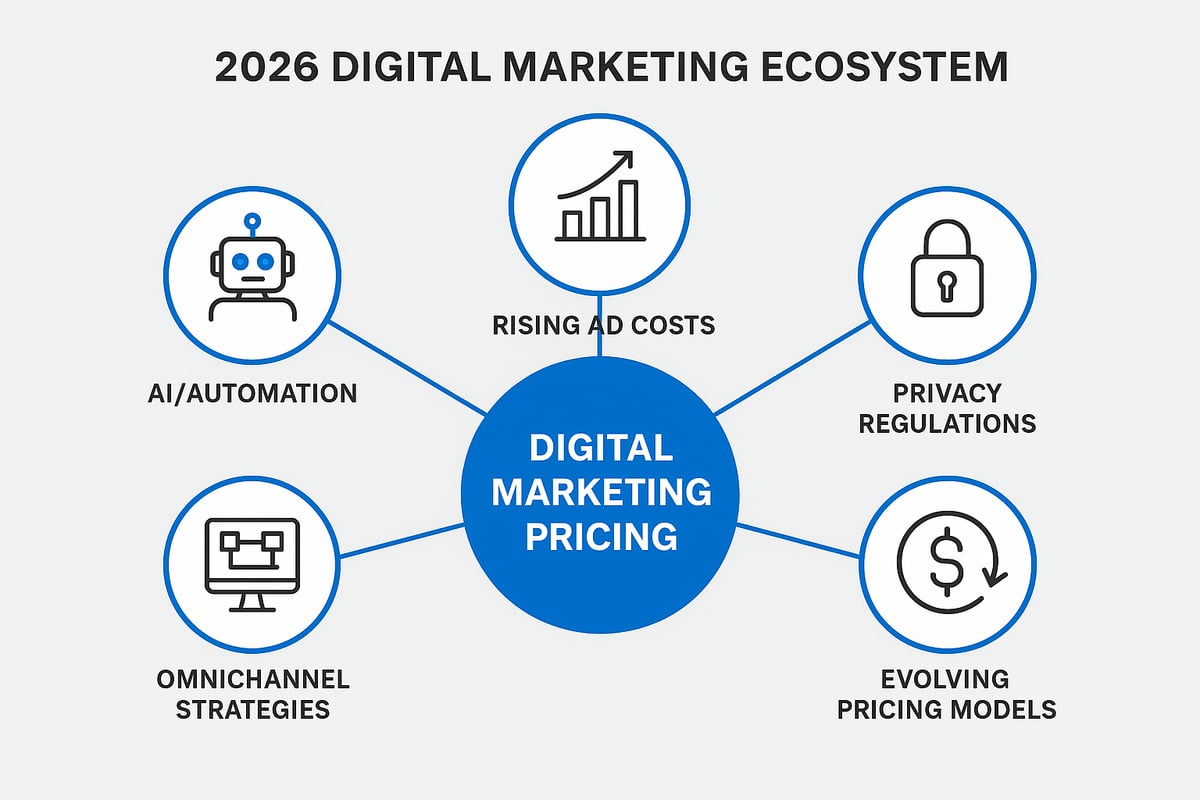
Step 3: Choose the Right AI Tools and Platforms

Choosing the best marketing automation ai platform is crucial. Look for solutions that scale with your business, integrate smoothly with your existing tech stack, and fit your budget.

Key selection criteria:

  • Scalability for growing data and user needs
  • Seamless integration with CRM, CMS, and analytics tools
  • Transparent pricing and support

Compare leading platforms like HubSpot, Salesforce, Mailchimp, and ActiveCampaign. Each offers distinct features, so match your needs to their strengths.

Curious how conversational AI fits in? Explore how ChatGPT and marketing automation are transforming campaign personalisation and customer engagement.

Step 4: Prepare and Unify Your Data

Clean, unified data is the backbone of effective marketing automation ai. Start by cleansing your databases—remove duplicates, standardise formats, and enrich profiles with missing details.

Pull data from all sources: CRM, website analytics, social media, and e-commerce platforms. Break down silos by syncing data across systems.

Stay compliant with GDPR and privacy regulations. Set clear data governance policies and train your team on best practices. Unified, compliant data unlocks the full power of ai-driven marketing.

Step 5: Build and Launch Automated Workflows

Design your customer journeys using marketing automation ai triggers for personalisation. Map out each step, from welcome emails to abandoned cart reminders.

Test your workflows with a small audience first. Check that triggers fire correctly and that content feels personalised. Use ai to analyse customer behaviour and refine the journey.

Once confident, launch your automations across all channels—email, ads, SMS, and chatbots. Monitor early results and adjust quickly for maximum impact.

Step 6: Monitor, Analyse, and Optimise

Set up real-time dashboards to track how your marketing automation ai campaigns perform. Focus on metrics like click-through rates, conversion rates, and customer lifetime value.

Run regular A/B tests to compare different messages or workflows. Let ai-powered analytics surface insights you might miss manually.

Optimisation is ongoing. Use predictive analytics to spot trends and opportunities for improvement. The more you analyse and adapt, the better your results.

Step 7: Upskill Your Team for AI Success

To get the most from marketing automation ai, invest in your team’s skills. Offer hands-on training with your chosen platforms and encourage learning through online courses and webinars.

Build a culture that values innovation and data-driven decision-making. Empower staff to experiment, share results, and stay curious about emerging ai trends.

When your team understands both the tech and the strategy, your marketing automation ai investment will deliver lasting value.

Real-World Success Stories: AI Marketing Automation in Action

Businesses of all sizes are discovering the game-changing power of marketing automation ai. Across industries, AI-driven automation is delivering measurable results, from higher conversions to happier customers. Let’s break down how leaders are winning with this technology right now.

Real-World Success Stories: AI Marketing Automation in Action

E-commerce: Boosting Conversions with AI Personalisation

E-commerce brands are leveraging marketing automation ai to create hyper-personalised shopping experiences. By analysing browsing patterns and purchase history, AI recommends products in real time and adjusts pricing dynamically.

One leading online retailer saw a 35% increase in average order value after deploying AI-driven recommendations. The system tailors product suggestions and special offers based on each shopper’s unique behaviour.

According to AI’s Impact on Marketing Automation, 80% of marketers now credit AI with improving their ability to convert leads and drive sales. This shows how AI is not just a trend but a necessity for today’s e-commerce success.
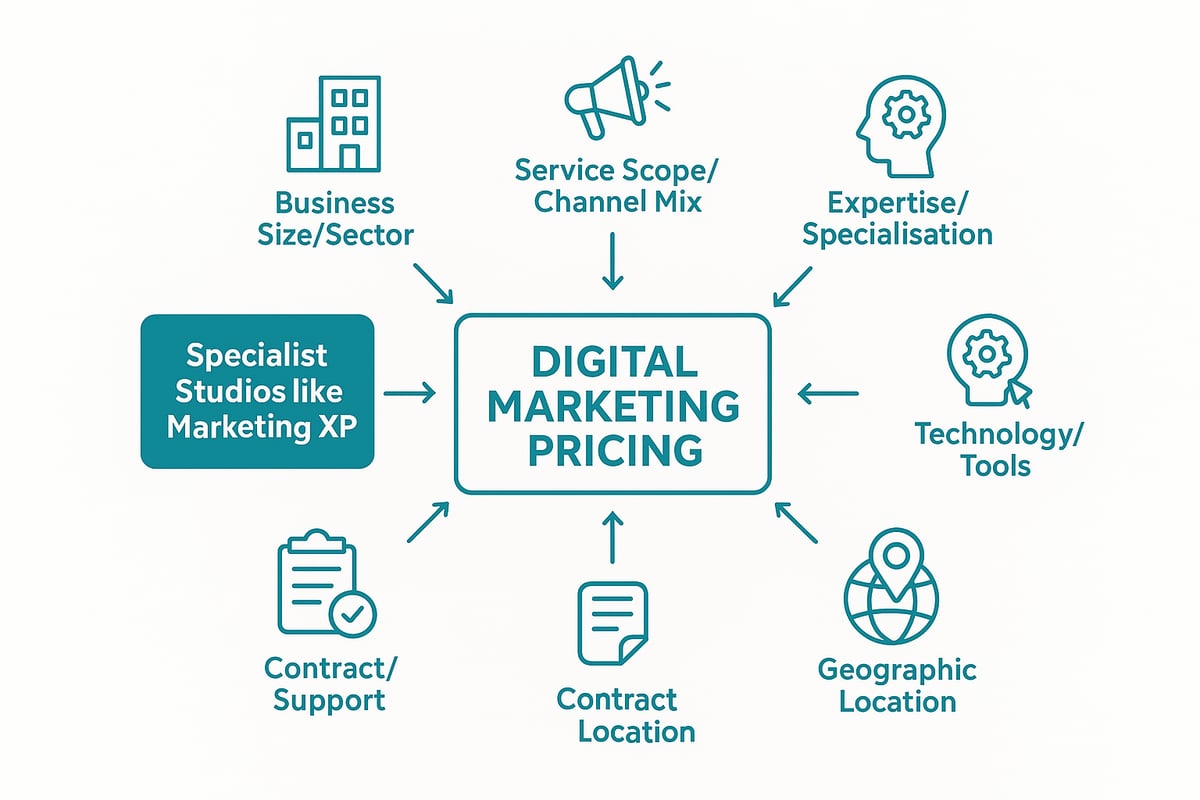
B2B Lead Generation: Smarter Nurturing with Predictive Analytics

B2B companies are turning to marketing automation ai for sharper lead nurturing. Instead of treating all leads the same, AI platforms score prospects using behavioural data and engagement signals.
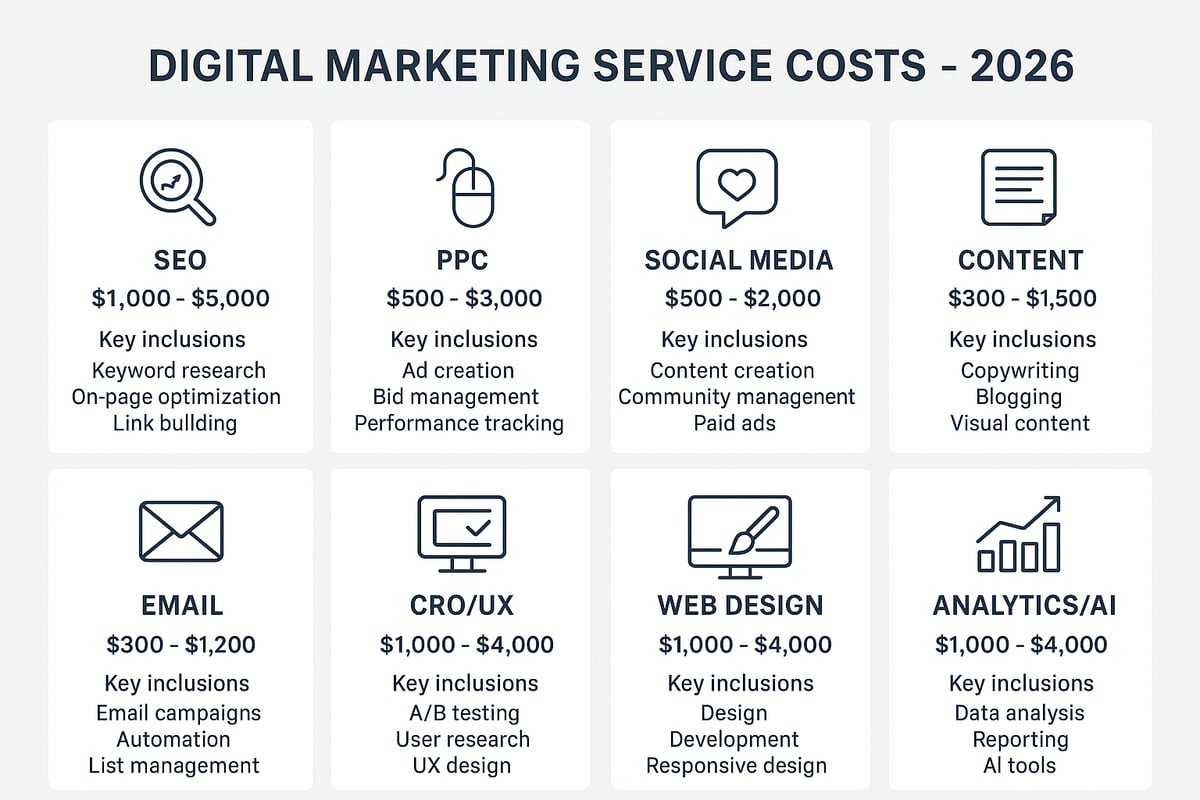
A SaaS business implemented predictive analytics to prioritise high-value leads. The result? A 40% boost in sales-qualified leads, thanks to smarter targeting and timely follow-ups.
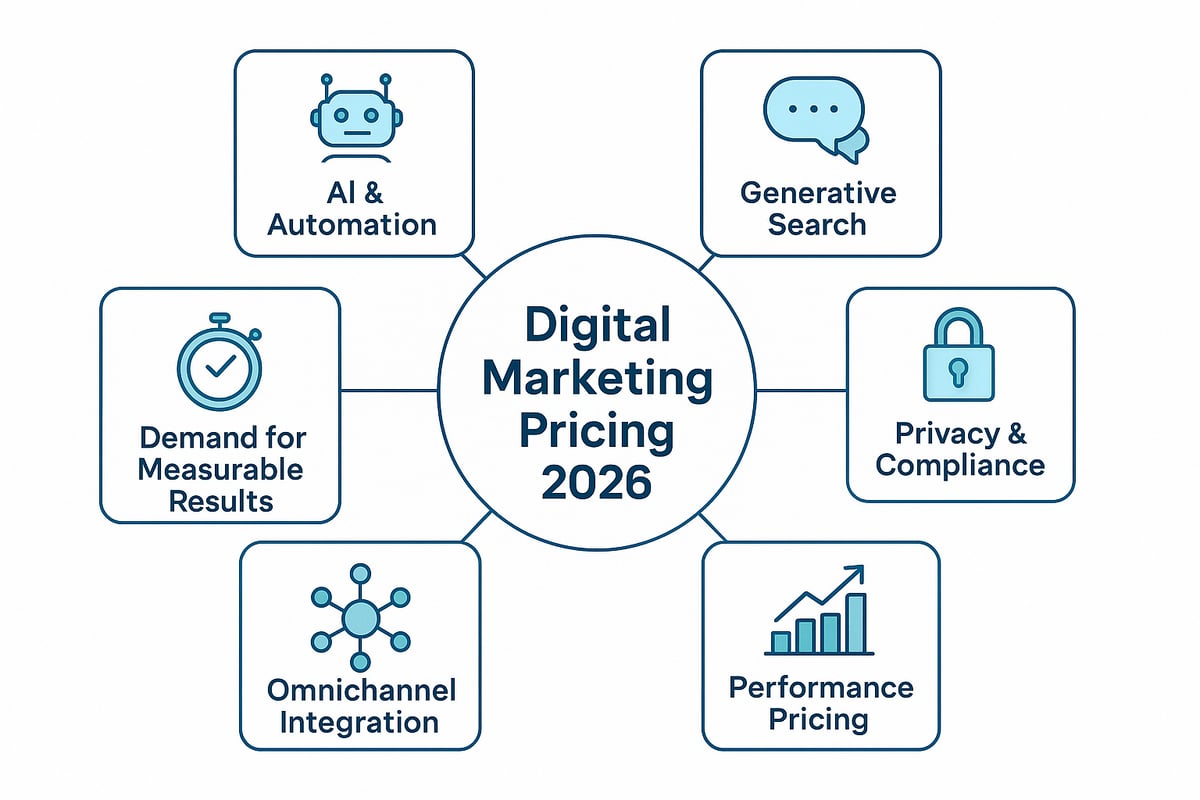
With AI, sales teams focus on the hottest opportunities, improving efficiency and conversion rates. As highlighted in Marketing Automation Usage and Performance, companies using AI for lead management consistently outperform those relying on manual processes.

Content Marketing: AI-Driven Content Creation and Distribution

Content publishers are using marketing automation ai to streamline content production and distribution. AI tools analyse audience interests, generate personalised articles, and recommend optimal publishing times.

One publisher saw content production time drop by 50% after adopting AI for topic generation and automated scheduling. The system ensures articles reach the right readers at the right moment, boosting engagement.

For marketers, this means less time spent on manual tasks and more energy devoted to creative strategy. AI empowers teams to create more, faster, and with better targeting.

Customer Service: AI Chatbots and Sentiment Analysis

Marketing automation ai is transforming customer service by enabling always-on support. Brands are deploying AI chatbots that handle up to 70% of routine queries, freeing human agents for complex issues.

A telecom company introduced chatbots with built-in sentiment analysis. Customers now get instant responses, and the company saw a 60% drop in response times, along with higher satisfaction scores.

AI also tracks sentiment trends, alerting teams to potential issues before they escalate. This proactive approach leads to happier, more loyal customers.

Marketing XP: AI-Powered Solutions for Small Businesses

Marketing automation ai is not just for big players. Marketing XP empowers small businesses with AI-driven automation tailored to their needs.

  • Shopify website optimisation with AI recommendations
  • Personalised email campaigns that adapt to customer behaviour
  • Hands-on AI training for in-house teams

SMEs using Marketing XP report more leads, higher conversion rates, and a better understanding of their customer base. The unique blend of expert consultancy and practical execution helps businesses harness AI’s potential without a steep learning curve.

Future Trends and Predictions for Marketing Automation AI

Ready to future-proof your marketing? The landscape of marketing automation ai is evolving at breakneck speed. Let’s look at the five key trends that will define 2025 and beyond, giving you a competitive edge in a world where standing still means falling behind.

Hyper-Personalisation and Predictive Customer Journeys

The future of marketing automation ai is hyper-personalised, with AI anticipating customer needs before they even express them. Marketers can now deliver tailored offers, content, and experiences in real time, thanks to advanced predictive analytics. Imagine a website adjusting its offers instantly based on browsing behaviour, or email campaigns that predict when a prospect is ready to buy.

Brands are already seeing results, with hyper-personalisation driving higher engagement and loyalty. This level of automation turns every interaction into a conversion opportunity, ensuring that your messaging always hits the mark. The power of marketing automation ai lies in making each customer feel like your only customer.

Voice, Visual, and Conversational AI

Voice assistants and AI-powered image recognition are transforming how customers search, shop, and interact with brands. As voice search adoption grows, marketing automation ai will need to optimise content for spoken queries. Visual AI tools can now identify products in images, making social commerce more seamless.

Conversational AI, including chatbots and virtual assistants, is delivering instant, human-like support across channels. These innovations let businesses engage users 24/7, answer questions, and guide decisions with minimal friction. To stay ahead, make sure your marketing automation ai strategy embraces these emerging interfaces.

Privacy-First AI and Ethical Automation

With data privacy regulations tightening, marketing automation ai must be transparent and ethical. Consumers expect brands to respect their data and explain how AI-driven decisions are made. Compliance with GDPR and the new EU AI Act is no longer optional.

Leading marketers are shifting towards privacy-first strategies, using anonymised data and explainable AI models. This builds trust and future-proofs your campaigns against regulatory changes. For more on the latest adoption and effectiveness statistics, check out Marketing Automation Adoption Trends.

AI Democratisation: Tools for All Business Sizes

Once reserved for big enterprises, marketing automation ai is now accessible to SMEs and even solo entrepreneurs. No-code and low-code platforms allow anyone to build smart campaigns without a data science degree. This democratisation means you can compete with larger rivals, regardless of your budget or technical expertise.

Affordable tools make it possible to automate email, ads, and analytics with just a few clicks. As platforms become more intuitive, expect even faster adoption and more creative use cases. The future of marketing automation ai is truly for everyone.

Preparing for the Next Wave: Continuous Learning and Adaptation

Staying ahead in marketing automation ai means never stopping learning. AI and automation tech are evolving so quickly that yesterday’s best practice could be obsolete tomorrow. Smart marketers are joining communities, attending webinars, and investing in ongoing training.

Here are some ways to future-proof your team:

  • Subscribe to industry newsletters
  • Join AI-focused marketing forums
  • Schedule regular training sessions

By fostering a culture of curiosity and adaptability, you’ll make sure your marketing automation ai strategy doesn’t just keep up, but leads the pack.

Ready to put these AI marketing automation strategies into action for real results in 2025? If you’re serious about growing your leads and sales but want straight-talking advice tailored to your business, let’s chat. I’ll help you figure out what’s working, what’s not, and exactly where AI can give you that edge—no buzzwords, just practical steps that actually move the needle. Whether you’re looking to optimise your Shopify site or ramp up your lead generation, you don’t have to go it alone.
Get free 45 min consultation
Let’s make your next move your best one.

Why Should Anyone Click Your Google Shopping Ad?

When someone searches your product type in Google, they’re met with an aisle of near-identical options. If you sell desks, it’s you vs. hundreds of desks. So… why should they click yours?

After optimising Shopping and Performance Max (PMax) campaigns with millions in ad spend, we’ve noticed the brands that win do a few simple things differently—and they do them consistently.

Below is exactly what we implement for top-performing Shopify brands, why it works, and how to apply it in your own account today.

1) The Invisible Fix That Gets More Clicks

Problem: Product titles sound nice… but don’t match what people actually type.

Example: A client listed “Modern Computer Desk”. It read well, but it was invisible among lookalikes.

What we did: Checked Campaigns → Insights & reports → Search terms and found the real money phrase: “adjustable desk for home office.” We added that exact phrase to the product title.

Result: Within two weeks, click-throughs jumped—and conversions followed.

Do this now (5-minute task):

  1. Open your PMax/Shopping campaign → Insights & reports → Search terms.
  2. Export the last 30–90 days and sort by clicks + conversions.
  3. Rewrite product titles in your feed to include the highest-intent phrases (don’t stuff; make it natural).
  4. Refresh the feed and re-fetch in Merchant Center.

Tip: Prioritise products with high impression share but low CTR. Title relevance is often the culprit.

2) When Google Stops Guessing, You Start Winning

Problem: One campaign for every product. One budget to cover “rent, groceries, and holidays.” Something suffers.

Why it matters: Google’s algorithm will push spend to a handful of easy winners while great products stay unseen.

Fix: Split campaigns to control where money goes and what signals Google learns from.

Proven structures:

  • Branded vs. Non-Branded (baseline for most stores)
  • By Category (e.g., Desks, Chairs, Storage)
  • By Price Tier (e.g., ≤£99, £100–£299, £300+)

For big catalogues (1,000s of SKUs): Start with Branded vs. Non-Branded; add Category if search intent (from Step 1) shows clear differences.

Why it works: Cleaner signals, steadier CPA/ROAS, easier scaling.

Do this now:

  1. Duplicate your primary Shopping/PMax campaign.
  2. Use Brand exclusions and Brand-only audience signals to separate intent.
  3. Set distinct budgets + targets per campaign (e.g., non-brand gets more cautious tROAS/tCPA).
  4. Monitor Search categories and Search terms weekly and refine.

3) Win Clicks Without Slashing Prices

You don’t need to be the cheapest—you need to look competitive where it matters.

Where to look: In Google Merchant Center → Products, there’s a Sale price suggestions column. Google runs simulations using your ad performance, price sensitivity over the last 7 days, and market data to suggest which items benefit most from a price change.

A fast, profitable test:

  1. Identify your top 10 revenue drivers in PMax/Shopping.
  2. Apply Google’s suggested discount only to those SKUs.
  3. Use a Merchant Center Promotion (so you show as “best value” in ads) rather than dropping site-wide prices.
  4. Track impression share, CTR, CVR, and profit for 7–14 days.

Note: If you change the price on-site, the product page must reflect the discount. Promotions help you test ad price perception without tanking margins across every channel.

4) The 20% CPC Edge That Feels Like Cheating (EU Only)

If you sell in Europe, route your Shopping ads through a Comparison Shopping Service (CSS) partner. You’ll typically pay ~20% less per click—baked into the auction after Google’s EU fine. Same campaigns, same data, different entry point.

Compounding impact: Spend £20k/month? That’s roughly £4k in extra clicks—every month.

Tools we like: We often pair DataFeedWatch for feed management with a CSS partner to claim the discount.

Do this now:

  1. Choose a CSS partner and link Merchant Center.
  2. Keep campaigns as-is; confirm ads serve via the CSS.
  3. Reinvest the CPC savings into non-brand or new products.

5) Data That Makes Every Pound Work Harder

Average advertisers glance at ROAS once a month and “go with their gut.” Top brands label the account so spend flows automatically to what works.

Create dynamic custom labels for:

  • Top performers: Rolling top 20% by revenue or profit
  • Seasonal items: Based on historical demand windows
  • Margin tiers: High vs. low (from your back-end data)
  • Price bands: e.g., ≤£50, £51–£150, £151+

How to use labels:

  • Split campaigns or asset groups by label.
  • Set tougher targets on low-margin items, looser on high-margin.
  • Rotate creative (images, headlines) based on label—e.g., “Best-seller” badges for top 20%.

Outcome: Your account shifts from reactive to proactive. Every pound knows where it’s going and why.

Quick Checklist (Copy/Paste)

  • Pull 30–90 days of Search terms → rewrite titles with real phrases.
  • Split Branded vs. Non-Branded (add Category/Price if needed).
  • Test Sale price suggestions on top 10 SKUs with a Promotion.
  • If in the EU, switch to a CSS for ~20% CPC savings.
  • Build custom labels (top 20%, seasonal, margin tiers) and route budgets accordingly.
  • Review Search categories, Insights, and Budget pacing weekly.

Common Pitfalls to Avoid

  • Keyword stuffing titles: Make them readable; lead with the primary phrase, keep key specs (size, material, colour).
  • Mixing brand & non-brand in one pot: You’ll misread performance and over-credit branded demand.
  • Only chasing ROAS: Track profit and incrementality, especially when testing price/promos.
  • Ignoring feed health: Disapprovals, missing GTINs, or weak images will quietly cap scale.

Need a Hand?

If you’d like help applying this to your Shopify store—title rewrites, smart structures, promotions, CSS setup, and data-driven labelling—book a call with Marketing XP. We’ll show you what’s working right now and build a plan that protects margin while you scale.

What is ChatGPT (and what it’s actually doing for my clients’)?

I spend my days in the trenches with marketing teams, wrestling with Shopify bugs at 2am, and watching Google Ads accounts like they’re newborn babies. I’m not here to sell you AI fairy dust or promise ChatGPT will replace your entire team by Thursday.

Instead, let me show you exactly how my clients are using ChatGPT to get actual work done – the unglamorous, deadline-driven, client-breathing-down-your-neck kind of work that keeps businesses running.

ChatGPT in one sentence (because you’re busy)

ChatGPT is like having a bright marketing assistant who never sleeps, writes faster than you do, and doesn’t judge you for asking the same question three different ways until you get what you need.

OpenAI just rolled out GPT-5 across ChatGPT, and honestly? It’s the first AI update that made me text my clients at 7pm because I was genuinely excited about what we could build together.

What it actually does (with real client stories)

Writing & editing that doesn’t sound like a robot wrote it

Last Tuesday, Sarah from Optima Hair Specialists called me in a panic. She needed three landing pages by Friday, each targeting different customer fears about hair systems. Twenty minutes with ChatGPT later, we had:

  • “Hair that looks like you – only better” (for first-timers)
  • “The maintenance question everyone asks” (for the practical crowd)
  • “What your colleagues will actually notice” (for the self-conscious)

The workflow: I fed ChatGPT her customer consultation notes, asked for headline variations by emotional angle, then had it write landing page sections that spoke directly to each worry. Sarah’s conversion rate jumped 23% that month.

Research that doesn’t take all weekend

Remember when “competitive research” meant opening 47 browser tabs and crying softly? My client at Midland Air Conditioning was struggling to position their home office AC units against cheaper alternatives.

I uploaded their competitor pricing sheets to ChatGPT and asked: “What’s the real value gap here, and how do we explain it without sounding defensive?”

It came back with a comparison that highlighted energy efficiency savings over 5 years, turning a £2,000 “expensive” install into a £300-per-year investment. That framing helped them close three big residential jobs in the following month.

Data analysis that actually makes sense

My Shopify client at Sunday Print Shop was drowning in sales data. Which products should they bundle? When should they run promotions? ChatGPT ate their 90-day export and spat out:

  • Five high-margin bundle ideas (custom hoodie + matching cap = 34% higher AOV)
  • A seasonal promotion calendar that actually matched their inventory cycles
  • Product descriptions that mentioned the best-selling items first

Result: Their average order value increased 18% in six weeks.

How real businesses use this stuff

Monday morning at the solicitors’ office

Emma runs a husband-and-wife legal practice specialising in wills and probate. Every Monday, she needs to publish something helpful for families dealing with bereavement – but writing about death is emotionally draining.

Now she starts with: “Act as a caring legal guide. Write a 900-word blog helping families understand what happens in the first week after someone dies. Tone: warm, no legal jargon, like you’re explaining to a neighbour.”

ChatGPT gives her the structure and sensitivity she needs, then she adds the personal touches that make her practice special. Her Google ranking for “probate help” improved, but more importantly, the phone calls got gentler – people felt prepared instead of panicked.

Wednesday crisis at the print shop

The Sunday Print Shop team needed 12 product descriptions by Thursday (classic client timing, right?). Instead of panic-writing generic copy, I showed them how to batch-process:

“Act as a Shopify copywriter. Here are 5 embroidered hoodies in different colors. Write unique descriptions that highlight the fabric quality, personalisation options, and UK dispatch times. Make each one feel special, not like a template.”

Four hours instead of four days. The descriptions were good enough to use immediately and personal enough that customers started mentioning the copy in their reviews.

Friday afternoon with the cultural workshops

Jas runs Punjabi Roots, offering cultural workshops to schools. Teachers kept asking the same logistical questions, so we used ChatGPT to create a comprehensive schools pack:

“Create a teacher-friendly overview of our KS2-KS4 Indian cultural workshop. Include learning outcomes, equipment needs, and a sample timetable. Write it like you’re addressing practical head teachers who need to justify educational value.”

The result? Bookings doubled because teachers could see exactly how the workshops fit their curriculum requirements. Less back-and-forth emails, more confirmed sessions.

The simple workflow that actually works

Here’s what I teach every client:

Monday: Feed ChatGPT your customer context (who they are, what they worry about, how they talk)
Tuesday: Ask for first drafts of whatever you need
Wednesday: Edit like you normally would
Thursday: Test the results
Friday: Refine your prompts based on what worked

No magic, no revolution – just faster first drafts that sound human.

Download: Idea → Prompt → ChatGPT → Draft → Edit → Publish (pipeline graphic)

My copy-paste prompt formula (steal this)

Act as a [role that matches your voice].
Write a [specific deliverable] for [your exact audience].
Context: [their situation, your offer, their main worry].
Tone: [how you normally sound].
Include: [must-have elements].
Output: [exact format you need].

Real example from last week:

“Act as a reassuring clinic copywriter. Write a 300-word FAQ answer: ‘Will my hair system look obvious?’ Audience: men considering their first non-surgical option. Tone: confident but understanding. Include: fitting process, natural hairline techniques, and maintenance reality. Output: headline + 3 short paragraphs + gentle CTA.”

The result felt like a conversation, not a sales pitch.

Where ChatGPT shines vs where it definitely doesn’t

It’s brilliant at:

  • Breaking through “I don’t know where to start” paralysis
  • Turning messy notes into clean copy
  • Creating multiple versions of the same message
  • Research that would take you hours on Google

It struggles with:

  • Your specific industry quirks (unless you teach it first)
  • Perfect accuracy on numbers (always double-check)
  • Capturing your exact brand voice without examples

My rule: Treat it like hiring a talented freelancer. Give clear briefs, provide examples, and edit everything.

Features worth knowing about (the ones clients actually use)

Web search with citations: When my racing stables client needed current prize money data for owner presentations, ChatGPT pulled fresh figures from the British Horseracing Authority and cited every source.

Canvas for co-editing: Instead of endless email attachments, my solicitor client and I now edit blog posts together in real-time. She adds legal accuracy, I keep the tone human.

File uploads: Drop in CSVs, PDFs, meeting transcripts — ask for summaries, action lists, or talking points. Game-changer for client strategy calls.

Voice mode: Perfect for car journeys between client meetings. I’ll talk through a brief, and by the time I arrive, I have three headline options to present.

Is GPT-5 actually worth the hype?

Short answer: if you’re already using ChatGPT for work, yes.

The difference isn’t revolutionary — it’s evolutionary in the best way. Better first drafts, fewer “that’s not quite what I meant” moments, faster responses when you’re on a deadline.

My racing stables client noticed it first: “The training updates sound more like how I’d actually write them.” My print shop client loved that bundle suggestions now considered seasonal trends automatically.

It’s like the difference between a good assistant and a great one — subtle but significant when it’s 4pm and you need something done properly.

Quick start for your team (the version that actually sticks)

  1. Pick one weekly task (blog writing, ad copy, product descriptions)
  2. Save your successful prompts in a shared doc
  3. Create a brand brief for ChatGPT (your tone, your audience, your key messages)
  4. Measure what matters (time saved, quality of first drafts, client feedback)

Start small, get wins, build confidence. Revolution through evolution, not disruption.


Need help setting this up properly? I work with teams to create ChatGPT workflows that actually save time instead of creating more work. Drop me a line — I promise no AI snake oil, just practical systems that help you ship better work faster.

Why You Shouldn’t Optimise for Google’s AI Mode

The digital marketing world is buzzing with talk about Google’s AI Mode. Everyone wants to know how to get their content featured in AI-powered search results. But here’s the thing: optimising directly for AI Mode might be the worst strategy you could choose.

This might sound controversial. After all, AI search is clearly the future. But before you jump on the AI optimisation bandwagon, let’s take a step back and think about how we got here in the first place.

How Optimisation Got Us Into This Mess

Remember the old days of SEO? We wrote thousands of identical articles. We stuffed keywords into every paragraph. We created content purely to show up in search results. The result? The internet became flooded with rubbish content that served no real purpose.

This poor user experience is exactly why Google introduced AI Overviews. It’s why we now have AI Mode. The search giant needed to fix the mess that aggressive optimisation tactics created.

Now, many marketers want to repeat the same mistakes with AI Mode. They’re creating content specifically for AI systems to digest and summarise. They’re chasing new platforms just to get AI visibility. But this approach misses the bigger picture entirely.

The Real Problem with AI Mode Optimisation

It’s a Zero-Sum Game

Think about this logically. AI systems like Google’s AI Mode are designed to keep users within their own ecosystem. They want people to get answers without clicking through to your website.

When AI Mode features your content, it summarises the key points right there in the search results. Users get what they need without visiting your site. You might get a small amount of traffic, but it will never be enough to justify making AI optimisation your primary strategy.

You’re essentially working hard to feed a system that has no intention of sending you meaningful traffic. That’s not a sustainable business model.

The Traffic Simply Isn’t There

Let’s be honest about the numbers. Even when AI systems feature your content, the click-through rates are incredibly low. Users are getting their answers directly from the AI summary. They don’t need to visit your website.

This means you’re investing time and resources into a strategy that delivers minimal returns. Meanwhile, you could be focusing on tactics that actually drive traffic and build your brand.

Three Tactics You Should Avoid

1. Unnatural Summarisation

Many content creators are now writing specifically for AI consumption. They structure their articles to be easily summarised by large language models. They use unnatural language patterns that AI systems prefer.

This approach creates the same problems we had before. Content becomes robotic and formulaic. It serves the algorithm rather than real human readers. We end up with more low-quality content cluttering the internet.

Remember, people can tell when content is written for machines rather than humans. This approach damages your brand reputation and reader trust.

2. Platform Chasing for AI Visibility

LinkedIn Pulse and Reddit have become popular targets for AI optimisation. Marketers are creating content on these platforms purely to get featured in AI search results.

This strategy is fundamentally flawed. These platforms want to keep users engaged within their own ecosystems. They’re not designed to drive traffic to your website.

LinkedIn Pulse content rarely generates significant external traffic. Reddit posts might get upvotes, but they don’t typically drive lasting business results. You’re essentially scraping the bottom of the barrel.

3. Building Content Moats

Some marketers are creating hundreds of pieces of content to cover every possible search intent. They call this building “content moats” around their topics.

This mass-production approach is exactly what created the content quality crisis in the first place. It leads to thin, repetitive content that serves no real purpose.

Google’s algorithms are getting better at identifying and penalising this type of content strategy. The short-term gains aren’t worth the long-term risks.

What You Should Do Instead

Think Like a Journalist, Not an SEO

The most successful content creators are thinking like journalists rather than SEO specialists. They focus on building genuine audience relationships rather than just search engine visibility.

Consider how news organisations like the BBC or The Guardian operate. People visit these sites directly because they trust the content quality. Readers bookmark these sites and check them regularly. They don’t always find this content through search engines.

This direct relationship bypasses search engines entirely. It creates a sustainable traffic source that doesn’t depend on algorithm changes or AI developments.

How to Build Direct Relationships

Start by creating content around original ideas and perspectives. Don’t just respond to trending topics. Develop your own insights and share them with your audience.

Write content that reflects your genuine expertise and opinion. People should be able to recognise your unique voice and perspective across all your content.

Focus on solving real problems for your audience. Create content that people actively seek out because it provides genuine value.

Invest in Digital PR

Digital PR is no longer just about traditional publicity. It’s become a core component of modern SEO strategy. This approach helps you get featured on authoritative third-party websites.

Here’s why this matters for AI visibility: AI systems often pull information from trusted sources like Tom’s Guide, CNET, or industry publications. They’re less likely to feature content directly from brand websites.

If you want your expertise featured in AI responses, you need to get it published on these authoritative platforms. Digital PR is the most effective way to achieve this goal.

Building Your PR Strategy

Start by identifying the key publications in your industry. These might be trade magazines, influential blogs, or news websites that your target audience trusts.

Develop relationships with journalists and editors at these publications. Offer them genuine insights and exclusive information that their readers would find valuable.

Create newsworthy content that these publications want to cover. This might include original research, industry surveys, or expert commentary on current events.

Develop In-House Subject Matter Experts

Modern search algorithms pay attention to author credibility and expertise. They want to see real people with genuine knowledge writing about topics in their field.

This means you need to develop recognised thought leaders within your organisation. These people should be publishing content not just on your website, but across the industry.

When your experts become recognised voices in your field, it boosts your entire organisation’s credibility. AI systems are more likely to feature content from recognised experts than from anonymous corporate blogs.

Building Expert Recognition

Encourage your team members to speak at industry conferences and events. This builds their personal reputation and associates them with your brand.

Get your experts featured in podcasts, interviews, and guest articles. The more they appear across different platforms, the stronger their credibility becomes.

Support your experts in developing their own personal brands on social media and professional networks. Their individual success reflects positively on your organisation.

Create Original, Shareable Content

The most valuable content online is original research and analysis. This type of content naturally attracts backlinks and social shares. It positions you as a thought leader rather than a follower.

Original content also has the best chance of being featured by AI systems. When everyone else is referencing your research, AI algorithms recognise you as the authoritative source.

Types of Original Content to Create

Conduct industry surveys and publish the results. Original data is always in high demand and naturally attracts media attention.

Analyse new developments in your field before anyone else does. When Google releases new features or patents, be the first to explain what they mean.

Run experiments and share the results. Test new strategies or technologies and document what you learn.

Create comprehensive guides that become the definitive resource on specific topics. These pieces of content continue to attract traffic and links for years.

The New Era of Content Strategy

We’re entering a phase where innovation beats optimisation. The old tactics of reverse-engineering successful content and creating similar pieces won’t work anymore.

AI systems are sophisticated enough to recognise and reward genuine expertise and originality. They can identify content that provides real value versus content that simply follows a formula.

This shift actually benefits businesses that focus on quality over quantity. You no longer need to produce hundreds of pieces of content to compete. Instead, you need to create fewer pieces that offer genuine insights and value.

Why Quality Trumps Quantity

High-quality, original content naturally attracts the signals that AI systems value. It gets shared more frequently. It attracts backlinks from other authoritative sources. It keeps readers engaged for longer periods.

This type of content also builds genuine brand authority. When people associate your brand with valuable insights and original thinking, they’re more likely to seek you out directly.

Building for the Long Term

The businesses that succeed in the AI era will be those that focus on sustainable, long-term strategies. They’ll build direct relationships with their audiences rather than depending entirely on search traffic.

They’ll create content that serves real human needs rather than trying to game AI algorithms. They’ll invest in building genuine expertise and thought leadership.

Most importantly, they’ll remember that behind every AI system are real people looking for real solutions to real problems.

Final Thoughts

Google’s AI Mode represents a significant shift in how people find and consume information online. But the solution isn’t to optimise directly for AI systems.

Instead, focus on the fundamentals that have always worked: creating valuable content, building genuine expertise, and developing direct relationships with your audience.

The tactics that got us into the current content quality crisis won’t solve the problems that AI Mode creates. We need a different approach entirely.

By thinking like journalists rather than SEOs, investing in digital PR, developing recognised experts, and creating original content, you’ll build a sustainable content strategy that works regardless of how AI systems evolve.

The businesses that thrive in the AI era won’t be those that game the system. They’ll be those that provide genuine value and build lasting relationships with their audiences. That’s a much more sustainable approach than chasing the latest optimisation tactics.

Remember: AI Mode should be a byproduct of your broader content strategy, not the entire focus of it. Build something valuable, and the visibility will follow naturally.

Is SEO Really Dead in 2025?

You’ve probably heard this before: “SEO is dead!” It seems like every time Google makes a change, someone’s declaring the end of search engine optimisation. But here we are in 2025, and the question feels more pressing than ever.

With AI churning out content at lightning speed, Google’s new AI-powered search experience changing how we see results, and more people getting answers without ever clicking through to websites, it’s natural to wonder if SEO has finally breathed its last breath.

The short answer? SEO isn’t dead. But it’s definitely not the same game it used to be.

Why Everyone Keeps Writing SEO’s Obituary

Every Google update seems to trigger the same reaction. Site owners watch their traffic drop and immediately assume SEO has died. But here’s the thing: this has been happening for years, and SEO keeps adapting.

The folks at Ahrefs actually dug into this question with real data and found something interesting: SEO isn’t dying, it’s just changing. The sites that adapt survive and thrive. The ones that don’t? Well, they get left in the dust.

SEO Today is Harder, But Not Dead

Let’s be honest: ranking well in 2025 is tough. Gone are the days when you could stuff keywords into mediocre content and call it a day. Google’s got smarter. It understands what people actually want, not just what words they type.

The challenge now is standing out in an ocean of content. Everyone’s publishing. AI tools are generating millions of articles daily. The bar for quality has never been higher.

To succeed today, you need:

  • Genuine expertise and authority
  • Well-structured, properly marked-up content
  • Smart connections between your pages
  • Content that genuinely helps people

The Real Challenge: AI is Changing the Game

Here’s where things get interesting. AI isn’t just creating more content, it’s changing how people search. Google now often provides AI-generated answers right at the top of search results. People get their answers without visiting any website at all.

This doesn’t spell doom for SEO, but it does mean you need to think bigger. You can’t rely solely on Google traffic anymore. Building your own audience through email lists, communities, and brand recognition becomes crucial. You also need to think beyond Google: platforms like YouTube, TikTok, and even Reddit are becoming important search channels.

What Actually Works Right Now

Despite all the changes, some fundamentals still drive results:

Smart keyword targeting remains important. Focus on what people actually want to know, not just popular search terms.

Connecting your content through internal links helps both users and search engines understand your site better.

Truly helpful content wins every time. Not fluff, not filler: content that genuinely solves problems or answers questions.

Quality backlinks still matter, though relevance matters more than quantity these days.

Technical excellence is non-negotiable. Your site needs to load fast, work on mobile, and be easy for search engines to understand.

Building a Future-Proof Strategy

Want to stay ahead? Here’s what clever businesses are doing:

Establish real credibility. Your expertise needs to be obvious and verifiable. Google values content from people who actually know what they’re talking about.

Create content clusters. Build comprehensive topic coverage with main pages supported by related articles that dive deeper into specific aspects.

Help search engines understand your content with proper structured data markup.

Diversify your traffic sources. Don’t put all your eggs in one basket. Build audiences on multiple platforms.

Use AI thoughtfully. These tools can help with research and ideation, but they shouldn’t replace human insight and expertise.

The Bottom Line

SEO isn’t dead, but lazy SEO definitely is. If you’re still using outdated tactics like clickbait headlines, spinning content, or buying dodgy backlinks, you’re fighting yesterday’s battle with tomorrow’s weapons.

Modern SEO requires more sophistication. It’s about understanding what people really need, providing it in a well-structured way, and building genuine authority in your field.

The businesses succeeding with SEO in 2025 aren’t just chasing rankings: they’re building long-term value for their audiences. And that approach will serve them well no matter how much the search landscape continues to evolve.

SEO has survived countless predictions of its demise. It’ll likely survive many more, continuing to adapt as technology and user behaviour change. The question isn’t whether SEO will survive: it’s whether your approach will evolve with it.